Click-Through Rate (CTR) in SEO: Formula, Benchmarks & How to Improve It
Your rankings are stable, your impressions are up, and your traffic is flat. The number that explains the gap is click-through rate.
Click-through rate (CTR) is the percentage of impressions that turn into clicks. It is one of the first numbers you check on almost any channel because it tells you what share of the people who saw your search result, ad or email actually clicked. The mechanic is the same everywhere, but in SEO it has a special job: it decides how much traffic a ranking is really worth.
This guide covers the CTR formula, what a good CTR looks like in 2026 on each channel and at each Google position, why AI Overviews have cut organic CTR, and the tactics that move the number. Every benchmark comes from a public study, listed at the end.
What is click-through rate (CTR)?
Put simply, CTR is clicks divided by impressions. An impression is one view of your result, ad or link. A click is one visit that view generated.
Google Ads defines CTR this way for paid search, and Google Search Console uses the same logic for organic results. A higher CTR means more of the people who see your listing find it relevant enough to act on. That is all it measures.
CTR vs impressions vs conversions
These three get mixed up constantly, and confusing them leads to bad calls.
- Impressions count how many times your content was shown.
- Clicks count how many of those views led to a visit.
- Conversions count how many of those visits ended in the action you wanted: a purchase, a signup, a download.
CTR sits in the middle, between reach and outcome. It grades how well your title, snippet or creative earns the click. It says nothing about what happens next, which is why you read it alongside conversion rate.
How to calculate CTR (the formula)
The formula is short:
CTR = (Clicks ÷ Impressions) × 100
Divide clicks by impressions, then multiply by 100 to turn it into a percentage.
A worked example
A blog post with 150 clicks from 5,000 impressions in Search Console has a CTR of 3%: 150 ÷ 5,000 = 0.03, and 0.03 × 100 = 3%.
A Google Ads campaign with 200 clicks from 10,000 impressions lands at 2%. Same formula, different channel.
Where to find your clicks and impressions
You rarely have to do the math yourself:
- Google Search Console: Performance › Search results shows clicks, impressions, CTR and average position for every query, page, country and device.
- Google Ads: CTR at campaign, ad group and keyword level.
- Email platforms: clicks and click rate per campaign.
- YouTube Studio: impressions and impressions CTR under Reach.
One Search Console detail matters: the site-wide CTR blends branded and non-branded queries, every position and every device. A single average hides almost everything useful, so read CTR per query and per page.
What is a good CTR in SEO? Organic CTR by position
There is no single good CTR. In organic search, the rate that counts as strong depends mostly on where you rank and what else is on the results page.
For years, guides quoted a position 1 CTR near 28% to 30%. That figure no longer holds, and if you plan around it you will over-forecast your traffic. In its September 2026 report, First Page Sage measured a blended position 1 CTR of 7.1%, followed by 3.0% for position 2 and 1.7% for position 3.
The cause is AI answers. On a results page with an AI answer, position 1 draws about 3.6% of clicks. On a page without one, it still draws 22.6%.
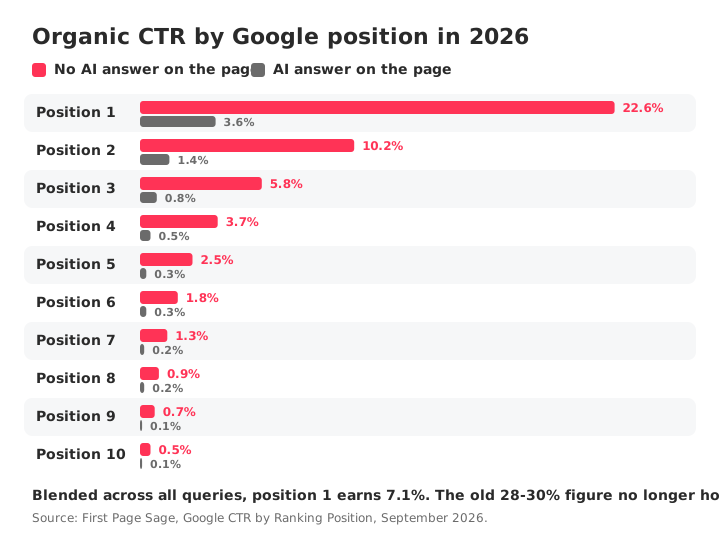
Three practical consequences:
- Benchmark each query against its own position. A 4% CTR is weak at position 1 on a query without AI answers, and excellent at position 4.
- Expect lower CTR on informational queries. They trigger AI Overviews far more often than transactional or branded queries.
- Branded queries inflate the average. People searching your name click you. Split branded from non-branded before you judge anything.
How AI Overviews and SERP features cut organic CTR
Seer Interactive tracked 3,119 queries across 42 organizations and found that organic CTR on queries with AI Overviews fell from 1.76% to 0.61% between June 2024 and September 2025, a drop of about 61%.
There is an upside: brands cited inside the AI Overview earned about 35% higher organic CTR than brands that were not cited. Being the source the answer quotes is now part of earning the click. Our guides to AI Overview ranking factors and generative engine optimization cover how to get there.
Other SERP features pull in both directions. Ads, featured snippets, "People also ask" boxes and video carousels push your listing down. Rich snippets such as review stars or product details make your own listing bigger and can lift CTR at the same position.
CTR benchmarks by channel
The formula never changes. The benchmark does. Treat these as a starting line, then compare against your own history, which is the number that matters.
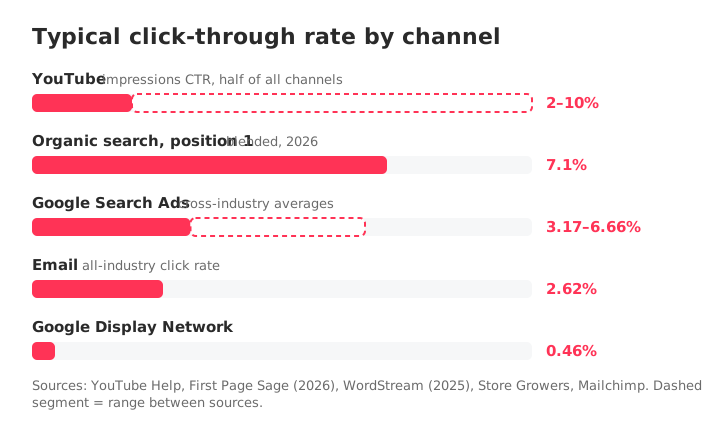
- Google Search Ads: about 3% to 7%. WordStream puts the 2025 cross-industry average at 6.66%, while Store Growers reports about 3.17%.
- Google Display Network: about 0.46%. Display interrupts people who are doing something else, so rates run far lower than search. That is normal.
- Email marketing: Mailchimp reports an all-industry average click rate of 2.62%.
- YouTube: half of all channels and videos have an impressions CTR between 2% and 10%, according to YouTube.
- Organic search: see the position table above.
Why CTR matters for SEO (and beyond)
In organic search, CTR decides how much traffic a ranking delivers. Two pages sitting at position three can earn very different clicks depending on their title and description. Lifting CTR on a page you already rank is often faster than earning a better position.
In Google Ads, expected CTR is one of the three components of Quality Score, alongside ad relevance and landing page experience. A higher expected CTR can lift Quality Score, which tends to lower cost per click and improve ad position.
In email, weak engagement over time can hurt sender reputation and deliverability, so click behavior matters beyond a single campaign.
How to improve organic CTR
The tactics share one logic: give the right searcher a clear, relevant reason to choose your result.
1. Rewrite the title tag around the query
The title is the biggest lever you control. Put the main keyword near the front, match the intent of the query (a definition, a list, a comparison, a price), and add a specific detail that competitors lack: a number, a year, a format. Keep it short enough to avoid truncation. Our guide to the SEO title covers the details, and the free Title Tag Checker flags length and keyword placement.
2. Write a meta description that states the payoff
Google rewrites many descriptions, but a good one still gets shown often. Say what the reader gets, in their words, and answer the obvious follow-up question. See our meta description guide. You can preview title and description together in the free SERP Simulator before publishing.
3. Earn rich results with structured data
Review stars, prices, availability, breadcrumbs and video thumbnails make a listing bigger and more useful. Add structured data on the pages that are eligible, and validate it.
4. Keep the URL short and readable
The URL appears in the result as breadcrumbs. A clean URL slug with the topic in plain words reads as more trustworthy than a string of parameters.
5. Match the format people expect
If every result on the page is a list or a guide and yours is a product page, CTR will suffer whatever the title says. Check the SERP first and match the search intent.
6. Test one change at a time
Change one element, note the date, and compare equal periods before and after. SEO A/B testing gives you a more reliable read on bigger sites, and it is the only way to know what actually moved the number.
How to find low-CTR opportunities in your own data
The fastest wins are queries where you already rank on page 1, with plenty of impressions, but earn fewer clicks than that position normally gets. Here is the routine:
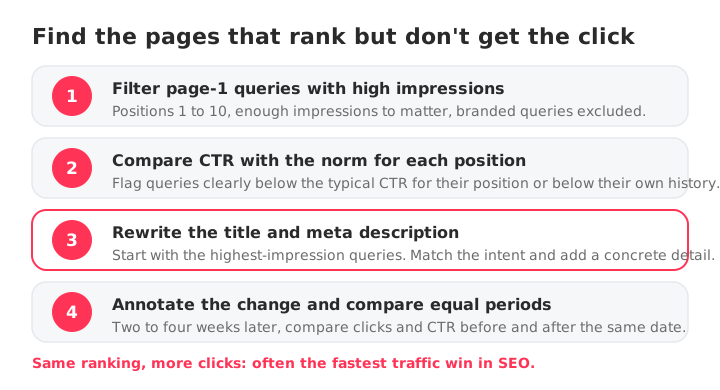
- Filter queries ranking in positions 1 to 10 with meaningful impressions. In Search Console, open Performance › Search results and turn on all four metrics.
- Compare each CTR with the typical CTR for its position, and with the same query's CTR in earlier periods. Exclude branded queries.
- Rewrite the title and meta description of the pages behind the under-performers, starting with the highest-impression queries.
- Mark the date of the change and compare equal periods two to four weeks later.
Doing this by hand means exporting Search Console data, matching queries to pages and rebuilding the view every week. SEOcrawl AI does the heavy lifting. Its SEO Dashboard reads clicks, impressions, CTR and position for every page and keyword from Search Console, stores the data beyond the 16-month window and surfaces winners and losers between periods, so a page that keeps its ranking but loses clicks stands out.
You can tag pages and queries by rules, by hand or through the SEOcrawl AI MCP to track CTR for a whole content group, and annotate the day you change a title so the before-and-after sits on the chart. A Search Console audit is a good place to start if you have never looked at your CTR this way.
CTR by channel: what changes
The levers differ by channel.
Paid search (PPC)
Keyword relevance, match types and ad assets (sitelinks, callouts) shift CTR. More relevant keywords and richer ad formats give people more reasons to click.
Email marketing
Subject line and preview text drive opens; the body drives clicks. Track click-to-open rate (CTOR), clicks divided by opens, alongside CTR. It isolates how well the email works once someone opens it.
YouTube and video
Thumbnail and title carry most of the weight. Impressions CTR in YouTube Studio tells you whether the people who saw your thumbnail chose to watch. See our YouTube SEO guide.
Display and programmatic
Creative, placement and audience targeting matter more than copy. Expect low absolute numbers and judge them against display benchmarks, not search.
CTR vs conversion rate
CTR and conversion rate answer two different questions. CTR asks how many people clicked. Conversion rate asks how many of those clicks completed the goal.
A high CTR with a low conversion rate is a red flag. It usually means the title or ad promised something the page did not deliver. Chasing clicks on their own pulls in the wrong visitors, so always read the two metrics together.
Common CTR mistakes to avoid
Optimizing CTR in isolation. A rising CTR that drops your conversions is not a win. Tie every CTR target to a downstream goal.
Judging the site-wide average. It mixes branded and non-branded queries, all positions and all devices. Segment before you react.
Using outdated benchmarks. Planning around a 30% CTR for position 1 will over-forecast traffic on any query with an AI answer.
Clickbait titles. A title that over-promises can lift CTR for a while and then hurt engagement and trust. Our article on clickbait explains why.
Misreading the data. Bot traffic and click fraud inflate paid and display CTR, and tracking errors distort it either way. Make sure your numbers reflect real people before you act.
FAQs
What is click-through rate (CTR)?
CTR is the percentage of people who click a link after seeing it: clicks divided by impressions, multiplied by 100. It applies to organic search results, paid ads, emails and social posts. A higher CTR means a larger share of the people who saw your result found it relevant enough to click.
How do you calculate click-through rate?
Use CTR = (clicks ÷ impressions) × 100. For example, 150 clicks from 5,000 impressions gives a 3% CTR. Google Search Console, Google Ads, email platforms and YouTube Studio all report clicks and impressions, so you rarely need to work it out by hand.
What is a good CTR for SEO?
It depends on position and on the results page. First Page Sage's September 2026 data puts the blended CTR at 7.1% for position 1, 3.0% for position 2 and 1.7% for position 3. Compare each query with the typical CTR for its position, and with your own history, rather than chasing one universal number.
What is the average CTR for position 1 on Google?
About 7.1% blended across all queries, according to First Page Sage (September 2026). On results pages without an AI answer, position 1 still earns about 22.6%; on pages with one, about 3.6%. The old 28-30% figure no longer reflects today's results pages.
Do AI Overviews lower organic CTR?
Yes. Seer Interactive found that organic CTR on queries with AI Overviews fell from 1.76% to 0.61% between June 2024 and September 2025, a drop of about 61%. Brands cited inside the AI Overview earned about 35% higher organic CTR than brands that were not cited.
How do I improve organic CTR?
Find queries where you rank on page 1 with plenty of impressions but a CTR below what that position usually earns. Then rewrite the title tag and meta description around the searcher's intent, add structured data where you're eligible for rich results, keep the URL short and readable, and measure the change against a fixed date.
What is a good click-through rate for Google Ads and email?
WordStream puts the 2025 Google Search Ads average at 6.66%, while Store Growers reports about 3.17%, and the Display Network averages around 0.46%. Mailchimp reports an all-industry average email click rate of 2.62%.
What is the difference between CTR and conversion rate?
CTR measures how many people click; conversion rate measures how many of those clicks complete a goal, such as a signup or a purchase. A high CTR with a low conversion rate usually means the title or ad promised something the page does not deliver.
Sources
- Google Ads Help, Clickthrough rate (CTR): Definition
- Google Ads Help, About Quality Score
- First Page Sage, Google CTR by Ranking Position (September 2026)
- Seer Interactive, AIO Impact on Google CTR: September 2025 Update
- WordStream, Google Ads Benchmarks 2025
- Store Growers, Google Ads Benchmarks
- Mailchimp, Email Marketing Benchmarks
- YouTube Help, Impressions and click-through rate FAQs
Author: David Kaufmann

I've spent the last 10+ years completely obsessed with SEO — and honestly, I wouldn't have it any other way.
My career hit a new level when I worked as a senior SEO specialist for Chess.com — one of the top 100 most visited websites on the entire internet. Operating at that scale, across millions of pages, dozens of languages, and one of the most competitive SERPs out there, taught me things no course or certification ever could. That experience changed my perspective on what great SEO really looks like — and it became the foundation for everything I've built since.
From that experience, I founded SEO Alive — an agency for brands that are serious about organic growth. We're not here to sell dashboards and monthly reports. We're here to build strategies that actually move the needle, combining the best of classical SEO with the exciting new world of Generative Engine Optimization (GEO) — making sure your brand shows up not just in Google's blue links, but inside the AI-generated answers that ChatGPT, Perplexity, and Google AI Overviews are delivering to millions of people every single day.
And because I couldn't find a tool that handled both of those worlds properly, I built one myself — SEOcrawl AI, an enterprise SEO intelligence platform that brings together rankings, technical audits, backlink monitoring, crawl health, and AI brand visibility tracking all in one place. It's the platform I always wished existed.
Discover more content about this author
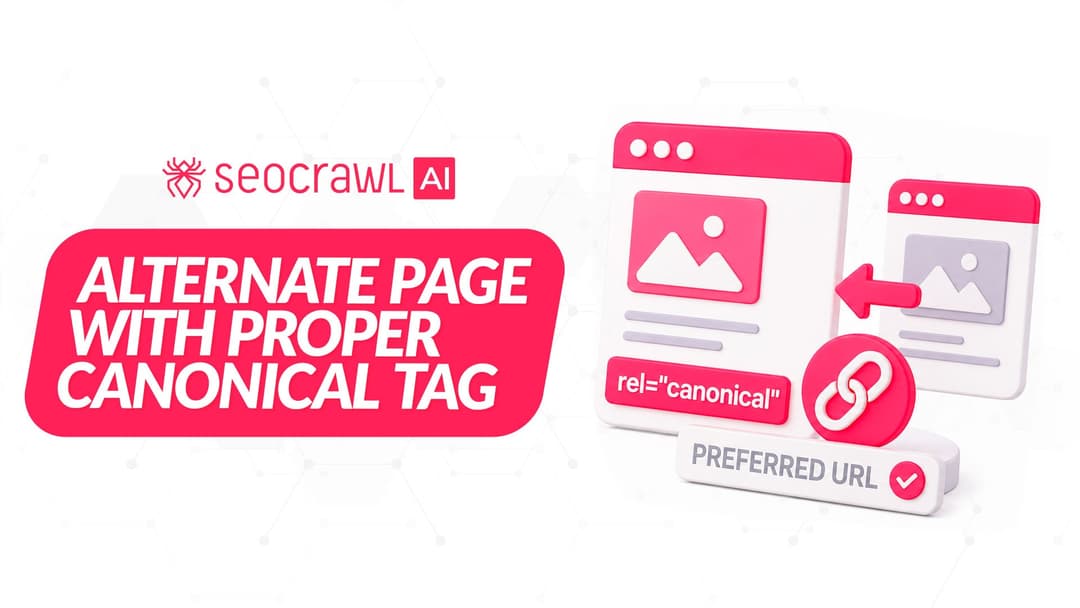
Seeing "Alternate page with proper canonical tag" in Search Console? Most of the time Google is doing exactly what you asked. Here's how to tell the normal cases from the real problems, and how to fix the ones that matter.