Free AEO Checker: see what AI can actually read on your page
Paste a URL. We load it twice, once the way AI crawlers read it (raw HTML, no JavaScript) and once the way people see it, show you exactly what AI misses, and grade the page 0–100 for answer-engine readiness.
What the AEO Checker grades
- AI view vs human view: the share of the text people see that AI crawlers can read without running JavaScript, with every hidden block highlighted.
- Structured data AI can read: JSON-LD in the HTML response, answer-friendly schema types (FAQPage, HowTo, Article, Product) and schema injected by JavaScript.
- Answer formatting: an answer-first intro, question-style headings, lists and tables that answer engines can lift into a reply.
- Content structure: one clear H1, a logical heading hierarchy, semantic HTML and enough depth to be worth citing.
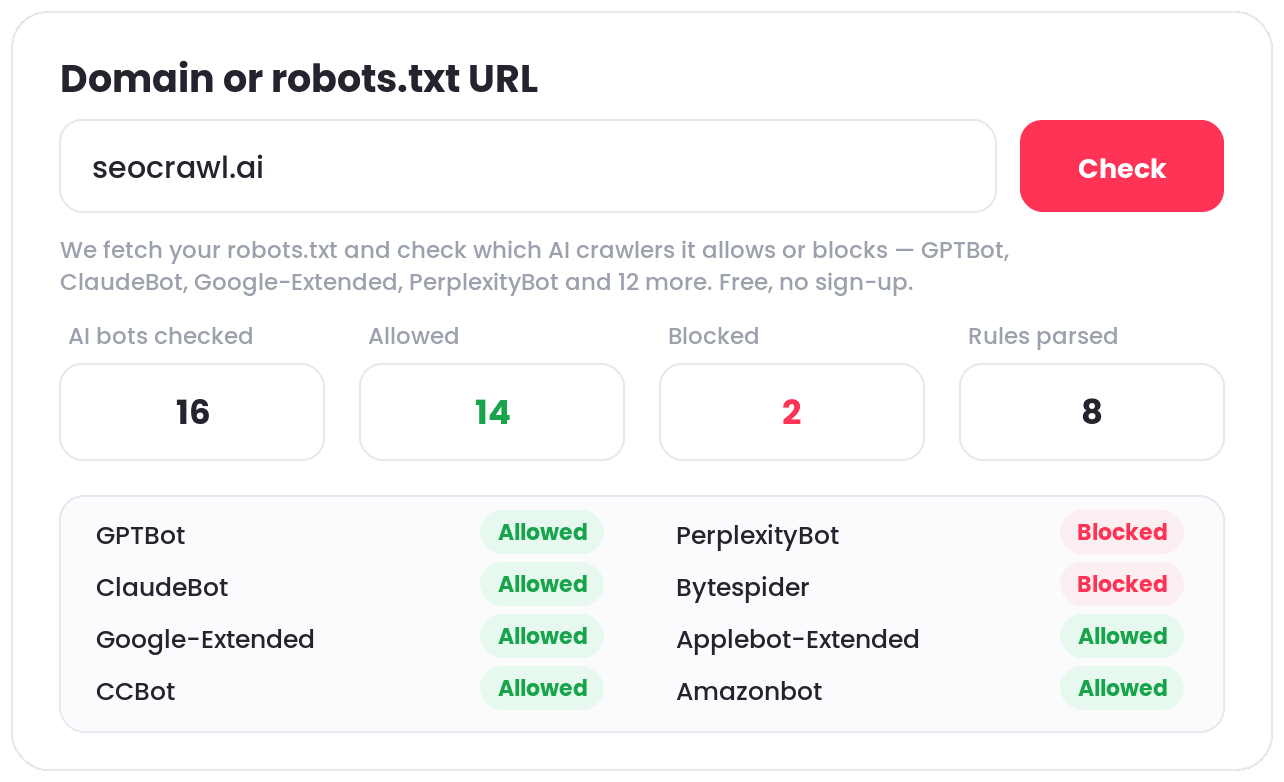
- AI crawler access: robots.txt rules for GPTBot, OAI-SearchBot, ClaudeBot, PerplexityBot and Google-Extended, whether your server answers a ChatGPT request, indexability and llms.txt.
- Trust and freshness: title and meta description, author and E-E-A-T signals, publish and update dates, Open Graph.
AI can't cite what it can't read
ChatGPT, Claude, Perplexity and Gemini answer questions by fetching pages and quoting them. But most of their crawlers only read the HTML your server returns. A study by Vercel and MERJ found that none of the major AI crawlers render JavaScript: GPTBot and ClaudeBot download JavaScript files but never run them.
So if your prices, product details, FAQs or even your main heading are added by JavaScript, people see them and AI doesn't. The page looks perfect in your browser and is half empty to the systems you want to be cited by.
The AEO Checker shows you both versions side by side, flags every block AI can't see, and grades the rest of what makes a page easy to quote: structured data, answer formatting, crawler access and trust signals.
How to read your AEO score
80–100 · Excellent
AI crawlers can read your content and the page is well structured to be quoted. Keep it fresh and track whether answer engines actually cite it.
40–79 · Fair to good
The basics are there, but something holds the page back: content behind JavaScript, missing schema, or weak answer formatting. Start with the high-priority fixes.
0–39 · Poor
AI crawlers struggle to read or trust this page. Usually the main content only exists after JavaScript, or crawlers are blocked. Fix that first, then the rest.
Common reasons AI misses your content
The main content is rendered in the browser
Single-page apps (React, Vue, Angular) often send an almost empty HTML shell and build the page with JavaScript. People never notice; AI crawlers get the empty shell.
Fix: Use server-side rendering or static generation (Next.js, Nuxt, Astro), or a prerendering service for crawlers.
Schema added through a tag manager
JSON-LD injected by Google Tag Manager or a client-side plugin exists only after JavaScript runs, so AI crawlers never see your FAQPage or Product markup.
Fix: Print the JSON-LD directly in the HTML template on the server.
A CDN or firewall blocks AI bots
Cloudflare and other CDNs can block AI crawlers by default, even when robots.txt allows them. Your page works for people and returns 403 to ChatGPT.
Fix: Review your bot rules (e.g. Cloudflare's “AI Scrapers and Crawlers” setting) and allow the AI crawlers you want to be cited by.
Answers hidden behind clicks
Tabs, accordions and “load more” buttons that fetch their text only when clicked keep that text out of the HTML.
Fix: Keep the text in the HTML and only hide it with CSS, so it is there for crawlers from the start.
Know if AI actually cites you
A good AEO score means your page is ready to be cited. SEOcrawl AI's AI Tracker shows whether it is: which prompts mention your brand in ChatGPT, Gemini, Perplexity and Claude, which pages they cite, and how that changes after each fix.
AEO Checker FAQ
What is an AEO checker?
AEO stands for Answer Engine Optimization: making a page easy for answer engines like ChatGPT, Claude, Perplexity and Google AI Overviews to read, trust and quote. An AEO checker (or AEO grader) tests a page against those requirements and tells you what to fix. This one also shows you exactly what AI crawlers can and can't read on the page.
Do AI crawlers run JavaScript?
Mostly no. A Vercel and MERJ analysis of AI crawler traffic found that none of the major AI crawlers (including GPTBot, ClaudeBot and PerplexityBot) render JavaScript. Google's Gemini can use Googlebot's rendering, but you shouldn't count on every AI system doing so. If content matters, put it in the HTML.
How is the AEO score calculated?
Around 20 fixed checks across six groups (what AI can read, structured data, answer formatting, content structure, AI crawler access and trust signals) each earn a weighted score. The total is a 0–100 grade: the same page always gets the same score. AI only writes the verdict and the action plan, it never changes the number.
How does the AI view vs human view comparison work?
We request the page with ChatGPT's user agent and read the HTML your server returns, with no JavaScript. Then we open the same page in a real headless browser, let the scripts run and collect the visible text. Every block people see that isn't in the HTML is marked “Hidden from AI”.
Why does my page return 403 to ChatGPT?
Usually a CDN or firewall rule. Cloudflare, for example, blocks AI crawlers by default on new domains with its “AI Scrapers and Crawlers” setting. Note that real AI crawlers come from published IP ranges, so a firewall may treat them differently from our test. Check your bot settings to be sure.
How is this different from the AI Visibility Checker?
The AI Visibility Checker asks AI models about your brand and measures whether they mention you. The AEO Checker looks at one page and measures whether it is technically ready to be read and cited. Use the AEO Checker to fix pages and the AI Visibility Checker to see the result.
Is the AEO Checker free?
Yes. It's free with no sign-up. To keep it fast for everyone there is a small hourly limit per visitor. To check whole sites and track AI citations over time, use SEOcrawl AI.