Generative Engine Optimization (GEO): The Complete Guide for 2026
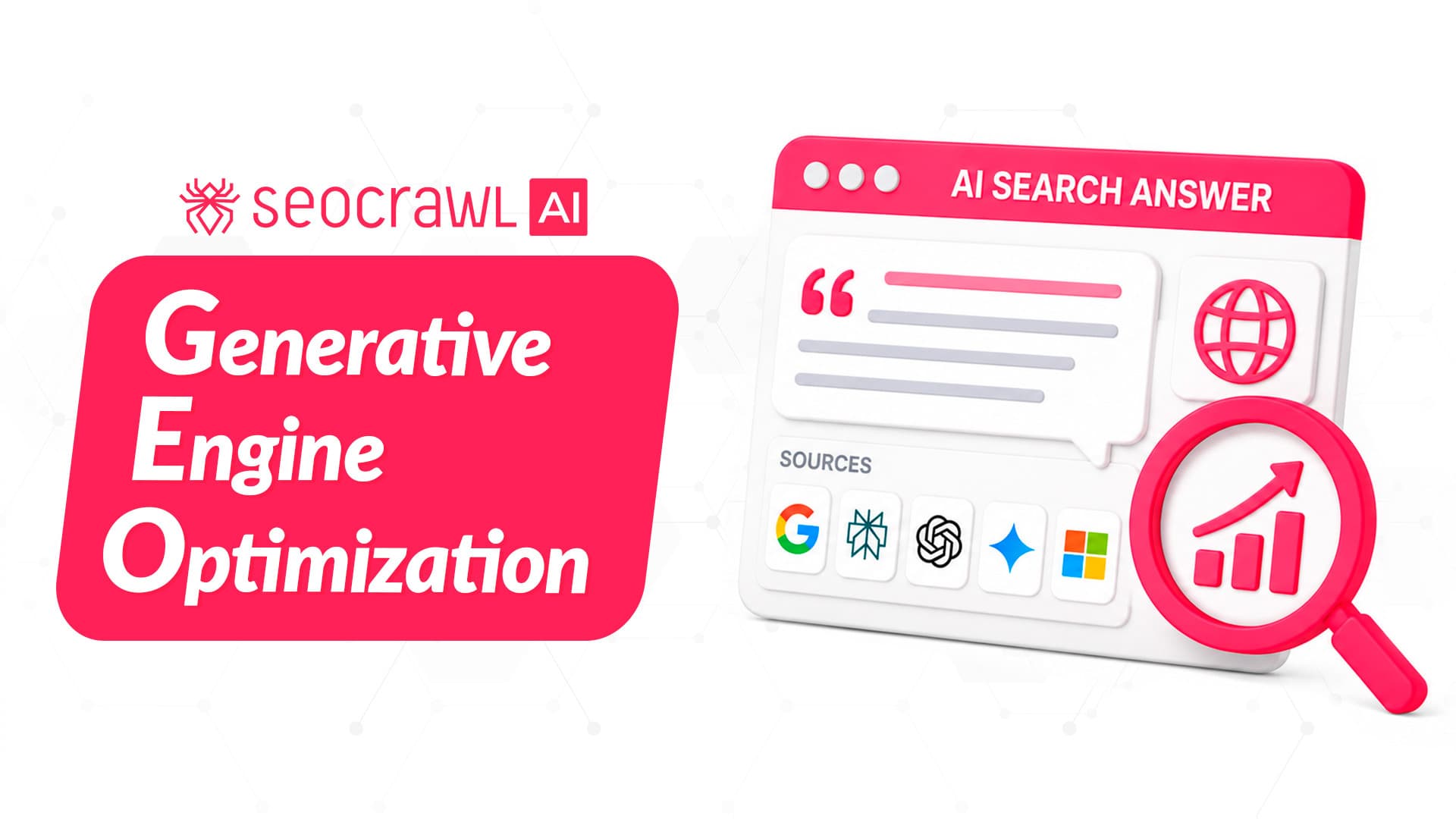
Generative engine optimization (GEO) is the work of getting your content cited inside AI answers, not just ranked in a list of blue links. As ChatGPT, Perplexity, and Google AI Overviews become where people start their research, the brands that get quoted win the visibility that used to come from page-one rankings. This guide covers what GEO is, how it differs from SEO, and the tactics that measurably move the needle. If your focus is ChatGPT specifically, see how to rank in ChatGPT.
What is generative engine optimization (GEO)?
Generative engine optimization (GEO) is the practice of optimizing your content so that AI-powered search tools (Google AI Overviews, Perplexity, ChatGPT, Gemini) select it as a source when synthesizing answers to user queries.
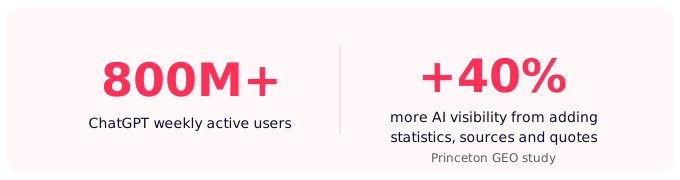
The term was formally defined in November 2023 in a research paper led by Princeton University, Georgia Tech, the Allen Institute for AI, and IIT Delhi. The study tested 10,000 queries across multiple generative engines and evaluated nine optimization strategies. Tactics such as adding statistics, citing sources, and including quotations improved the visibility of content in AI-generated responses by up to 40%.
That's the number most GEO articles bury at the end. But we believe it belongs at the top, because it tells you what actions actually move the needle.
GEO definition
GEO is the discipline of making your content the source AI systems choose to cite. Where SEO asks "does Google rank this page?", GEO asks "does the AI quote this page when a user asks a relevant question?" The two are related but not the same. A page can sit at position 1 and never appear in an AI answer. A page can also get cited repeatedly by Perplexity without ranking particularly high in traditional results.
Why it matters now
ChatGPT now has over 800 million weekly active users, which is more than the population of Europe. A growing share of those sessions are product and service recommendation queries. If your content strategy is still built entirely around ranking blue links, you're optimizing for a world that's shrinking.
How generative engines work
Retrieval-augmented generation (RAG) in plain English
When a user submits a query to an AI search tool, the system doesn't write from memory. It retrieves relevant documents from indexed web content, passes them to a large language model, and that model synthesizes a response. What gets selected depends on how directly the content answers the query, how authoritative the source is, how clearly it's structured, and whether it contains specific, citable claims.

Remember: the model selects passages, not pages. A page where the relevant answer is buried in paragraph eight loses to a page where the answer is in the first 60 words of a clearly structured section.
The platforms you need to optimize for
Each platform has different citation behavior. Treating them as identical is a mistake.
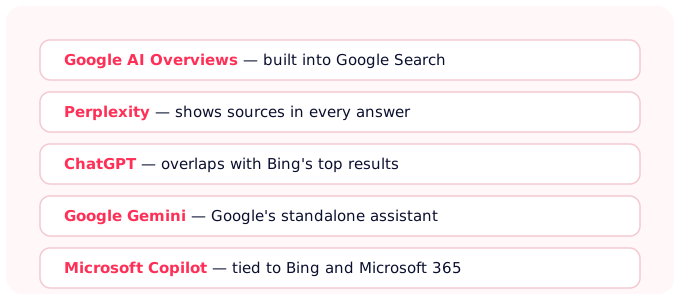
- Google AI Overviews: integrated into Google Search, draws heavily from content Google already trusts for traditional rankings
- Perplexity AI: the most citation-explicit of the major tools; every answer includes a sourced URL list, making it especially useful for citation analysis
- ChatGPT: runs prompts on a recurring basis; in retrieval mode, 87% of citations overlap with Bing's top results (Seer Interactive)
- Google Gemini: Google's standalone AI assistant, shares some signals with AI Overviews but operates separately
- Microsoft Copilot: deeply integrated with Bing and Microsoft 365, particularly relevant in enterprise contexts
How AI decides what to cite
Three factors dominate: relevancy to the query, brand mention frequency across the web, and content structure that allows clean extraction. Citing credible sources within your content also increases your likelihood of being cited by AI — it signals thoroughness and trustworthiness.
GEO vs. SEO: key differences
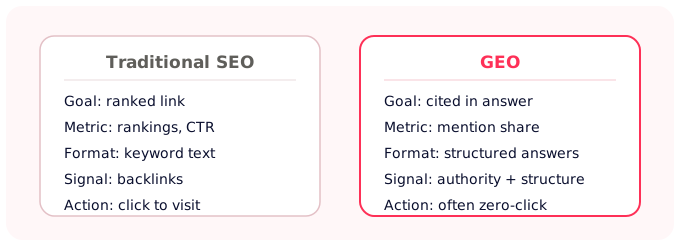
| Dimension | Traditional SEO | GEO |
|---|---|---|
| Goal | Ranked link position | Citation inside the AI answer |
| Primary metric | Rankings, CTR | Mention share, citation rate |
| Content format | Keyword-optimized text | Conversational, structured answers |
| Key signal | Backlinks, on-page optimization | Authority, specificity, extractable structure |
| User action | Click to visit | Often zero-click |
Will GEO replace SEO?
Traditional search still drives the overwhelming majority of organic traffic for most websites. The content AI tools cite is largely built on the same authority signals as traditional SEO. GEO is a layer, not a replacement for your SEO strategy.
The authority signals overlap (backlinks, E-E-A-T, brand credibility), but the pipeline is different. You need to understand what each channel rewards separately before you can optimize for both efficiently.
Core GEO strategies
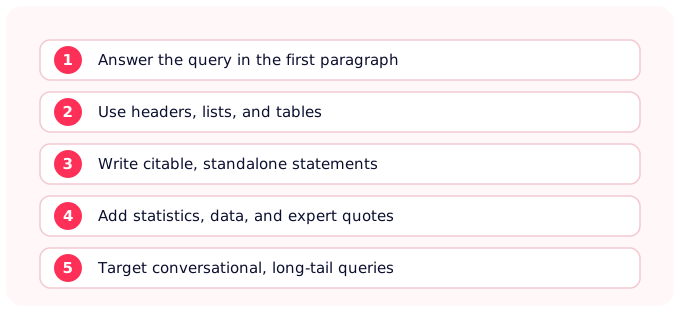
Answer user intent directly in the first paragraph
Write your opening as if it's the only thing the AI will read. Because sometimes it is. Your first 100–200 words should deliver the core answer to the primary query. No setup, no extended intro. AI tools look for extractable answers, and if your response is buried after a long preamble, the model may not reach it.
Use clear, structured formatting
Headers, numbered lists, and tables give AI systems explicit signals about how content is organized. A bulleted list of features is easier for an LLM to extract and attribute than the same information in dense prose. Structure is more than a UX choice; it's a GEO signal.
Avoid context-dependent references: "this approach", "as mentioned above", "the method earlier". Each section should stand alone. A model extracting a passage for a citation needs something that makes sense without surrounding paragraphs.
Write citable, standalone statements
Vague claims get ignored. Specific, standalone statements get cited. "Our platform helps teams work better" is not citable. "Teams using AI prompt tracking replace ad-hoc checks with automated daily runs across ChatGPT, Claude, Gemini, and Perplexity, with every run timestamped for historical comparison" is.
Include statistics, data, and expert quotes
The Princeton GEO research found that adding statistics, citing sources, and including quotations improved content visibility in AI-generated responses. Numbers anchor claims. Named quotes signal credibility. First-party data (internal research, product metrics, case study results) is particularly valuable because it's unique and unreplicable by competitors.
Target conversational and long-tail queries
AI search skews toward natural language questions, not short keyword strings. "Best rank tracker" is an SEO query. "How do I track whether ChatGPT is recommending my brand?" is a GEO query. Build content around the questions your target users actually ask in conversation: use People Also Ask, AlsoAsked, and direct prompt testing in each AI tool to identify them.
Technical GEO: structured data and site signals
Most GEO content focuses on content tactics and skips the technical layer. That's a gap worth closing.
Schema markup types that help AI understand your content
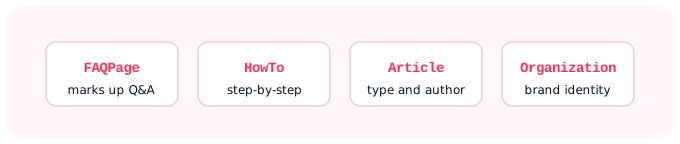
Structured data reduces ambiguity. When an AI crawler has to guess what a page is about, it can make errors, but schema gives it the answer directly. These are the most relevant types for GEO:
- FAQPage: marks up Q&A content explicitly, making it easier for AI to extract individual answers
- HowTo: signals step-by-step instructional content
- Article / BlogPosting: establishes content type and authorship
- Organization and Person: helps AI systems correctly identify the brand behind the content
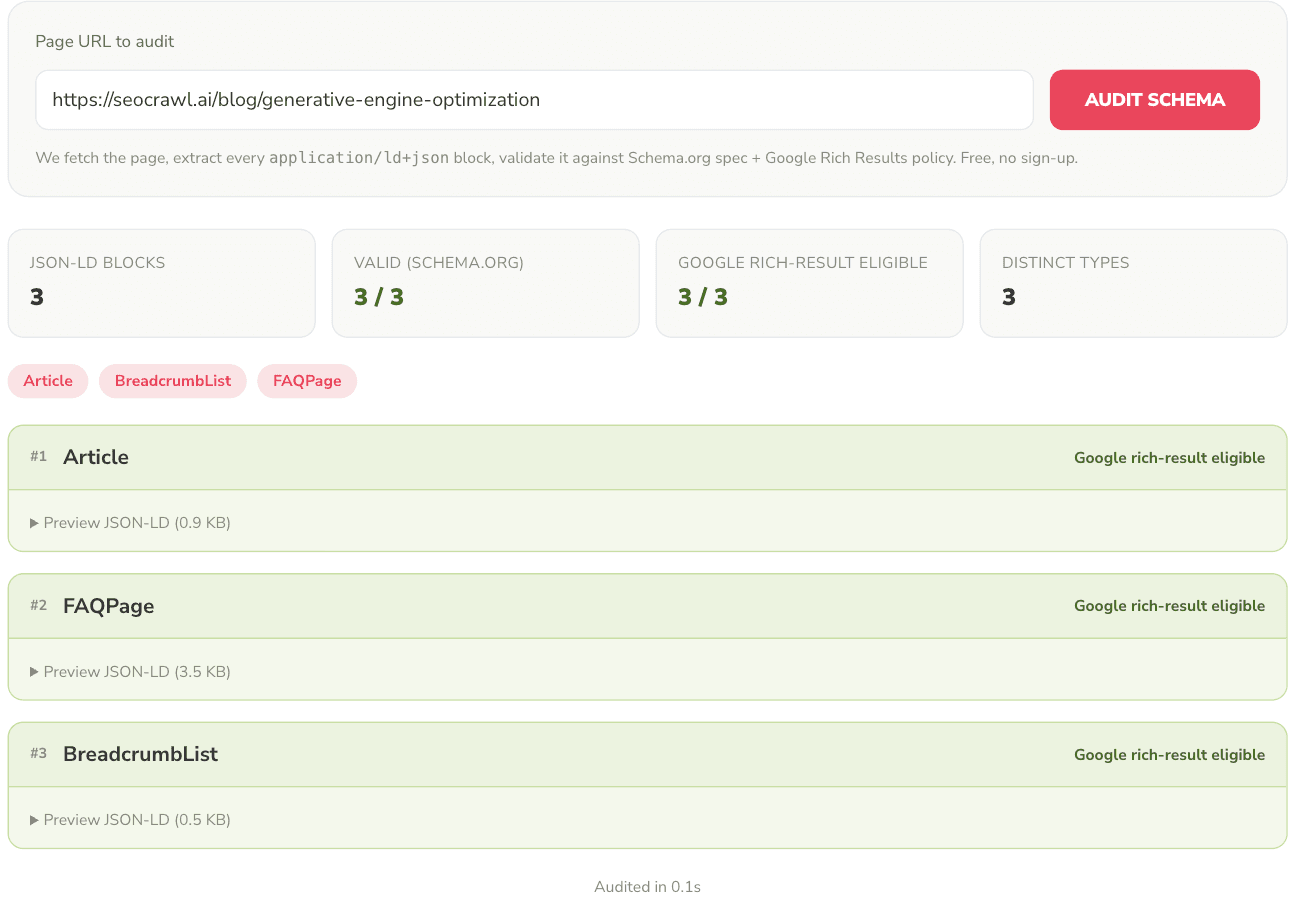
Before you ship the markup, you need to validate it. SEOcrawl AI has a free Schema Validator that checks your FAQPage, HowTo and Article structured data against Google's requirements, so a stray field does not cost you the rich result.
Crawlability for AI bots
AI crawlers (GPTBot from OpenAI, PerplexityBot, Google-Extended) need clean, crawlable pages. A page that blocks crawlers in robots.txt risks being skipped regardless of content quality. Check your robots.txt and verify you're not inadvertently blocking crawlers you want accessing your content.
If you want to block specific crawlers (a legitimate choice for some content), do it deliberately and with awareness of the trade-off. SEOcrawl AI's free llms.txt Generator lets you generate a ready-to-host llms.txt file so AI crawlers know exactly what to read on your site.
Building E-E-A-T and brand authority for GEO
Why AI favors authoritative sources
AI systems are trained on and retrieve from the broader web. Sources that appear most frequently, are cited most often by other credible sources, and are associated with recognizable entities are more likely to surface in AI-generated answers.
Google's E-E-A-T framework (Experience, Expertise, Authoritativeness, Trustworthiness) maps directly onto the signals AI tools use to evaluate content credibility.

Build third-party mentions deliberately
Building authoritativeness (getting cited by other websites considered authorities) and understanding how to get featured on those sources is how you get mentioned on AI platforms through citations.
Practically: earn coverage in industry publications, get quoted in relevant articles, build a presence on review platforms where buyers research your category. Each external mention is a data point that makes AI systems more likely to surface your brand when a relevant query appears.
Digital PR as a GEO signal
A quote from your CEO in a recognized industry outlet can work both as a traditional PR win and as a citation signal for AI tools. When Perplexity or ChatGPT synthesizes an answer about your category, it draws from the same high-authority sources that Google does. That's why placing original research, company data, and expert commentary in credible publications serves GEO directly.
Author credentials and byline signals
Named authors with verifiable credentials increase content credibility in AI systems. Include a proper author bio with relevant expertise, link to their other published work, and keep the bio consistent across the site. This is an E-E-A-T signal that flows directly into GEO performance.
How to measure GEO performance
The five metrics that matter
The five metrics that matter for AI visibility are: mention rate (the share of tracked prompts where your brand appears), share of voice (your share of total brand mentions vs. competitors), citation rate (how often LLMs link to your own domain), sentiment mix (the ratio of positive, neutral and negative mentions), and topic coverage (which subtopics of your category you appear in vs. which competitors own).
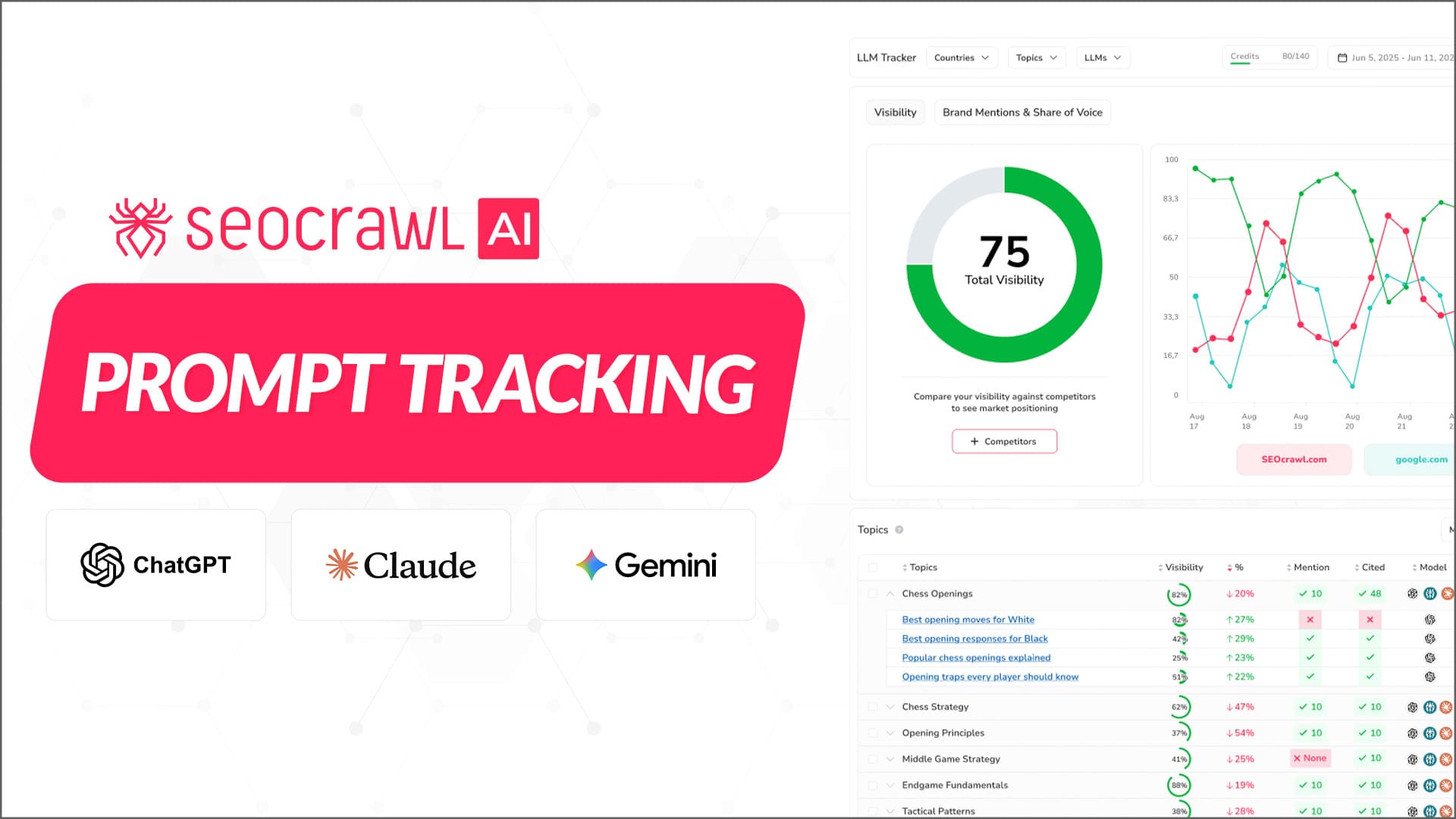
Tactics only matter if you can see their results. Want to know if your brand is showing up in AI answers right now? SEOcrawl AI's Prompt Tracking monitors your brand mentions, share of voice, and citation URLs across ChatGPT, Claude, Gemini, Perplexity, and Copilot — broken down by topic, country, and model variant.
Set up a GEO reporting framework
- Define your prompt set: 20–50 questions your target buyers are most likely to ask AI tools about your category
- Establish a baseline: mention rate, share of voice, citation rate, and sentiment per prompt cluster
- Configure tracking per LLM and per key market
- Track weekly, compare month-over-month
- Connect AI visibility data to your existing SEO and traffic reporting. The goal is one consolidated view, not two separate reports
Tools for tracking AI search visibility
SEOcrawl AI's Prompt Tracking monitors brand mentions, citation URLs, share of voice, and sentiment across ChatGPT, Claude, Gemini, Perplexity, and Copilot. The toolbar lets you filter by country, topic, and LLM, and export everything in a single click.
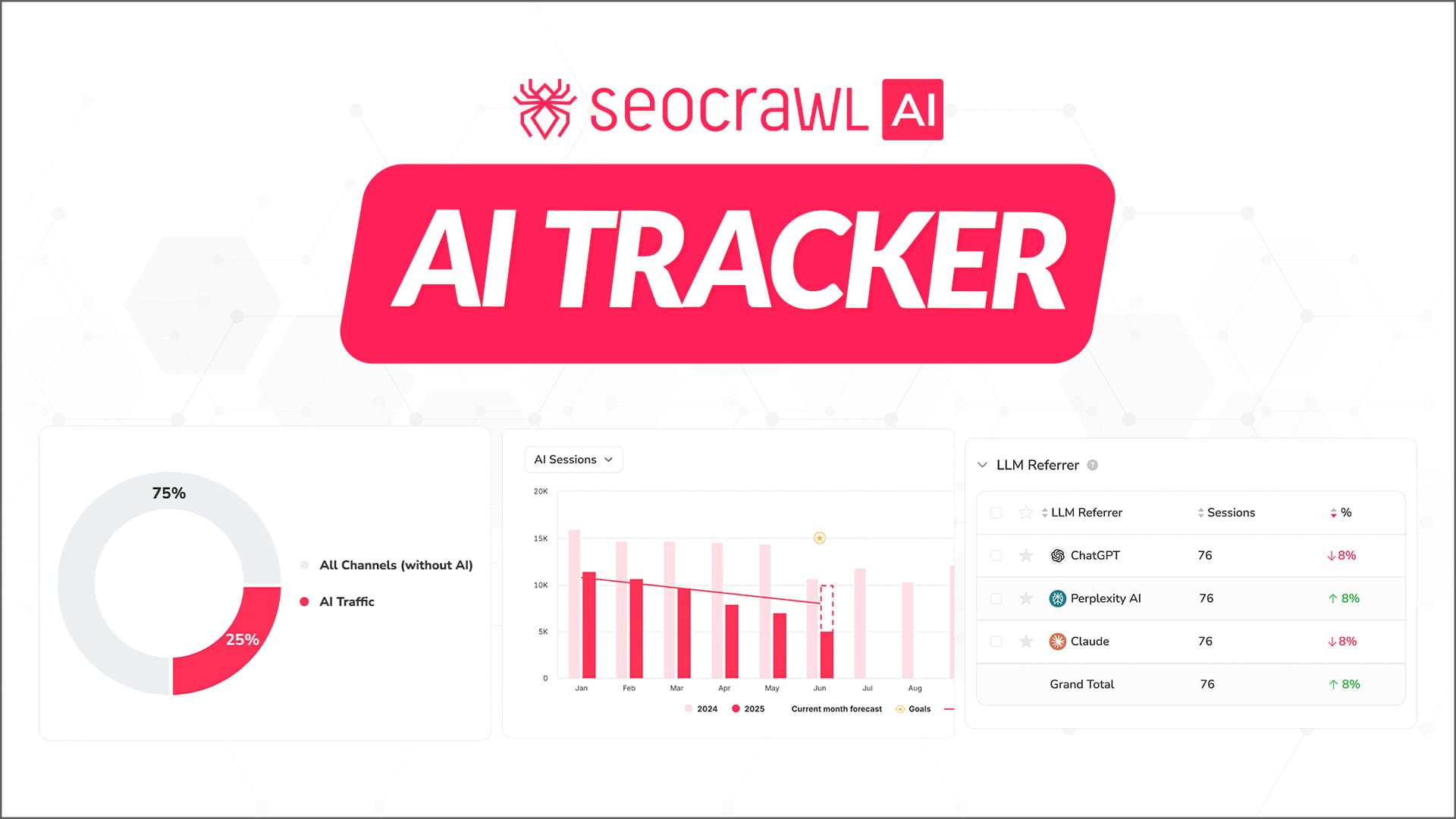
If you also want to measure the traffic those AI mentions are actually sending to your site, SEOcrawl AI's AI Tracker connects to GA4 and shows sessions, conversions, and landing pages from AI referral sources.
For manual validation, run your target prompts directly in each AI tool on a regular schedule and record what brands and sources appear. This is time-intensive but gives you ground-truth data that no automated tool fully replaces.
GEO quick-start checklists
Audit your existing content for GEO readiness
- Does your most important content answer the primary query in the first 100–200 words?
- Do you have FAQ sections with FAQPage schema on key pages?
- Does your robots.txt allow the AI crawlers you want to access your content?
- Do your pages include specific statistics, data points, or expert quotes?
- Is author information clear, named, and credible on every published piece?
10-step GEO implementation checklist
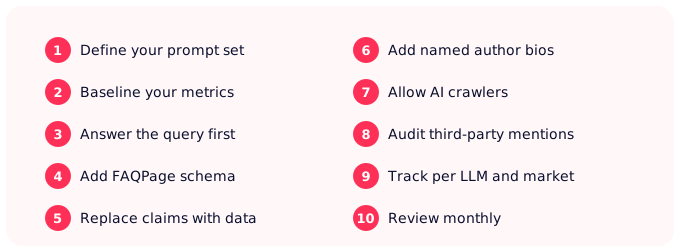
- Define your prompt set (20–50 queries that your buyers ask AI tools)
- Establish a baseline for mention rate, share of voice, and citation rate
- Rewrite page openings to answer the primary query in the first paragraph
- Add or improve FAQ sections with FAQPage schema
- Replace vague claims with specific, citable statements and data points
- Add named author bios with verifiable credentials
- Verify robots.txt allows GPTBot, PerplexityBot, and Google-Extended
- Audit your third-party mention presence (reviews, industry coverage, citations)
- Set up structured tracking per LLM and per market
- Review monthly. AI citation patterns shift faster than traditional rankings
FAQs
What is generative engine optimization (GEO)?
Generative engine optimization is the practice of optimizing your content so that AI-powered search tools (including Google AI Overviews, Perplexity, ChatGPT, and Gemini) select it as a source when generating answers to user queries. Unlike traditional SEO, which targets a ranked position in a list of links, GEO targets inclusion in the synthesized answer itself.
Will GEO replace SEO?
Traditional search still drives the majority of organic traffic for most websites, and the content AI tools cite is largely built on the same authority signals as traditional SEO. GEO complements existing SEO practice, and brands with strong SEO foundations are generally better positioned for AI citation than those without. Both are needed.
How does generative engine optimization work?
AI search tools use retrieval-augmented generation (RAG): they retrieve relevant documents from indexed web content, then use a large language model to synthesize a response. Content that directly answers the query, is clearly structured, contains specific citable claims, and comes from a credible source is more likely to be selected. GEO is the practice of optimizing for those selection criteria.
Which AI platforms does GEO target?
The primary platforms are Google AI Overviews, Perplexity, ChatGPT, Google Gemini, and Microsoft Copilot. Each has different citation behavior. Perplexity shows sources explicitly in every answer, while ChatGPT and Gemini surface citations less consistently. Effective GEO accounts for these differences rather than treating all platforms as identical.
How is GEO different from SEO?
SEO targets ranked link positions and measures success in clicks and rankings. GEO targets inclusion in AI-synthesized answers and measures success in mention rate, share of voice, and citation rate. The underlying foundation (credible, well-structured content on an authoritative domain) is shared. The weighting and pipeline are not.
How do I measure GEO success?
Track five core metrics: mention rate, share of voice, citation rate, sentiment mix, and topic coverage. Break each down by LLM and by country. Tools like SEOcrawl AI's AI Tracker and Prompt Tracking automate this across ChatGPT, Claude, Gemini, Perplexity, and Copilot. Supplement automated tracking with regular manual prompt testing.
What content formats work best for GEO?
Q&A sections, FAQs, numbered step-by-step guides, concise standalone definitions, and data-backed statements. These formats are structured for extraction so the AI can lift a clean answer without needing surrounding context to make sense of it.
Is GEO only relevant for large brands?
No. Any authoritative, well-structured content can be cited. Niche expertise and clear answers can outperform large brands if the content directly addresses a specific query. Depth and specificity matter more than domain authority alone.
Author: David Kaufmann

I've spent the last 10+ years completely obsessed with SEO — and honestly, I wouldn't have it any other way.
My career hit a new level when I worked as a senior SEO specialist for Chess.com — one of the top 100 most visited websites on the entire internet. Operating at that scale, across millions of pages, dozens of languages, and one of the most competitive SERPs out there, taught me things no course or certification ever could. That experience changed my perspective on what great SEO really looks like — and it became the foundation for everything I've built since.
From that experience, I founded SEO Alive — an agency for brands that are serious about organic growth. We're not here to sell dashboards and monthly reports. We're here to build strategies that actually move the needle, combining the best of classical SEO with the exciting new world of Generative Engine Optimization (GEO) — making sure your brand shows up not just in Google's blue links, but inside the AI-generated answers that ChatGPT, Perplexity, and Google AI Overviews are delivering to millions of people every single day.
And because I couldn't find a tool that handled both of those worlds properly, I built one myself — SEOcrawl AI, an enterprise SEO intelligence platform that brings together rankings, technical audits, backlink monitoring, crawl health, and AI brand visibility tracking all in one place. It's the platform I always wished existed.
Discover more content about this author