AI Overviews Ranking Factors: What Actually Gets Your Content Cited
In its biggest markets, Google reports AI Overviews are driving over a 10% increase in Search usage for the query types that show them, and the pages earning citations inside them aren't always the ones ranking #1. This guide breaks down how to compete in this new layer of search visibility.
What Are AI Overviews and Why Do Ranking Factors Matter?
Google's AI Overviews are AI-generated summaries that appear at the top of search results, pulling cited sources directly into the answer.
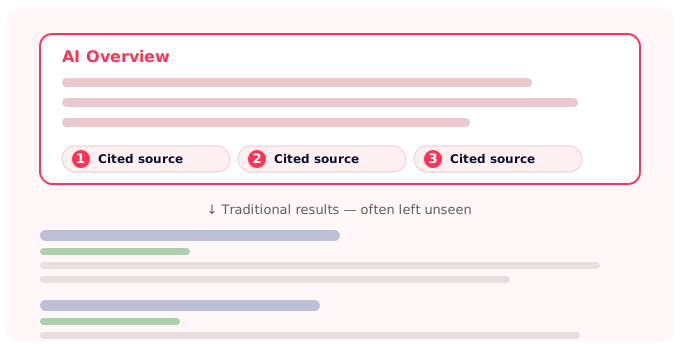
How AI Overviews differ from traditional organic results
Unlike traditional organic results, AI Overviews generate a synthesized answer on the spot with citations embedded inside it. The user may never scroll to the blue links below. This distinction is what makes them so important for SEO strategy. AI Overview optimization targets citation inside the answer.
Why being cited in an AI Overview is a new SEO priority
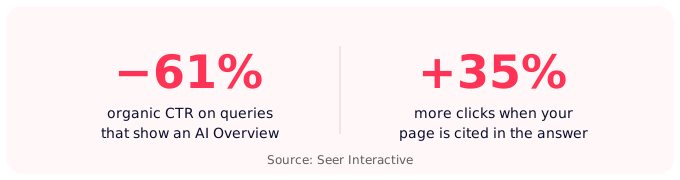
AI Overviews have cut organic CTR by 61% on affected queries. For pages that sit below an AI Overview without being cited, that traffic loss is unrecovered. But there's a counterweight: getting cited inside an AI Overview now earns 35% more clicks than holding a traditional ranking alone (Seer Interactive).
Conductor's analysis found 25.11% of searches triggered an AI Overview in Q1 2026, up from 13.14% in March 2025 — nearly double in twelve months. In commercial verticals, BrightEdge puts that figure closer to 48%. Either way, citation has become a primary visibility channel (Conductor).
The relationship between AI Overview citations and organic traffic
Being cited in an AI Overview still doesn't replace organic traffic. Pages that earn citations tend to see higher-quality clicks: users who click through from an AI Overview have already read a summary that referenced your content, which means they arrive with stronger intent and context than a typical organic click.
Core AI Overviews Ranking Factors: The Full Breakdown
Rankings are influenced by Google's core ranking systems (PageRank, Reviews, Helpful Content) alongside AI models, including Gemini and MUM, and databases like the Shopping Graph and Knowledge Graph.
Topical authority and E-E-A-T signals
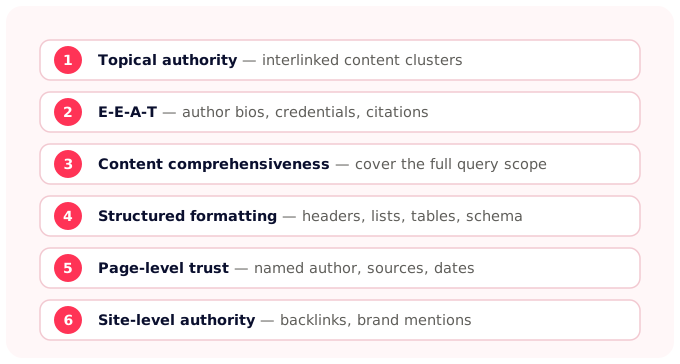
Topical authority and E-E-A-T sit at the top of that stack. The June 2025 Core Update made topical authority stronger as a ranking input. Now, sites that have interlinked content clusters consistently outperform broader, shallower sites by up to 30%.
Content comprehensiveness and query coverage
A page that answers the core question but ignores adjacent questions a user might have is less citeable than one that covers the topic fully. Google's AI system is looking for the best extractable passage for a given query, and a comprehensive page gives it more to work with. This is why thin pages that address one narrow intent rarely earn citations, and why content clusters outperform isolated pages.
Structured, scannable formatting (headers, lists, tables)
AI Overviews favor content that is easy to extract. Headers signal topic boundaries, lists make items individually parseable, and tables allow direct comparison. All of these reduce the work the AI system has to do to pull a coherent answer.
Page-level trust signals (author bios, citations, sources)
At the page level, trust signals tell Google's AI that the content is attributable and verifiable. A named author with a linked bio, external sources cited and linked, a visible publication date, and no unsourced statistical claims all contribute. 96% of AI Overview citations now come from verifiably authoritative sources, which means pages without these signals are effectively excluded from most citation consideration.
Site-level authority and backlink profile
Site-level authority — built through backlinks from relevant, trusted domains and third-party brand mentions — signals to Google that the domain is recognized as reliable in its field. This matters for AI Overview selection because the system evaluates source credibility at both the page and domain level. A strong backlink profile doesn't guarantee citation, but a weak one is a meaningful disadvantage.
| Ranking factor | What to optimize |
|---|---|
| Topical authority | Build content clusters; interlink related pages |
| E-E-A-T | Author bios, credentials, external citations |
| Content comprehensiveness | Cover the full query scope including related questions |
| Structured formatting | Headers, lists, tables, FAQ schema |
| Page-level trust | Named author, sources cited, publication date visible |
| Site-level authority | Backlinks from relevant domains, brand mentions |
How Google Selects Sources for AI Overviews
The role of the Knowledge Graph and entity recognition
Google's Knowledge Graph is a database of entities (people, organizations, places, concepts) and the relationships between them. Pages that are clearly associated with recognized entities are easier for Google's AI to evaluate for authority and relevance. This is one reason why brand mentions, proper nouns, and entity-rich content tend to perform better in AI Overview citation than vague or generic content.
How retrieval-augmented generation (RAG) influences source selection
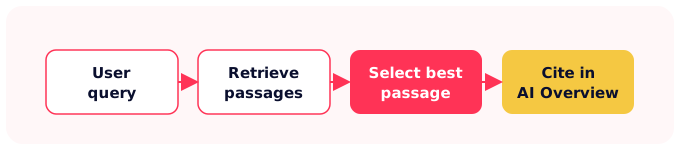
Google's AI Overviews use a retrieval-augmented generation pipeline: rather than generating answers purely from its training data, the system retrieves relevant passages from indexed pages and uses them to construct the response, citing the sources it drew from. In plain terms, the AI is searching for the best passage to answer a query, then building an answer around it.
Why AI Overviews often pull from pages NOT in position 1–3
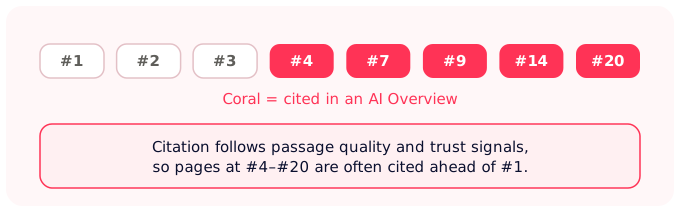
Because the RAG pipeline selects for passage quality and trust signals rather than organic rank, a page at position 8 with a clear, well-structured answer to a specific query can be cited ahead of the #1 result. AI Overviews frequently cite pages from positions 4–20 and beyond. This makes AI Overview optimization an opportunity for pages that have strong content but haven't yet built the link authority to compete at the top of traditional results.
The importance of being indexed and crawlable
All of the above will be irrelevant if Google can't reliably access your page. Being indexed and crawlable is the hard baseline for AI Overview citation. A page that Googlebot can't render or that fails basic technical standards won't be considered for citation regardless of content quality.
E-E-A-T and Its Outsized Role in AI Overview Citations

Experience: first-hand content signals Google rewards
Experience refers to demonstrated, first-hand knowledge of the subject. Does the author have direct involvement with what they're writing about? Google rewards content that could not have been written by someone who had only read about the topic: original examples, real deployment data, proprietary case studies, and specific details that reflect lived experience.
Expertise: credentials, author pages, and bylines
Expertise is about verifiable knowledge. Author bio pages with relevant professional background, clear bylines, links to other published work, and (where applicable) formal credentials or institutional affiliations all contribute.
The December 2025 Core Update extended E-E-A-T requirements beyond YMYL topics to all content categories, which means expertise signals are now relevant for every niche, not just health and finance.
Authoritativeness: third-party mentions and brand signals
Authoritativeness is built externally: backlinks from relevant, trusted domains; brand mentions in authoritative publications; citations from other credible sources; and presence in the Knowledge Graph.
A page can have strong experience and expertise signals and still underperform on authoritativeness if the domain hasn't earned external recognition. Both dimensions matter.
Trustworthiness: HTTPS, privacy policy, editorial standards
Trustworthiness covers site-level hygiene: HTTPS, a clear and accessible privacy policy, accurate contact information, transparent editorial standards, and content that doesn't mislead or make unverifiable claims. These signals are the baseline, and without them, the other three E-E-A-T dimensions don't fully register.
Pre-publish E-E-A-T checklist
- Named author with a linked bio page
- Author's relevant credentials or experience stated
- Publication date and last-updated date visible
- External sources cited and linked
- No unverifiable or unsourced statistical claims
- HTTPS enabled
- Privacy policy and contact information accessible
Content Formatting Best Practices for AI Overview Visibility
Using concise, direct answers in the first 100 words
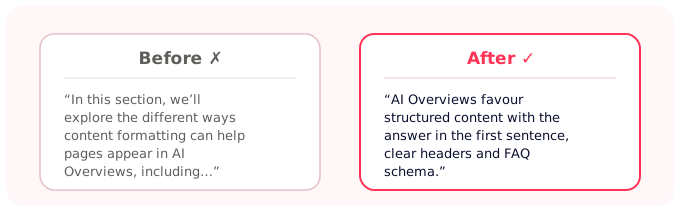
The first 100 words of any section are the highest-value real estate for AI Overview citation. Lead with the direct answer, not with context-setting or restating the question. Every word before the actual answer is friction for both the AI system and the reader.
| Before | After |
|---|---|
| "In this section, we'll explore some of the different ways that content formatting can play a role in helping your pages appear in AI Overviews, including a discussion of headers, lists, and other structural elements..." | "AI Overviews favor structured content with direct answers in the first sentence, clear headers, and FAQ schema. Each paragraph should answer one question completely." |
Structured data and schema markup that helps AI parsing
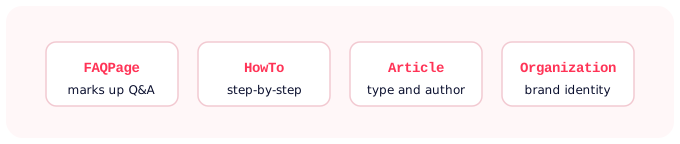
FAQ schema, HowTo schema, and Article schema help Google identify what type of content is on a page and extract it more reliably. They reduce ambiguity about the structure and intent of a page's content. Adding or updating Article, FAQ, and Organization schema on priority pages is one of the most actionable steps following the March 2026 update.
Optimal use of bullet lists, numbered steps, and definition blocks
Lists make individual items parseable without surrounding context. Numbered steps give the AI a clear sequence to extract. Definition blocks — a term followed by a direct explanation — are among the easiest structures for AI systems to pull into a summarized answer.
How content length and depth affect citation likelihood
Longer content isn't inherently more citeable; comprehensiveness is. A 600-word page that fully answers a specific query with clear structure can outperform a 3,000-word page that buries its answers in padding. That said, queries with eight words or more are significantly more likely to trigger an AI Overview, and those longer, more specific queries tend to reward deeper content. Match depth to the actual complexity of the query, not to a word count target.
Technical SEO Factors That Influence AI Overview Inclusion
Core Web Vitals and page experience signals
The March 2026 Core Update introduced a meaningful change to how Core Web Vitals are evaluated: rather than evaluating LCP, INP, and CLS as independent pass/fail signals, Google now aggregates them into a composite performance score where all three metrics contribute to a single ranking factor. A page that passes two out of three metrics but fails the third is penalized more than it was before.
Mobile-friendliness and rendering requirements
The majority of Google searches happen on mobile, and AI Overviews appear heavily in mobile results. A page that doesn't render correctly on smaller screens, loads slowly on mobile connections, or has layout issues on touch devices is at a structural disadvantage for AI Overview citation regardless of content quality.
Crawl budget and indexation health
Orphan pages, excessive redirect chains, blocked resources, and misconfigured robots.txt directives all reduce how reliably Googlebot can access and evaluate your content. Regular crawl audits surface these issues before they become citation blockers. If a page isn't being crawled efficiently, it won't be indexed reliably — and if it isn't indexed reliably, it won't be cited.
Avoiding content that triggers AI Overview exclusion
Some content characteristics actively exclude pages from AI Overview consideration. The March 2026 Core Update targeted mass-produced AI content lacking editorial oversight, sites relying on parasitic SEO, and sites with poor intent matching that cover keyword topics without truly satisfying user needs. The practical test: if a page wouldn't qualify for a featured snippet, it almost certainly won't be cited in an AI Overview.
Keyword and Query Alignment Strategies
Targeting question-based and conversational queries
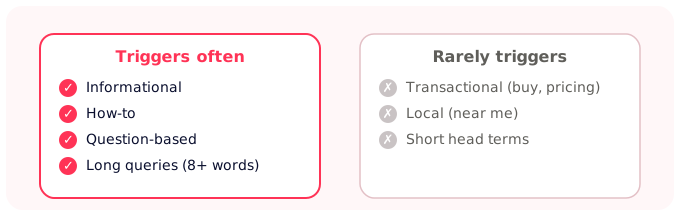
AI Overviews trigger most consistently on informational, how-to, and question-based queries, particularly longer ones. This means content written around conversational, specific questions — the kind users type when they genuinely want to understand something — is inherently better positioned for citation than content targeting short, high-volume head terms.
Matching content to informational and commercial investigation intents
Transactional queries (buy, pricing, near me) and purely local queries trigger AI Overviews far less frequently than informational and commercial investigation queries. This is both a challenge and an opportunity: informational content needs AI Overview optimization; product and local pages are relatively protected from citation-driven cannibalization.
Using semantic keyword clusters to broaden citation surface area
A single page targeting one keyword gives Google's AI one passage to evaluate. A content cluster — a set of interlinked pages covering a topic from multiple angles — gives the system multiple high-quality passages across multiple queries. Clusters expand the surface area available for AI Overview citation.
Long-tail queries where AI Overviews appear most frequently
A page that clearly answers "how does retrieval-augmented generation affect AI Overview source selection" is more likely to be cited for that query than a page that vaguely covers AI search optimization at a high level. Specificity is a competitive advantage in this environment.
How to Track and Measure AI Overview Performance
Using Google Search Console to identify AI Overview impressions
Google Search Console includes AI Overview data in the Performance report. Filter by search type to identify URLs appearing in AI Overviews. This gives you impression and click data for pages being cited, which is the starting point for any tracking workflow.
Want to master GSC? Read our guide: How to Use Google Search Console.
Third-party tools for monitoring AI Overview citations
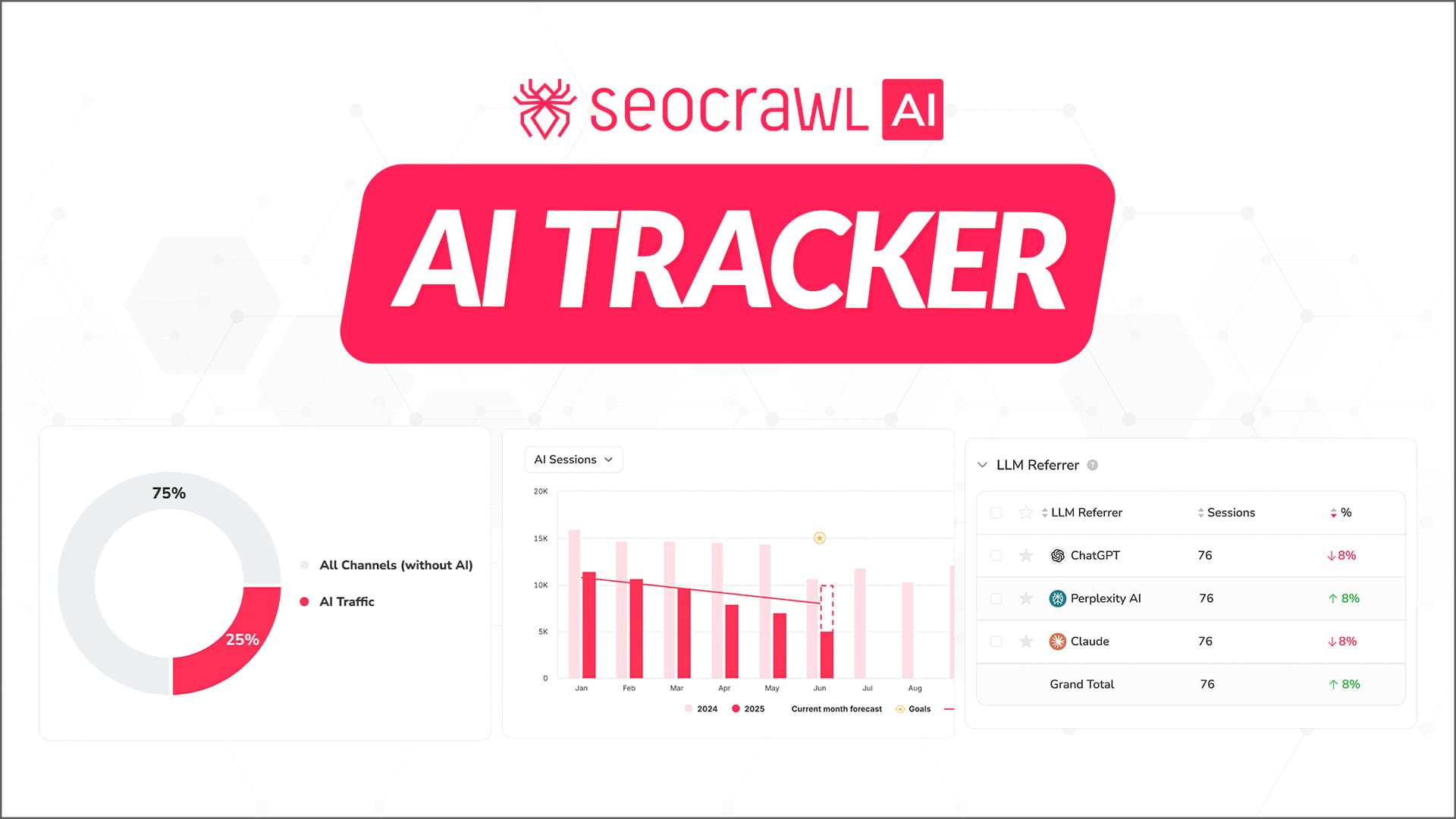
SEOcrawl AI's AI Tracker goes beyond GSC by putting AI-referred traffic data directly alongside your organic performance metrics. You can understand how AI impacts your traffic, compare it with organic traffic, get detailed insights by pages, languages, and devices, and discover how many sessions each model (ChatGPT, Claude, Perplexity) generates.
Key metrics: citation rate, click-through from AI Overview, impression share
| Metric | Where to track |
|---|---|
| AI Overview impressions | GSC Performance report, filtered by search type |
| CTR from AI Overview citations | GSC Performance report |
| AI-referred sessions by LLM | SEOcrawl AI Tracker |
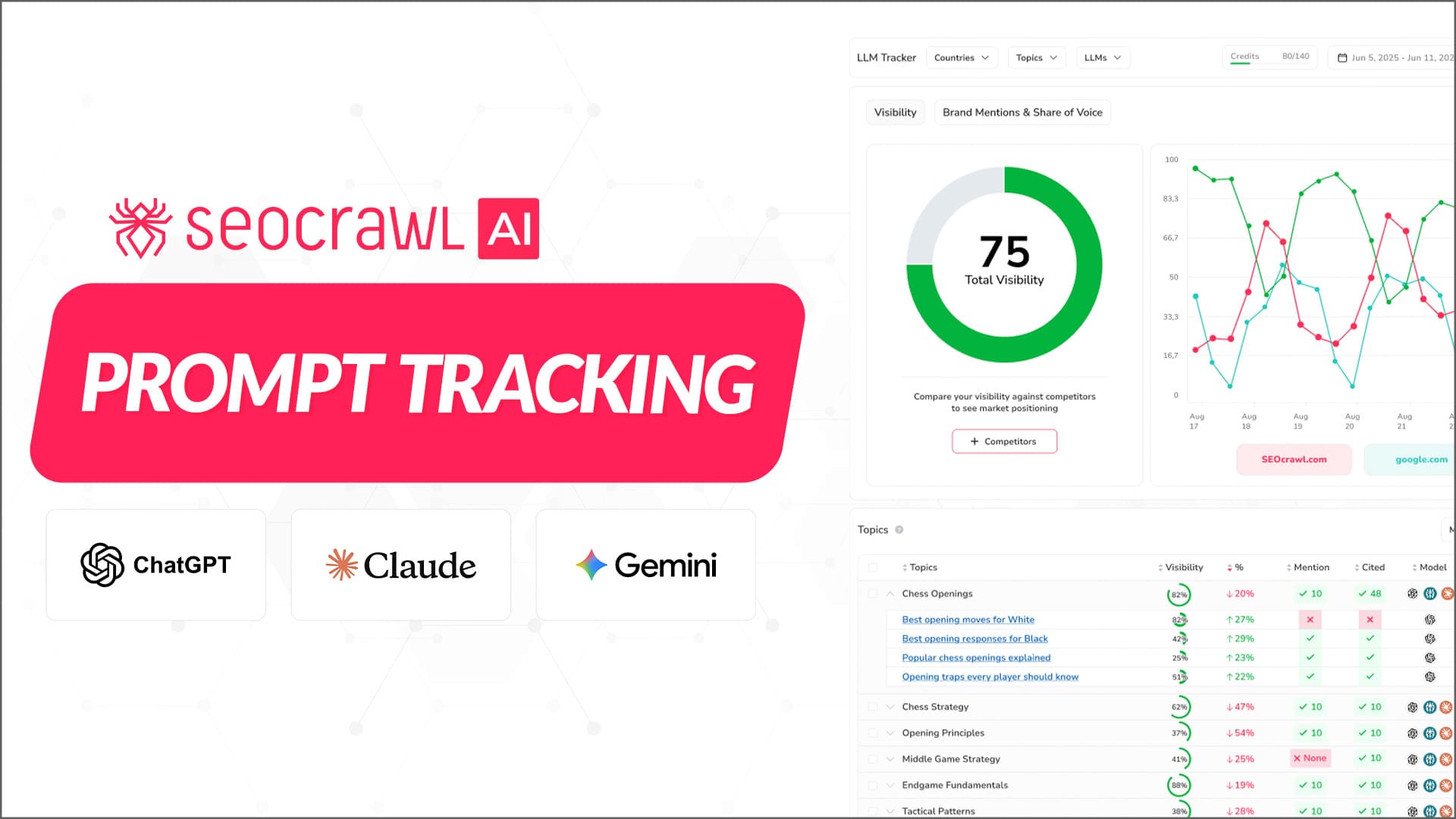
| Brand mention frequency in LLM responses | SEOcrawl AI Prompt Tracking |
| Competitor citation share-of-voice | SEOcrawl AI Prompt Tracking |
Action Plan: Optimizing Existing Content for AI Overviews
Step-by-step content audit checklist
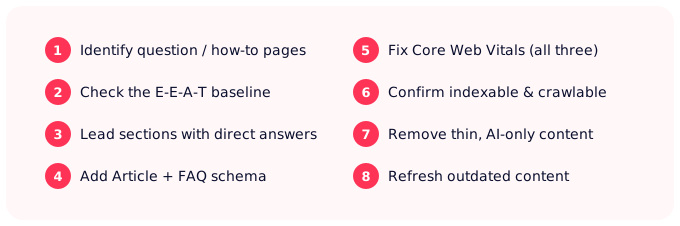
- Identify informational pages targeting question-based or how-to queries. These are your highest-potential candidates.
- Check each page's E-E-A-T baseline: named author, credentials visible, external sources cited, last-updated date shown.
- Review the opening 100 words of each target section. Does it give a direct answer before any preamble?
- Confirm structured data is implemented: at minimum Article schema; FAQ schema where the page has a Q&A section.
- Run Core Web Vitals. Fix LCP, INP, and CLS together. All three now contribute to the composite score.
- Check indexation: is the page indexed, crawlable, and not blocked in robots.txt?
- Verify there are no thin, duplicate, or AI-generated-without-oversight content issues on the page.
- Check content freshness: when was this page last meaningfully updated? Sites with more recently updated content showed stronger AI Overview visibility following the March 2026 update.
Quick wins vs. long-term structural changes
Quick wins (1–2 weeks):
- Add or update author bios with relevant credentials
- Add last-updated dates to priority pages
- Add FAQ schema to pages that already have a Q&A section
- Rewrite section openings to lead with the direct answer
- Fix Core Web Vitals failures across all three metrics
Longer-term structural changes (4–12 weeks):
- Build topical clusters around your core subjects if you're currently publishing isolated pages
- Develop first-hand case studies, original data, or proprietary insights to strengthen E-E-A-T
- Establish a citation tracking workflow using GSC + SEOcrawl AI Tracker + Prompt Tracking
Monitor your AI Overview citation performance alongside organic rankings in one place with SEOcrawl AI's AI Tracker.
FAQs
What are the most important AI Overviews ranking factors?
No single factor dominates. Citation is the result of several signals working together. The five pillars are topical authority, E-E-A-T, content comprehensiveness, structured and scannable formatting, and technical crawlability. Since the December 2025 Core Update, E-E-A-T requirements have expanded beyond YMYL topics to all content categories, raising the baseline across the board.
Do you need to rank #1 organically to appear in an AI Overview?
No. AI Overviews frequently cite pages from positions 4–20 and beyond. Citation is driven by content relevance, extractability, and trust signals, not solely by organic rank. This makes AI Overview optimization a genuinely separate track from traditional rank-chasing.
How does E-E-A-T affect AI Overview citations?
Google's AI systems use E-E-A-T signals to assess source credibility. Most AI Overview citations now come from verifiably authoritative sources. Author credentials establish expertise, first-hand content signals experience, third-party mentions build authority, and site-level trust signals address trustworthiness. Pages that clearly demonstrate all four are consistently stronger citation candidates.
Does schema markup help you appear in AI Overviews?
Structured data (FAQ, HowTo, Article schema) helps Google parse and extract content more reliably, increasing citation likelihood. It's a supporting factor, not a guarantee. Adding or updating Article, FAQ, and Organization schema on priority pages is one of the most actionable steps following the March 2026 update.
How can I track whether my pages are being cited in AI Overviews?
Start with Google Search Console's Performance report filtered by the AI Overviews search type. For deeper tracking, SEOcrawl AI's AI Tracker measures AI-referred sessions by LLM source and compares them against organic traffic. The Prompt Tracking feature monitors brand citations across ChatGPT, Gemini, Perplexity, and Claude directly.
Which types of queries trigger AI Overviews most often?
Informational, how-to, and question-based queries trigger AI Overviews most frequently, especially longer queries of eight words or more. Transactional and local queries are less likely to trigger them. YMYL topics face stricter E-E-A-T requirements and are sometimes excluded.
Can optimizing for AI Overviews hurt my regular organic rankings?
No. The tactics that improve AI Overview citation rates (stronger E-E-A-T, cleaner structure, stronger topical authority, better Core Web Vitals) align directly with Google's core ranking signals. The same content signals Google evaluates for web search increasingly determine whether your content gets surfaced in AI Overviews, cited by ChatGPT, or referenced in Perplexity.
How long does it take to see results after optimizing for AI Overviews?
Most practitioners report citation changes within 4–8 weeks of publishing or updating content, tied to Google's recrawl frequency for the domain. Quick-win changes like adding author bios or FAQ schema can show up faster; structural changes like topical cluster development take longer.
Author: David Kaufmann

I've spent the last 10+ years completely obsessed with SEO — and honestly, I wouldn't have it any other way.
My career hit a new level when I worked as a senior SEO specialist for Chess.com — one of the top 100 most visited websites on the entire internet. Operating at that scale, across millions of pages, dozens of languages, and one of the most competitive SERPs out there, taught me things no course or certification ever could. That experience changed my perspective on what great SEO really looks like — and it became the foundation for everything I've built since.
From that experience, I founded SEO Alive — an agency for brands that are serious about organic growth. We're not here to sell dashboards and monthly reports. We're here to build strategies that actually move the needle, combining the best of classical SEO with the exciting new world of Generative Engine Optimization (GEO) — making sure your brand shows up not just in Google's blue links, but inside the AI-generated answers that ChatGPT, Perplexity, and Google AI Overviews are delivering to millions of people every single day.
And because I couldn't find a tool that handled both of those worlds properly, I built one myself — SEOcrawl AI, an enterprise SEO intelligence platform that brings together rankings, technical audits, backlink monitoring, crawl health, and AI brand visibility tracking all in one place. It's the platform I always wished existed.
Discover more content about this author
CTR tells you how many of the people who saw your result actually clicked. Here's the formula, what a good CTR looks like in 2026 by channel and by Google position, and how to get more clicks from the rankings you already have.