How Search Intent Influences SEO
Search intent is a concept that is gaining strength in 2020 and represents a significant shift in how we understand and approach the content of our websites, but do we really know what it is and how to adapt to it?
The importance in SEO
Google has always wanted to provide users with the answer to the searches they perform. Logically, this depends heavily on their keywords. This way, we can clearly see that it is not the same if someone searches for "buy sushi" as if the search is "what is sushi".
Search intent is obviously different for each case, but this is an obvious practical example. The intent the user has is not always defined so explicitly in their keywords.
That is why it is the task of both SEO professionals and Google to create, index and rank the appropriate results based on search intent, since Google will no longer display, as it did before, lengthy texts with large amounts of keywords if they do not answer that search.
Therefore....
What is Search Intent?
Having understood the example, we can better address the concrete definition of what Search Intent is. In short, it refers to the REAL search intent of a user.
We have emphasized the "real" part because Google is able to interpret, based on what and how we write, what we may be looking for. This is thanks to improvements such as Rank Brain, its machine learning algorithm.
For SEOs, it is important to identify it and optimize their strategy according to this search intent.
Several relevant aspects come into play here, such as semantics, context, the way of presenting not only the text but also the supplementary elements that support it, etc. In other words, Google will analyze based not only on keywords but also on how we relate them, how we present them and, ultimately, how they respond to the demand for the requested information.
Previously, a page with little text content would be labeled by any SEO as difficult to rank, but knowing the concept of Search Intent, we are going to give you another very visual example.
If we perform a search like "euros to dollars conversion", do we want to land on a page with extensive text talking about euros and dollars and a long table with equivalences? Most likely, if we see that, we will close the page within seconds. If, on the other hand, we arrive at a URL with no content but with a bar to enter the amount of euros we want to convert and a button to click and give us the result in dollars, isn't that what we were looking for?
Well, this perfectly sums up what search intent is. While an old-school SEO would recommend the first option, today's SEO makes it possible to rank URLs in the top 1 with barely any content, taking this factor into account.
This therefore requires the Google bots to know how to properly relate the content and elements, to ensure that Search Intent is adequately satisfied.
Types of Search Intent
Logically, as we dive deeper into Search Intent, we find greater complexity.
To begin with, on the Internet we must distinguish between different types of user search intent:
Transactional search
Users who want to perform an action, such as buying a product, subscribing to a service, downloading programs, etc.
Example: "buy automatic coffee machine"
Informational search
Users who need to obtain information about a topic.
Example: "what is folic acid"
Specific informational search
This is informational search taken to the limit, when the user needs a specific piece of data.
Example: "how many inhabitants does Granada have"
"Go" search
Users looking for a specific destination, about which they want information for a likely visit.
Example: "what to do in Granada"
Navigational search
Users who are searching for a web address, but do not know or have forgotten the URL.
Example: "amazon"
"Device Action" search
Users who want to perform an action with a mobile device.
Example: "add reminder"
Geolocation search
Users who search for services near their location.
Example: "vegan restaurants near me" With this classification of Search Intent, many options are obviously excluded and, even within each category, the specific characteristics could motivate infinite different searches.
But at least it serves to highlight the most frequent types of search intent posed by the user.
Google and its position on Search Intent
The SEO professional has a lot of work to do to create a Search Intent strategy (we will see this in detail later), but Google also has its share of work.
The search engine needs to properly understand the search intent of its users. As the Internet continues to grow, classifying content in relation to the searches performed is more complex.
In fact, at first it did not have developed tools to analyze this search intent, but now it has indeed advanced in this regard.
For example, if you perform a search like "hotel in Granada", Google is not going to focus on definition results about what the hotels in Granada are. It interprets (probably with complete accuracy) that you are looking for a hotel to stay in the Andalusian city and offers you the best related results or, at least, those that have been best optimized for SEO for that purpose.
Therefore, Google is doing its part. And, most importantly, if SEOs do not do theirs, they will not only miss the opportunity to achieve a higher ROI on their optimized pages, but the competition may even get ahead of them and then it will be more difficult to obtain optimal positions.
How to work on Search Intent in SEO
The work of the SEO professional regarding Search Intent is identified above all in 2 main phases:
- User analysis
- On-page SEO
User analysis
To optimize our content according to search intent, we must first know what intent our users really have when they use the search engine.
Here we have many tools to obtain the information we want and on which we can work in the future:
- Analysis of searches on our website.
- Google Analytics.
- Keyword research.
- Market studies.
On-page SEO
One of the important features of Search Intent is that it is primarily based on on-page SEO. That is, almost all the work has to be focused on optimizing the internal content of our website.
When identifying the search intentions of users that can offer us better performance, it is time to create, update and optimize the content of our website to be rankable within this strategy.
Search Intent in searches
As we mentioned before, Google is working on searches based on user intent. They have made significant progress, which we can take advantage of to better define our SEO strategy.
Some of the elements we have noticed in recent months according to these changes are the following:
Difference between query and keyword
SEO professionals must understand the difference between query and keyword. While the latter is the classic keyword on which a website was optimized, the former is the intent, that is, the objective the user has in their use of Google.
SERP features
A notable change in Google's results are the SERP features that we are seeing more and more frequently.
These features consist of striking digital content that complements the search results, precisely to solve users' needs in a faster and more practical way.
Examples of SERP features:
- Presentation of a map when the user searches for a nearby service or a holiday destination.
- Biographical data and stock images, when the user wants information about a person or even a company.
- Related images and data, with which to address the user's exact search, for example when they search for the currency of a country.
We can optimize our page content based on how these SERP features are displayed, to help the search engine provide results that satisfy users' search intent.
Equivalence between searches and user situation
Another optimal Search Intent strategy is to optimize our content, anticipating the situation the user is in. The possibilities are endless, but surely for our commercial sector we will find well-identified key situations.
Some of the basic user situations on Google are the following:
- Discover: The user wants to learn how to do something. We must optimize content for searches of the type "How to + keywords".
- Opinion: The user is looking for opinions, reviews and comments about a service, establishment or place. We must work on queries of the type "Reviews + keyword" or "Opinions + keyword".
- Action: The user has made up their mind about an action. The queries worked on will be of the type "Buy + keyword", "Download + keyword", etc.
Benefits of working on Search Intent
Every SEO ranking strategy offers its benefits. Investing time and resources can also be of great use to us.
In general, the main advantages this strategy provides are the following:
- We broaden the target in search engines, which perhaps we did not take into account before.
- At the same time, we are relevant to users with more specific searches.
- We prevent the competition from getting ahead of us in searches of this type.
- We make the information on our website more useful and, consequently, we improve the conversion potential.
Do you still have questions or any suggestions? We would love to read you in the comments!
Author: David Kaufmann

I've spent the last 10+ years completely obsessed with SEO — and honestly, I wouldn't have it any other way.
My career hit a new level when I worked as a senior SEO specialist for Chess.com — one of the top 100 most visited websites on the entire internet. Operating at that scale, across millions of pages, dozens of languages, and one of the most competitive SERPs out there, taught me things no course or certification ever could. That experience changed my perspective on what great SEO really looks like — and it became the foundation for everything I've built since.
From that experience, I founded SEO Alive — an agency for brands that are serious about organic growth. We're not here to sell dashboards and monthly reports. We're here to build strategies that actually move the needle, combining the best of classical SEO with the exciting new world of Generative Engine Optimization (GEO) — making sure your brand shows up not just in Google's blue links, but inside the AI-generated answers that ChatGPT, Perplexity, and Google AI Overviews are delivering to millions of people every single day.
And because I couldn't find a tool that handled both of those worlds properly, I built one myself — SEOcrawl AI, an enterprise SEO intelligence platform that brings together rankings, technical audits, backlink monitoring, crawl health, and AI brand visibility tracking all in one place. It's the platform I always wished existed.
Discover more content about this author
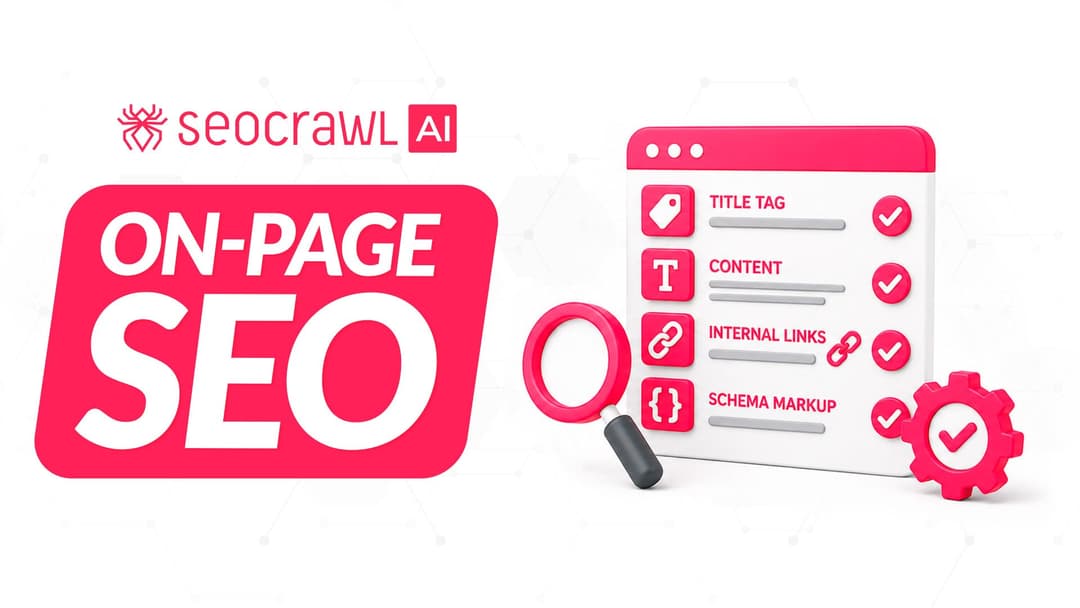
On-page SEO is everything you control on a page: content, title, meta description, headings, URL, images and internal links. Here is a checklist element by element, an audit process and what changes with AI Overviews and AI Mode.