AI Prompt Tracking SEO Software
Track, measure and optimize your brand visibility across AI platforms like ChatGPT, Gemini and more.
SEOcrawl AI's AI Prompt Tracking software helps you understand how the most important language models mention, rank and recommend your brand. Monitor visibility, compare competitors and uncover new growth opportunities.




Prompt Tracking Features
SEOcrawl AI's AI-powered suite gives you the most complete visibility across every supported platform.
AI Visibility Score
Understand how your brand is performing across the main AI platforms. Get a score that summarizes your overall visibility in citations and mentions.
Competitor Comparison
See who sits alongside you — or above you — in the AI-generated answers. Learn what your competitors are doing, what type of content is winning them citations and act in consequence.
Country, Topics and LLMs Filters
Filter by country, topic cluster and language model to zoom in on the exact segment that matters. Track how your visibility changes per market, topic and AI model.
Prompt-Level Tracking
Track every individual prompt and get full transparency into the complete LLM response. Switch to compare mode and see how rankings shift across dates and models.
AI Citation Analysis
Drill into authoritative sources: what URLs do the LLMs cite, how often and for which topics. Identify content gaps, citation opportunities and domains building AI authority.
Add and Monitor Custom Prompts
The prompts we track are only an example. Create your own to achieve a complete source of truth of how your specific business, brand and organization shows up in AI answers.
Get a Guided Tour of SEOcrawl AI
Book a 30-minute call with our team — we'll walk you through SEOcrawl AI on your own data.
Frequently Asked Questions
What is prompt tracking?
Prompt tracking is the practice of monitoring how — and how often — your brand appears inside the answers generated by AI models like ChatGPT, Claude and Gemini. Instead of measuring your position on a Google results page, prompt tracking captures the LLM's actual output: whether your brand is mentioned, in what position relative to competitors, with what sentiment, alongside which citations, and for which prompts. It's the measurement layer of GEO (Generative Engine Optimization) and AEO (Answer Engine Optimization), and the only reliable way to know whether the AI ecosystem is recommending you to buyers.
How is prompt tracking different from traditional keyword rank tracking?
Traditional rank tracking measures your position on a search engine results page while prompt tracking measures how and how often your brand appears inside AI-generated answers. A Google ranking is a single, deterministic position, while an LLM response is generative text where your brand may be mentioned once, multiple times or not at all. That answer can also change by model, country and prompt phrasing. Both signals now matter, but they require different tools to measure.
How does SEOcrawl AI's Prompt Tracking compare to Semrush, BrightEdge, or manual tracking?
Most SEO platforms bolt AI visibility on as an afterthought. They often offer single "AI mentions" counts with no competitor breakdown, no sentiment, and no historical data. SEOcrawl AI tracks Share of Voice, citations, sentiment and topic coverage per LLM (ChatGPT, Claude, Gemini), per country, and over time so you can see the trend as a whole. Compared to manual tracking, it eliminates the hours spent running prompts by hand and delivers consistent, comparable data across every model and market in one dashboard.
What AI platforms (ChatGPT, Claude, Gemini) does SEOcrawl AI's prompt tracker support?
SEOcrawl AI tracks the three LLMs that drive almost all AI search demand today — ChatGPT, Claude and Gemini — with additional models added on a rolling basis. Each model is queried independently from the country and language you configure, so a US user on ChatGPT and a French user on Gemini are tracked as two separate surfaces with their own Share of Voice, citations and sentiment. We refresh the model versions as providers release new ones, so you never measure on a stale snapshot.
How does Prompt Tracking measure my Share of Voice in AI answers?
Every prompt run records every brand mentioned in the response — yours and your competitors'. Share of Voice is then calculated as the percentage of total brand mentions across your prompt set that go to you, broken down per LLM (ChatGPT, Claude, Gemini), per country and per topic cluster. You'll see who outranks you on each individual prompt, the gap in absolute mentions, and how the curve has moved week over week — so you can correlate it directly with the content, PR or product moves that should be lifting it.
Which AI search visibility metrics and KPIs should I track?
The five metrics that matter for AI visibility are: Mention rate (the share of tracked prompts that mention your brand at all), Share of Voice (your share of total brand mentions vs. competitors), Citation rate (how often LLMs link to your own domain when they answer prompts in your category), Sentiment mix (the ratio of positive, neutral and negative mentions) and Topic coverage (which subtopics of your category you appear in vs. which competitors own). SEOcrawl AI reports all five per LLM and per country, so you can spot whether you're losing ground in a specific market or model rather than only at the aggregate level.
Can I see which websites and pages the LLMs cite when they mention my brand?
Yes. Prompt Tracking captures every citation URL the model returns alongside a brand mention — so you can see whether ChatGPT, Claude or Gemini are pulling content from your own domain, your blog, third-party reviews or competitor pages. The Cited Domains report ranks the sources LLMs trust most for the prompts you care about, which is the foundation of any link-building or GEO strategy targeted at AI search.
Does Prompt Tracking analyse sentiment and topics around my brand in AI answers, not just whether I'm mentioned?
Yes. For every mention, we tag the surrounding sentiment (positive, neutral or negative) and the topics the LLM associates with your brand — pricing, features, use cases, comparisons against alternatives, and so on. That way you see not only that ChatGPT, Claude or Gemini recommend you, but in what context, and you can react quickly when a competitor starts owning a topic where you used to lead. Sentiment and topic trends are tracked over time so you can correlate them with content launches, PR moves or product changes.
Is Prompt Tracking the right tool for GEO (Generative Engine Optimization) and AEO (Answer Engine Optimization)?
It's the measurement layer of both. Generative Engine Optimization (GEO) is the practice of optimizing your content so generative models — ChatGPT, Claude, Gemini — recommend or cite your brand inside their answers. Answer Engine Optimization (AEO) is the closely related discipline of being chosen as the source of the answer itself. Both shift the goal from "rank #1 on Google" to "be the brand the AI recommends". Prompt Tracking provides the ground truth those disciplines need: for every prompt, are you mentioned, in what position, with what sentiment, against which competitors? Without that data, any GEO or AEO programme is guesswork — you cannot optimize what you do not measure.
How do I choose which prompts to track, and how often is the data refreshed across countries and languages?
You can define prompts manually — the questions your buyers actually ask ("best CRM for startups", "AI SEO platform 2026", "alternatives to Semrush") — or import suggestions from your seed keywords and competitor research. Each prompt is configured per LLM, per country and per language, so a US user asking ChatGPT in English and a French user asking Gemini in French are tracked as two independent surfaces. Prompts run on a daily, weekly or monthly cadence depending on your plan, with full historical data so you can compare any two dates side by side. Most teams start with 20–50 high-intent prompts and expand once they see which ones drive real mentions.
How do I use prompt tracking data to improve my brand's visibility in ChatGPT and other LLMs?
Prompt tracking turns AI visibility into a closed loop. First, identify the prompts where you are missing or out-ranked — that is your gap map. Second, look at the Cited Domains report to find the third-party sources the LLMs trust for those prompts (review sites, comparison guides, niche publications): those are the placements and link-building targets that actually move the needle. Third, build content on your own domain that directly answers the prompt patterns we surface, since LLMs disproportionately cite well-structured, factual pages. Finally, re-run the prompts and watch Share of Voice, sentiment and citation rate move — the feedback signal you simply do not get from traditional SEO tools.
More AI Tools
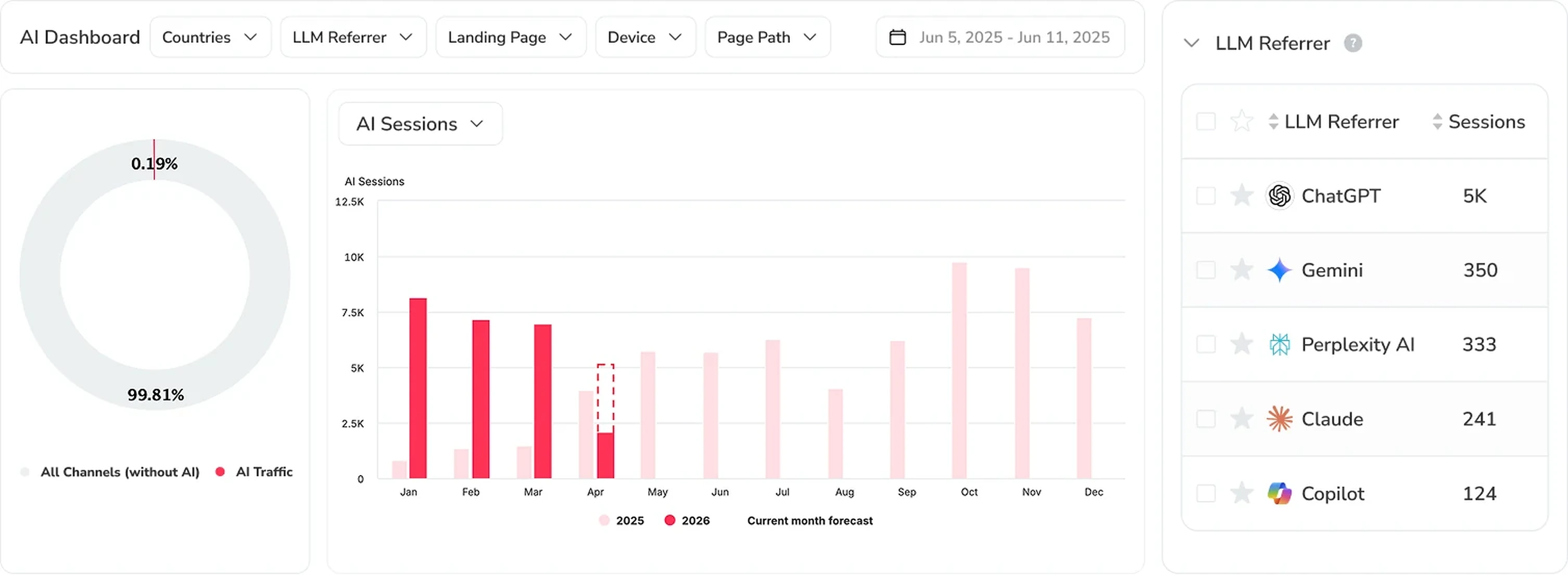
AI Traffic Tracker
Discover how much traffic AI models like ChatGPT, Claude and Perplexity drive to your site.

ChatGPT Prompt Tracking
Track how ChatGPT mentions, ranks and recommends your brand.

Claude Prompt Tracking
Track how Claude mentions, ranks and recommends your brand.

Gemini Prompt Tracking
Track how Gemini mentions, ranks and recommends your brand.

Perplexity Prompt Tracking
Track how Perplexity mentions, ranks and recommends your brand.

Copilot Prompt Tracking
Track how Microsoft Copilot mentions, ranks and recommends your brand.