AI Traffic vs. Google Organic in 2026: A Study of 16,000+ Websites
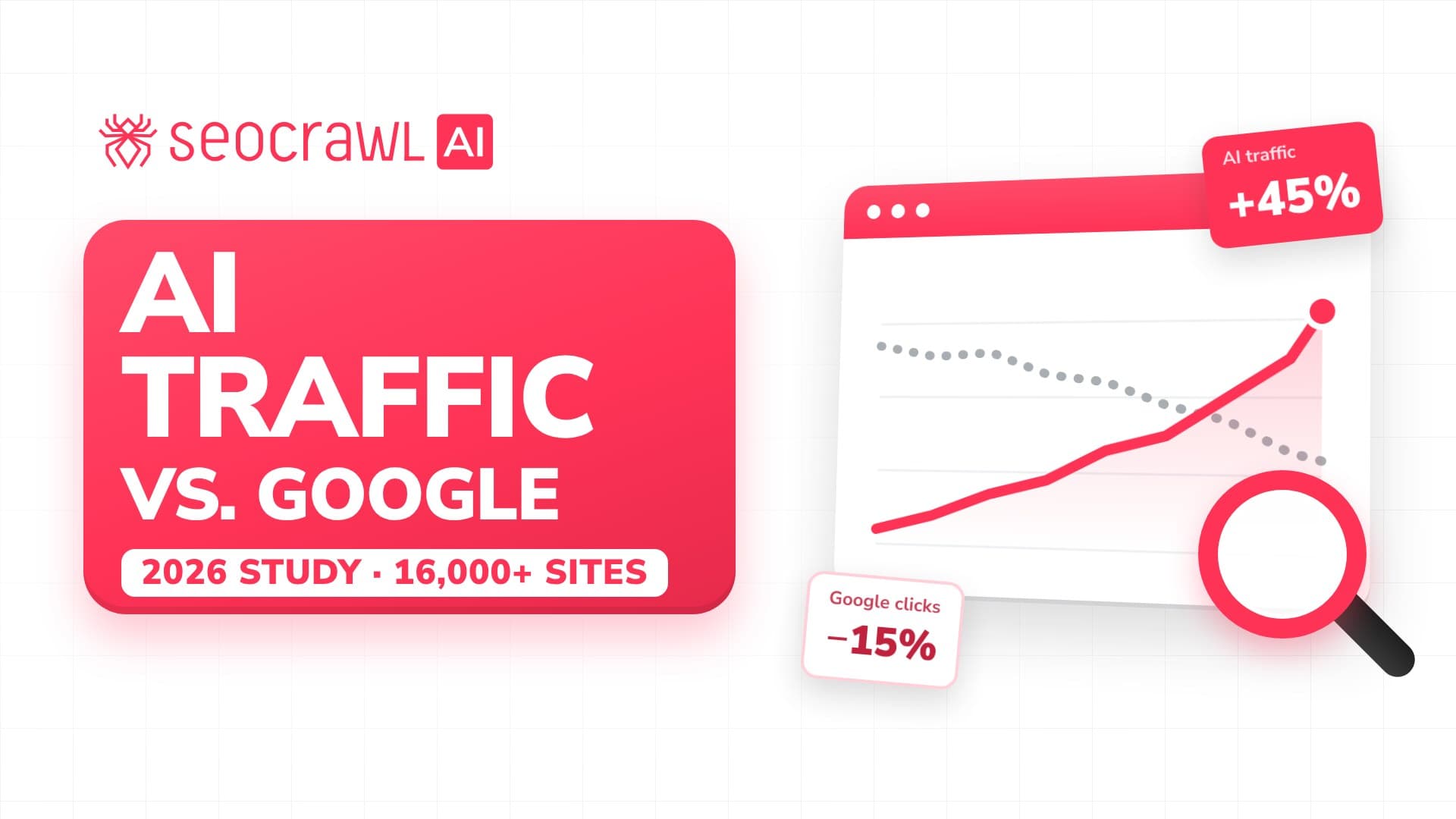
AI assistants are one of the fastest-growing sources of website traffic, but they are not replacing Google yet. To put real numbers on it, we analysed Google Search Console and Google Analytics 4 data from more than 16,000 websites connected to SEOcrawl AI, measuring traditional search and the generative channel side by side over the last two years.
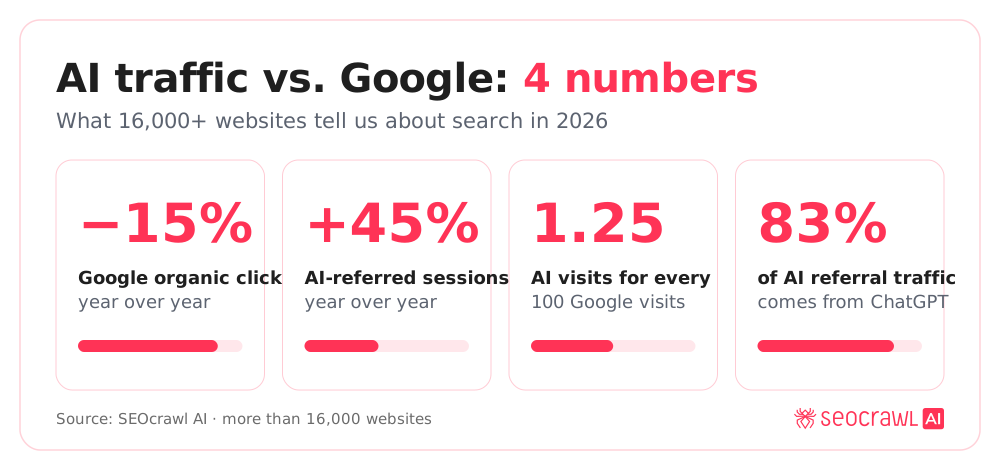
The short version: AI referral traffic grew about 45% in a year, yet it still equals just over 1 visit for every 100 that Google organic search sends — while Google itself sent 15% fewer clicks.
Google organic clicks fell 15% in a year
Across a fixed group of 16,661 websites with Search Console data in every month since May 2024, Google organic clicks fell from 3.72 billion (September 2024–August 2025) to 3.16 billion (September 2025–August 2026). That is 559 million fewer clicks: −15.0%.
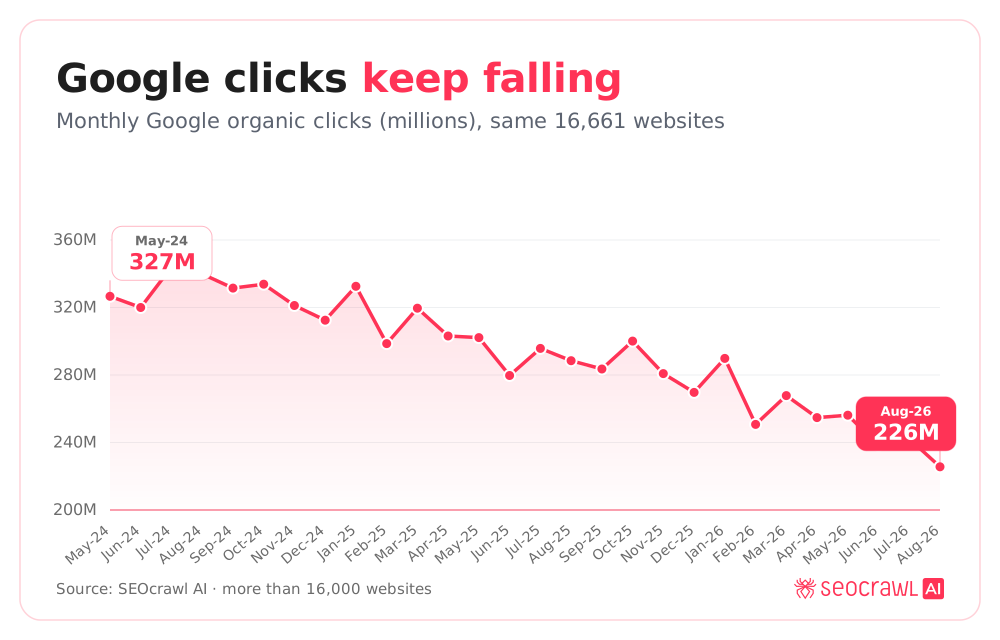
The typical website did worse than the total suggests. The aggregate is held up by the largest sites — the top 1% of sites produce about 70% of all clicks — so the median site lost 20.1% of its Google clicks, and 69% of sites received fewer clicks than a year earlier.
The decline is accelerating
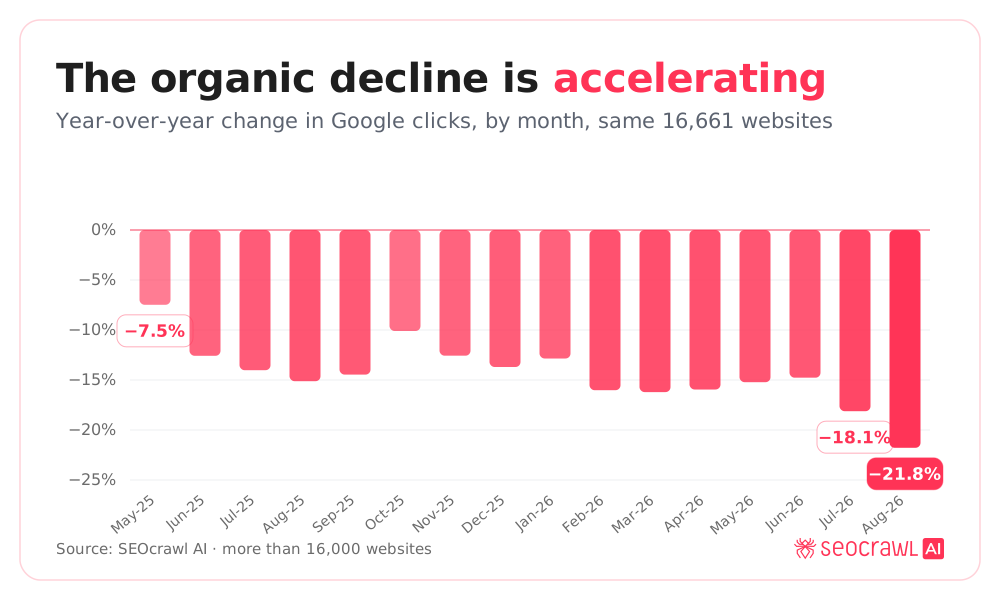
Every month since May 2025 has been below the same month of the previous year, and the gap keeps widening. The year-over-year drop went from −7.5% in May 2025 to between −10% and −16% through the winter, then to −18.1% in July and −21.8% in August 2026, the steepest monthly drop in the series.
Demand is not what disappeared. Total impressions across the cohort were flat year over year (+0.4%) while clicks fell 15%: sites are still being shown, they are being clicked less. That pattern fits a world where more searches are answered on the results page itself, in AI Overviews, AI Mode and other rich results.
AI traffic is up 45% — from a very small base
On the AI side, we measured GA4 sessions whose source is an AI assistant (ChatGPT, Gemini, Perplexity, Claude, Copilot, DeepSeek and others) across 3,949 websites with Analytics connected.
- AI-referred sessions grew 44.6% year over year (March–August 2026 vs March–August 2025). In the strict cohort of 3,099 sites with complete history, growth was 41.1%: from 2.13 million to 3.00 million sessions.
- AI's share of all website sessions rose from 0.23% to 0.36%, reaching 0.42% in August 2026.
- AI grew at 57.6% of sites. Four in ten saw flat or falling AI referrals.
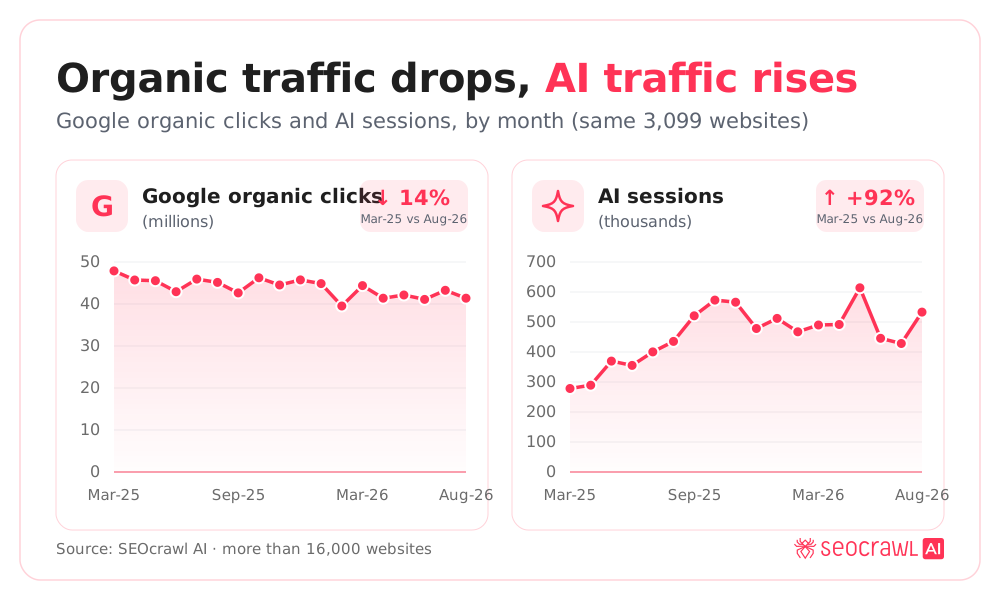
The growth is real. The scale is not there yet. For every 100 sessions from Google organic search, AI assistants now send 1.25, up from 0.70 a year earlier. In August 2026, the latest month measured, the ratio reached 1.52.
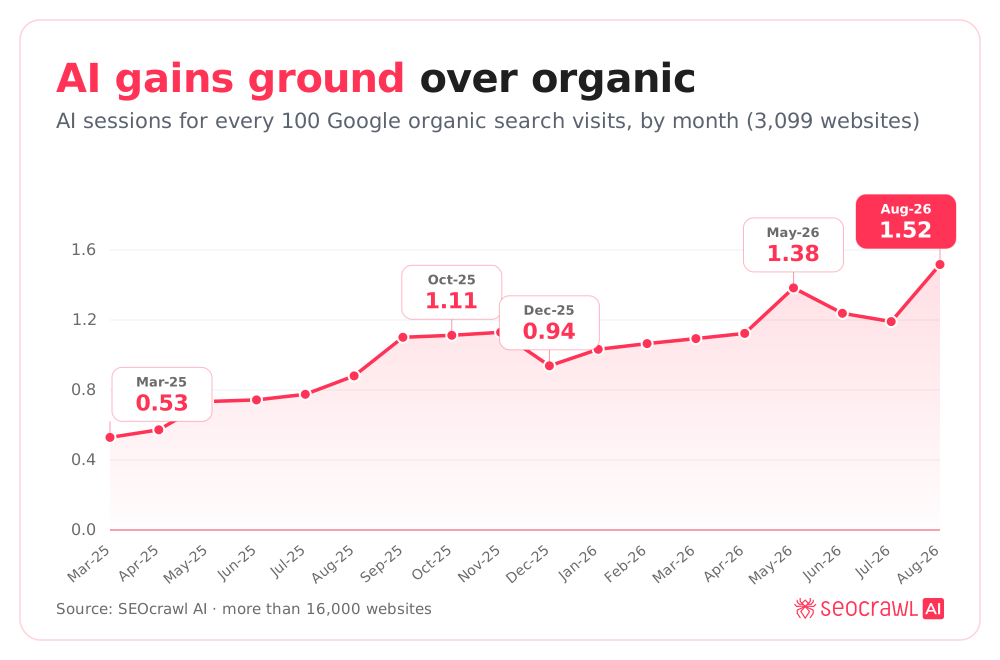
The trend holds however you measure it. Among large sites only (1,193 sites with 1,000+ Google clicks a month) the ratio went from 0.68 to 1.21, and measured against Search Console clicks instead of GA4 sessions it went from 0.78 to 1.18. Either way, AI roughly doubled relative to Google within 18 months — and remains close to one visit per hundred.
Put together, the uncomfortable conclusion is that what websites are losing in traditional search is not being recovered through AI, not at today's volumes. Google organic still sends around 80 times more visits than all AI assistants combined.
The real AI numbers are higher than any study can measure
There is an important caveat, and it cuts in AI's favour: a large part of AI-driven traffic is never recorded as AI.
- App traffic without a referrer. Visits from the ChatGPT apps often lose their referral information, so GA4 counts them as direct traffic.
- Google's own AI answers look like organic. Clicks from AI Overviews and AI Mode are reported in Search Console as ordinary organic clicks, with no way to separate them.
- Answers without clicks. Much of AI's influence never becomes a visit: people read a recommendation and later search for the brand or type the URL.
That makes 1.25 per 100 the measurable part of the channel, not its true weight.
"The easy headline would be that AI is already eating traffic, and that is not true yet. But keep in mind we are only seeing the tip of the iceberg: part of AI traffic is not even logged as such. What matters is the speed, and at this rate preparing for AI search stops being optional." — David Kaufmann, CEO and co-founder of SEOcrawl AI
ChatGPT sends 83% of AI referral traffic
Within AI traffic the market is far more concentrated than search ever was. Between March and August 2026, ChatGPT accounted for 83.3% of AI-referred sessions, ahead of Gemini (6.0%), Perplexity (4.7%), Claude (3.7%) and Copilot (2.1%). In August 2026 alone, ChatGPT's share reached 91%.
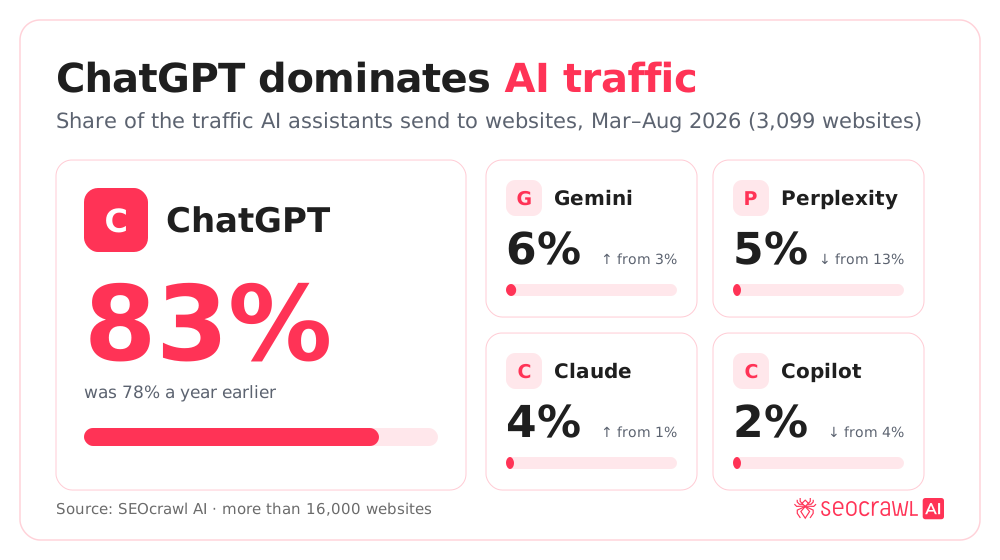
The mix is moving fast. Claude referrals grew 6.6-fold and Gemini almost tripled, while Perplexity's referrals fell by half and its share dropped from 13.1% to 4.7%.
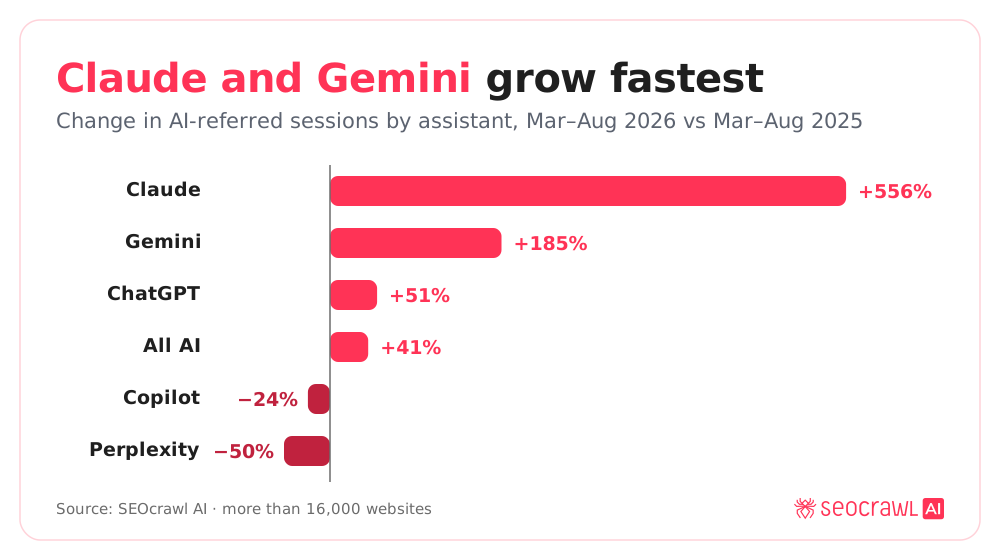
For a brand, that means visibility in the AI channel is decided today largely inside a single product — but not one that stands still.
Industry by industry: who is losing Google, who is winning AI
The averages hide very different stories. We classified the 6,700 largest websites in the sample, which account for 99% of all clicks, into industries, and compared the median website in each one, so a single large site cannot skew the result.
Google clicks: jobs, SaaS and education are hit hardest
Every industry lost Google clicks, but not equally. The median jobs and recruitment site lost 38% of its Google clicks year over year, and 86% of those sites declined. SaaS & tech lost 24%, and education, local & professional services and finance about 20%. At the other end, gaming, gambling and sports lost 4–8%.
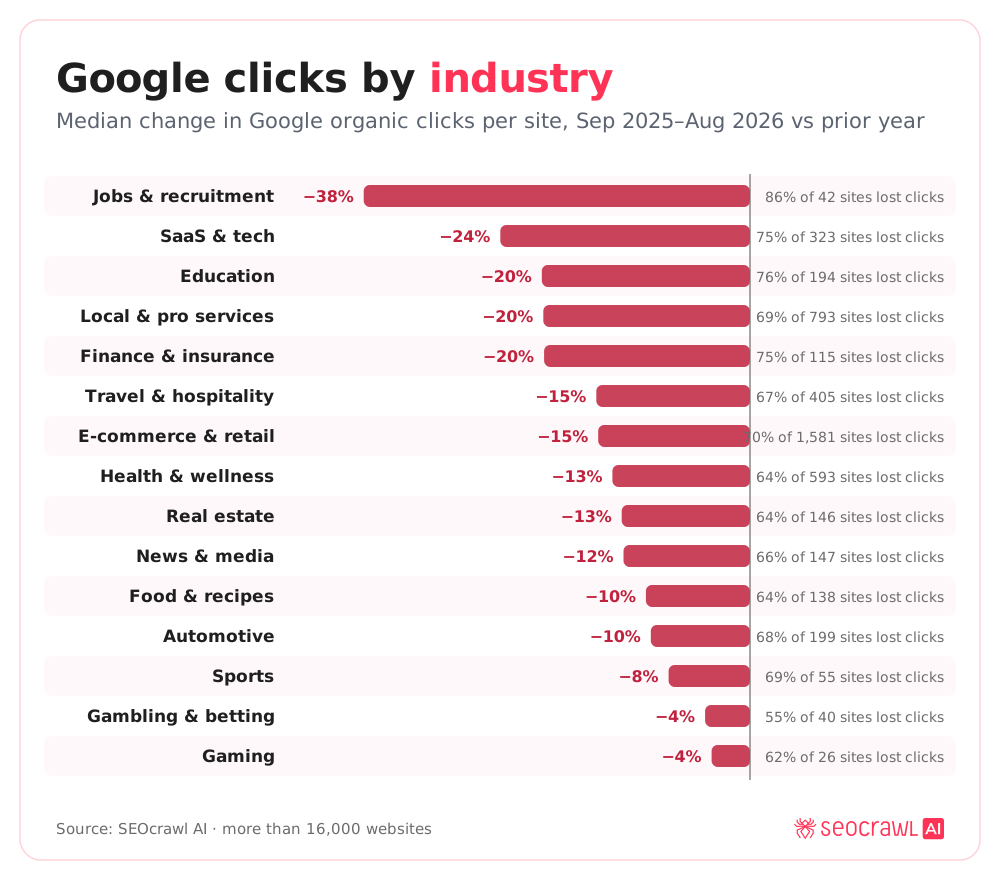
The pattern fits what AI answers do best. Industries built on informational queries, such as "how to", definitions, comparisons and career questions, are the ones where Google and AI assistants now answer directly. Industries where people want to play, bet, follow a live match or buy something keep more of their clicks.
AI traffic: education, SaaS and travel get the most
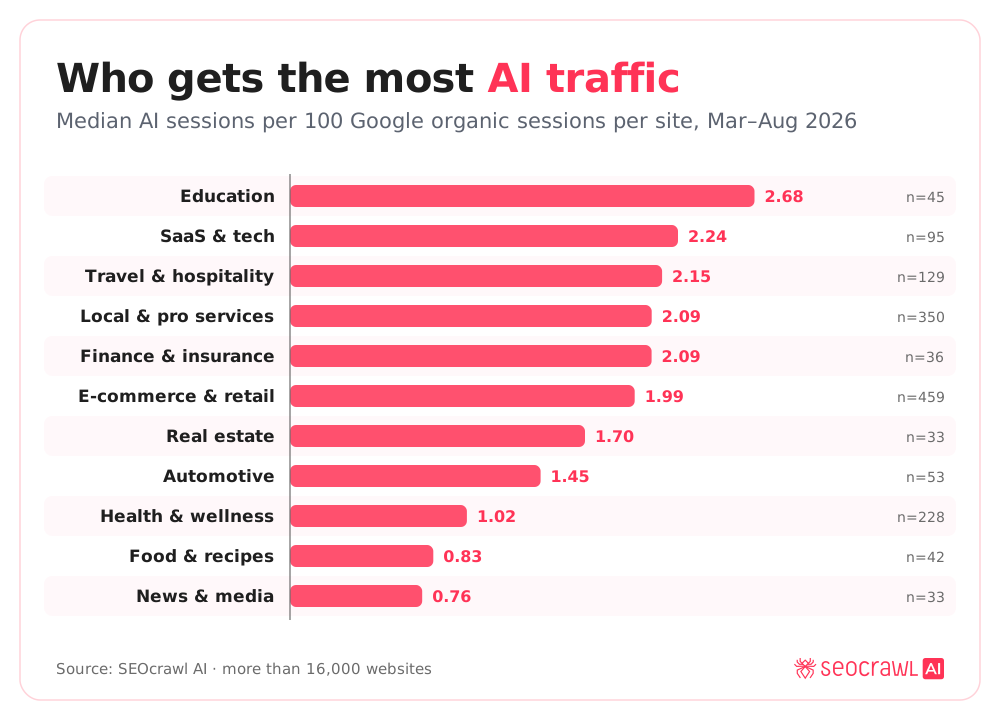
Relative to their Google traffic, education sites get the most AI visits: 2.68 for every 100 Google organic visits at the median site, against 1.71 across all sites. SaaS & tech (2.24), travel (2.15), local services and finance (2.09) and e-commerce (1.99) follow. News & media (0.76), food (0.83) and health (1.02) get the least.
AI growth: travel and shopping lead
Where AI traffic is growing is a different list. The median travel site more than doubled its AI referrals (+120%), and e-commerce (+54%), real estate (+52%), food (+50%) and automotive (+42%) follow. In those industries between two-thirds and three-quarters of sites grew their AI traffic.
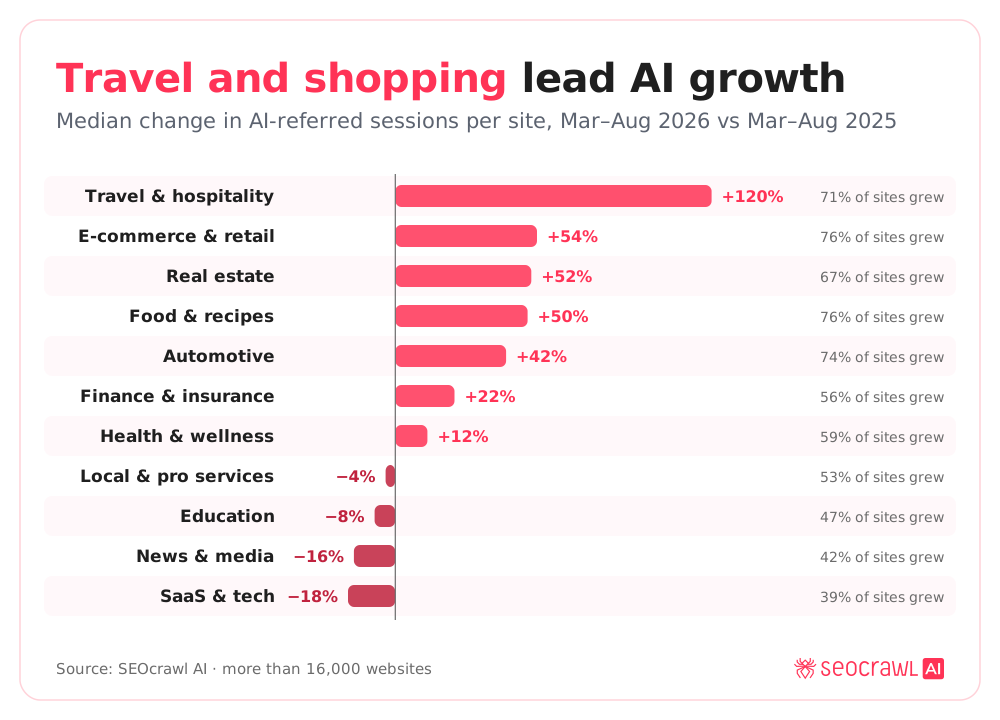
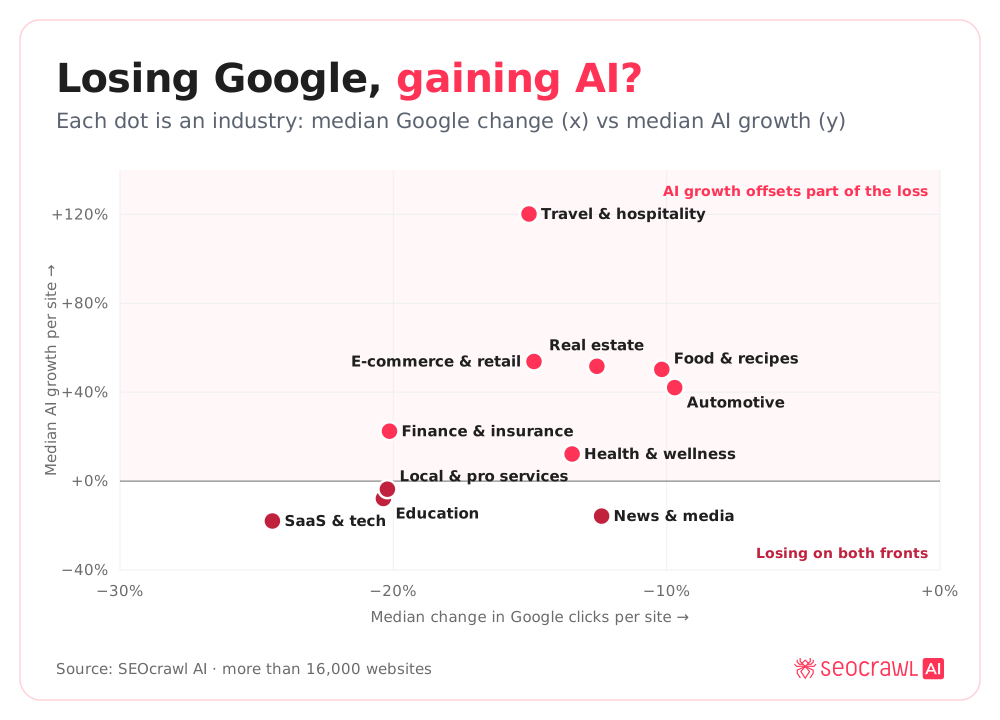
SaaS & tech, education and news move the other way: AI referrals fell at the median site, and fewer than half of those sites grew. They already get a lot of AI traffic, but assistants increasingly answer their questions without sending the visit. Transactional industries — booking a trip, buying a product, finding a home or a car — still need the click.
Each industry has its own AI mix
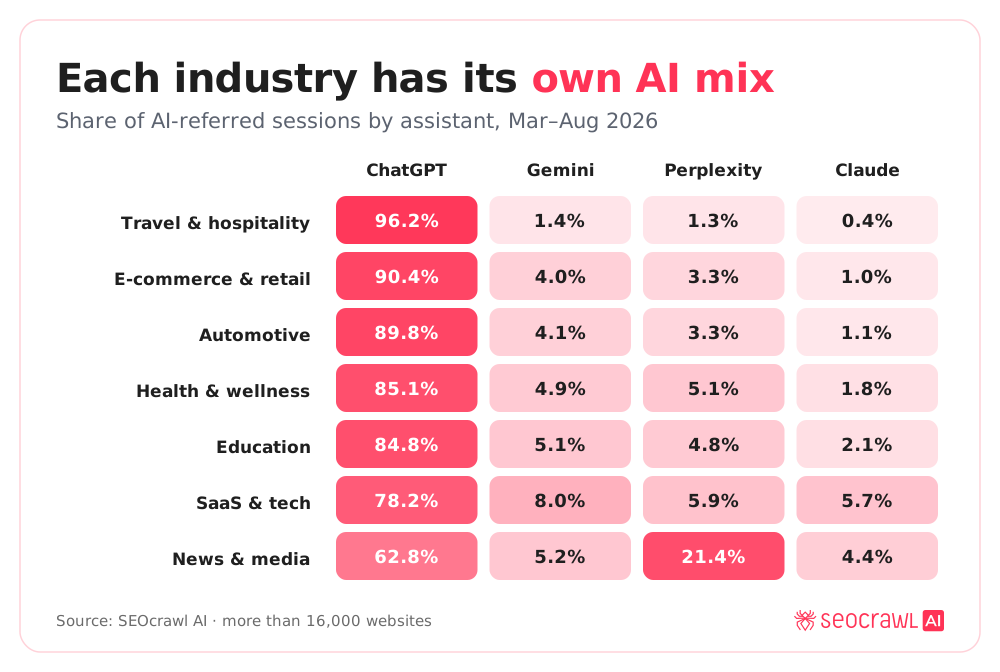
ChatGPT leads everywhere, but how much it dominates varies. In travel it sends 96% of AI referrals. In news & media, Perplexity sends 21%, far above its 5% average, which fits its focus on cited, up-to-date sources. SaaS & tech is the most diverse industry: Gemini sends 8% and Claude 5.7%, more than five times its share in e-commerce and 14 times its share in travel.
Mid-size websites are hit hardest
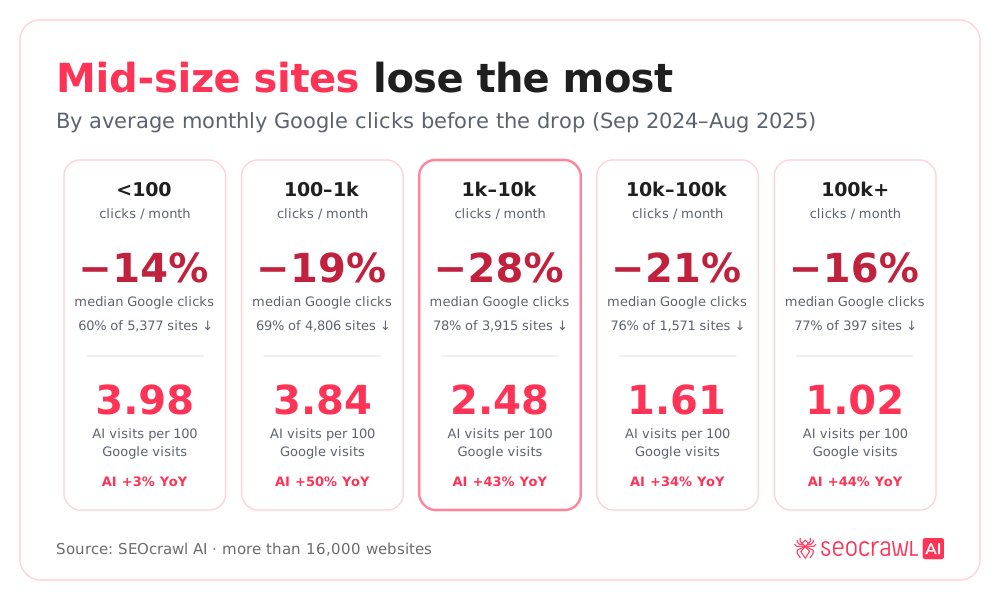
Size matters too. Grouping sites by their Google traffic before the drop, mid-size sites with 1,000–10,000 clicks a month lost the most: −28% at the median, with 78% of them declining. The smallest sites (−14%) and the largest (−16%) held up better.
Smaller sites are also more exposed to AI: sites with under 1,000 Google clicks a month get around 4 AI visits per 100 Google visits, four times the ratio of the largest sites (1.02). For a small brand, AI assistants are already a noticeable source of visitors.
What this means for SEO and marketing teams
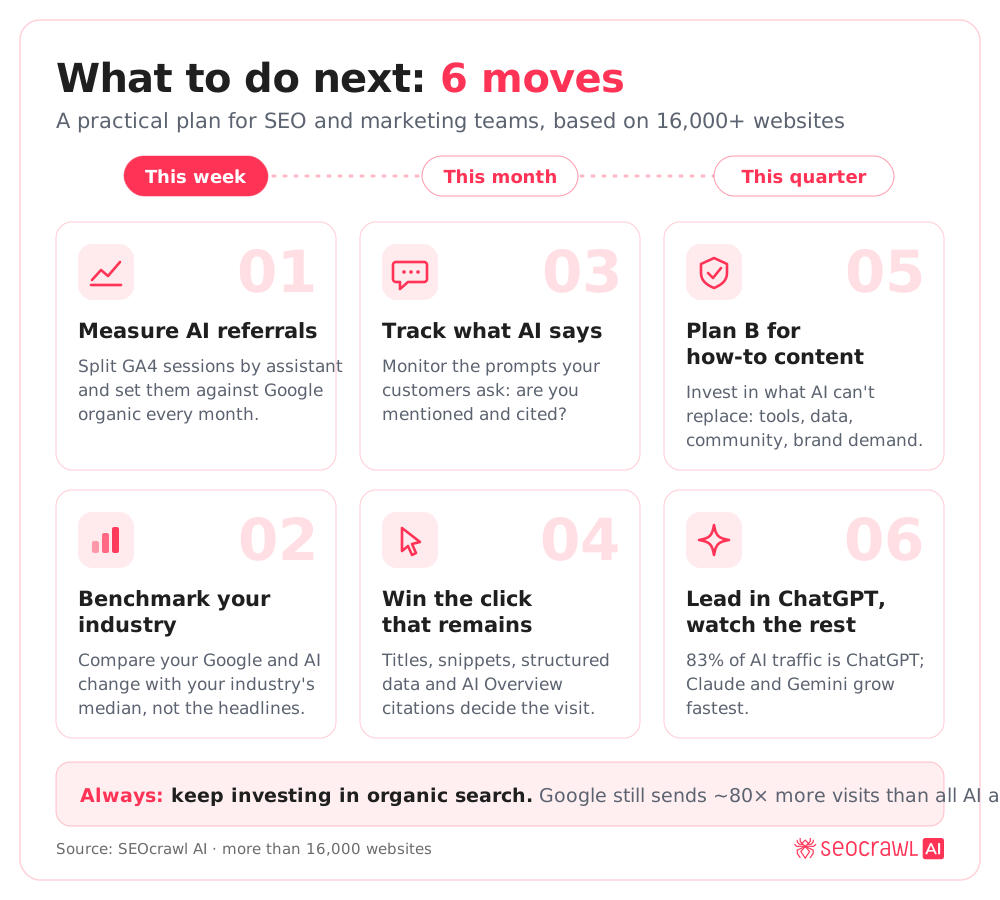
The six moves in detail:
- Don't abandon organic search. It still carries the overwhelming majority of visits. A 15–20% loss of clicks is a reason to defend and diversify, not to switch channels.
- Measure AI referrals separately, by assistant, and set them against Google organic every month. You can't see a curve bending without a baseline. SEOcrawl AI's AI Tracker does this automatically from your GA4 data.
- Track what AI says about your brand, not just the clicks. Prompt Tracking monitors whether ChatGPT, Gemini, Perplexity, Claude and Google's AI answers mention and cite you for the questions your customers ask.
- Win the click that remains. With impressions steady and clicks falling, titles, snippets, structured data and being cited inside AI Overviews decide who still gets the visit.
- Benchmark against your industry, not the headlines. A travel site losing 15% of Google clicks is at the median; a SaaS site losing 15% is doing better than most. Compare your own site with your industry's numbers above.
- Informational content needs a plan B. If your traffic depends on how-to and definition queries (SaaS, education, jobs, news), assume fewer clicks from both Google and AI, and invest in what assistants can't replace: tools, data, community and brand demand.
The mistake would be to wait until the AI channel is big before working on it: by then, the positions will already be taken.
Methodology
- Sample: aggregated, anonymised data from websites connected to SEOcrawl AI whose owners have authorised the aggregated, anonymous analysis of their data. No individual site is identified, and no figure is based on fewer than ten sites.
- Google organic: Google Search Console clicks and impressions at property level, all countries and devices, May 2024–August 2026. Comparison: September 2025–August 2026 vs September 2024–August 2025.
- AI traffic: GA4 sessions whose source is an AI assistant domain (chatgpt.com, chat.openai.com, gemini.google.com, perplexity.ai, claude.ai, copilot.microsoft.com, chat.deepseek.com, plus Mistral, Grok, Poe, Meta AI and You.com as "other"), paid media excluded, March 2025–August 2026. Comparison: March–August 2026 vs March–August 2025. AI is compared with GA4 sessions from google / organic for a like-for-like ratio.
- Fixed cohorts: to avoid distortion from sites joining or leaving, trends use fixed groups of sites with data in every month: 16,661 sites for Google; 3,949 sites with GA4 for AI, of which 3,099 have complete monthly data (strict cohort); 1,193 large sites as a robustness check.
- Industries: the 6,728 largest websites in the sample (99% of all Google clicks; sites with 1,000+ Google clicks a month, plus sites with GA4 and 100+ clicks) were classified into industries from their domain and site name. Industry figures use the median website and are only published for industries with at least 25 websites (40 for Google figures, except gaming with 26). Because the classified group excludes the smallest sites, industry medians are not directly comparable with the all-site median.
- Site size: sites are grouped by their average monthly Google clicks in September 2024–August 2025, before the period measured.
- Clicks, not impressions: in September 2025 Google stopped supporting the parameter that returned 100 results per page, and impressions reported in Search Console fell for technical reasons unrelated to real demand. The organic analysis therefore relies on clicks, which reflect real visits.
All charts in this article can be reused with attribution and a link to this study.
Author: David Kaufmann

I've spent the last 10+ years completely obsessed with SEO — and honestly, I wouldn't have it any other way.
My career hit a new level when I worked as a senior SEO specialist for Chess.com — one of the top 100 most visited websites on the entire internet. Operating at that scale, across millions of pages, dozens of languages, and one of the most competitive SERPs out there, taught me things no course or certification ever could. That experience changed my perspective on what great SEO really looks like — and it became the foundation for everything I've built since.
From that experience, I founded SEO Alive — an agency for brands that are serious about organic growth. We're not here to sell dashboards and monthly reports. We're here to build strategies that actually move the needle, combining the best of classical SEO with the exciting new world of Generative Engine Optimization (GEO) — making sure your brand shows up not just in Google's blue links, but inside the AI-generated answers that ChatGPT, Perplexity, and Google AI Overviews are delivering to millions of people every single day.
And because I couldn't find a tool that handled both of those worlds properly, I built one myself — SEOcrawl AI, an enterprise SEO intelligence platform that brings together rankings, technical audits, backlink monitoring, crawl health, and AI brand visibility tracking all in one place. It's the platform I always wished existed.
Discover more content about this author
On-page SEO is everything you control on a page: content, title, meta description, headings, URL, images and internal links. Here is a checklist element by element, an audit process and what changes with AI Overviews and AI Mode.