SEO A/B Testing: How to Test Changes and Trust the Results
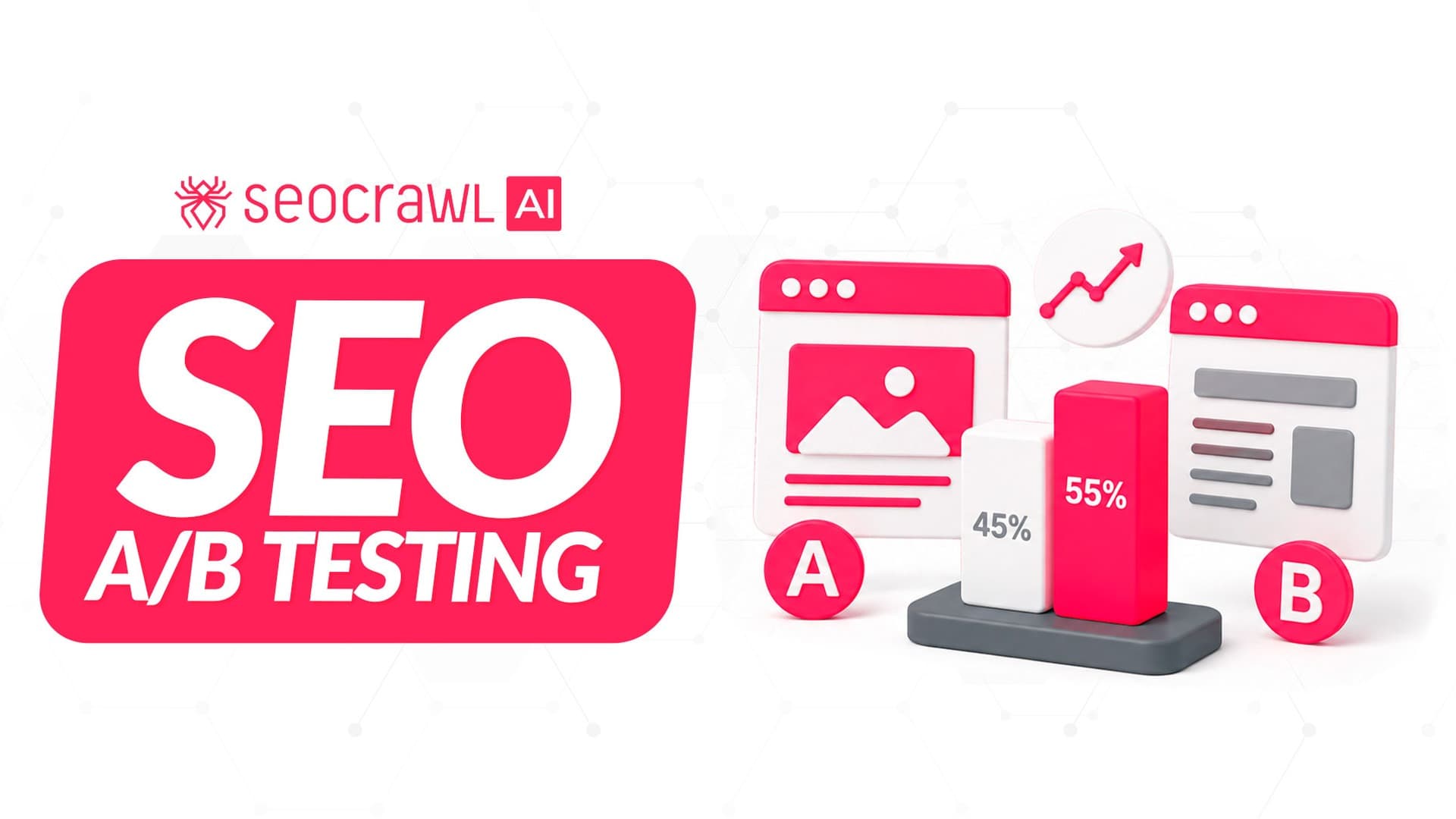
SEO A/B testing (or SEO split testing) is a method for measuring the real impact of an on-page change by splitting similar pages into a control group you leave alone and a variant group you change, then comparing how each group's organic performance trends over the following weeks.
Because both groups live through the same season, competitors, and algorithm updates, those forces cancel out, and the difference left is a fair estimate of what your change actually did. Unlike conversion testing, it splits pages rather than users.
Let's say you rewrite the titles on 400 product pages. Three weeks later, clicks are up 8%. Did the new titles do that? Or did a competitor slip, did seasonal demand rise, or did Google push a quiet update that week?
With a single before/after number, you can't separate your change from everything else that moved at the same time. SEO A/B testing closes that gap.
Why you can't A/B test SEO the way you A/B test CRO
In CRO, you serve two versions of the same page to different users and see which converts better. You can't do that for SEO, because Google indexes one version per URL, and showing search engines one thing while showing users another based on user-agent is a guideline violation.
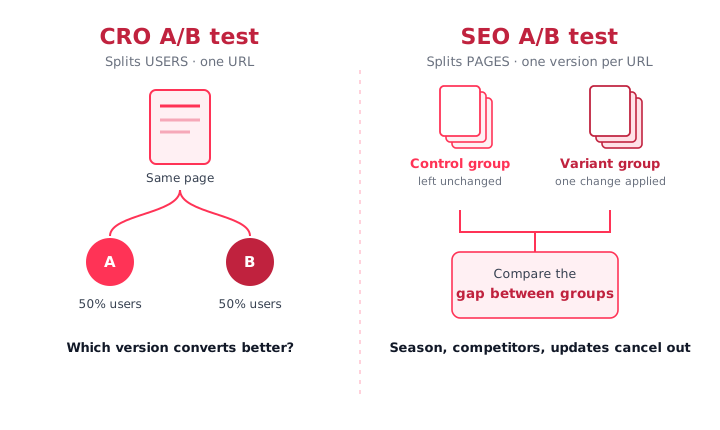
So instead of splitting users on one page, SEO testing splits pages into comparable groups. That's why it needs a set of pages that behave alike (product pages, category pages, location pages, article templates) rather than a single landing page.
How SEO split testing works
The mechanics are simple once the CRO habit is unlearned:
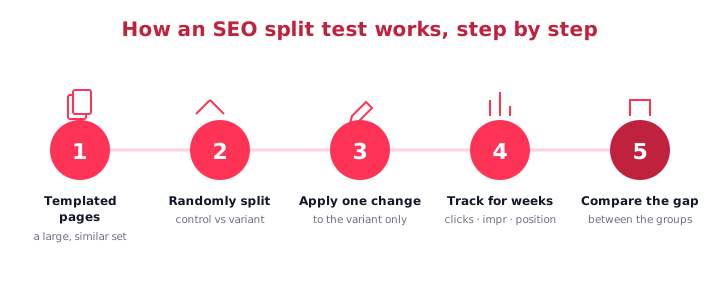
- Take a large set of similar, templated pages.
- Randomly assign them to a control group and a variant group.
- Apply one change to every page in the variant group.
- Track organic clicks, impressions, and positions for both groups over several weeks.
- Compare the difference between the groups, not the raw before/after of the variant alone.
Because both groups live through the same season, the same competitors, and the same algorithm updates, those forces cancel out, and the remaining gap is attributable to your change.
How to run and measure SEO experiments
Pick a good candidate
You need a group of pages similar enough to behave the same way. Templated pages are ideal. If your site has only a handful of unique pages, classic split testing won't work — there's a realistic alternative further down.
Write a falsifiable hypothesis around one variable
Don't work just on "improving titles," but something you can prove wrong: "Adding the primary keyword to the H1 on category pages will increase organic clicks." If you edit titles, internal links, and schema at once, a positive result won't tell you which change did the work.
Size the groups
Practitioners running these tests, including SearchPilot and the r/bigseo community, suggest on the order of a few hundred pages per group so the result rises above noise. This is a rule of thumb from the field, not a Google requirement.
Fewer pages means a noisier, less trustworthy result.
Run it long enough
Google's own guidance is to run a test only as long as needed and then remove the test elements, and warns that the time for a reliable test varies with your traffic and conversion rates. In practice, that means weeks, not hours, and long enough to cover full weekly cycles and Google's indexing lag.
Read results and check statistical significance
The result you care about is the gap between the variant group and the control (or the control-based forecast). Statistical significance is what tells you that gap is a real effect and not random week-to-week variance. A 6% lift that could just as easily be noise is not a win.
Don't declare a winner on day three, and don't stop the moment the line looks good ("peeking" inflates false positives). Wait until the test reaches significance or your predefined end date.
What to test, with SEO A/B testing examples
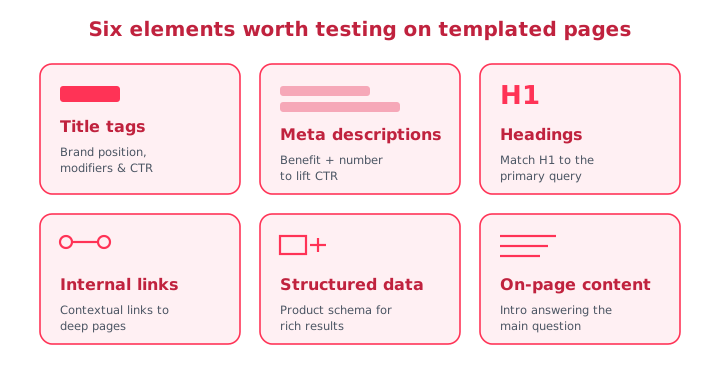
Test elements where a small change can plausibly shift how Google ranks or how users click. Concrete hypotheses:
- Title tags: "Moving the brand name to the end of the title will raise CTR on blog pages."
- Meta descriptions: "Adding a benefit + number to the meta will raise CTR on product pages."
- H1s and headings: "Matching the H1 to the primary query will lift clicks on category pages."
- Internal links: "Adding 3 contextual internal links to deep pages will raise their impressions."
- Structured data: "Adding Product schema will win rich results and increase CTR."
- On-page content: "Adding a 120-word intro answering the main question will improve position."
A worked example of SEO split testing (illustrative)
These numbers are not a real case study, just an example.
An e-commerce site has 1,200 near-identical category pages.
Hypothesis: appending "Free Shipping Over $50" to the title tag will raise CTR.
- Split: 600 pages control, 600 variant, assigned randomly.
- Change: applied only to the 600 variant titles.
- Duration: 6 weeks.
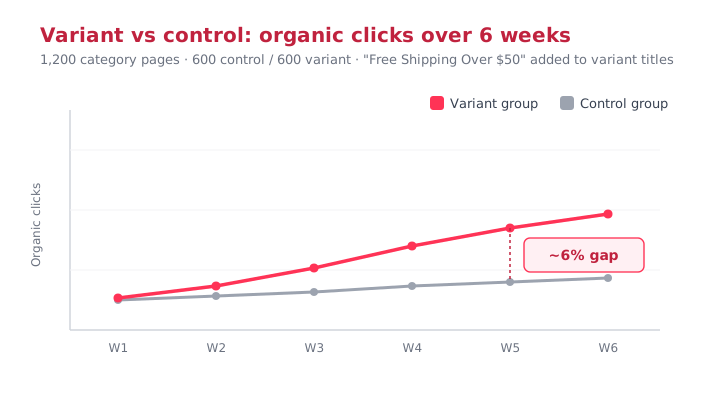
By week 5, the variant group's clicks are trending about 6% above the control group, and the difference clears the significance threshold.
The control group rose slightly too (seasonal). This shows the raw variant number overstated the effect, and the control corrected it.
Decision: roll the title change out sitewide.
Had you looked only at the variants' before/after, you'd have credited your change with the seasonal lift as well.
Can you A/B test SEO on a small site?
Classic split testing needs page volume most sites don't have. If you run a blog or a small business site, you won't get a clean control and variant group of hundreds of pages.
The realistic alternative is time-based before/after testing on a single page or a small set:
- Establish a clean baseline in Google Search Console (several weeks of stable data).
- Ship one change and record the exact date.
- Compare like-for-like periods, ideally year-over-year, to blunt seasonality.
- Treat the result as directional evidence, not statistical proof.
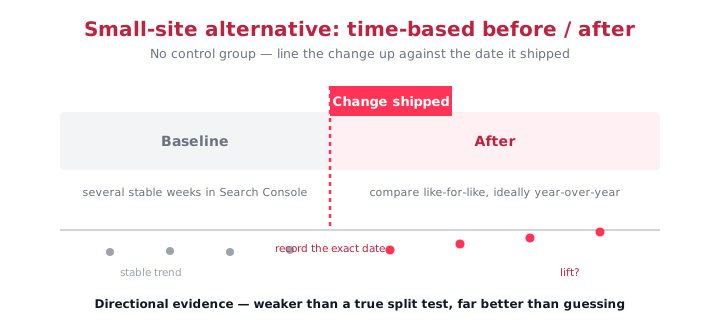
It's weaker than a true controlled test, but far better than eyeballing a dashboard and guessing. The critical requirement is knowing precisely when the change went live so you can line it up against the data, which is where annotations come in.
SEO A/B testing best practices
- Seasonality: a holiday spike can masquerade as a win. A control group or year-over-year comparison neutralizes it.
- Algorithm updates mid-test: a core update can swamp your signal entirely. Track update dates and check whether one landed inside your test window.
- Samples too small: a handful of pages produces noise, not evidence.
- Too many variants, or running too long: Google advises removing test elements once you conclude; keep it A vs B, not A through Z.
- Cloaking: never serve Googlebot a different variant than users. Use a 302 (temporary) redirect, not a 301, and add
rel="canonical"to variant URLs pointing back to the original. A 302 tells search engines the redirect is temporary and to keep the original URL indexed;rel="canonical"groups the variants under the original. - Calling winners early: significance first, celebration second.
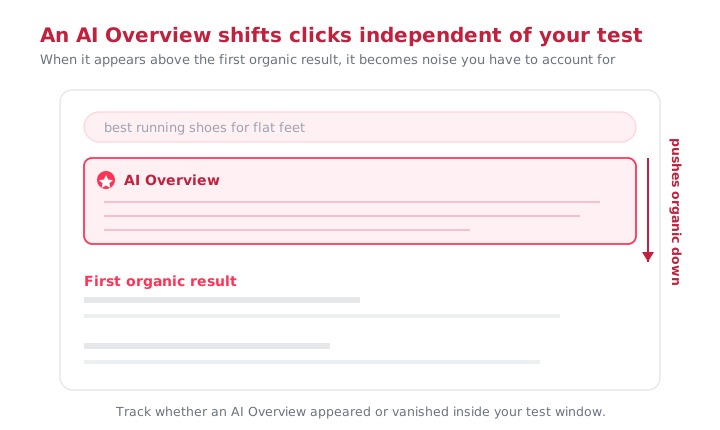
- Ignoring AI Overviews: an AI Overview appearing or disappearing over your test window shifts clicks independent of your change. For many keywords, the AI Overview sits above the first organic result, so it's now part of the noise you have to account for.
SEO A/B testing tools
- SearchPilot: server-side split testing built for large, templated sites; the recognized category authority.
- seoClarity: split-testing modules with crawler-behavior insight.
- Statsig: analytics and experiment design, including page-level SEO tests.
- VWO and other CRO tools: user-side testing; useful for conversion, not for measuring organic ranking impact.
How to measure SEO test impact in SEOcrawl AI
Reading the organic impact against real Search Console data is a separate job from SEO experimentation. SEOcrawl AI takes care of all the steps: filtering GSC to the right pages, marking when a change shipped, and separating your result from an algorithm update.
- Build a tag for each group and assign it manually, by auto-rules, or through the SEOcrawl AI MCP server from Claude or ChatGPT, then filter Search Console by group. The same tags feed the top-pages and winners/losers views, so you can compare the two groups' trends directly.
- SEOcrawl AI Annotations generate a before/after report for the exact URLs and keywords you define, and the report updates automatically at the 7-, 14-, and 30-day marks, emailed to whoever you assign. That's the small-site before/after workflow, automated.
- Google Core Updates are detected and annotated automatically, so you can see at a glance whether an update overlapped your test window and interpret the result accordingly.
- The winners/losers view surfaces the biggest changes between two periods with the deltas pre-computed, so you're comparing groups instead of exporting spreadsheets.
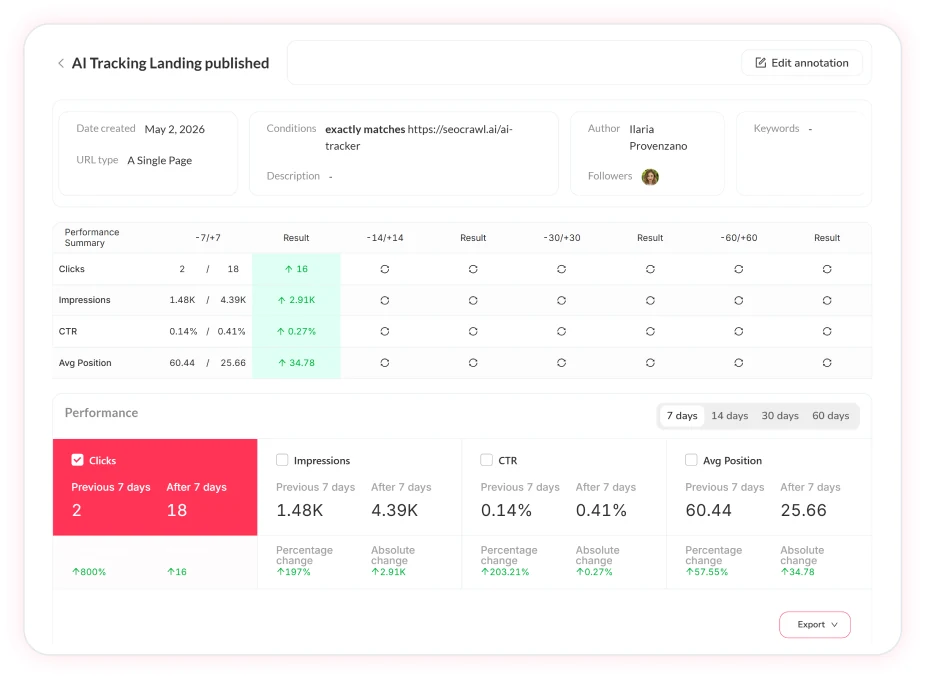
Because the data comes straight from GSC with unlimited retention, you can also compare full years to control for seasonality, which matters most on the smaller sites that can't run a true split test.
Measure the impact, don't guess it. SEOcrawl AI filters Search Console to each group, annotates when your change shipped, and flags any core update that overlaps your test window — so the gap you read is your change, not the noise. Try SEOcrawl AI or explore the SEO Dashboard.
FAQs
What is SEO A/B testing?
SEO A/B testing measures the impact of an on-page change by splitting similar pages into a control group and a variant group, changing only the variant, and comparing organic performance over several weeks. Unlike conversion testing, it randomizes by page instead of by user, which lets you isolate a change's effect from seasonality, competitors, and algorithm updates.
How is SEO A/B testing different from CRO A/B testing?
CRO testing splits users across two versions of the same page to compare conversion rates. SEO testing splits pages into control and variant groups, because Google indexes one version per URL.
CRO optimizes for on-page behavior; SEO testing optimizes for organic clicks and rankings.
How long should an SEO A/B test run?
Google advises running a test only as long as needed to reach a reliable conclusion, which depends on your traffic. In practice, plan for several weeks so the test covers full weekly cycles and Google's indexing lag, and stop when the difference between groups reaches statistical significance or your predefined end date.
Can A/B testing hurt your SEO?
Not if you follow Google's testing guidelines. Don't cloak: Googlebot and users must see the same content. Use 302 (temporary) redirects rather than 301 for variant URLs, and add rel="canonical" on variants pointing to the original so signals stay consolidated. Remove all test elements once the test concludes.
How many pages do you need for an SEO A/B test?
Practitioners running these tests commonly suggest at least a few hundred pages per group, which is why templated sites (e-commerce, listings, large blogs) are the natural fit.
Smaller sites can't reach that volume and should use time-based before/after measurement on individual pages instead.
Can you A/B test SEO without a testing platform?
Yes, with a before/after approach. Set a baseline in Search Console, ship one change, record the date, and compare like-for-like periods (ideally year-over-year to control seasonality).
It's directional rather than statistically bulletproof, but reliable enough to guide decisions when you record exactly when the change went live, for example with SEOcrawl AI annotations.
Author: David Kaufmann

I've spent the last 10+ years completely obsessed with SEO — and honestly, I wouldn't have it any other way.
My career hit a new level when I worked as a senior SEO specialist for Chess.com — one of the top 100 most visited websites on the entire internet. Operating at that scale, across millions of pages, dozens of languages, and one of the most competitive SERPs out there, taught me things no course or certification ever could. That experience changed my perspective on what great SEO really looks like — and it became the foundation for everything I've built since.
From that experience, I founded SEO Alive — an agency for brands that are serious about organic growth. We're not here to sell dashboards and monthly reports. We're here to build strategies that actually move the needle, combining the best of classical SEO with the exciting new world of Generative Engine Optimization (GEO) — making sure your brand shows up not just in Google's blue links, but inside the AI-generated answers that ChatGPT, Perplexity, and Google AI Overviews are delivering to millions of people every single day.
And because I couldn't find a tool that handled both of those worlds properly, I built one myself — SEOcrawl AI, an enterprise SEO intelligence platform that brings together rankings, technical audits, backlink monitoring, crawl health, and AI brand visibility tracking all in one place. It's the platform I always wished existed.
Discover more content about this author
CTR tells you how many of the people who saw your result actually clicked. Here's the formula, what a good CTR looks like in 2026 by channel and by Google position, and how to get more clicks from the rankings you already have.