Complete SEO Guide for Your Shopify Ecommerce
One of the debates you often hear in the digital world, and especially in the online store space, is whether it is advisable to use Shopify when launching an ecommerce, since it has many fans and an equally large number of detractors due to the SEO issues it brings with it.
Throughout this article, we want to share with you what Shopify is and the best SEO strategies for this content manager. Want to know more? Then stay with us!
What is Shopify?
Specifically, Shopify is a CMS or control panel specialized in the creation and management of eCommerce platforms for businesses that want to offer their products and solutions to their customers in a direct, simple, and up-to-date manner.
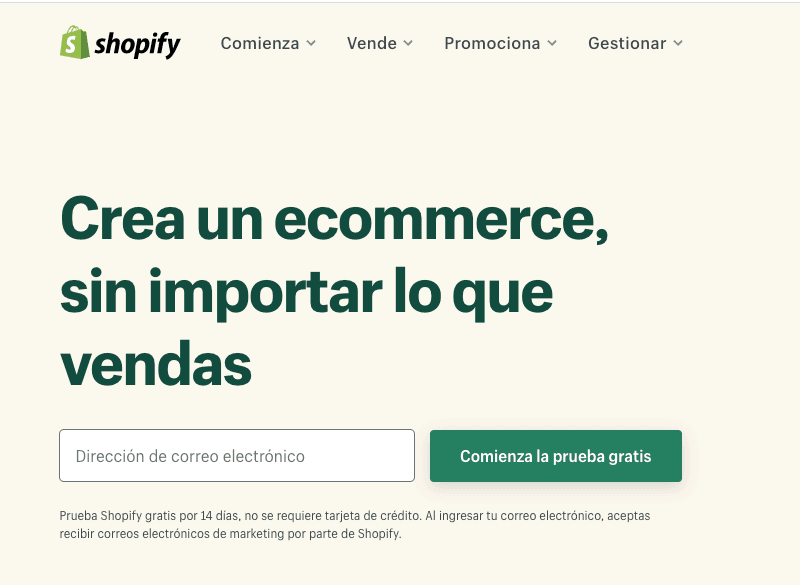
Among its greatest advantages, Shopify stands out for offering the possibility of designing and creating the business's online store quickly and without advanced web programming knowledge, through templates and a construction interface that lets you add elements and have the store up and running in just a few minutes without much trouble. Interesting, right?
In fact, it is as simple as going to the official Shopify website, signing up, picking one of the more than a hundred templates focused on different industries like technology, clothing and footwear, or food, and then choosing the pricing plan that fits your needs, ranging from the simplest one (ideal for small businesses and entrepreneurs) to the most complete package designed for large enterprises.
Growth has become exponential in recent years, going from a handful of employees to thousands of them and incorporating new high-value features such as Shopify Pay and the marketplace that each business can have, called Shop.
Why is Shopify usage growing so much?
Since 2009, Shopify had been experiencing sustained sequential growth thanks to the benefits it offers, but from 2017 onward the platform went from growing linearly to growing exponentially, doubling and tripling its usage share compared to previous periods, year over year.
There are several reasons why Shopify has grown so much in recent times, which have to do with the strategies applied and the ease of use of the platform along with its advantages and features.
General advantages of Shopify
Obviously, Shopify's growth is hand in hand with its advantages as a software service, which are broad. Among the most notable, the platform offers the option to create and customize an online store, with hundreds of templates specialized in the business type. In minutes, you can create the store, customize it, and integrate a blog to publish articles of interest and valuable information for your audience.
Shopify includes quality hosting in the purchase plan, so the customer does not have to worry about contracting external hosting for the store. Starting from the Advanced plan, companies can monitor the statistics generated by their customers and buyers in the store, so marketing strategies can be steered with greater impact and a clear goal.
As a Shopify flagship feature, customer service is top quality, with full assistance through every possible channel such as email, chat, and forums, as well as resource and support platforms like Shopify Academy.
Additionally, with Shopify and its integrated payment service Shopify Pay, online store customers can pay directly for their purchases, accepting up to 70 currencies from around the world and charging a percentage per payment, without having to worry about tax calculation since the platform automatically breaks them down according to each country.
Finally, Shopify-based online stores are able to handle services and orders instantly, an attribute valued by users when purchasing items online.
What type of websites use Shopify?
Although Shopify is a CMS or website content manager, its focus, as has probably become clear, is on creating online and ecommerce stores where items, products, solutions, and services are sold.

SEO optimization in Shopify
Now that we have made clear the rise of this CMS and some of its main advantages, when we talk about SEO we undoubtedly run into one of the platform's weak points. Within its great variety, mainly because of some limitations that come imposed by default, Shopify today presents itself as a platform with difficulties at the SEO level compared to other CMSs that are more versatile in this regard, such as WordPress.
SEO-related issues with Shopify
Some of the most common issues, and those that can most impact our organic results, are:
Duplicate content
One of the most relevant and frequent drawbacks you have to deal with is duplicate content, when two pages and URLs on a site have similar content, making it difficult for search engines to know which page to index as canonical and splitting the link signal between the two pages.
First of all, Shopify generates duplicate product pages by default by rendering them at two different URL paths, with the canonical in the case of:
-
"path:/products/"
-
and the non-canonical being: "/collections/.*/products/", with the pages of this latter URL carrying the canonical tag pointing to the associated product page.
While this partially solves the duplicate content problem with respect to Google, it simultaneously creates a problem with internal site linking, because Shopify will link to the non-canonical version of product pages and this sends confusing signals to crawlers, since the most frequently linked pages are not the ones you want taken into account for Google rankings. Let's not forget that the canonical is not a directive but a suggestion, and that based on internal signals Google may interpret a different canonical than the one you have marked.
Forced URL structures
This point is directly related to the previous one. When Shopify creates URLs for product pages and sections, it uses folders. That is, every page created on the website is assigned to a URL folder that cannot be modified.
This system means the URL will always include a folder name. Therefore, Shopify will always automatically add the folder names:
-
/pages
-
/products
-
/collections or
-
/blogs in the URL.
This matters for SEO because using this system will always lead to the creation of unnecessarily long URLs, whereas shorter URLs are always recommended for the purpose of optimizing the store for search engines, crawling, and indexing.
Near-identical product pages with different URLs
It's not uncommon to see Shopify stores with product pages that can cause SEO issues, since they display almost the same information and images for an item but the URL changes slightly. This can lead to duplicate content problems, as in the previous topic.
These types of problems occur in Shopify because it uses product "tags" to help customers filter search results. By classifying information with this method, duplicate product pages and multiple URLs can be created in the process.
Limited sitemap
A Sitemap is a list of all the pages on a website, and having one makes it easier for search engines to crawl them. In this respect, Shopify does a decent job of automatically generating XML sitemaps for its users that can be accessed.
Likewise, although Shopify automatically generates and updates the sitemap of the store for the user, they are currently only prepared to be produced in a limited or "locked" way within four main categories that include: products, collections, blogs, and web pages, and that is a problem.
The issue is that these limited sitemaps clearly omit the corresponding sections for images and videos. Without this capability, it is difficult for Google and other search engines to index the store's visual content, which is important and is present on every product page.
Indexing audiovisual content is necessary, as it is good practice to have everything of value on the website indexed so that you get better rankings in search results.
The easiest solution would be to make use of internal Shopify tools, such as the Image Sitemap app. It's worth noting that the mentioned application is paid.
Limitations on modifying the robots.txt file
Something important related to SEO for Shopify stores is that it is not possible to modify or adjust the robots.txt file, from which it is easy to tell Google which pages to index and which not, among other functions.
On the other hand, Shopify does let you add commands to disable crawling and indexing on internal search pages, the shopping cart, policy pages, etc. But the limitation is that it doesn't let you modify the robots.txt file, which is the simplest way to control the store's crawling, so you have to use other methods such as adding nofollow, canonical, and noindex tags to pages in the index.
Ability to perform bulk redirects
What Shopify does allow is redirecting old or expired pages by default, thus consolidating them. This is done by accessing Online Store-Navigation-URL Redirects. However, they must be done one by one and there is still no way to implement redirection on a general basis, since Shopify does not let you access or modify the ".htaccess" file, so we have to limit ourselves to performing them from its admin panel.
SEO apps for Shopify
Shopify allows the user to install apps or additional software that add functionality. Apps in Shopify are similar to plugins in WordPress, and in the same way there are paid and free options.
In this sense, you can install SEO feature apps on the platform that help with site optimization, making manual work easier and in fact being installable without developer support. Let's look at the best SEO apps available for Shopify:
SEO Booster
SEO Booster is a Shopify application that includes structured data features, automatic updates for image tagging, as well as updates for possible SEO keywords that we could use in our content.
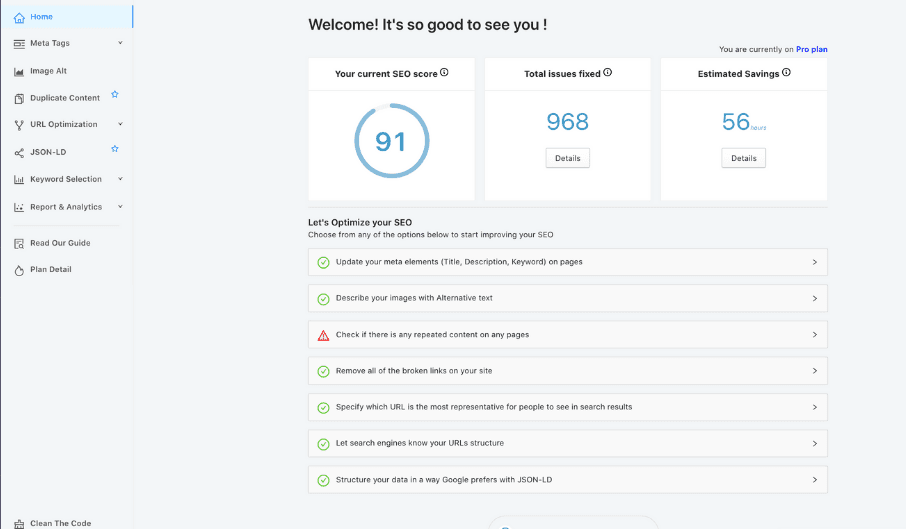
The application also provides information and reports to help you better understand whether the applied SEO strategy is working as well as it should. Overall, it is a very powerful application that helps the store get more traffic from Google.
What makes SEO Booster unique is the fact that it is designed for everyone, from beginners to advanced users, helping the user have more confidence in their ability to design strategies and manage the store's SEO effectively. The application offers a 14-day free trial, a limited free plan that might be sufficient for small stores, and for those who require additional features they can upgrade to a paid plan.
Avada SEO Suite
Avada SEO Suite is designed to optimize different aspects of the store in an agile and effective way.
For example, the app lets you optimize store images regarding alt tags, image size, and quality so they load faster.
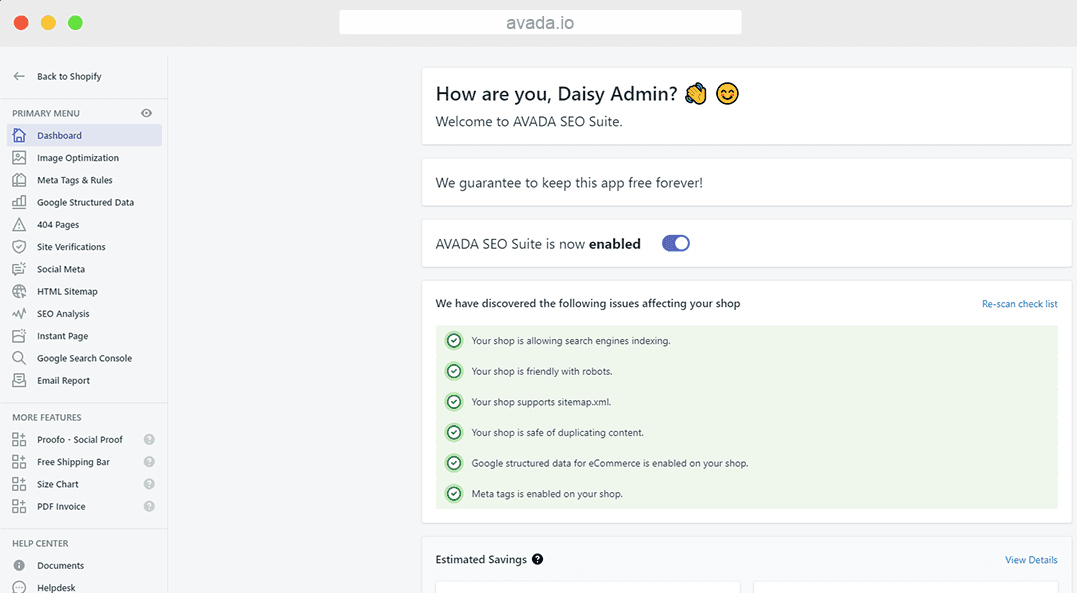
It also automatically adds rich snippets and makes it easy to control meta tags such as the title and description of each product. Weekly reports and integration with Google Search Console are additional benefits of this platform, and best of all, the app is completely free.
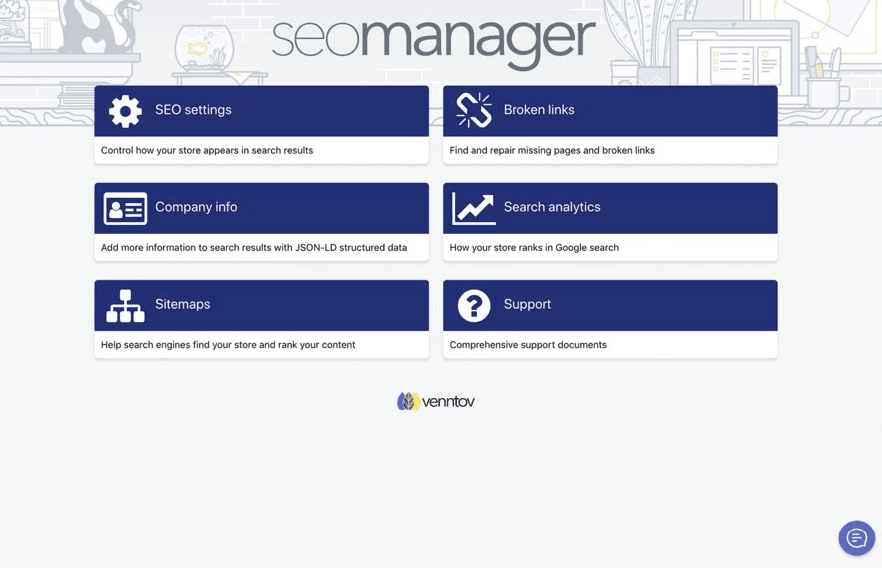
SEO Manager
With more than a dozen SEO features, this platform includes a range of functions designed to help users get better rankings in search results. In addition, it provides real-time information, which helps users better understand which of their Shopify SEO tactics are working and which are not.
Users can start with a 14-day free trial to decide whether they want to continue using it.
SEO Image Optimizer
Images are very necessary when you have an online store, since they are what show potential customers what they are going to buy without seeing it in real life yet. Therefore, you must make sure the website is optimized for Google image search, which is very easy thanks to SEO Image Optimizer.
This app, as its name indicates, automatically optimizes the ALT tag on website images, simplifying the process of generating more traffic. The application is also very easy to use, as no coding skills are required to install and implement its features.
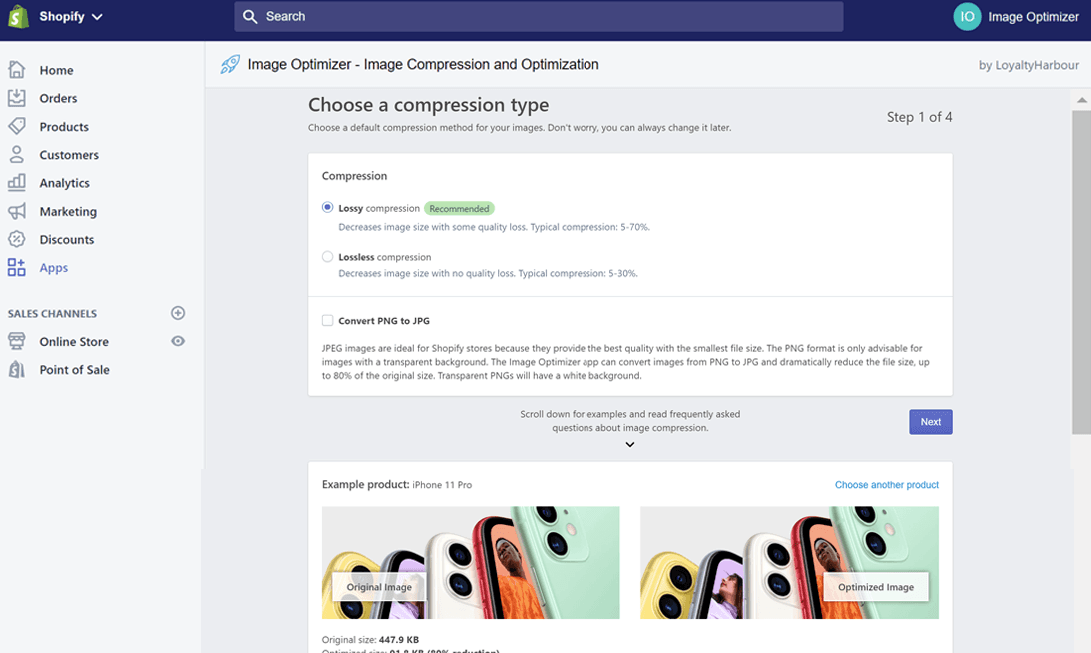
Installation is free and it has two different service packages. The free plan offers limited features at no cost, while the paid plan has added features.
Plug In SEO
Getting a website to rank in the SERPs or Google results is not as simple as following best practices and hoping that the strategies work. Because you also have to monitor each tactic to confirm that there are no SEO problems. That is a good reason to consider using Plug in SEO, since it runs automatic tests regularly.
This application will check page titles, blog post structure, headings, meta descriptions, speed, and more autonomously. Then it will provide a detailed report of the website's SEO results directly and let you know if there are any issues and what improvements are relevant.
You can choose to continue with the free plan if you consider it sufficient. On the other hand, users who need additional features such as full structured data support can upgrade to the Plus plan.
AMP by Ampify Me
This app for Shopify lets you convert the store into an AMP or accelerated mobile page. This will be a mobile site that not only looks correct on a phone screen but also loads faster. That is crucial considering that the bounce rate increases to 38% when a web page takes more than five seconds to load.
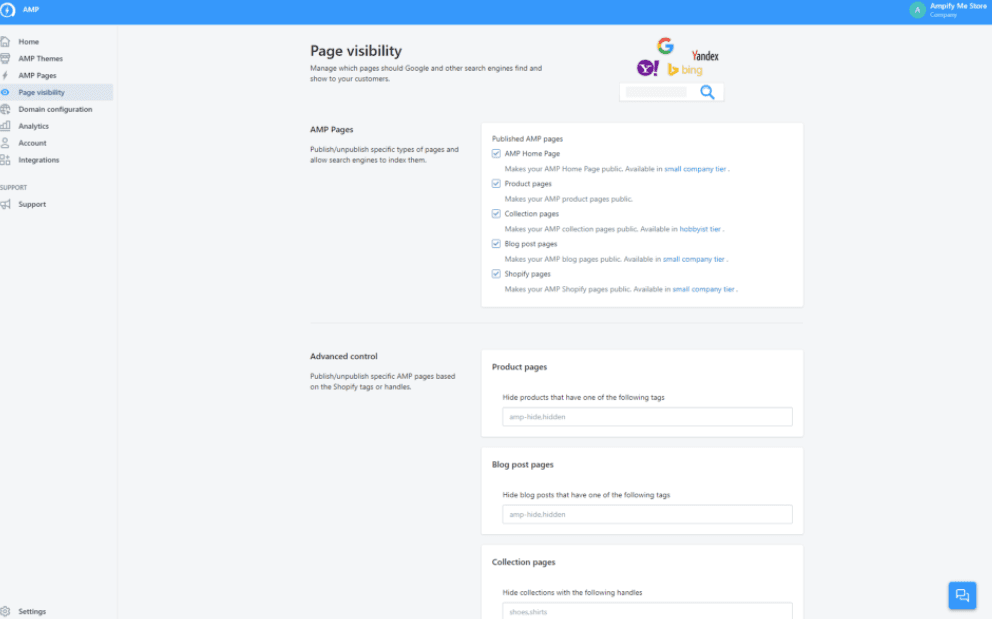
Unlike the other apps mentioned, AMP by Ampify Me's pricing and plan options are more diverse. There is a free version as well as several paid ones based on the project's needs.
JSON-LD for SEO
Instead of simply showing the name and description of the page in a search result, there are two elements that can be added and modified, Rich Snippets or enriched fragments, and these types of fragments can display reviews, product prices, and more. This helps users better determine whether it is worth clicking on that link.
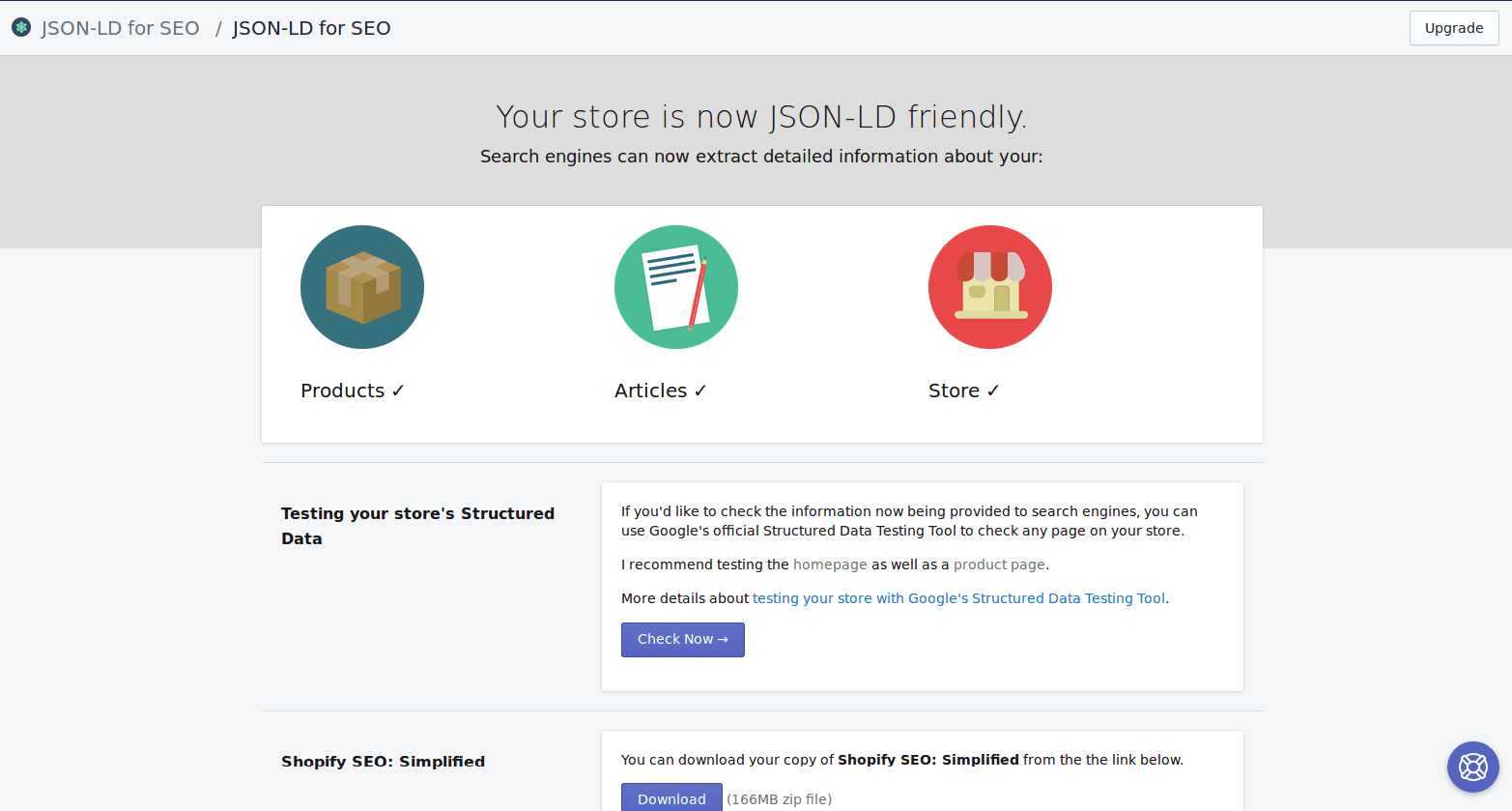
However, to ensure that a rich snippet is favored to appear, you must provide Google with the information correctly. A single error in the data can prevent the snippets from appearing in the search results. Fortunately, the JSON-LD for SEO app generates the necessary code, so it will be error-free.
Smart SEO
Smart SEO is an app that saves time and automates processes in the management of online stores under Shopify. The main function of this platform is to automatically generate meta tags and alt tags, so you don't have to generate and enter them manually, and to automatically repair broken links.
Likewise, it offers support in several languages for meta tags, which is useful for any business that has multiple stores in different languages and countries.
In addition, given Shopify's shortcoming regarding users' ability to manage their store's sitemap, Smart SEO becomes valuable by including a feature with which you can edit said sitemap within the application.
Yotpo Reviews
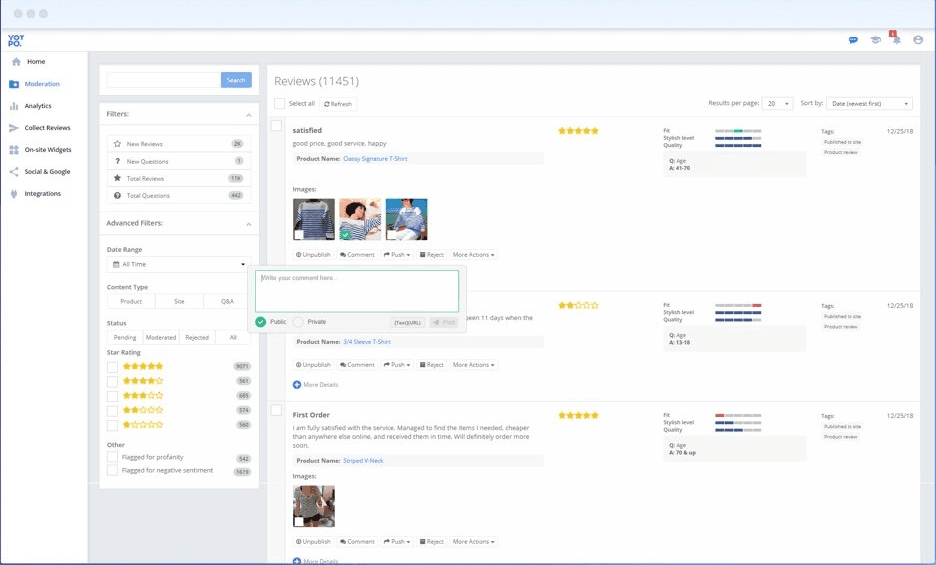
Yotpo Reviews is an app that lets you add user reviews to the products sold in the store, thus increasing sales by providing potential buyers with opinions from others who previously purchased the item or service. In addition, this makes the content on the pages eligible to be rated with stars in searches and therefore shown in the results.
Conclusions
As you can see, the great number of possibilities and versatility that creating an ecommerce with Shopify entails are enormous. Also, as we have seen, it is increasingly optimized for SEO positioning, which will mean that many of the actions will be automated and your online store will grow significantly in search engines. What are you waiting for? Start using Shopify today!
Dear reader, did you know about or have previous experience with Shopify? Did you know about all the SEO apps we've told you about? Let us know! Until next time!
Author: David Kaufmann

I've spent the last 10+ years completely obsessed with SEO — and honestly, I wouldn't have it any other way.
My career hit a new level when I worked as a senior SEO specialist for Chess.com — one of the top 100 most visited websites on the entire internet. Operating at that scale, across millions of pages, dozens of languages, and one of the most competitive SERPs out there, taught me things no course or certification ever could. That experience changed my perspective on what great SEO really looks like — and it became the foundation for everything I've built since.
From that experience, I founded SEO Alive — an agency for brands that are serious about organic growth. We're not here to sell dashboards and monthly reports. We're here to build strategies that actually move the needle, combining the best of classical SEO with the exciting new world of Generative Engine Optimization (GEO) — making sure your brand shows up not just in Google's blue links, but inside the AI-generated answers that ChatGPT, Perplexity, and Google AI Overviews are delivering to millions of people every single day.
And because I couldn't find a tool that handled both of those worlds properly, I built one myself — SEOcrawl AI, an enterprise SEO intelligence platform that brings together rankings, technical audits, backlink monitoring, crawl health, and AI brand visibility tracking all in one place. It's the platform I always wished existed.
Discover more content about this author
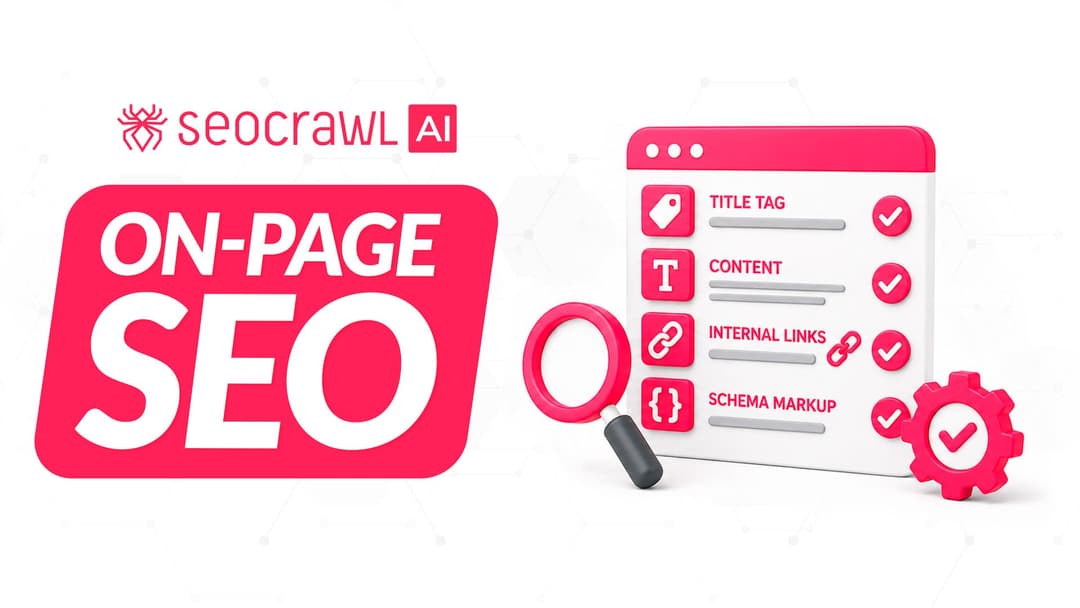
On-page SEO is everything you control on a page: content, title, meta description, headings, URL, images and internal links. Here is a checklist element by element, an audit process and what changes with AI Overviews and AI Mode.