How to Detect and Fix Duplicate Content?

If you work in the world of SEO, you have probably found yourself in the situation of having to deal with one of the most common problems that affects search engine rankings and can lead to penalties: duplicate content. Search engines like Google, Bing, or Yahoo have as their main goal to display the most relevant information for users' search intent. To do this, they rank in descending order, rewarding original, high-quality content and penalizing content that has been copied, duplicated, is irrelevant, or has been manipulated to rank higher on the results pages.
In this article we are going to explain what duplicate content is, how we can detect and fix it, its impact on SEO, and the tools we can use to work on it. Will you join us? Let's get started! ?
What is duplicate content?
As we have already mentioned, search engines like Google penalize pages that have duplicate content, which is interpreted as two pages with different URLs but the same content. Therefore, as much as possible, avoid copying content from another website and pasting it on your site (you'll save yourself many headaches with Google and potential legal action from the owners of the websites you pulled it from!?).
SEOcrawl AI Tip**:** We strongly recommend that you take care of the content on your website and avoid this bad practice. Be patient and persistent, write original content, and the results will come sooner rather than later. In this regard, Google is very clear about its position, as we can see in its official documentation on duplicate content, so we must be very careful with the content we write.
In SEO ranking, we can distinguish two types of duplicate content: internal and external duplicate content.
Internal duplicate content
This type of duplicate content generally occurs due to poor implementation of URL parameters or poor management of taxonomies in categories and tags. The possible causes that can generate internal duplicate content are:
- Errors in creating categories and tags: This error is common in blogs where there is a large list of articles and categories and tags are created without any order or logic. Let's see an example:
Imagine we have a digital marketing blog with several categories:
https://myblogdigital.com/category-a/topic/
https://myblogdigital.com/category-b/topic/
https://myblogdigital.com/category-c/topic/
To avoid duplicate content, it is necessary to mark which one is the main one and have the other two canonicalize to the main URL.
- "Non-www" vs "www" and "http" vs "https" domains: This is another error we must pay attention to. It is possible that if we have not specified to the search engines which is the canonical domain, they can access the other versions and generate duplicate content. Therefore, from SEOcrawl AI, we recommend establishing which will be your canonical domain and setting up 301 redirects to the version you want to be the preferred one.
- Parameterized URLs: This error is common on ecommerce websites where URLs with parameters allow filtering to offer information to users. Suppose we have a watch sales site and the following URL:
https://www.mywatchstore.com/watches/garmin?color=black
This page would show all "Garmin" model watches in black.
The possibility of setting filters on pages can be a serious inconvenience if not managed properly, since search engines can display several URL combinations:
https://www.mywatchstore.com/watches/garmin?color=black&type=sport
https://www.mywatchstore.com/watches/garmin?type=sport&color=black
Therefore, from SEOcrawl AI we recommend that you set the canonical version to the unfiltered page so that the rest of the parameterized URLs preserve their page authority (URL Ratio).
External duplicate content
External duplicate content refers to any content that is extracted, fully or partially copied from one or more websites owned by different webmasters or administrators.
This is a practice considered as spam in the eyes of search engines; therefore, as we mentioned at the beginning of the article, it should be avoided at all costs.
Another cause of external duplicate content can be due to syndication strategies, in which websites send traffic to other sites in order to manipulate search engines. Google's algorithm is smart enough today to detect this type of practice.
How can we check whether our website has duplicate content?
Knowing how to detect duplicate content is crucially important in a website's content strategy. If we don't control this factor, we run the risk of our pages gradually slipping from the top results on Google, since Google continually refines the SERPs in search of original, high-quality content. That is why we are going to present an example of how we could detect content on our website and give some strategies to avoid this type of content.
Suppose we have an online store (ecommerce) where we have a printable version of each of the product pages. This is considered duplicate since there are two "versions" of the same content under different URLs:
Product detail page:
https://mywebsite.com/product3560Printable version page:
https://mywebsite.com/product3560_printTo avoid this type of duplicate content we can apply the following strategies:
Strategy #1: Use of 301 redirects
If we have restructured our website, we can set up 301 redirects (permanent redirects) through SEO plugins included in the different repositories of the content management systems (CMS), or through the .htaccess file, to intelligently redirect users, search engine bots, and other tools with crawler functionality.
Strategy #2: Use of the canonical tag
The rel="canonical" tag is used to tell search engines which is the original page (canonical version) and which pages are a copy. In this way, the search engine spider will focus its indexing crawl budget on the page marked with this meta tag.
To use the canonical tag, we first have to choose which page we want to be the one shown by search engines and add the following line to the HTML code in the </head> section (let's see an example of canonical on a product page on the Zalando website):
<link rel="canonical" href="https://www.zalando.es/adidas-originals-stripe-circle-camiseta-estampada-white-ad121000k-a11.html"/>
For example, if on one URL we show the details of a product and on another URL we show the same details with different colors, we can tell Google which is the canonical URL we want to show users.
Strategy #3: Use of the robots.txt file
By editing this file we can tell search engine bots not to crawl certain pages or sections of our website. Imagine we have the following product pages on our website:
https://www.mywebsite.com/category/product-page.html/
https://www.mywebsite.com/category/product-page1.html/ (version with duplicate content)
With the following directive in the robots.txt file:
- Disallow /product-page.1html/
We can prevent duplicate content from occurring, in addition, of course, to setting the first URL as the canonical version.
Impact of duplicate content on SEO ranking
After the release of the first version of the Google Panda algorithm back in 2011, which penalized domains with thin content and duplicate content, Matt Cutts published a video in 2013 about how Google handles duplicate content and what negative effects it can have on ranking positions from an SEO perspective:
The conclusions we can draw from Matt Cutts' video are that, although according to Google 25-30% of the web is duplicate content, the search engine does not treat it directly as spam unless the intent is to fraudulently create or copy content in large quantities or directly manipulate positions in the search result pages with "black hat" tactics.
In short, creating this type of content can generate poor quality signals to search engines like Google, as well as pose a barrier to consolidating link metrics (such as authority, relevance, or trust) of the content, from the point of view of external links (backlinks) that may link to different versions of that content.
Tools to detect duplicate content
When it comes to detecting duplicate content, there are countless tools on the market that can make this task easier. Let's take a look at them! ?
Tools to detect duplicate content on our website
- Ahrefs: With Ahrefs we can see, within the "site audit" functionality and as long as we have added a project for SEO auditing, whether our website has duplicate content or not. To do this, we will go to the "duplicate content" tab. Once there, we will be shown a graph where we can identify the possible errors we need to correct:
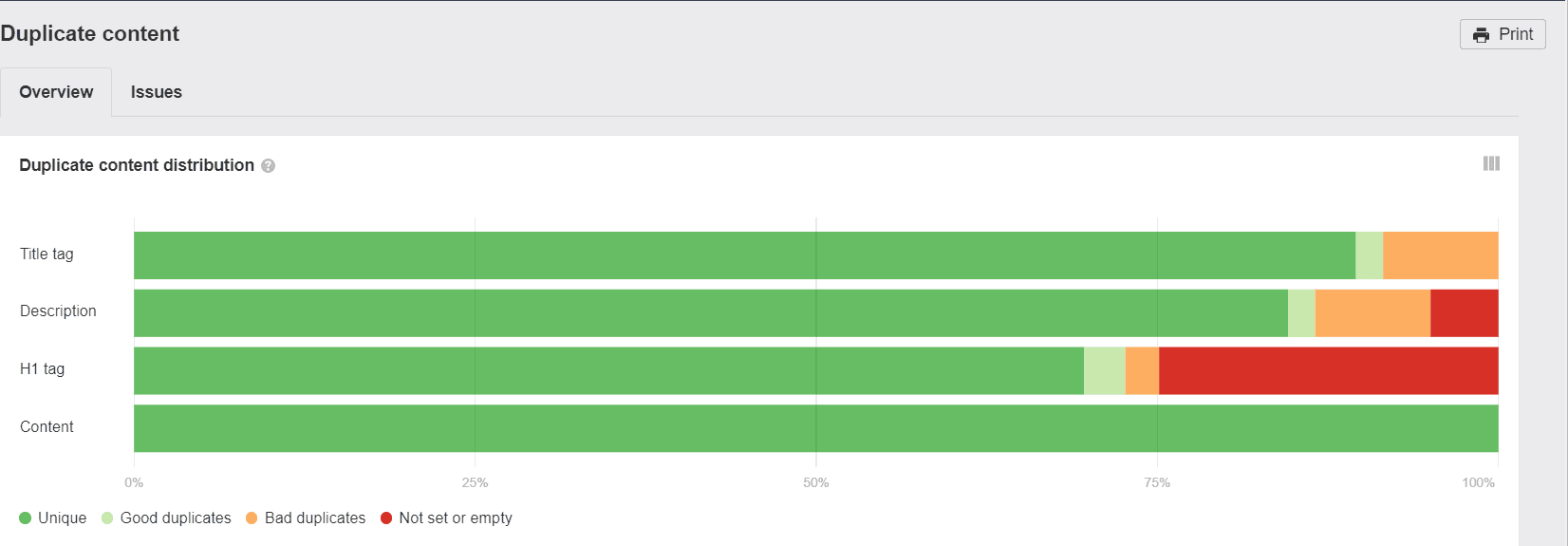
View of Ahrefs' "Duplicate Content" functionality
- Screaming Frog: With this well-known software crawler, it is also possible to detect duplicate content. To do this, we will have to enter a domain to scrape and export the "internal" data to .csv format. Once in the spreadsheet, you can view, sort, and filter which pages have duplicate titles, meta descriptions, headers, etc.
SEOcrawl AI Tip: Use conditional formatting rules in your spreadsheet to set which URLs you will correct based on the level of duplicate content you have and the importance and relevance of each page.
- Safecont: This tool is really interesting since it is focused exclusively on content analysis and uses "machine learning" to detect and find clusters and content similarities. It is quite comprehensive, and its use can bring us many benefits if we want to detect duplicate content on our website.
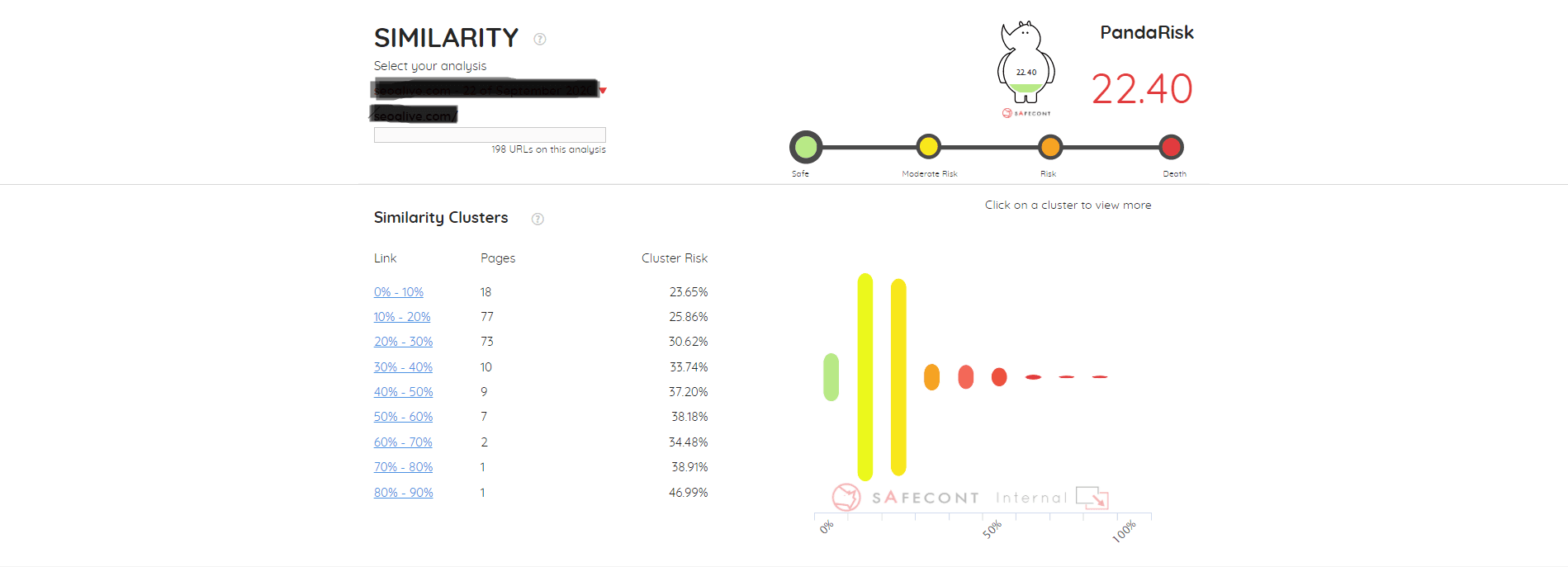
View of Safecont's "Similarity" functionality
Tools to detect duplicate content from another website
- Copyscape: If we want to know if a piece of content is duplicated with respect to another website, Copyscape is a search engine specialized in detecting web pages that plagiarize content. In this search engine, you only need to enter the URL where the content you want to check is hosted, and the tool returns the pages that share that content, sorted from highest to lowest degree.
- Plagium: This is another tool very similar to Copyscape, with the difference that we have to enter the text to check instead of the URL. It should be noted that it has a paid version, so the "free" version has a limit of up to 5,000 characters to check.
Conclusions
At SEOcrawl AI we are 100% "White Hat SEO", so our recommendation at the end of the article is to avoid duplicate content at all times. If you detect this type of content on your website, rely on all the strategies and tips we have provided. ? Remember: Google likes original, high-quality content!
And you, have you had a bad experience with duplicate content or have you suffered any penalty because of it? How did you solve it? Tell us about it if you'd like, in the comments box! We'll be happy to reply. Until next time!
Author: David Kaufmann

I've spent the last 10+ years completely obsessed with SEO — and honestly, I wouldn't have it any other way.
My career hit a new level when I worked as a senior SEO specialist for Chess.com — one of the top 100 most visited websites on the entire internet. Operating at that scale, across millions of pages, dozens of languages, and one of the most competitive SERPs out there, taught me things no course or certification ever could. That experience changed my perspective on what great SEO really looks like — and it became the foundation for everything I've built since.
From that experience, I founded SEO Alive — an agency for brands that are serious about organic growth. We're not here to sell dashboards and monthly reports. We're here to build strategies that actually move the needle, combining the best of classical SEO with the exciting new world of Generative Engine Optimization (GEO) — making sure your brand shows up not just in Google's blue links, but inside the AI-generated answers that ChatGPT, Perplexity, and Google AI Overviews are delivering to millions of people every single day.
And because I couldn't find a tool that handled both of those worlds properly, I built one myself — SEOcrawl AI, an enterprise SEO intelligence platform that brings together rankings, technical audits, backlink monitoring, crawl health, and AI brand visibility tracking all in one place. It's the platform I always wished existed.
Discover more content about this author

On-page SEO is everything you control on a page: content, title, meta description, headings, URL, images and internal links. Here is a checklist element by element, an audit process and what changes with AI Overviews and AI Mode.