Internal Linking: Strategy and Best Practices
One of the cardinal points that cannot and should not be missing when working on SEO positioning is interlinking. And why do we believe it's so valuable? For a very simple reason: because we are the ones in control of establishing the relationships between URLs that will bring greater semantic richness around the topics we're interested in ranking for. And if this connection we've created is crawled, indexed and understood by Google exactly as we've laid it out, we'll have more and better chances of climbing positions in the SERPs.
That's why, this time, we've reserved an entire post to talk about this topic. Here you'll find the definition of internal linking, the benefits it brings within on-page SEO and how to improve it according to your overall SEO strategy planning. Ready?
? NOTE: If you make it to the end of this post, you'll find a very practical bonus: how to detect opportunities through some of the tools well known by everyone.
What is interlinking or SEO-oriented internal linking?
First things first: what is interlinking? The simplest definition that comes to mind is this: a technique by which the pages of a site are connected in a thoughtful way through internal links to establish a clear information architecture whose ultimate goal is to position certain URLs of interest.
How does Google interpret internal links?
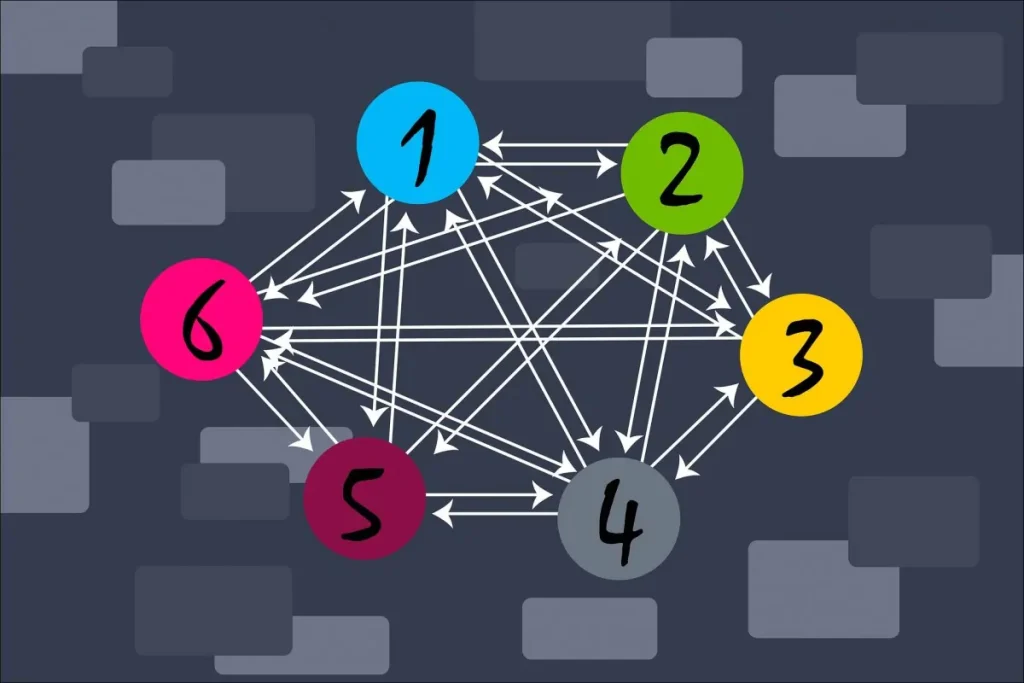
Thanks to a well-thought-out construction of hyperlinks or internal links, Google interprets that all the URLs that make it up have a certain thematic connection. It also ends up understanding which of them are the most relevant. The creation of these nodes helps to strengthen their overall semantics and signal which are the sources of interest both for users and for Google's crawlers. With this, the chances of those pages acting as 'sources' ranking organically are greater.
Advantages of interlinking
Improves indexing
Thanks to the creation of controlled internal links between the pages of a domain, we will improve efficiency at the indexing level, since we will tell Google the path we want it to follow and avoid its crawl budget being wasted on pages that don't bring us any SEO value.
Improves user experience
Let's remember that for Google, above all else, the satisfaction or good experience of its users comes first. If we work on offering related content with internal links from where the user accesses our website, we will be improving their experience. And if users like it, Google does too. Clearly, thanks to good interlinking, you'll have another point in your favor to gain positions in its search results.
Reduces the bounce rate
Thanks to inlinks or internal links, we will make navigation easier for the user who has landed on a particular URL. If we add related internal hyperlinks on that URL and they interact with them, the bounce rate will be reduced. This ultimately translates into more page views and longer time spent on our website (key to achieving set goals).
Defines your website's architecture
Building a solid web architecture, whose intention is to help Google understand what the website is about and which sections it should give more value to, depends on how interlinking or internal linking is being worked on. Thanks to the network we weave, we will achieve a clear and understandable information architecture for both bots and users.
Helps rank the pages we're interested in
Thanks to the authority transfer that is passed from some pages to others through internal links, we have the ability to rank those URLs that interest us. (Always keep this in mind, because it's extremely important to consider this concept when developing your interlinking strategy.)
It's a tool against the cannibalization of important keywords
In case Google isn't understanding which of your URLs it should interpret as the important one when the user enters a query in the search engine and shows several pages in a ranking order that doesn't interest you, drawing up an internal linking strategy will help you rank exactly the URL you do want to rank, and not the others that cannibalize with it.
Unwritten rules for quality internal linking
Although SEO isn't akin to exact mathematics where all problems can be solved, there are certain actions you can rely on to achieve quality interlinking that helps you rank. We could highlight mainly 2:
- Avoid implementing more than 3 or 4 links per page:
Although it depends on the length of your content, as a rule, it's better not to over-optimize the text with internal links; you'll overwhelm users with information and the link juice will become overly diluted. That is, the authority transferred from the source URL will be smaller.
- Avoid 404 inlinks errors:
As you already know, Google and 404s don't get along well, especially when there are many within a domain. Be careful not to overlook internal links whose destination pages have a 404 error. It will excessively affect navigability and user experience. Moreover, they prevent Google's bots from continuing to crawl the rest of the domain from these types of pages. If this number of pages with 404 errors is high, it will end up indirectly harming organic positioning.
How to improve SEO with internal links?
As we've mentioned among the advantages, one of the great benefits of working on your site's interlinking is that it will help you define your website's information architecture in a solid and coherent way. With it, both Google and users will clearly understand what content you want to highlight.
There are no secret formulas for creating the perfect internal linking strategy, sorry. It's a matter of analyzing all the information you have or think you may come to have and placing it logically to organize it as much as possible. That way, you'll get it indexed the way you want only on the parts that matter to you. In any case, so you can get an idea of how you can structure it, keep in mind that web architectures are classified into 3 types:
-
Horizontal or flat information architecture
-
Vertical information architecture
-
Mixed web architecture
Now, let's develop in more depth some of the tips you can put into practice to improve your website's SEO by using internal links:
Main menu
The main navigation menu is the perfect place to include those sections we want to highlight. It will not only be relevant to the user, but Google will also come to make this interpretation, since those links to those selected pages will be repeated throughout the site and will be considered the most important.
Use the footer
We usually display the most relevant pages through a navigation network at the top, but we forget about the footer. Don't leave it aside, it's also a powerful resource when it comes to interlinking. In it, you can display those pages that, without being in the first link in terms of relevance, are also important at the SEO level.
Don't underestimate the sitemap
We talk about the main menu, the footer, we even consider using the sidebars to implement the most important pages… and we don't even consider using the HTML URL that has to do with the sitemap.
While it's true that for small websites this resource may not be necessary, for sites with many pages this file makes crawling easier for Google, since from here it indicates in a few clicks how the entire site is organized.
Get the most out of breadcrumbs
The use of breadcrumbs is perfect for addressing both good user experience and improved ranking. These paths help us work on interlinking; that is, reinforcing the links between the different pages of the site. And, of course, helping Google understand the position of each sub-page within the created structure.
Take advantage of content clusters
Without going into too much detail, we'll say that a content cluster is a group of pages with content related to the term discussed in a particular URL. Thanks to content clusters, we will favor semantic richness around a specific topic, which will give us the opportunity to offer concrete answers from different related pages and resolve all derivative questions that arise around that topic.
Thanks to interlinking, all these pages will complement each other and provide greater visibility to the main content.
Where else can we include internal links to help rank the pages we're interested in?
Depending on the objective we're pursuing, we can use the following mini internal linking strategies:
-
Link from newly created content to older content: this way, we'll bring the organic ranking of the latter, possibly in decline, back to life.
-
We can also link from URLs with old content to new URLs, in case we detect that the old ones have relevant authority and/or organic sessions.
-
In general, whether from old URLs or not, create links that transfer authority from the pages with more sessions and/or organic visibility to others with worse performance.
How to detect opportunities to improve internal linking?
All of the above is great in theory, but how do we detect, for example, which URLs have the most pull in the SERPs to use them in our favor and build our own interlinking strategy?
There are many SEO tools with which you can extract information to analyze it. However, we're going to focus on two that we use daily at SEOcrawl AI:
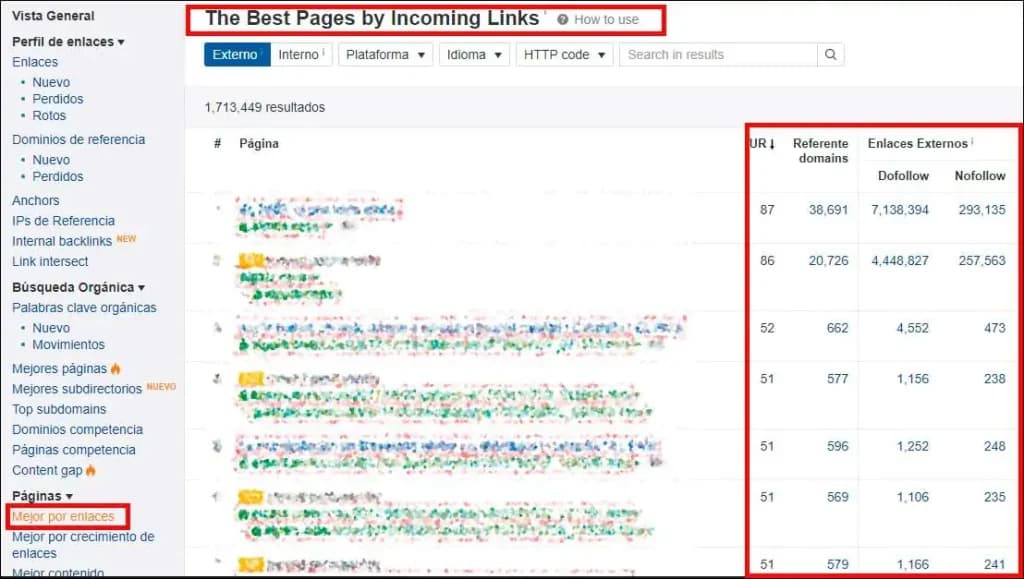
Finding relevant pages by incoming links in Ahrefs
The idea here is to locate URLs on your domain that are relevant to other external pages in the sector. These URLs will have great authority, so they are perfect for transferring SEO strength from them to those you're interested in ranking. To find these opportunities you just have to follow these steps:
-
Enter your domain name in Ahrefs
-
Click on 'Best pages by links'
Next, choose those that make sense to link to the URL you want to rank. Of course, without going crazy; don't go all out using each and every one of those with the most visibility to link to your target URL… Bet on naturalness and balance.
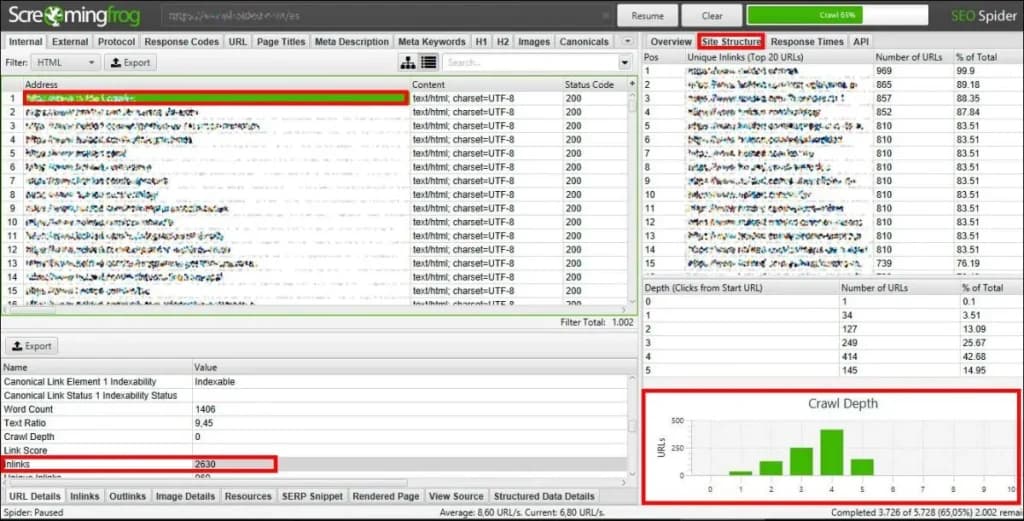
The 'level' and 'inlinks' sections of Screaming Frog
Through these sections that you'll find in the Screaming Frog panel, you'll be able to analyze which URLs have almost no internal links, and vice versa, as well as detect the depth at which they are found within the information architecture.
This way, we'll be able to know which URLs we should pay more attention to in terms of the amount of inlinks, as well as know which pages are the ones that perform the worst because they are precisely many clicks away from the home page.
Interlinking or internal linking has a lot more to offer, we know. But we'll take it step by step. In the meantime, if you want to chip in your two cents, we'd be delighted to read you in the comments section!
Author: David Kaufmann

I've spent the last 10+ years completely obsessed with SEO — and honestly, I wouldn't have it any other way.
My career hit a new level when I worked as a senior SEO specialist for Chess.com — one of the top 100 most visited websites on the entire internet. Operating at that scale, across millions of pages, dozens of languages, and one of the most competitive SERPs out there, taught me things no course or certification ever could. That experience changed my perspective on what great SEO really looks like — and it became the foundation for everything I've built since.
From that experience, I founded SEO Alive — an agency for brands that are serious about organic growth. We're not here to sell dashboards and monthly reports. We're here to build strategies that actually move the needle, combining the best of classical SEO with the exciting new world of Generative Engine Optimization (GEO) — making sure your brand shows up not just in Google's blue links, but inside the AI-generated answers that ChatGPT, Perplexity, and Google AI Overviews are delivering to millions of people every single day.
And because I couldn't find a tool that handled both of those worlds properly, I built one myself — SEOcrawl AI, an enterprise SEO intelligence platform that brings together rankings, technical audits, backlink monitoring, crawl health, and AI brand visibility tracking all in one place. It's the platform I always wished existed.
Discover more content about this author
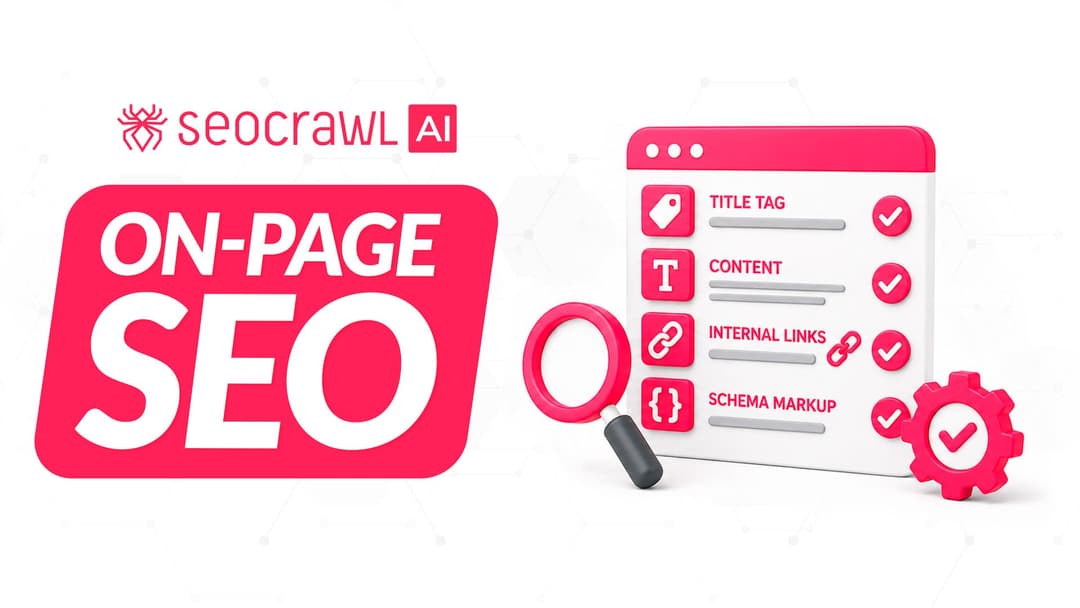
On-page SEO is everything you control on a page: content, title, meta description, headings, URL, images and internal links. Here is a checklist element by element, an audit process and what changes with AI Overviews and AI Mode.