What Is Answer Engine Optimization (AEO)?
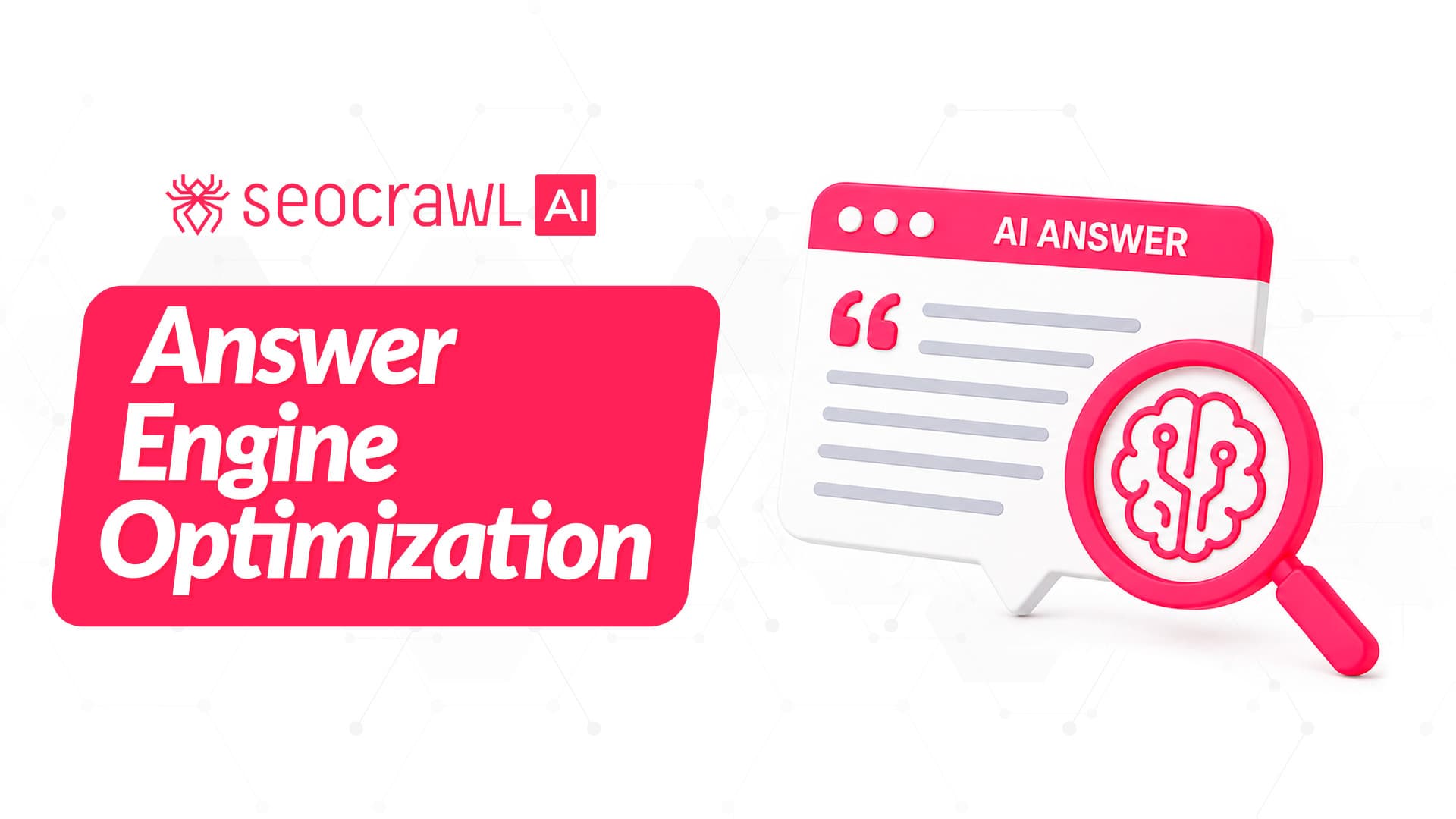
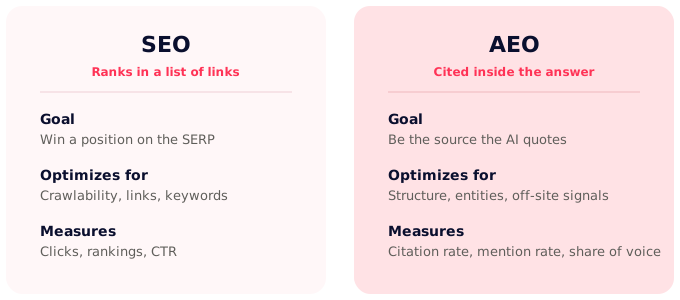
Answer Engine Optimization (AEO) is the practice of optimizing content so that AI-powered systems — ChatGPT, Gemini, Perplexity, Google AI Overviews, Microsoft Copilot — select it as a source when generating answers to user queries. Where traditional SEO optimizes for ranking in a list of links, AEO optimizes for being cited inside the answer itself.
SEOcrawl AI's AI Tracker already shows that AI-referred traffic is a measurable channel for a growing number of sites. The question is whether your brand is capturing it.
What are answer engines and how do they work?
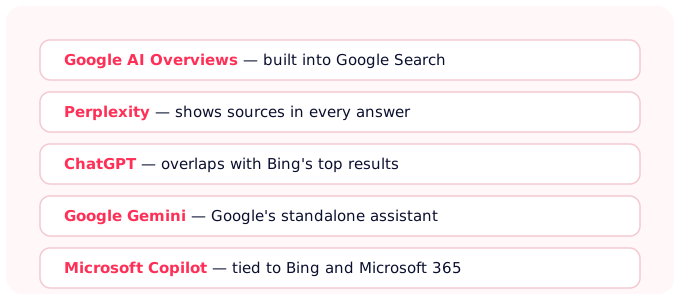
Answer engines are AI systems that respond to queries with synthesized, conversational answers rather than a ranked list of links. The main ones in 2026 are Google AI Overviews and AI Mode, ChatGPT Search, Perplexity, Microsoft Copilot, and Gemini.
Most of them use a process called Retrieval-Augmented Generation (RAG): when a query comes in, the system fetches current web content, combines it with the model's training data, and synthesizes a response. For a detailed look at what specifically influences AI Overviews' selection, see our guide to AI Overviews ranking factors.
Why does AEO matter right now?
AI search is already sending traffic to potential customers, and if it's not going to your site, it's going to a competitor's.
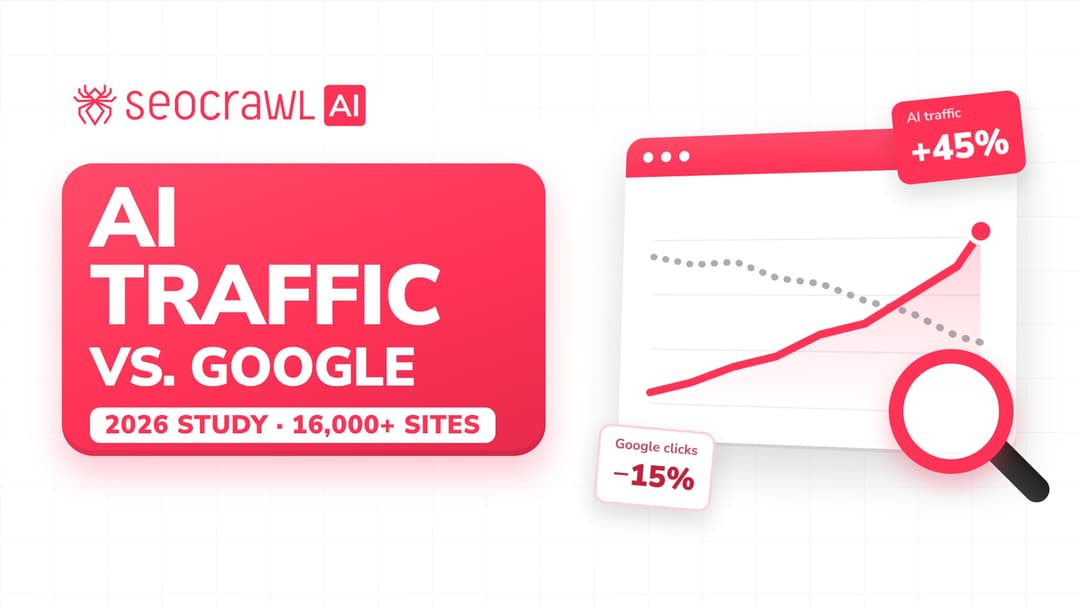
Research from Seer Interactive found that AI Overviews reduce click-through rates for top-ranking content by 67%. At the same time, ChatGPT processes 2.5 billion prompts daily, and roughly a third of those prompts trigger a live web search.
That's a massive volume of queries where the answer comes from an AI citation instead of a SERP click.
Google has stated that AI Overviews are rooted in core Search ranking systems, so strong SEO is still the foundation. But AEO adds the layer that determines whether your content gets cited once it's already visible to the system.
AEO vs SEO: what's the difference?
A page that ranks well in Google tends to be crawlable, authoritative, and well-structured, and that makes it a candidate for AI citation. AEO only adds specific requirements around content structure, entity clarity, and off-site presence. For a deeper breakdown of how these three disciplines compare, see our guide to SEO vs AEO vs GEO.
How to optimize for answer engines
AEO doesn't require a separate content strategy from scratch. What changes is how you apply the principles you already know.
Structure content around questions
Answer engines extract answers from content by matching a query to a relevant passage. The easier you make that happen, the better:
- Open each section with a direct answer to the question the heading implies. Don't bury the point.
- Keep paragraphs short and declarative (40 to 60 words is a useful target for extractable blocks).
- Use question-based H2s and H3s that mirror how people actually ask things.
- Add an FAQ section at the end of any informational article, covering the natural follow-up questions.
Use schema markup
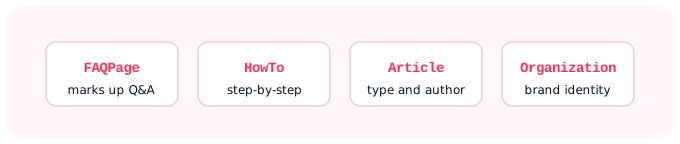
Schema doesn't directly guarantee citations, but it reduces ambiguity. These are the most useful types for AEO:
ArticleorBlogPostingwithauthor,datePublished, anddateModifiedFAQPagefor question-and-answer sectionsOrganizationwithsameAslinks to your verified profiles (LinkedIn, Wikipedia, Crunchbase)Personfor attributed authors with linked credentials
SEOcrawl AI's free Schema Validator lets you audit any page's JSON-LD against Schema.org spec and Google's Rich Results policy before publishing.
Build topical authority
A single well-optimized article is rarely enough. LLMs tend to cite sources that cover a topic comprehensively — a cluster of interlinked articles that collectively address every angle of a subject builds the kind of topical authority that gets consistently cited.
This is also where generative engine optimization and AEO overlap: the goal is to become the domain a model associates with a given subject area, not just rank for one keyword.
Earn off-site citations and brand mentions
Answer engines don't only look at your site. They weight corroboration — if multiple trusted sources reference your brand, data, or content, that cross-domain signal increases confidence in your authority.
The highest-leverage places to build off-site presence are Wikipedia (for companies and concepts with enough notability), Reddit (firsthand community discussion), LinkedIn (thought leadership from named individuals), and earned coverage in trade press and established industry publications.
Keep content accurate and up to date
LLMs penalize content that conflicts with other sources. Watch out for outdated statistics, stale product descriptions, or factual inconsistencies that may reduce the probability of citation.
Add a visible dateModified to every post, update data-heavy sections regularly, and make sure your content reflects your current positioning — not what you published two years ago.
How to measure AEO performance
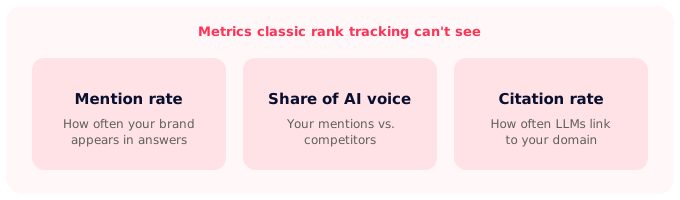
You can't optimize what you don't measure, and AEO introduces metrics that classic rank tracking doesn't cover.
SEOcrawl AI's AI Tracker measures actual traffic reaching your site from ChatGPT, Claude, and Perplexity — from sessions and users to landing pages and demographics — giving you a direct view of how AI-referred traffic compares to organic.
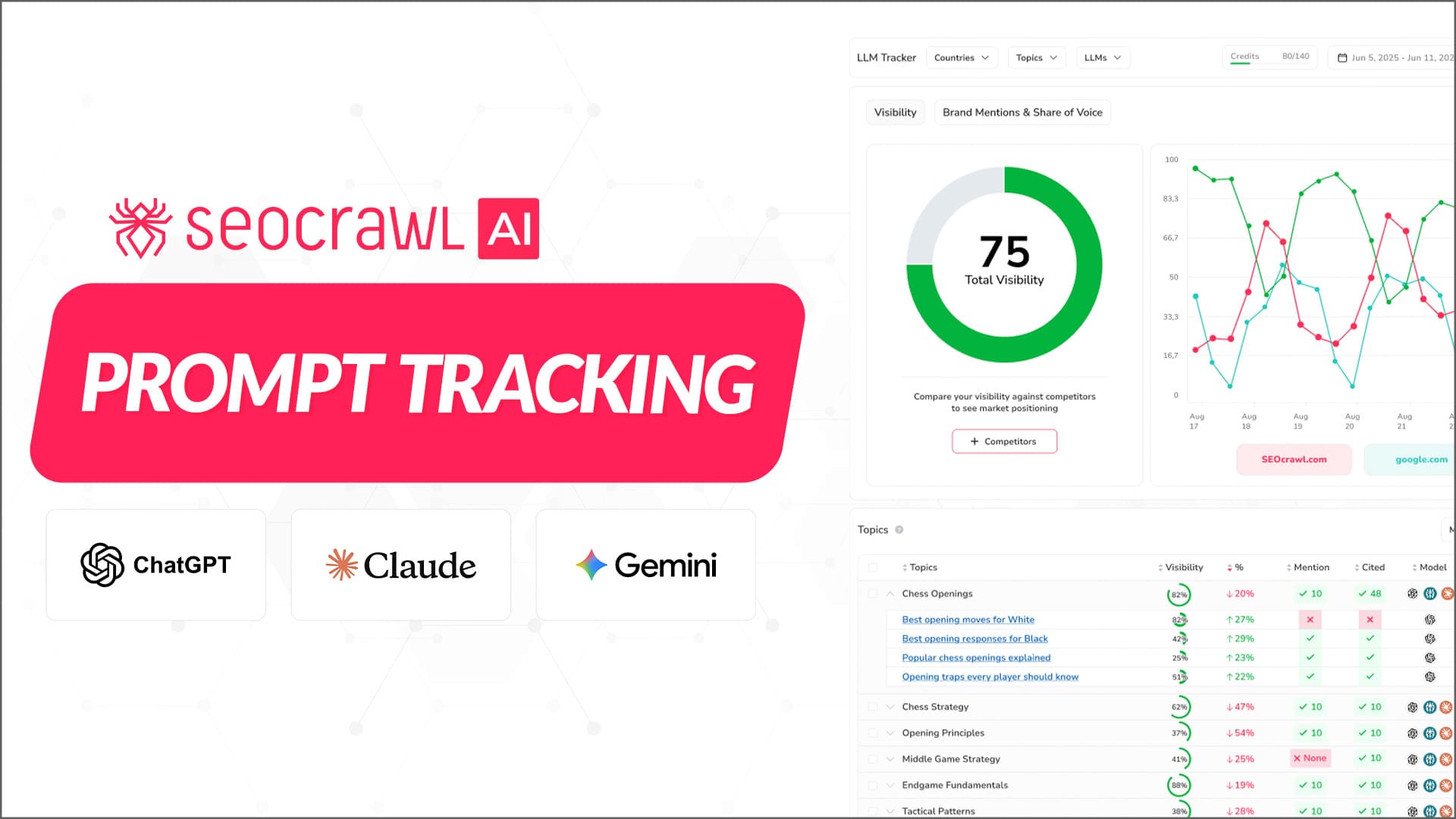
To see whether your brand is actually being cited inside the answers themselves, SEOcrawl AI's Prompt Tracking monitors your brand citations across major AI platforms so you can identify trends and compare share of voice against competitors over time.
FAQs
What is answer engine optimization (AEO)?
Answer Engine Optimization (AEO) is the practice of optimizing content so that AI-powered systems like ChatGPT, Perplexity, Gemini, Google AI Overviews, and Microsoft Copilot select it as a source when generating answers to user queries.
How is AEO different from SEO?
SEO optimizes for ranking in search engine results pages while AEO optimizes for being cited in AI-generated answers. The success metrics are different: SEO measures traffic, rankings, and CTR; AEO measures citation rate, brand mention rate, and share of AI voice. That said, strong SEO is still the foundation for AEO.
Does AEO replace SEO?
No. Traditional organic traffic still represents the majority of search-driven visits for most websites. AEO extends your visibility into AI-generated answers that may or may not include a link to your site. The ideal approach is to treat AEO as an additional layer, not a replacement.
What are the main answer engines to optimize for?
In 2026, the primary ones are Google AI Overviews and AI Mode, ChatGPT Search, Perplexity, Microsoft Copilot, and Gemini. Each has slightly different behavior, but the approach most of them use is to source crawlable content with clear authorship, topical authority, and off-site corroboration.
How do I know if my content is being cited by AI tools?
Start with Google Search Console filtered to the AI Overviews search type for Google-side data. For ChatGPT, Perplexity, and other LLMs, you need a dedicated prompt tracking tool that monitors your brand citations across major AI platforms so you can identify trends and compare share of voice against competitors over time.
What is generative engine optimization (GEO), and how does it relate to AEO?
GEO and AEO describe overlapping practices under different labels. Both aim to earn visibility inside AI-generated responses rather than only on results pages. In practice, AEO tends to emphasize structured content and question-based formatting for direct answer extraction, while GEO often refers more broadly to the full set of signals (entity footprint, off-site presence, schema) that influence how generative models represent your brand.
Is AEO only relevant for large brands?
Citation in AI answers depends on content quality, topical authority, and entity clarity, not on brand size. A focused site that dominates a narrow topic cluster can earn consistent AI citations in its category, even against larger competitors with broader coverage. In fact, smaller brands often have an advantage, since it's easier to build genuine topical depth in a specific niche than to compete across dozens of topics.
Author: David Kaufmann

I've spent the last 10+ years completely obsessed with SEO — and honestly, I wouldn't have it any other way.
My career hit a new level when I worked as a senior SEO specialist for Chess.com — one of the top 100 most visited websites on the entire internet. Operating at that scale, across millions of pages, dozens of languages, and one of the most competitive SERPs out there, taught me things no course or certification ever could. That experience changed my perspective on what great SEO really looks like — and it became the foundation for everything I've built since.
From that experience, I founded SEO Alive — an agency for brands that are serious about organic growth. We're not here to sell dashboards and monthly reports. We're here to build strategies that actually move the needle, combining the best of classical SEO with the exciting new world of Generative Engine Optimization (GEO) — making sure your brand shows up not just in Google's blue links, but inside the AI-generated answers that ChatGPT, Perplexity, and Google AI Overviews are delivering to millions of people every single day.
And because I couldn't find a tool that handled both of those worlds properly, I built one myself — SEOcrawl AI, an enterprise SEO intelligence platform that brings together rankings, technical audits, backlink monitoring, crawl health, and AI brand visibility tracking all in one place. It's the platform I always wished existed.
Discover more content about this author