SEO vs AEO vs GEO: What's the Difference and Which One Do You Need?
SEO, AEO, and GEO are three disciplines that now define search visibility. SEO gets you ranked in Google. AEO gets you surfaced as a direct answer in AI-powered features. GEO gets you cited by the language models that are now handling a growing share of research, comparison, and discovery queries.
They're not competing approaches, but three parts of the same strategy, and each targets how people find information in 2026.
To keep it short: you need all of them. Where to focus depends on your goals, your category, and where your audience is searching.
What is SEO?
Search Engine Optimization is the practice of improving a website's visibility in search engine results pages. The focus is primarily on Google, which still holds roughly 90% of global search market share and processes an estimated 16.4 billion searches per day.
What it optimizes for
SEO optimizes for ranking: appearing in the top positions of a results page when someone searches for a relevant keyword. The goal is to gain organic traffic by getting clicks from users who find your page in the results.
Success is measured in keyword positions, organic sessions, click-through rate, and conversions from organic traffic.
Key signals in 2026
The core signals haven't changed dramatically, but their weighting has evolved:
- Backlinks from authoritative, relevant domains remain a strong trust signal
- Technical health: crawlability, Core Web Vitals, indexation, site structure
- E-E-A-T (Experience, Expertise, Authoritativeness, Trustworthiness), especially for YMYL topics
- Content depth and topical coverage across a cluster
- On-page optimization: title tags, headers, internal linking, semantic relevance
Why SEO is still the foundation
Google has explicitly stated that AI Overviews and AI Mode are rooted in its core Search ranking systems. This means a page that doesn't rank can't easily earn AI citations either.
95% of Americans continue using traditional search engines even as AI tool adoption grows. SEO isn't going away — it's just no longer enough on its own.
What is AEO (Answer Engine Optimization)?
Answer Engine Optimization is the practice of structuring content to be used by AI-powered features — Google AI Overviews, featured snippets, voice search, and AI Mode — as direct answers to a query. For the full breakdown, read our guide on answer engine optimization.
What it optimizes for
AEO optimizes your content to be selected as the answer that appears above or instead of organic results. The user may not click through, but the goal is that your content (and brand) is the source of the answer.
Success is measured in AI Overview inclusion rate and featured snippet ownership.
How to optimize your content for answer engines
Once your content ranks, AEO determines whether it gets pulled into AI-powered features. For that, you need your content to be extractable:
- Write short, direct answers immediately after question-based headings
- Use FAQ schema (FAQPage) and HowTo markup
- Build your Article schema with clear authorship and date signals
- Structure your content around the exact phrasing of user questions
- Always follow E-E-A-T signals: named author, credentials, cited sources, visible date
- Include first-hand data: original statistics, proprietary research, or customer evidence carries more weight than recycled third-party content
SEOcrawl AI's free Schema Validator lets you audit any page's JSON-LD against Schema.org spec and Google's Rich Results policy before publishing.
Where AEO shows up: AI Overviews, featured snippets, voice search
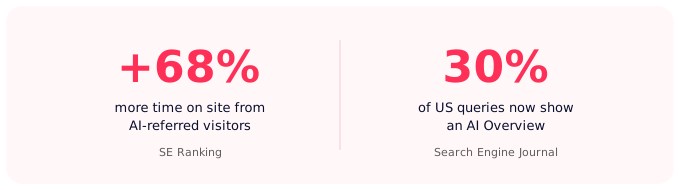
AI Overviews now appear in roughly 30% of US queries and reach 1.5 billion monthly users globally, according to Search Engine Journal data from January 2026.
Organic CTR for queries with an AI Overview falls 67% compared to queries without one, per Seer Interactive's analysis of 25 million impressions.
Voice search and smart assistant responses also draw from the same pool of structured, direct-answer content. If your content is formatted for AEO, it's eligible across all these surfaces.
What is GEO (Generative Engine Optimization)?
Generative Engine Optimization is the practice of building the brand signals, content authority, and off-site presence that cause language models — ChatGPT, Claude, Gemini, Perplexity, Copilot — to cite your brand or content when generating responses. For the full breakdown, see our guide on generative engine optimization.
What it optimizes for
GEO optimizes for citation and mention: being named, linked, or referenced inside AI-generated answers.
Unlike AEO, which targets structured features within Google Search, GEO targets the open-ended conversational responses of standalone LLMs and AI search tools.
Success is measured in brand mention rate, citation rate (how often your domain is linked), share of AI voice (your mentions vs. competitors), and topic coverage (which subtopics you appear in).
Key signals and tactics to include GEO in your content
GEO operates at a different level than AEO. It's about being known well enough that language models name your brand when generating answers.
- Build topical authority with a dense cluster of interlinked content that covers a subject comprehensively
- Audit your entity clarity — keep a consistent name, description, and attributes across your website, Wikipedia, Wikidata, Crunchbase, LinkedIn, and Google Business Profile
- Obtain off-site corroboration, like mentions in Wikipedia, Reddit, LinkedIn, trade press, and other sources LLMs treat as high-trust
- Produce original data and research — proprietary statistics, surveys, and case studies make your content a primary source
- Use Organization schema with
sameAslinks to all verified profiles
Which platforms use GEO signals
ChatGPT Search leads AI referral traffic with 55–60% share, followed by Perplexity at 18–22%, according to Digital Applied's 2026 analysis. Gemini is accelerating rapidly, growing from 5.7% to over 21% AI chatbot market share in twelve months.
Did you know? Visitors referred by AI platforms spend 68% more time on websites than those from traditional organic search. AI doesn't just bring users to your site — it brings quality traffic.
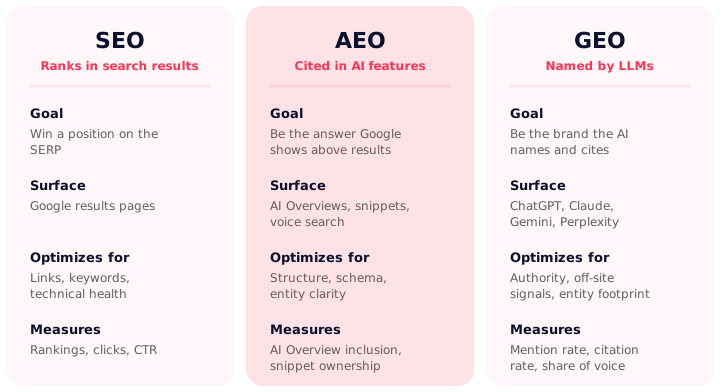
SEO vs AEO vs GEO: side-by-side comparison
A well-structured article with clear authorship, topical depth, and schema markup is a strong SEO asset, a candidate for AI Overview inclusion, and a source LLMs are more likely to cite — all at the same time.
Get all three layers with SEOcrawl AI
Tracking visibility across SEO, AEO, and GEO is now more important than ever — but it requires different tools for different surfaces. SEOcrawl AI brings them into one clean space.
The SEO Dashboard unifies Google Search Console and GA4 data with rankings, organic traffic, impressions, and technical health, so your SEO data is always current.
If SEO and GEO are one game now, they should live on one screen. SEOcrawl AI puts your classic rankings and traffic next to your AI visibility in the same dashboard, so you brief, measure and report both from a single view instead of stitching two tools together.
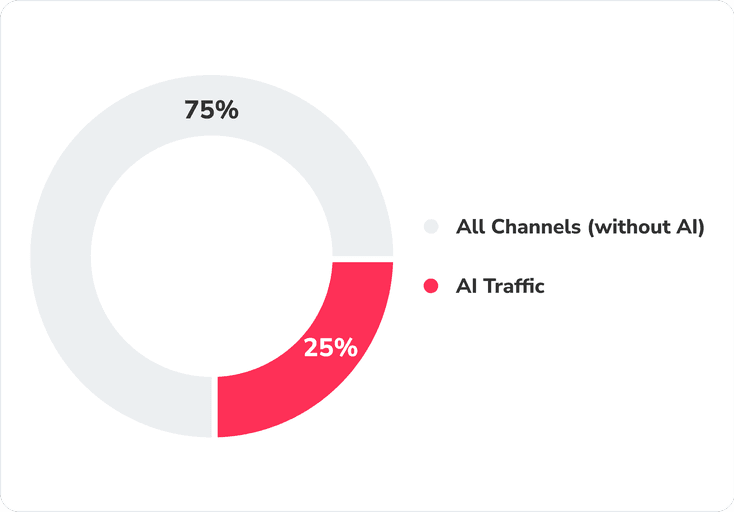
With our AI Tracker, you can see the actual traffic coming from ChatGPT, Claude, and Perplexity: sessions, users, landing pages, and how AI-referred visits compare to organic.
Prompt Tracking monitors your brand citations and share of voice across all major LLMs on a recurring schedule, with full citation history and competitor comparison.
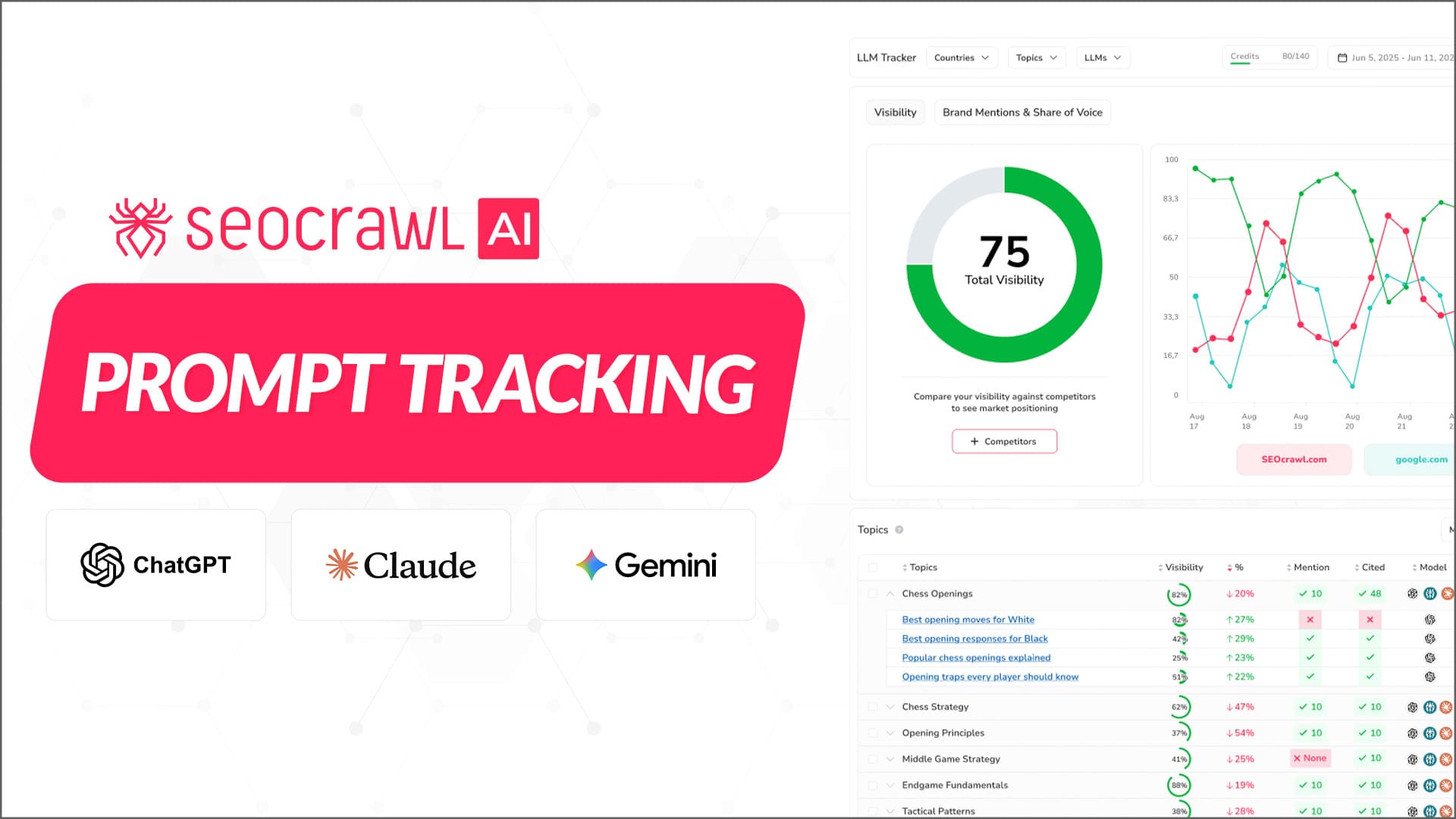
Most SEO teams already have rankings and traffic covered. What's missing is the AI layer. Discover all the SEO, AEO, and GEO features SEOcrawl AI has to offer and see exactly where you stand in AI search, not just traditional rankings.
FAQs
What is the difference between SEO, AEO, and GEO?
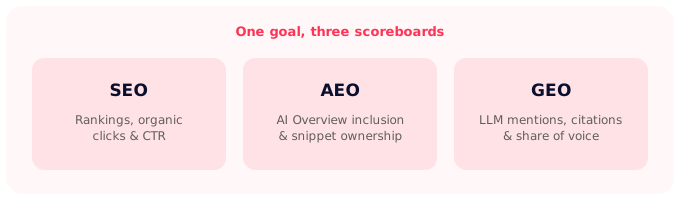
SEO optimizes for ranking in traditional search results. AEO optimizes for appearing as a direct answer in AI-powered features like Google AI Overviews and featured snippets. GEO optimizes for being cited by large language models (ChatGPT, Perplexity, Gemini, Claude) when they generate responses.
Is AEO the same as GEO?
They are related, but not the same. AEO focuses primarily on Google's AI-powered features (AI Overviews, featured snippets, voice search) and relies heavily on structured content and schema. GEO targets standalone LLMs and AI search tools, where brand authority, off-site corroboration, and entity signals matter more than schema alone.
Do I need SEO if I'm doing GEO?
Yes. Google has confirmed that AI Overviews are rooted in its core ranking systems, which means pages that don't rank are less likely to earn AI citations either. SEO is the foundation on which you can build your GEO strategy.
Is GEO replacing SEO?
No. Google still processes the vast majority of search queries, and 95% of Americans continue using traditional search engines. What's changing is that AI-powered surfaces now capture a meaningful share of informational and research queries. The most sensible approach is to extend your SEO strategy into GEO and AEO, not replace one with the other.
What is AEO in digital marketing?
AEO (Answer Engine Optimization) is the practice of formatting content so that AI-powered systems can extract and surface it as a direct answer to user queries. In digital marketing terms, it's the discipline that determines whether your brand is the source of the answer a user sees — in a Google AI Overview, a featured snippet, or a voice assistant response — rather than a link they may or may not click.
How do I measure GEO performance?
The core metrics are: mention rate (how often your brand appears in tracked AI responses), share of voice (your mentions relative to competitors), citation rate (how often LLMs link to your domain), sentiment mix, and topic coverage. Google Search Console provides data on AI Overviews appearances. For ChatGPT, Perplexity, and other LLMs, a dedicated prompt tracker is required. SEOcrawl AI's Prompt Tracking monitors all of these on a recurring schedule and surfaces trends over time.
Author: David Kaufmann

I've spent the last 10+ years completely obsessed with SEO — and honestly, I wouldn't have it any other way.
My career hit a new level when I worked as a senior SEO specialist for Chess.com — one of the top 100 most visited websites on the entire internet. Operating at that scale, across millions of pages, dozens of languages, and one of the most competitive SERPs out there, taught me things no course or certification ever could. That experience changed my perspective on what great SEO really looks like — and it became the foundation for everything I've built since.
From that experience, I founded SEO Alive — an agency for brands that are serious about organic growth. We're not here to sell dashboards and monthly reports. We're here to build strategies that actually move the needle, combining the best of classical SEO with the exciting new world of Generative Engine Optimization (GEO) — making sure your brand shows up not just in Google's blue links, but inside the AI-generated answers that ChatGPT, Perplexity, and Google AI Overviews are delivering to millions of people every single day.
And because I couldn't find a tool that handled both of those worlds properly, I built one myself — SEOcrawl AI, an enterprise SEO intelligence platform that brings together rankings, technical audits, backlink monitoring, crawl health, and AI brand visibility tracking all in one place. It's the platform I always wished existed.
Discover more content about this author
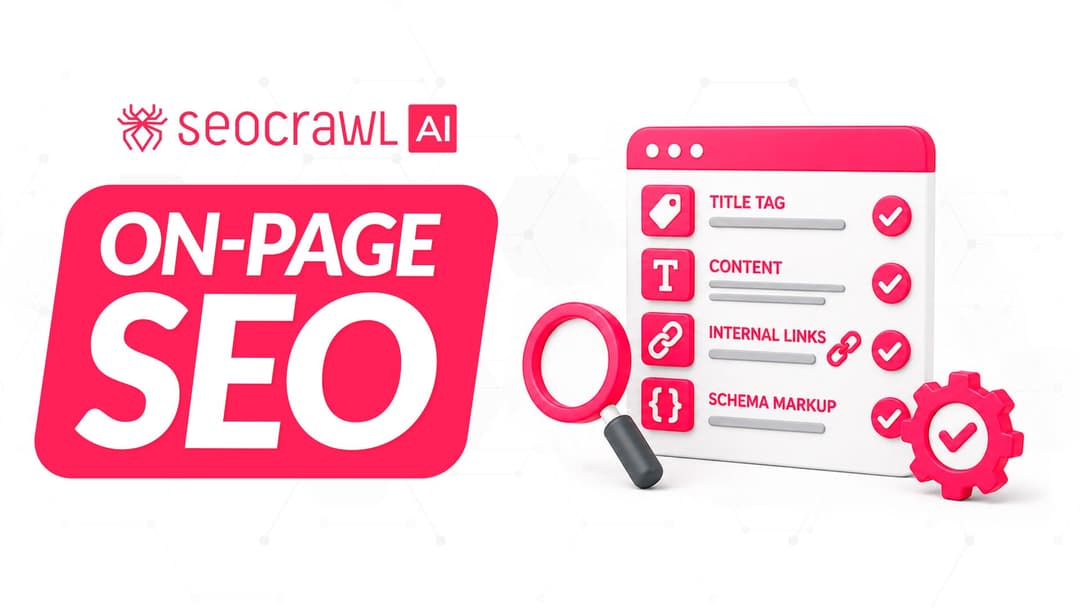
On-page SEO is everything you control on a page: content, title, meta description, headings, URL, images and internal links. Here is a checklist element by element, an audit process and what changes with AI Overviews and AI Mode.