Web Architecture for SEO: The Complete Guide

In every process, both SEO and web development, there is one phase that stands out in importance above the rest. We are talking about web architecture. Do we really know what it is and how it can influence our project?
To put it in context, and based on our experience, 70-80% of websites that fail do so because this phase was not properly planned and did not receive the critical importance it deserves.
What is Web Architecture?
We can define web architecture as the way the pages of a website are structured and linked to each other in a logical and coherent manner. An ideal web architecture helps users and search engine spiders easily find what they are looking for on a website.
Why is architecture important for SEO?
Let's use a very simple analogy. Think of a large store, a department store where we can find a wide variety of products, including food. Imagine we are buying a TV, and right next to it, when we want to look at furniture to place it at home, we see a shelf with tomatoes, and next to it a drawer with shirts and pants.
Do you think the shopper would get a good impression of the store or be able to buy and find what they are looking for in a short time? Probably the customer would leave without buying, and if someone on the street asked them what the store's specialty was, they would be completely unable to say.
Having given this quite graphic example, let's apply it more to our digital niche.

In an SEO environment, we can justify the importance of a proper web architecture mainly for three reasons:
- First: An optimized web architecture helps search engine spiders find and index all the pages of your website. It's simple: crawlers enter our website and, if they are unable to crawl it completely, to find all the pages and understand their importance and hierarchy, it is most likely (not to say certain) that they will leave some pages unindexed along the way. It may happen, as it often does, that those pages are the ones intended to generate conversions, thus losing all their potential.
This type of incident, due to a poor site architecture, usually occurs in large eCommerce sites where proper attention is not paid, leaving product pages unindexed along the way and losing all the organic sales they would bring us.
If you have pages on your site that are several clicks away from the homepage (or are not linked from any other page), Googlebot will have difficulty finding and indexing those pages. But if the site architecture is interrelated, the spiders can follow its internal links to 100% of the pages.
- Second: Through proper architecture and good use of internal linking, we will achieve an optimal distribution of authority (PageRank). By correctly linking the most relevant pages of our website, we will get Google to understand that they are the ones with the most weight and, therefore, show them above the rest.
Before any other action, we must consider at a business level which are the relevant pages we want to highlight for Google.
- Third: A correct website architecture makes it easy for visitors to find what they need. Going back to the department store example, if next to a product we place related products, content that can enrich the user's search, or content that complements the initial one, we will be able to retain the user more, get them to visit more areas of our establishment, and probably make a purchase.
That, translated to SEO, will provide:
-
Longer dwell time on the website.
-
Greater page consumption.
-
Higher number of clicks, etc.
All of these are signals Google receives that our site is interesting for the user, and therefore will help us rank better in the SERPs.
SILO-type web structure
If we investigate a little on this topic, we will often read the expression "SILO-type web structure". Let's see what we mean by this specific type of structure:
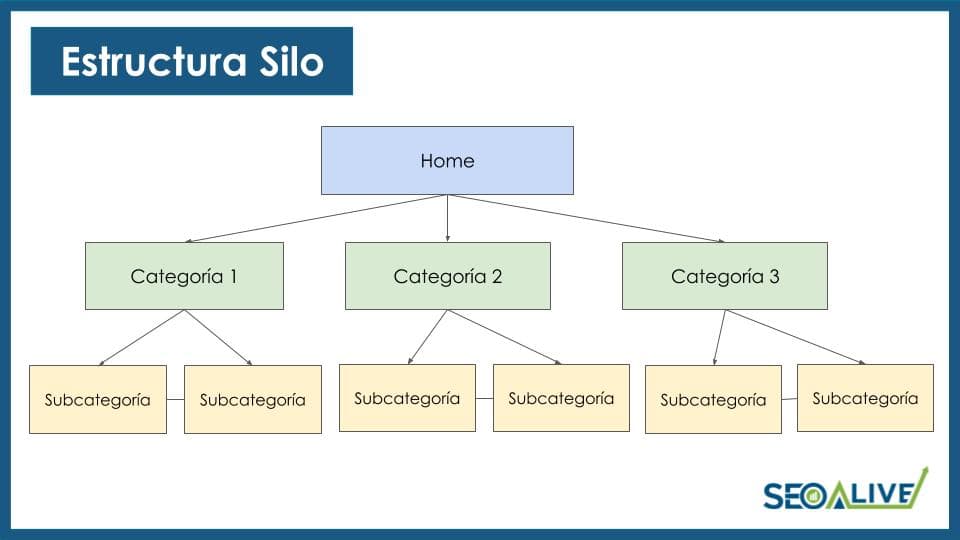
Silo structure is a form of SEO architecture that optimizes a site's structure by organizing its content into categories, which in turn host content on the same subject and avoid relating it to keywords from other categories. This structure pursues the goal of increasing the relevance of these keywords in the eyes of search engines.
In the previous example we see the disorder that would be generated in a non-SILO structure, in which if we wanted to grab a few blue candies, we would probably end up with some of another undesired color.
This type of procedure is very common and widely used when creating a web architecture and its internal linking, but it does not have to be strict, but rather adapt to the needs of the project.
Best practices when building our architecture
1. Use a "flat" site architecture
In general, a "flat" site architecture provides greater benefits from an SEO point of view.
A flat architecture means that users (and search engine crawlers) can reach any page on our website in 4 clicks or less.
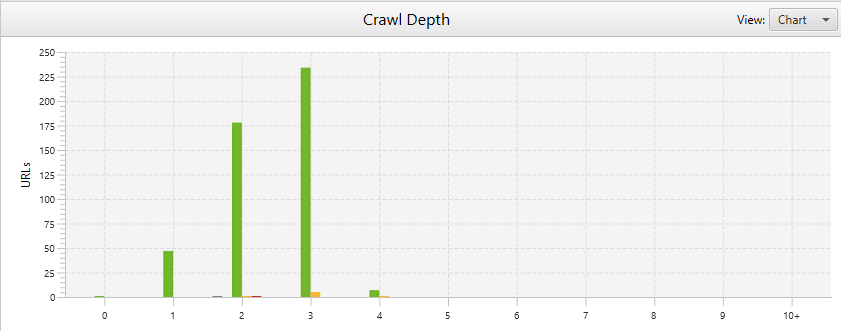
On the other hand, a "Deep" site architecture means that reaching certain pages can take between 4 and 10 clicks.
Why is this important?
First, a shallow web architecture means that link authority flows from the pages that have a greater number of backlinks, such as the home page, to the pages we want to rank, such as product pages.
Second, a flat architecture means that Google's spiders can find all the web pages of your site in a more optimal time, thus maximizing the crawl budget.
2. Simplicity in the website
There will be cases where simplifying a website will be more difficult due to its complexity. But it is advisable to keep this in mind when developing it, even on sites with hundreds of thousands of pages.
Not only is it bad for SEO, but it is also a bad user experience. Imagine you just landed on a random page on that site. Do you really think the user will find it easy to navigate and find what they need? Probably not.
But when your site's architecture is simple, it is very easy for users to navigate your site to find what they need, and if it is easy for users, it will also be easy for crawlers.
This is why it is important to establish a correct web hierarchy from the very first moment and maintain that idea throughout the growth of the website over time.
It is a very common mistake, on websites that begin to grow uncontrollably, to add categories and subcategories, linking them to each other without much study or criteria, creating clusters and a hierarchy tree without any sense, creating a website impossible to understand for Google's spiders.
3. Using category pages optimally
The pages we create as "category" make the organization of the architecture easy and scalable in the medium and long term.
Want to launch a new page? Add it to an existing category. And link the new page from that category. This way you will be able to grow steadily and maintain a proper flow of PageRank. For this, it is necessary to have properly carried out a good initial study with which to define this point.
Want to add a large number of new pages? We will create a new category. And link the new pages from the page of that new category.
Without the category structure, pages are added randomly... which usually results in a complicated site architecture.
It may be the case, on small sites, that a category structure does not make sense, and we exclusively organize the final pages. As we mentioned, this is usually for small sites, and we insist again on the importance of prior initial planning before launching into building the website.
4. URL Structure
Within our web architecture, the URL structure should logically follow its categories. This is really important, as it will help the user know where they are on the website simply by reading the URL, as long as it is friendly.
To help us with this, there is an element of vital importance in any web architecture, the breadcrumbs. They have, as we say, a very high weight, as they will serve to tell us at all times where we are on the website, how that page is related to its predecessor, what hierarchy it has, and will also help to improve the distribution of authority.
Here is an example of a URL structure that many sites use:
https://exampledomain.com/category/subcategory/keyword
The URLs don't have to look exactly like this, but it is important that all URLs on the site follow the same structure.
5. Use internal links
The architecture is determined by the way your pages are linked to each other.
That is why we have to link to category pages from a navigation menu, and from category pages to the individual pages of that category.
It is also important to use internal links to connect the content of one page to other related pages on our website.
These internal links are not just for SEO, but they help users have a better browsing experience.
Important: These internal links, with their corresponding anchor text, optimized for SEO, should have a CSS style that makes them stand out in the content they are in, so they can be easily identified visually as internal links.
6. Create and optimize our Sitemap
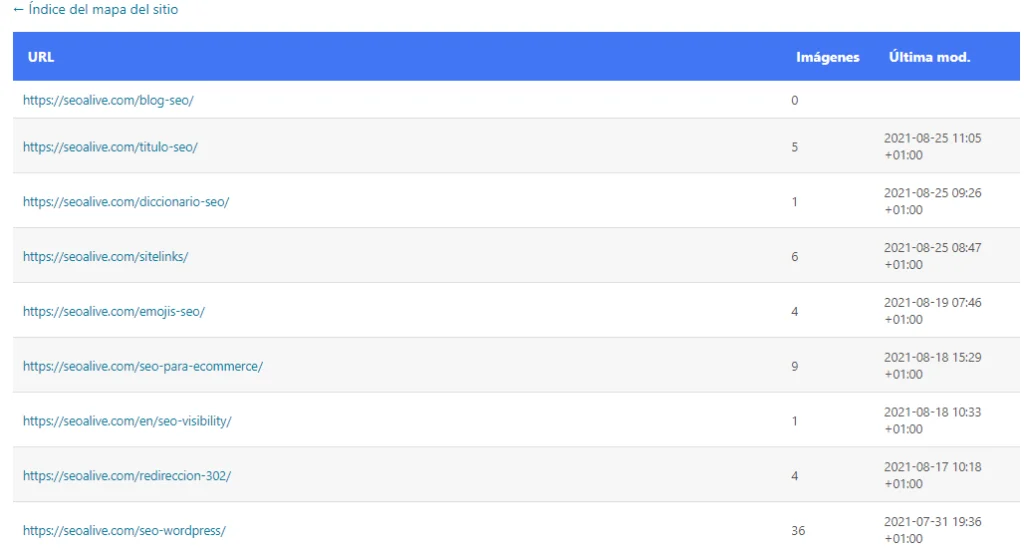
A sitemap is a great way to increase the "crawlability" of our website. It will also help us maintain greater control over the categories and subcategories of our website, as long as we keep it up to date and optimized.
As a final conclusion, when designing an architecture, we must first keep in mind the user experience in navigation and the sense we give it throughout their stay on our website. If it is optimal, clear, and simple for them, it will also be for Google and it will reward it.
Do you want us to help you organize the most optimal architecture for your website? Contact our team, we are happy to lend you a hand.
Author: David Kaufmann

I've spent the last 10+ years completely obsessed with SEO — and honestly, I wouldn't have it any other way.
My career hit a new level when I worked as a senior SEO specialist for Chess.com — one of the top 100 most visited websites on the entire internet. Operating at that scale, across millions of pages, dozens of languages, and one of the most competitive SERPs out there, taught me things no course or certification ever could. That experience changed my perspective on what great SEO really looks like — and it became the foundation for everything I've built since.
From that experience, I founded SEO Alive — an agency for brands that are serious about organic growth. We're not here to sell dashboards and monthly reports. We're here to build strategies that actually move the needle, combining the best of classical SEO with the exciting new world of Generative Engine Optimization (GEO) — making sure your brand shows up not just in Google's blue links, but inside the AI-generated answers that ChatGPT, Perplexity, and Google AI Overviews are delivering to millions of people every single day.
And because I couldn't find a tool that handled both of those worlds properly, I built one myself — SEOcrawl AI, an enterprise SEO intelligence platform that brings together rankings, technical audits, backlink monitoring, crawl health, and AI brand visibility tracking all in one place. It's the platform I always wished existed.
Discover more content about this author
On-page SEO is everything you control on a page: content, title, meta description, headings, URL, images and internal links. Here is a checklist element by element, an audit process and what changes with AI Overviews and AI Mode.