How to Rank in ChatGPT: A ChatGPT SEO Guide for 2026
ChatGPT has quietly become one of the most influential discovery engines on the internet. In 2026, millions of users are getting brand and product recommendations directly from AI-generated answers instead of traditional search results. If your business isn't showing up in those answers, you're invisible to a fast-growing segment of your audience.
What "ranking" in ChatGPT actually means in 2026
There's no position 1 in ChatGPT. No SERP to track. When someone asks ChatGPT for a tool recommendation or asks who the leading providers in a category are, the model generates a response. And either your brand is in that response, or it isn't.
How ChatGPT search retrieves and cites sources
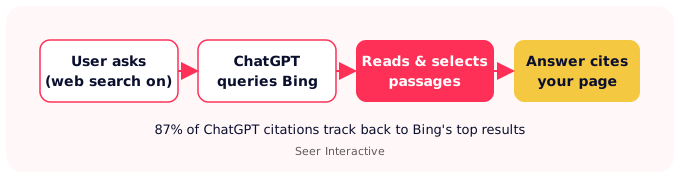
ChatGPT operates in two modes. When web search is off, it draws from its training data: everything it ingested before its knowledge cutoff. When web search is on (increasingly the default), it queries Bing in real time, reads the content, and synthesizes a response with inline citations. Both modes matter, and both respond to different signals.
The difference between traditional SEO and AI search optimization
Traditional SEO is about ranking a page for a keyword on a results page. AI search optimization is about building the conditions that make a model trust your brand enough to surface it in a generated answer.
Google rewards on-page relevance, backlink authority, and technical health. ChatGPT rewards brand mention frequency, off-page presence, and content that can be extracted cleanly without additional context. The overlap exists (backlinks and E-E-A-T matter in both), but the weighting and the pipeline are different.
Why ChatGPT rankings matter for traffic and brand visibility
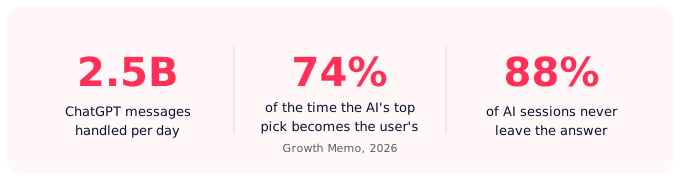
ChatGPT handles over 2.5 billion messages a day. A growing share of those are product and service recommendation queries. Users who get a recommendation from ChatGPT often don't go back to Google to verify. The AI's top pick becomes the user's top pick 74% of the time (Growth Memo, April 2026).
Referral traffic from AI sources converts at a disproportionately high rate. In 88% of AI Mode sessions, users never left the pane to check external sources. The brand that gets cited first has a significant advantage.
How ChatGPT decides which sources to cite
Understanding the citation mechanism is the basis of everything else. Most ChatGPT SEO advice skips this and jumps straight to tactics. That's a mistake.
Training data vs. real-time retrieval
In training data mode, ChatGPT answers based on what it learned during pre-training. The brands and sources that appeared frequently and authoritatively across the web before the model's cutoff are the ones it associates with a given topic. You can't retroactively influence this, but you can start building the signals that will matter for the next training cycle.
In real-time retrieval mode, ChatGPT uses Retrieval-Augmented Generation (RAG): it formulates a search query, pulls results from Bing, reads the content, and synthesizes a response with citations. This is where current optimization work has direct, measurable impact.
How Bing powers ChatGPT's live search results
87% of ChatGPT's citations in retrieval mode overlap with Bing's top results (Seer Interactive). This is the single most important data point for anyone trying to improve ChatGPT visibility. If your site ranks well on Google but isn't properly indexed on Bing, you're invisible in ChatGPT's retrieval mode regardless of how good your content is.
Google SEO and ChatGPT visibility are related but not the same thing. The authority signals overlap (backlinks, E-E-A-T, brand credibility), but the pipeline is different. Bing has its own crawler, its own index, and its own ranking signals.
Authority signals ChatGPT relies on (E-E-A-T, brand mentions, links)
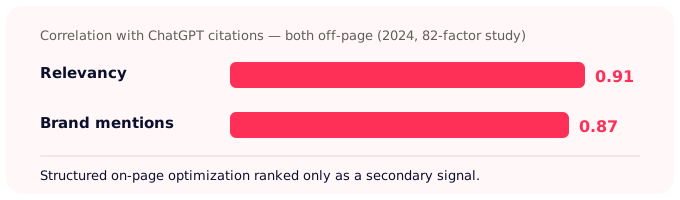
A 2024 analysis of 82 factors correlated with ChatGPT citations found that relevancy (r=0.91) and brand mentions (r=0.87) were the two strongest signals, both off-page. Structured on-page optimization didn't appear as a primary driver. This doesn't mean on-page doesn't matter, but if you're investing all your energy in on-page tweaks while ignoring off-page presence, you're optimizing the wrong layer.
How retrieval-augmented generation (RAG) affects source selection
RAG is the mechanism that makes ChatGPT's live search work. When a user asks a question with web search enabled, the model decomposes the query into sub-queries, retrieves relevant results from Bing, reads the content, and selects passages to synthesize into a response.
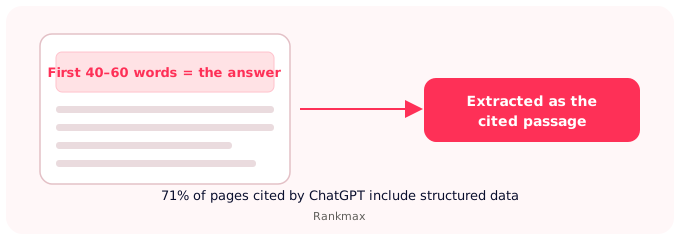
You can rank for fan-out sub-queries (the supporting questions the model generates when decomposing a main query) even if you don't rank for the primary keyword. Plus, the model selects passages, not pages. A page where the relevant answer is buried in a wall of text will lose to a page where the answer is in the first 60 words of a clearly structured section.
Build topical authority that AI models trust
The brands ChatGPT cites most consistently aren't necessarily the ones with the most pages or the highest Domain Authority. Topical authority means the model has encountered your brand as a credible source on a specific subject repeatedly, across your own content, third-party mentions, and editorial coverage.
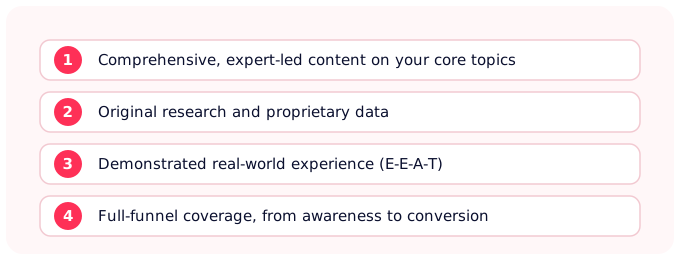
- Create comprehensive, expert-led content on your core topics. AI models favor sources that consistently provide complete, expert-level coverage of a subject.
- Publish original research and proprietary data. First-party data, case studies, and original analysis are citation magnets and what trains models to treat you as an authoritative source.
- Demonstrate real-world experience. First-person accounts, specific examples from practice, and genuine expertise signals all contribute to E-E-A-T.
- Cover the full funnel. Build content that addresses your topic from awareness-level questions down to conversion-ready comparisons.
Optimize your content structure for large language models
Using clear, declarative sentences and direct answers
The first 40-60 words of any section should deliver the core answer directly. Don't build up to it. A model extracting a passage for a citation needs something that stands alone without the surrounding context.
Avoid context-dependent pronouns: "this approach", "the method above", "as mentioned earlier". Each passage should be self-contained.
Format content with headers, lists, and tables LLMs can parse
Structured formatting is a signal to the model about how information is organized. Headers that frame a section as a question help the model identify what the section answers. Bullet points and tables allow the model to extract structured information without parsing flowing prose.
Use H2s and H3s as questions users actually ask, not as keyword phrases or topic labels.
Write concise definitions and summaries AI can lift verbatim
Include definitions for technical terms in the same sentence or the one immediately after. Here's an example of a citation-ready paragraph:
Retrieval-Augmented Generation (RAG) is the mechanism ChatGPT uses to answer questions with real-time web data. When a user asks a question with web search enabled, the model queries Bing, retrieves relevant pages, reads the content, and synthesizes a response with inline citations. Pages that are easy to parse (clear structure, direct answers, no jargon walls) are more likely to be selected as sources.
Every sentence in that paragraph can stand alone. No sentence requires the previous one to make sense.
Implement schema markup and structured data
Pages cited by ChatGPT include structured data 71% of the time (Rankmax). The most relevant schemas:
- FAQPage: Even though Google retired the FAQ rich result in May 2026, FAQPage schema remains valuable — LLMs read structured data when indexing pages independently of Google's display decisions. Answers of 80-150 words perform better for AI extraction than the 30-word answers built for Google's accordion.
- Article with Author: Explicitly links content to a verified person with credentials — a direct E-E-A-T signal at the schema level.
- HowTo: Useful for procedural content where a clear sequence aids extraction.
Optimize for featured snippets (they feed AI answers)
Content optimized for featured snippets (direct answers in the first paragraph, clear question-format headers, structured formatting) is exactly the kind of content AI models extract. The two optimization targets are almost identical.
If your pages are winning featured snippets for informational queries in your category, they're already structured the way AI models prefer.
Strengthen your brand's digital footprint and off-page signals
Earn high-authority backlinks from trusted domains
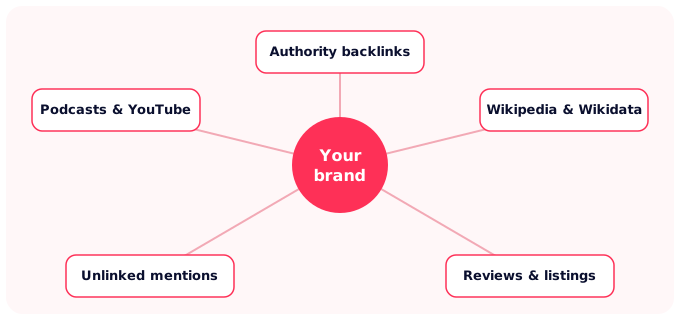
Backlinks from well-regarded publications do double duty: they contribute to your Bing ranking (direct pipeline to ChatGPT retrieval) and add data points to the model's association between your brand and the topic. A single link from an authoritative domain in your industry carries more weight than dozens of links from low-authority sites.
Get mentioned on podcasts, YouTube, and industry publications
Being a guest on a relevant podcast or contributing to a YouTube channel in your category generates mentions across multiple formats (show notes, transcripts, summary articles), each one a data point. Audio and video content increasingly appears in LLM training data.
Build consistent brand mentions across the web (unlinked citations count)
Your brand name appearing in relevant contexts without a hyperlink (unlinked brand mentions) trains the model to associate your brand with a topic. Frequency of co-occurrence matters independently of whether there's a link. Treat brand PR, community participation, and earned media as AI SEO signals, not just awareness activities.
Leverage Wikipedia, Wikidata, and Knowledge Graph presence
Wikipedia is among the most heavily weighted sources in LLM training data. A Wikipedia entry for your brand increases the model's ability to associate your name with a specific category, which directly raises citation likelihood. Wikidata entries have a similar effect on knowledge graph inclusion.
Optimize your Google Business Profile and third-party listings
Consistency of brand name, description, and category across platforms (Google Business Profile, G2, Capterra, industry directories) contributes to entity consistency. This tells models your brand is a stable, real entity with a clear identity, not a one-off mention in a single context.
Technical SEO foundations that support AI discoverability
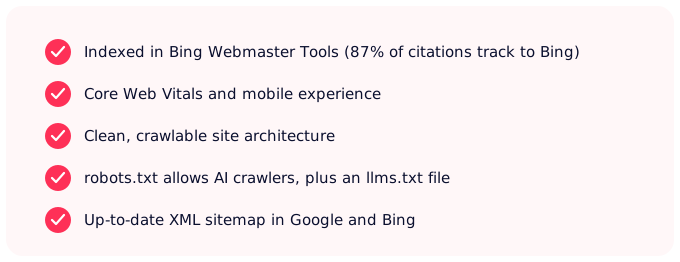
Ensure your site is indexed by Bing (not just Google)
Set up Bing Webmaster Tools, submit your sitemap, and verify that your most important pages are indexed. Given that 87% of ChatGPT citations track back to Bing results, this is the highest-ROI technical action available.
Optimize page speed, Core Web Vitals, and mobile experience
Slow pages and poor mobile experience reduce crawl priority across all bots, including AI crawlers. These are optimizations you'll need for any content that wants to be found by any crawler, regardless of ChatGPT. If you're unsure where you stand, start with your Core Web Vitals.
Use a clean, crawlable site architecture
Pages behind authentication walls, JavaScript-heavy rendering that blocks crawlers, or deeply buried URL structures all reduce the likelihood of AI systems reaching your content. A flat, logical architecture with clear internal linking makes it easier for every crawler to find and index your content.
Implement robots.txt and llms.txt to guide AI crawlers
Check your robots.txt file explicitly for AI crawler user agents: GPTBot (OpenAI), ClaudeBot (Anthropic), PerplexityBot. Legacy broad disallow rules can accidentally block them. If any AI crawler is blocked, that system cannot access your content in retrieval mode.
llms.txt is an emerging standard that allows site owners to specify which content AI systems should prioritize when indexing their domain. Adoption is still early in 2026, but implementing it now positions you ahead of the standard becoming widespread.
Submit and maintain an up-to-date XML sitemap
An accurate, current sitemap submitted to both Google Search Console and Bing Webmaster Tools ensures crawlers can find your content efficiently. For sites that publish frequently, dynamic sitemaps that update automatically reduce the lag between publication and indexation.
Reputation and trust signals that influence AI recommendations
Collect and showcase reviews on G2, Trustpilot, and Google
Review platforms are heavily indexed and carry strong sentiment signals. ChatGPT absorbs tone from what it finds about your brand. A brand with consistent positive reviews across multiple platforms gets described differently than one with mixed signals. Volume and recency both matter.
Build author authority pages with verifiable credentials
An author bio page with verifiable credentials, publication history, and professional profiles gives the model explicit signals about who is behind the content and why they should be trusted. Link author pages to external profiles (LinkedIn, industry association memberships) that the model can cross-reference.
Get featured in "best of" lists and industry roundups
Being included in curated lists by recognized publications combines off-page authority with direct topic-brand association. When the model retrieves a "best [category] tools" article to answer a recommendation query, every brand in that list gets a citation opportunity.
Respond to negative mentions to maintain brand sentiment
Unaddressed negative coverage shapes the sentiment with which AI models describe your brand. A brand with unresolved public complaints or negative coverage in authoritative sources will be described with those associations.
Measure and track your ChatGPT visibility in 2026
Tools to monitor AI search citations and brand mentions
Unlike Google, there's no Search Console for ChatGPT. Without dedicated tracking, you have no visibility into whether you're being cited or how you compare to competitors.
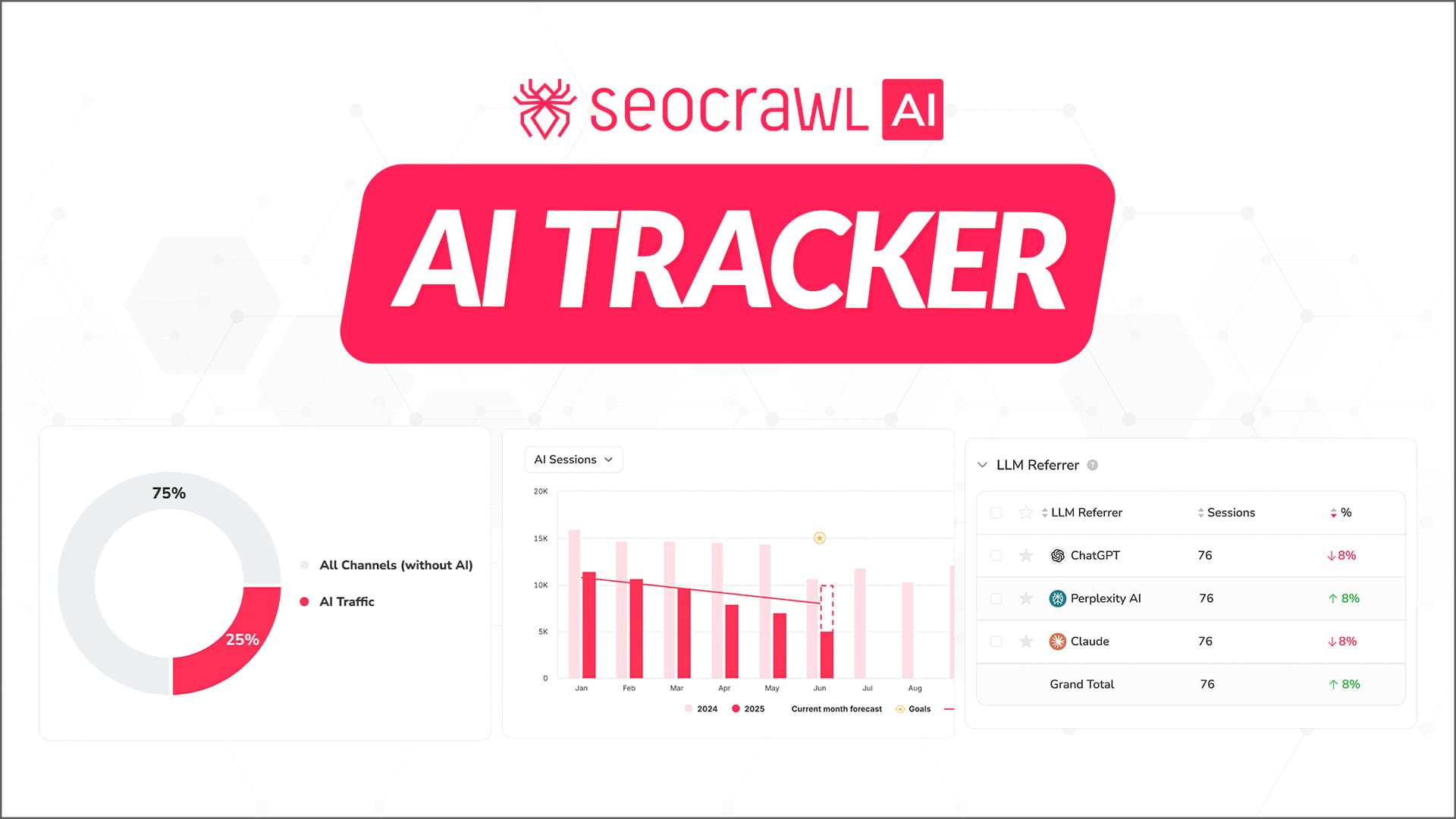
SEOcrawl AI's AI Tracker monitors brand mentions, share of voice, and sentiment across ChatGPT, Claude, Gemini, Perplexity, and Copilot, and connects that data to your classic SEO rankings and traffic in the same dashboard.
How to prompt-test your own ChatGPT visibility
The manual method requires no tools. Run category-level prompts in ChatGPT: "What are the leading [your category] tools?", "Which [your category] providers do most enterprise teams use?", "Compare [your brand] vs [competitor]". Then note whether your brand appears, where it appears, and how it's described.
But a single check can give you a misleading picture. For systematic tracking at scale, SEOcrawl AI's Prompt Tracker runs your prompts in ChatGPT on a schedule and logs every brand mention and cited URL, so you see the exact questions where ChatGPT already recommends you.
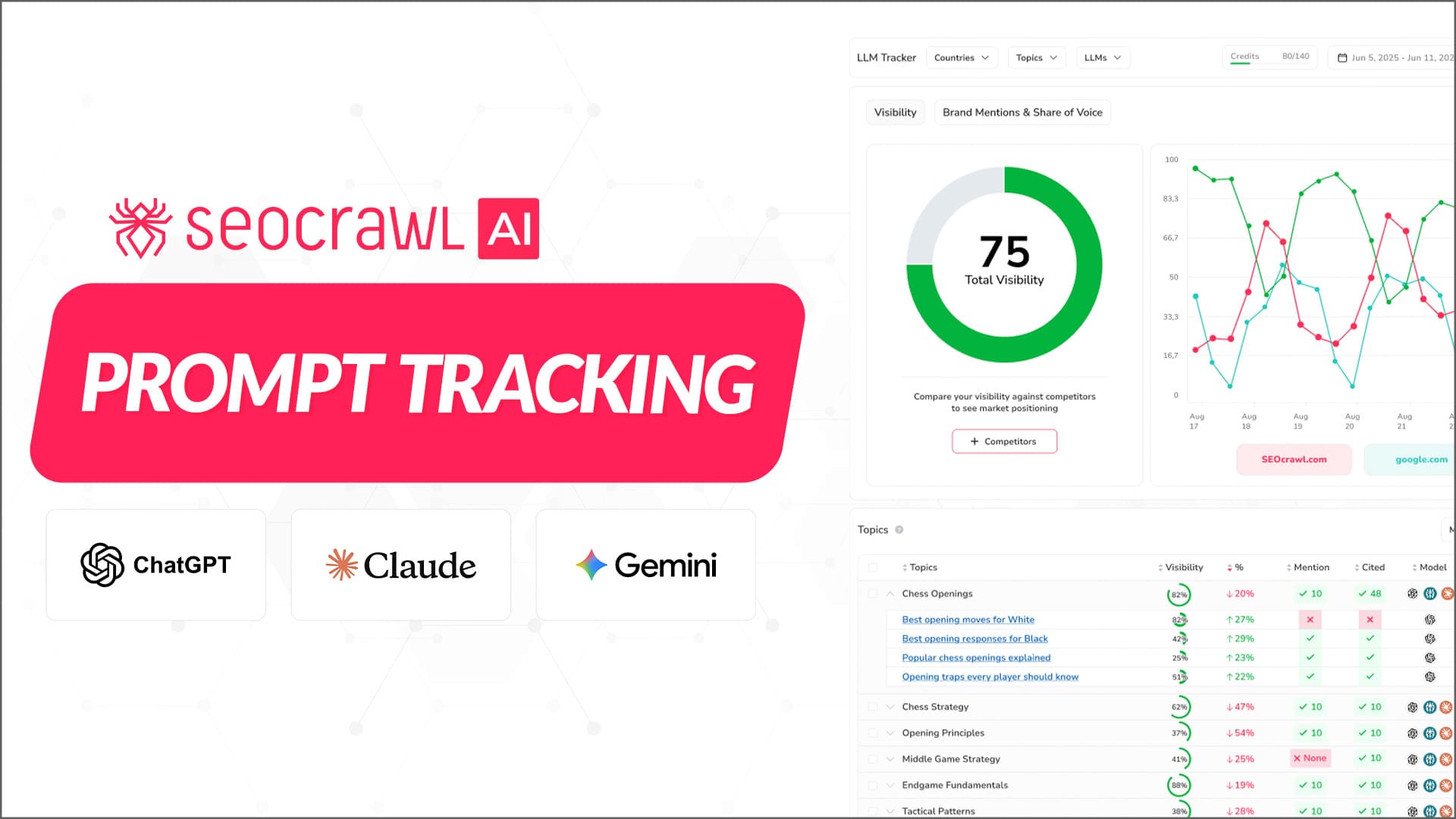
It also scores your share of voice against the competitors you name, and alerts you when one of them starts winning a prompt you used to own.
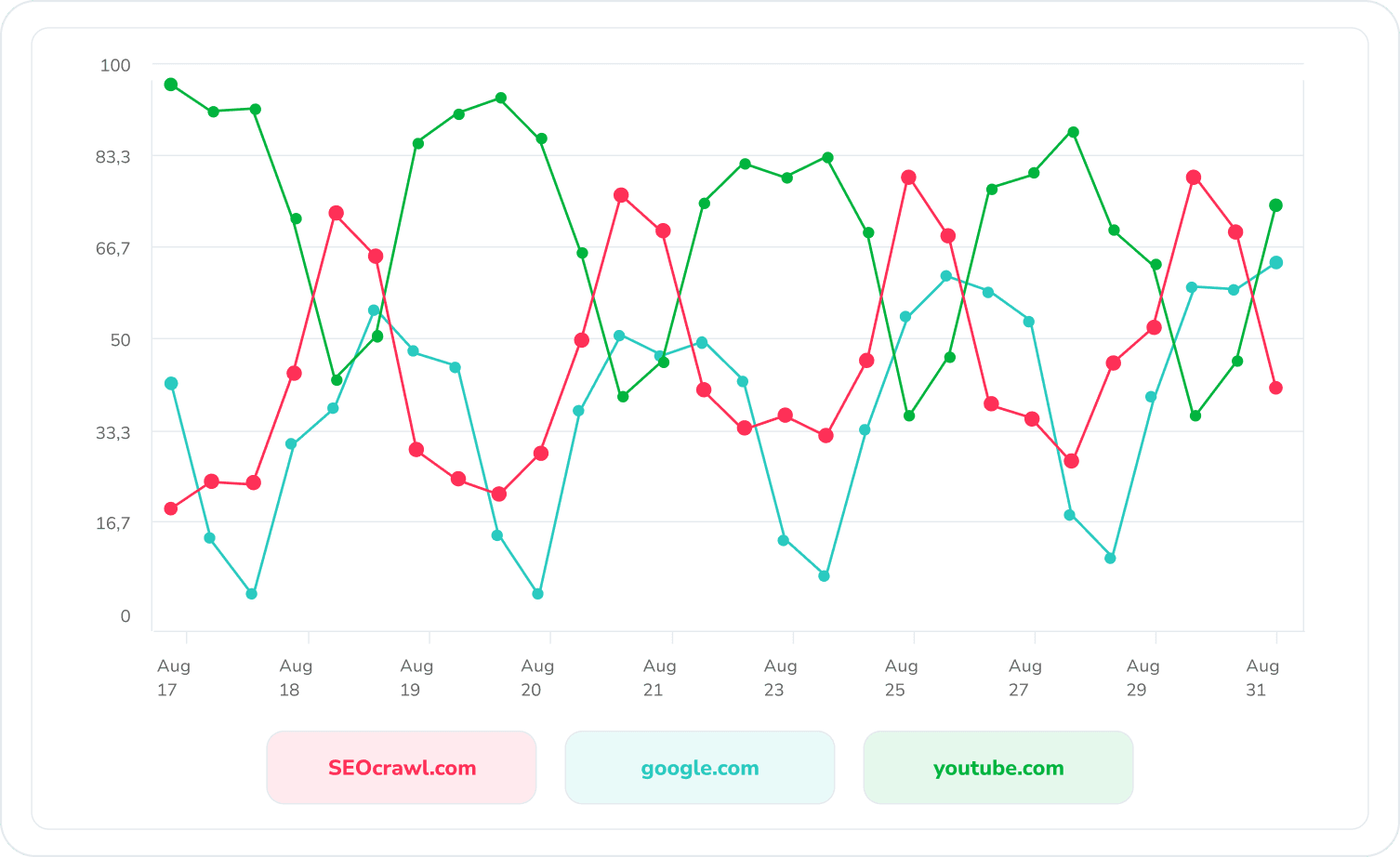
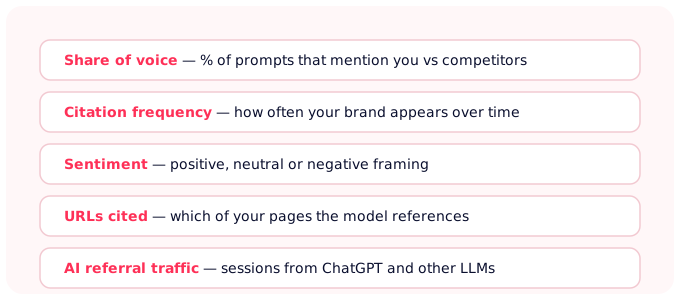
Key metrics: share of voice in AI, referral traffic from AI sources
- Share of voice: what percentage of relevant prompts include your brand, relative to competitors.
- Citation frequency: how often your brand appears across a defined set of prompts over time.
- Sentiment: whether the model describes your brand positively, neutrally, or with caveats.
- URLs cited: which of your pages the model references as sources.
- Referral traffic from AI: sessions attributed to ChatGPT, Perplexity, and other LLMs in your analytics, as a directional indicator of citation impact.
Iterating your strategy based on AI visibility data
AI visibility optimization is not a one-time project. The model's associations change as new content is published, as training data is updated, and as your off-page presence evolves.
Establish a baseline measurement, make targeted changes (a new listicle placement, a schema update, a Bing indexing fix), and measure the impact over 4-8 weeks. Build a feedback loop between the changes you make and the visibility data you collect.
Common mistakes that hurt your ChatGPT rankings
Thin AI-generated content that lacks real expertise
Content that lacks genuine expertise, original perspective, or first-hand experience doesn't build topical authority. It adds pages without adding signals. Worse, if the model has seen enough low-quality AI-generated content, it associates generic phrasing with low-authority sources, the opposite of what you want.
Ignoring Bing Webmaster Tools
Every SEO team has a Google Search Console workflow. Almost none have an equivalent Bing workflow. Given the direct pipeline from Bing to ChatGPT, this is one of the highest-impact gaps to close. And it's also one of the easiest, since setup takes minutes and costs nothing. Treat it with the same priority as Google Search Console.
Keyword stuffing vs. natural language optimization
ChatGPT doesn't reward keyword repetition. Instead, it favors pages that fully answer the question. A page that uses the target phrase ten times but doesn't provide a complete, extractable answer will be passed over for a page that answers the question directly, even if it uses the phrase less.
Neglecting off-site brand building
On-page optimization is necessary but not sufficient. If your brand has no off-page presence (like editorial mentions, listicle placements, or community discussion), the model has no reason to surface it, regardless of how well-structured your content is.
Blocking AI crawlers unintentionally
A robots.txt file written years ago may contain broad disallow rules that now block GPTBot (OpenAI), ClaudeBot (Anthropic), or PerplexityBot. Audit it explicitly for each AI crawler's user agent. This is the kind of mistake that's invisible until you check, and it disqualifies your content from the retrieval pipeline entirely.
Check also that your pages don't require authentication to load, that JavaScript rendering doesn't block content from being read, and that your most important pages return clean 200 status codes for all crawlers.
FAQs
Can you actually "rank" in ChatGPT the same way you rank on Google?
Not in the traditional sense. Google ranks pages by position on a results page. ChatGPT generates a response, and either includes your brand in it or doesn't. The equivalent of "ranking" is being cited or recommended. What drives recommendations is a combination of off-page authority, brand mention frequency, and content extractability, not keyword positioning.
Does Google SEO help you rank in ChatGPT?
Partially. Strong Google SEO builds authority signals (backlinks, E-E-A-T, brand credibility) that AI models also value. But ChatGPT's live search uses Bing, not Google. A site that ranks well on Google but isn't indexed on Bing will have limited ChatGPT visibility in retrieval mode.
How long does it take to start appearing in ChatGPT answers?
In retrieval mode, improvements to Bing ranking can show results in weeks. In training data mode, the timeline depends on the model's retraining cycle (typically months). The most reliable approach is to build off-page presence consistently: listicle placements, editorial mentions, and community discussion create a signal that influences both modes over time.
What is generative engine optimization (GEO) and how does it relate to ChatGPT ranking?
GEO is the practice of optimizing content to be cited by AI-generated answers across platforms like ChatGPT, Perplexity, and Google AI Overviews. It's the umbrella term for everything this article covers. The core principles (semantic completeness, off-page authority, structured content) apply across all major LLMs, with platform-specific variations in how each model weights different signals.
Does having a Wikipedia page help you rank in ChatGPT?
Yes, meaningfully. Wikipedia is among the most heavily weighted sources in LLM training data. A Wikipedia entry for your brand increases the model's ability to associate your name with a specific category, which directly raises citation likelihood. Wikidata entries have a similar effect on knowledge graph inclusion.
What is llms.txt, and should I add it to my website?
llms.txt is an emerging standard that functions like robots.txt but for AI crawlers. It allows site owners to specify which content AI systems should prioritize when indexing their domain. Adoption is still early in 2026, but adding it now is a low-effort forward-looking signal with no downside.
How do I check if ChatGPT is already mentioning my brand?
The manual method: run category-level prompts in ChatGPT (like, "what are the leading [your category] tools?") and note whether your brand appears and how it's described. For systematic tracking across multiple prompts and LLMs, SEOcrawl AI's AI Tracker monitors brand mentions, share of voice, and sentiment across ChatGPT, Claude, Gemini, Perplexity, and Copilot in one dashboard.
Does social media presence affect ChatGPT rankings?
Indirectly. Social posts themselves are rarely direct citation sources. But social activity drives content amplification. Posts that gain traction generate articles, discussions, and mentions that do get indexed. A strong social presence increases the surface area of your brand's off-page footprint, which is the primary driver of citation frequency.
Author: David Kaufmann

I've spent the last 10+ years completely obsessed with SEO — and honestly, I wouldn't have it any other way.
My career hit a new level when I worked as a senior SEO specialist for Chess.com — one of the top 100 most visited websites on the entire internet. Operating at that scale, across millions of pages, dozens of languages, and one of the most competitive SERPs out there, taught me things no course or certification ever could. That experience changed my perspective on what great SEO really looks like — and it became the foundation for everything I've built since.
From that experience, I founded SEO Alive — an agency for brands that are serious about organic growth. We're not here to sell dashboards and monthly reports. We're here to build strategies that actually move the needle, combining the best of classical SEO with the exciting new world of Generative Engine Optimization (GEO) — making sure your brand shows up not just in Google's blue links, but inside the AI-generated answers that ChatGPT, Perplexity, and Google AI Overviews are delivering to millions of people every single day.
And because I couldn't find a tool that handled both of those worlds properly, I built one myself — SEOcrawl AI, an enterprise SEO intelligence platform that brings together rankings, technical audits, backlink monitoring, crawl health, and AI brand visibility tracking all in one place. It's the platform I always wished existed.
Discover more content about this author
CTR tells you how many of the people who saw your result actually clicked. Here's the formula, what a good CTR looks like in 2026 by channel and by Google position, and how to get more clicks from the rankings you already have.