Google PageRank: What is it and how does it work?
Google uses hundreds of metrics in its role as a search engine to display relevant and valuable results for user queries. Each of those metrics, also known as signals or factors, has its own relevance, and PageRank is one of the most important ones that exist.
But, what is PageRank and how does it actually work? We will try to answer this in the present post, since this metric, although one of the earliest, is also one of the most essential.
What is PageRank?
By definition, PageRank is an algorithm created by Larry Page in 1999, co-founder of Google, which works as a classification system for websites for the Google search engine, ordering results according to the "authority" or importance of the site in relation to the links that connect to it, calculated based on a set of proprietary algorithms.
Although the explanation above is very simplified, since PageRank is actually a fairly complex logarithmic mathematical function, in which all incoming and outgoing links of a page intervene, it does help us understand its main function. Authority is measured according to each link that connects to the page and is taken as a "vote", therefore playing a fundamental role when classifying websites in Google's SERPs.
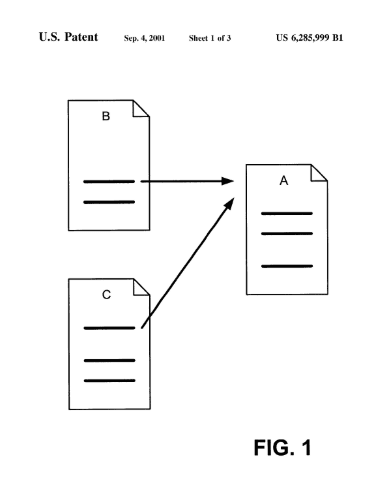
Here we leave you a link to the official Google patent about the calculation of PageRank. Representing it graphically (images courtesy of the official patents website) we have:
And complicating it a bit more:
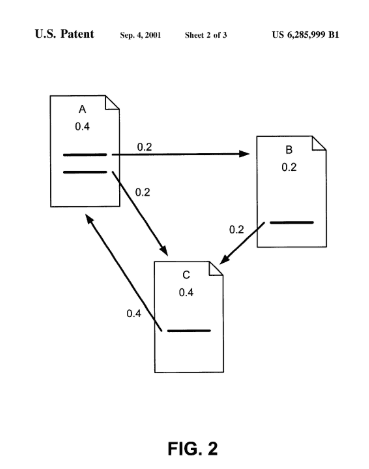
Since its launch, PageRank has undergone several modifications over time and even until 2016 it was public, until Google decided to hide the PR range of each page, keeping that value to themselves. Just because we don't have updated data visible, we shouldn't overlook it, since as we have mentioned, it will play a fundamental role in rankings.
How to calculate the PageRank or authority of a website?
Since we don't have quantifiable data or online references, it becomes a challenge for SEO professionals, although fortunately there are different tools on the market that use data similar to Google's to, based on their own algorithm, determine a domain authority for websites, such as MOZ, Sistrix, Ahrefs, Semrush, Majestic SEO, etc.
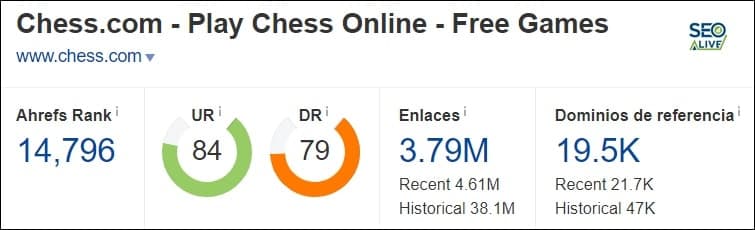
Example of URL and domain authority of Chess.com, one of our SEOcrawl AI clients.
Through these tools, we can measure the impact that the different SEO strategies we carry out on our websites have, both internally, improving internal linking, as well as with external linking from other authoritative portals.
The best way to improve PageRank on a website
If what we intend is to improve the authority of our target pages within our website, since logically we don't want all of them to have the same weight in Google's eyes, as a first course of action, we must draw up an internal linking strategy toward those target pages, always with the user in mind since it will affect their browsing experience, and we must always keep the focus on an optimal browsing experience.
Once this correct internal distribution of authority is traced (known as Linkjuice), we will proceed to carry out a proper external link acquisition strategy (linkbuilding). We will try to obtain quality links from reputable sites that already have good authority, related to our niche, and pointing to different pages on our website, so that they will be signals to Google of "receiving" PageRank from other websites, thereby increasing ours.
What not to do regarding PageRank?
While we previously mentioned some of the best and most consolidated techniques to improve the authority (PageRank) of our pages, we must keep in mind what we must NOT do when trying to achieve this improvement, as we can get a completely opposite effect, even falling into some kind of penalty.
When carrying out and planning strategies to improve our PageRank, it is essential not to add unimportant links, of low authority or unrelated to the site's niche just to increase a number. The quality of links has more influence than quantity, and we can incur penalty risks if we abuse low-quality ones.
It is very common in the world of SEO, to try to disproportionately accelerate what should be a "natural" growth in Google's eyes of a website's authority, exaggeratedly increasing the number of links pointing to our site, without taking into account the quality of the portals, the topic, the links that in turn point to those sites, etc.
If we fall into the temptation of this unnatural growth, we will probably have to answer to Google Penguin, which will gift us a penalty that will ruin all the efforts invested in our linkbuilding strategy.
What is PageRank Sculpting and why won't it help you improve your authority?
The PageRank Sculpting technique is defined as the artificial attempt to increase the authority of the pages on our website, through the use of attributes such as nofollow, transferring authority according to our own interests. Therefore we must avoid using the rel="nofollow" tag internally on our website, since this attribute is telling Google not to crawl the destination page by following that link, with which it would not transfer authority, but it would not be taken advantage of for other internal links either, but rather would be lost.
In the past, but now totally obsolete, this technique was used as a way to "direct" authority and therefore PageRank toward the pages that interested us. To prevent this manipulation, in many cases disproportionate on the part of webmasters, Google modified that attribute, so that authority would not be transferred through that link but would be "lost" in the depths of Google, making it a totally discouraged practice.
Author: David Kaufmann

I've spent the last 10+ years completely obsessed with SEO — and honestly, I wouldn't have it any other way.
My career hit a new level when I worked as a senior SEO specialist for Chess.com — one of the top 100 most visited websites on the entire internet. Operating at that scale, across millions of pages, dozens of languages, and one of the most competitive SERPs out there, taught me things no course or certification ever could. That experience changed my perspective on what great SEO really looks like — and it became the foundation for everything I've built since.
From that experience, I founded SEO Alive — an agency for brands that are serious about organic growth. We're not here to sell dashboards and monthly reports. We're here to build strategies that actually move the needle, combining the best of classical SEO with the exciting new world of Generative Engine Optimization (GEO) — making sure your brand shows up not just in Google's blue links, but inside the AI-generated answers that ChatGPT, Perplexity, and Google AI Overviews are delivering to millions of people every single day.
And because I couldn't find a tool that handled both of those worlds properly, I built one myself — SEOcrawl AI, an enterprise SEO intelligence platform that brings together rankings, technical audits, backlink monitoring, crawl health, and AI brand visibility tracking all in one place. It's the platform I always wished existed.
Discover more content about this author