What Is Query Fan-Out? The AI Search Technique Reshaping How Content Gets Found

Query fan-out is the AI search technique that turns a single user prompt into dozens (and sometimes hundreds) of parallel sub-queries, each retrieving different facets of an answer before an LLM synthesizes them into one response.
This method powers Google's AI Mode, ChatGPT, and Perplexity, and it shapes what content gets surfaced and cited. Understanding how fan-out works is now a prerequisite for any SEO or content strategy built for the AI search era.
What is query fan-out?
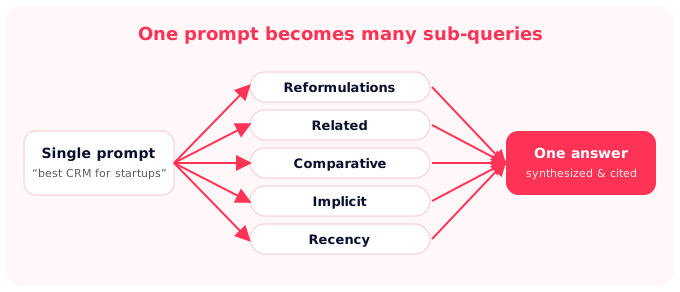
When you ask a model a question, the AI search system takes it and expands it into multiple parallel sub-queries. Each of those questions then goes out to retrieve specific information, and the final answer you see is a synthesis of everything that came back.
The term gained traction in 2024–2025 as Google began rolling out AI Mode. Engineers and SEOs started reverse-engineering how it worked, and what they found wasn't entirely new. Traditional query expansion has existed for decades (adding synonyms or related terms to a single search), but query fan-out is categorically different. It doesn't modify a query — it replaces it with many independent ones running simultaneously.
How it works: step-by-step
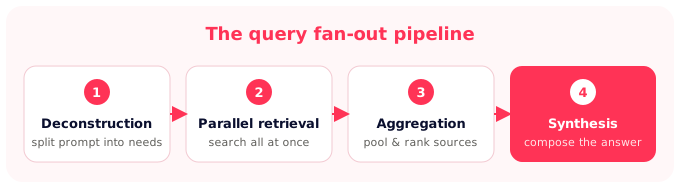
The pipeline behind query fan-out has four distinct stages. Each one matters because each is a potential point where your content either gets included or skipped entirely.
Step 1: Deconstruction
The AI parses the user's prompt and identifies every explicit and implicit need embedded in it.
A prompt like "best project management tool for remote teams" doesn't just ask for a product recommendation. It also implicitly asks about collaboration features, pricing, integrations, user reviews, and comparisons with alternatives. The system extracts all of these as separate retrieval targets.
Step 2: Parallel retrieval
Each sub-query goes out simultaneously to retrieve relevant sources. This is the "fan-out" moment: instead of a linear search, the system runs many searches in parallel. This happens in milliseconds.
Step 3: Source aggregation
Results from every sub-query come back and are pooled. The system evaluates which sources are authoritative, which are redundant, and which cover angles the others missed.
Step 4: Synthesis
The LLM takes the aggregated source pool and composes a final response. This is where your content either gets cited or disappears. Being left out doesn't mean your content ranked poorly — it means it didn't satisfy enough of the sub-query spectrum to survive aggregation.
Fan-out across platforms
Not all platforms implement query fan-out the same way. The scope, speed, and sub-query types differ meaningfully across Google, ChatGPT, and Perplexity.
| Platform | Fan-out scope | Behavior |
|---|---|---|
| Google AI Mode | Most aggressive — reported to spin up dozens to hundreds of sub-queries | Decomposes deeply into related, implicit, and comparative angles, then synthesizes with links |
| ChatGPT (search) | Moderate | Reformulates and expands the prompt, runs web retrieval, and cites a focused set of sources |
| Perplexity | Focused | Breaks the prompt into a smaller set of targeted sub-queries optimized for fast, citation-heavy answers |
The takeaway isn't the exact count on any given platform — those numbers move. It's that all of them decompose your prompt before they answer, so a page that only addresses the literal question is fighting at a disadvantage.
Types of sub-queries generated
Understanding which sub-query types your content covers (and which it doesn't) is the starting point for any fan-out optimization strategy.
| Sub-query type | What it retrieves | Example (from "best CRM for startups") |
|---|---|---|
| Reformulations | The same intent, reworded with synonyms | "top CRM software for early-stage companies" |
| Related | Adjacent topics the user likely cares about | "CRM pricing for small teams" |
| Comparative | Head-to-head and alternative angles | "HubSpot vs. Pipedrive for startups" |
| Implicit | Unstated needs baked into the prompt | "CRM with a free tier and easy onboarding" |
| Recency | Fresh or time-sensitive information | "best startup CRMs in 2026" |
| Entity expansion | Specific products, features, or names | "CRM integrations with Slack and Gmail" |
The two most commonly missed are comparative and implicit sub-queries — most content teams optimize for the stated question and ignore the unstated one.
Why query fan-out matters for SEO
Query fan-out doesn't directly affect traditional Google rankings. Your blue-link position is determined by the same signals it always was. What fan-out changes is whether you get cited inside an AI-generated answer.
- The citation problem. A page can rank #1 for a keyword and still never appear in an AI answer if it only satisfies one sub-query type.
- LLM invisibility. This is the phenomenon where a page ranks in traditional search but is never cited in AI answers. Fan-out increases this risk: the more sub-queries a prompt generates, the more angles your content needs to cover.
- The traffic impact. AI Overviews and AI Mode responses reduce click-through rates for the queries where they appear. If your content isn't cited inside those answers, you lose visibility at both levels — invisible in the AI answer, and fewer clicks from the SERP below it.
How to track it
Standard rank trackers don't capture fan-out exposure at all. They can measure your position on a SERP, but they miss inclusions in AI-synthesized answers.
Tools built specifically for AI search monitoring — like SEOcrawl AI's AI Tracker and Prompt Tracking — measure brand mentions, citation rate, and share of voice across ChatGPT, Claude, Gemini, and Perplexity. Those are the metrics that tell you whether your content is surviving fan-out aggregation.
How to optimize your content for query fan-out (7 tips)
Traditional SEO optimizes one page for one keyword. Fan-out optimization means covering the full sub-query spectrum that a prompt is likely to generate.
- Map content to the full sub-query spectrum. Before writing or updating a piece, ask: what are all the implicit, related, comparative, and high-intent questions someone asking this prompt might have? Those are the sections you should build.
- Build topic depth, not just breadth. An AI aggregating results prefers a source that goes deep on one sub-query angle over one that touches every angle shallowly.
- Structure content so AI can extract discrete answers. Each section should stand alone as a response to a specific question. Clear H2s and H3s, concise opening sentences per section, and FAQ-style formatting all help AI systems pull clean excerpts during aggregation.
- Strengthen E-E-A-T signals. During aggregation, the AI evaluates authority. Author credentials, original data, primary sources, and clear editorial standards all contribute to whether your content survives.
- Leverage FAQ and structured data markup. FAQ schema is one of the clearest signals that a piece of content is designed to answer specific queries — exactly what fan-out retrieval looks for.
- Anticipate comparative and implicit sub-queries. These are the most commonly missed. Build comparison sections even on pages that aren't explicitly about comparisons, and address objections, alternatives, and edge cases.
- Apply it to your own prompts too. If you build AI agents or agentic workflows, understanding fan-out changes how you write master prompts. A prompt that anticipates its own decomposition (breaking a task into sub-tasks upfront) retrieves better results than one that leaves all decomposition to the model.
If you want the bigger framework around all of this, our guide to generative engine optimization covers how fan-out fits into the wider shift from SEO to GEO.
FAQs
What is query fan-out in AI search?
Query fan-out is the process by which an AI system expands a single user prompt into multiple parallel sub-queries to retrieve comprehensive information. It is used by Google AI Mode, ChatGPT, and Perplexity.
How many sub-queries does query fan-out generate?
It varies by platform and query complexity, from a handful to dozens or hundreds running simultaneously. Google AI Mode is widely reported to generate the most aggressive fan-out of the major AI systems.
Does query fan-out affect traditional SEO rankings?
Not directly. Fan-out affects AI answer inclusion and citation, not classic blue-link rankings. But reduced click-through from AI answers does impact organic traffic for affected queries.
How can I optimize my content for query fan-out?
Build comprehensive topic coverage, anticipate implicit and comparative sub-queries, use structured data, and strengthen E-E-A-T signals so your content is cited across multiple sub-query types.
What is LLM invisibility?
The phenomenon where a page ranks well in traditional search but is never cited in AI-generated answers. Fan-out increases the risk because content must satisfy a wider range of sub-queries to be included in the synthesized response.
Is query fan-out the same as query expansion?
No. Traditional query expansion adds synonyms or related terms to a single search. Query fan-out generates entirely separate, parallel sub-queries that are each retrieved and synthesized independently.
Does query fan-out apply outside of search?
Yes. In agentic AI workflows, a master prompt is similarly decomposed into sub-tasks. Understanding fan-out is relevant for developers and AI product teams, not just SEOs.
Author: David Kaufmann

I've spent the last 10+ years completely obsessed with SEO — and honestly, I wouldn't have it any other way.
My career hit a new level when I worked as a senior SEO specialist for Chess.com — one of the top 100 most visited websites on the entire internet. Operating at that scale, across millions of pages, dozens of languages, and one of the most competitive SERPs out there, taught me things no course or certification ever could. That experience changed my perspective on what great SEO really looks like — and it became the foundation for everything I've built since.
From that experience, I founded SEO Alive — an agency for brands that are serious about organic growth. We're not here to sell dashboards and monthly reports. We're here to build strategies that actually move the needle, combining the best of classical SEO with the exciting new world of Generative Engine Optimization (GEO) — making sure your brand shows up not just in Google's blue links, but inside the AI-generated answers that ChatGPT, Perplexity, and Google AI Overviews are delivering to millions of people every single day.
And because I couldn't find a tool that handled both of those worlds properly, I built one myself — SEOcrawl AI, an enterprise SEO intelligence platform that brings together rankings, technical audits, backlink monitoring, crawl health, and AI brand visibility tracking all in one place. It's the platform I always wished existed.
Discover more content about this author

On-page SEO is everything you control on a page: content, title, meta description, headings, URL, images and internal links. Here is a checklist element by element, an audit process and what changes with AI Overviews and AI Mode.