12+1 SEO Tips to Improve Your Website's Results
Are there really SEO tricks that can help me rank my website quickly and effortlessly? The short answer is no, we're sorry. SEO only works when approached as a consistent, long-term strategy that is continuously measured so improvements can be implemented.
That said, you should be familiar with a whole toolkit of actions, more or less simple, that you can apply to your site and that will deliver results, if not immediate ones, then certainly solid and lasting ones. Want us to walk you through them? Let's get started!
On-Page SEO Tips
On-page optimizations are those carried out within the page itself, generally focused on technical aspects. Below we'll show you some of the most important ones.
1- Give Web Usability the Importance It Deserves
In other words, design your website with your users in mind, making it:
-
simple
-
friendly
-
intuitive
-
and, ultimately, easy to use.
Among other benefits, a usable website increases user satisfaction, drives more traffic, boosts time on site, and fosters loyalty...
So, what does it mean to optimize a website's usability?
-
Prioritize and structure content, so users always know where they are and can navigate the site intuitively.
-
Commit to a clean, clear, and simple design, avoiding unnecessary elements that cloud the overall image.
-
The main menu and headings should stand out, so users can take control of their navigation and decide where they want to go at any moment.
2- Go for Responsive Design
Responsive design means ensuring that your website will adapt perfectly to be viewed on any type of device: mobile phones of different sizes and resolutions, laptops or desktops, any type of screen, tablets...
Our recommendation when designing a website is to follow Google's guidelines regarding the mobile first index, meaning design with mobile in mind first and then adapt for desktop. Do this, and you'll succeed.
3- Forget About Black Hat
If you've been in this world for a while, you've surely heard about black hat: a set of "questionable" techniques used to trick Google and deliver fast, spectacular results.
We have bad news: black hat hardly ever works, and even less so in the long run. These are tactics that, years ago, before Panda and Penguin, helped sites rank at the top, but they have fewer and fewer followers because they carry a very high risk of penalties.
SEOcrawl AI tip: Are you tempted by the siren songs of black hat? All SEOs love testing new and different things, but if you want to experiment, try it on your own projects, never risk it on client sites.
4- Make Sure You're Visible to Search Engines
It's a rookie mistake, but more common than you'd think: a disallow directive in robots.txt protects a site that isn't ready to go live from being seen and indexed by search engines, and that's how it should be. Make sure to remove it before publishing the site, or Google won't be able to access it and, therefore, will never index it.
Likewise, be careful with pages containing the noindex tag, which tells the bot not to include that page in its index: check that no important content, or even the homepage itself, is tagged as noindex.
5- Work on Your Header Tags
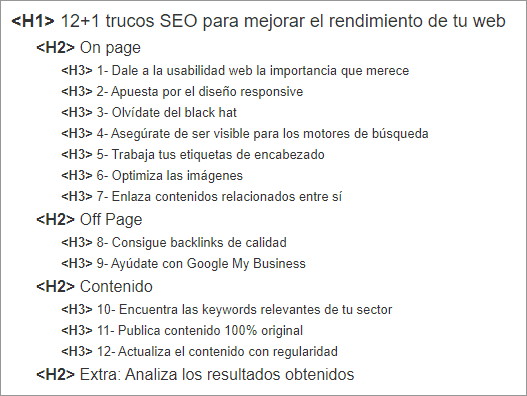
A solid content structure is important not only for users but also for Google's bots. Make sure each of your pages includes one, and only one, H1 tag that best describes that page's content, placing the keyword as far to the left as possible.
Next, design a hierarchical heading structure that organizes content logically, making it easy to understand at a glance. This will be useful for both humans and machines.
6- Optimize Your Images
In the 2.0 era, adding images to complement text is not just recommended but necessary: in addition to complementing the written content and improving comprehension, they "lighten" the informational load visually, creating more digestible and friendly texts.
Image optimization for the web is based on three points:
-
Alt tag or alternative text: the alt tag is used to describe the image content to the search engine. A good strategy is to include variations of the keyword you're working on, as long as they make sense.
-
File name: naming the image correctly, using keyword variations that describe its content, instead of a meaningless string of numbers and letters, can improve the user experience and help the image rank on Google.
-
Size and weight: so as not to drag down site loading, always upload images at the maximum size at which they'll be displayed and optimize them so they weigh as little as possible without losing quality.
7- Link Related Content to Each Other
One of the simplest ways to increase the time users spend on your site is to link thematically related content to each other: from a product to a post explaining how to use it, from one category to another with similar or complementary products, from one post to another that expands on an important concept...
Proper internal linking not only increases time on site but also helps prevent orphan pages on your site and ensures that link juice is distributed correctly among them.
Off-Page SEO Tips
We call off-page all those strategies that help us improve our website's ranking from outside of it. Want to know how? Take note.
8- Get Quality Links
For Google, every link from an external page to yours counts as a vote of confidence from that page, so the more you have, the better. Generating quality content and writing guest posts on friendly blogs can be a good way to start.
Designing a link building strategy that lets you grow while avoiding penalties should be one of your priorities. Want us to help you?
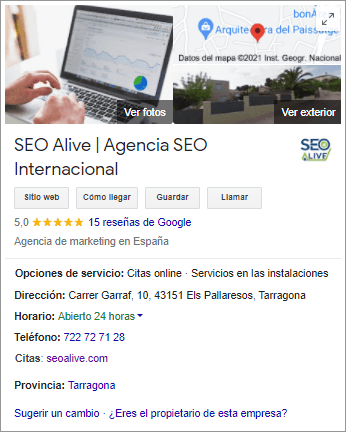
9- Leverage Google My Business
A Google My Business listing, especially for local projects, will help you be present at the exact moment when your potential customers need the service you offer.
Plus, you can personalize it with photos and videos of your business, reply to reviews (whether positive or negative), and make specific posts.
Content SEO Tips
A solid content strategy is key to improving the ranking of any web project. Want to know where to start?
10- Find the Relevant Keywords for Your Industry
Generating content just because, without a prior plan, is a mistake. Before you sit down to write, research the relevant keywords in your industry, those your potential customers use to search for the services or products you offer. To do this, observe how your competitors work or use free tools, like the Google Ads Keyword Planner, or paid ones, like Ahrefs or SEMrush.
11- Publish 100% Original Content
Once you're clear on what you should write about, create your own content plan and write 100% original texts: Google is very strict with duplicate content and can heavily penalize your project.
12- Update Content Regularly
If there's one thing that can encourage both users and Google's bot to visit your page frequently, it's knowing they'll always find something new. By contrast, a static page, with no frequent updates, won't. What's more, frequently updating your content gives you the opportunity to position yourself as an expert in your sector and improve your brand presence.
Extra: Analyze the Results You Get
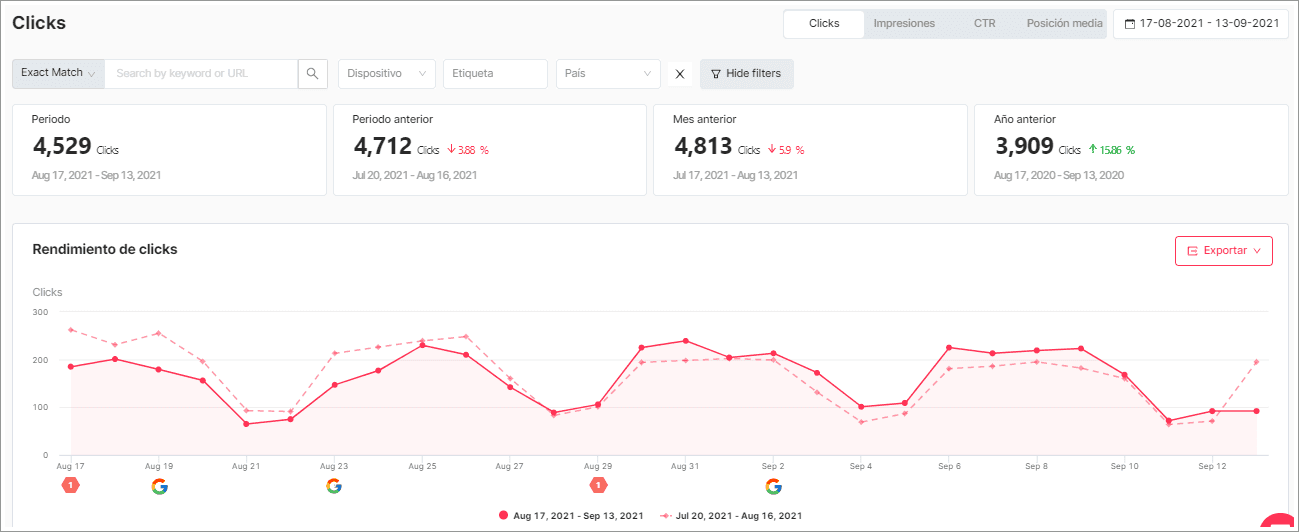
Constantly analyzing the results of the actions we implement is not an SEO tip: it's essential to know whether what we're doing makes sense or not. Continuously monitoring your KPIs will allow you to know which strategies are working well and, therefore, you should stick with them, and which aren't working, so you can make changes.
If you follow these guidelines, your site will be in good shape to achieve solid rankings in Google's search results. However, if you want to reach the top spots, you need to implement a full SEO strategy to help you get there. Want us to lend a hand?
Author: David Kaufmann

I've spent the last 10+ years completely obsessed with SEO — and honestly, I wouldn't have it any other way.
My career hit a new level when I worked as a senior SEO specialist for Chess.com — one of the top 100 most visited websites on the entire internet. Operating at that scale, across millions of pages, dozens of languages, and one of the most competitive SERPs out there, taught me things no course or certification ever could. That experience changed my perspective on what great SEO really looks like — and it became the foundation for everything I've built since.
From that experience, I founded SEO Alive — an agency for brands that are serious about organic growth. We're not here to sell dashboards and monthly reports. We're here to build strategies that actually move the needle, combining the best of classical SEO with the exciting new world of Generative Engine Optimization (GEO) — making sure your brand shows up not just in Google's blue links, but inside the AI-generated answers that ChatGPT, Perplexity, and Google AI Overviews are delivering to millions of people every single day.
And because I couldn't find a tool that handled both of those worlds properly, I built one myself — SEOcrawl AI, an enterprise SEO intelligence platform that brings together rankings, technical audits, backlink monitoring, crawl health, and AI brand visibility tracking all in one place. It's the platform I always wished existed.
Discover more content about this author
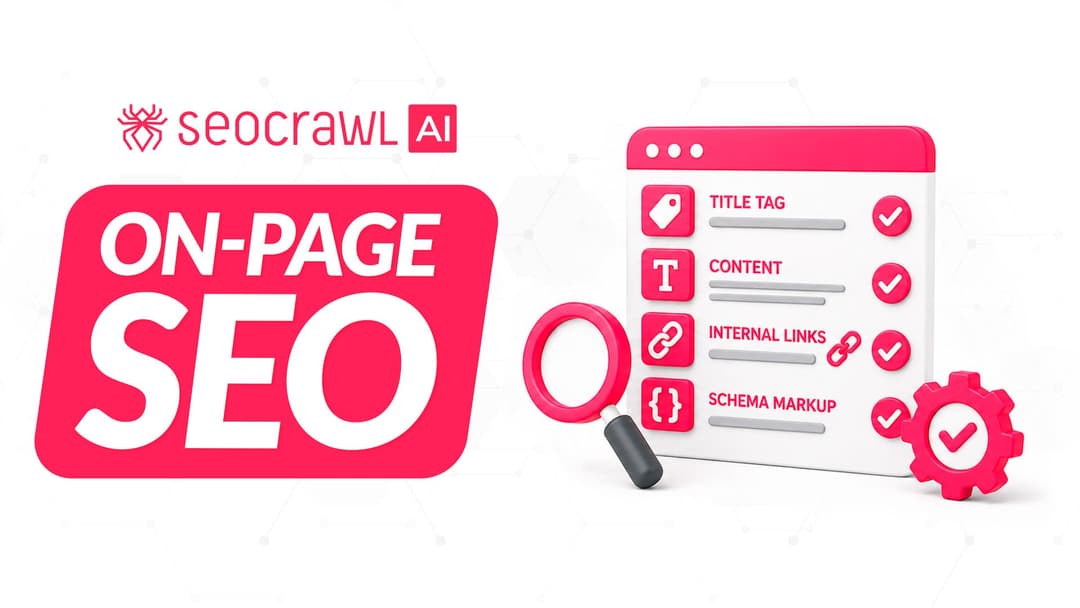
On-page SEO is everything you control on a page: content, title, meta description, headings, URL, images and internal links. Here is a checklist element by element, an audit process and what changes with AI Overviews and AI Mode.