Complete Guide to Mobile First Index
The growth in the use of mobile devices across the entire digital ecosystem, compared to the so-called desktop devices, is a reality that has been happening in recent years and that, as you might expect, Google was not going to overlook.
This is why, a few years ago, it began to introduce a new concept known as Mobile First Index.
What is the Mobile First Index?
Mobile First Index is the name given to the indexing and ranking methodology that prioritizes the mobile version of a website over its desktop version.
In this way, Google's bot first retrieves the elements of a site in its mobile version and prioritizes them when deciding the positions the page will occupy in the SERP results.
Previously, indexing was performed in almost all cases according to the desktop version, both for indexing and ranking.
This concept was first introduced in November 2016, when Google announced this new approach. Continuing with the history of this important change, on July 1, 2019, Google officially announced that all new sites would be considered for indexing under the Mobile First Index.
And more recently, Google has announced that in September 2020 the Mobile First Index will become the default behavior for all crawled sites.
Difference between Mobile First Index and Mobile Friendly
It's important to distinguish between the terms Mobile First Index and Mobile Friendly, because they refer to two different things, and users frequently use them interchangeably to mistakenly refer to the same concept.
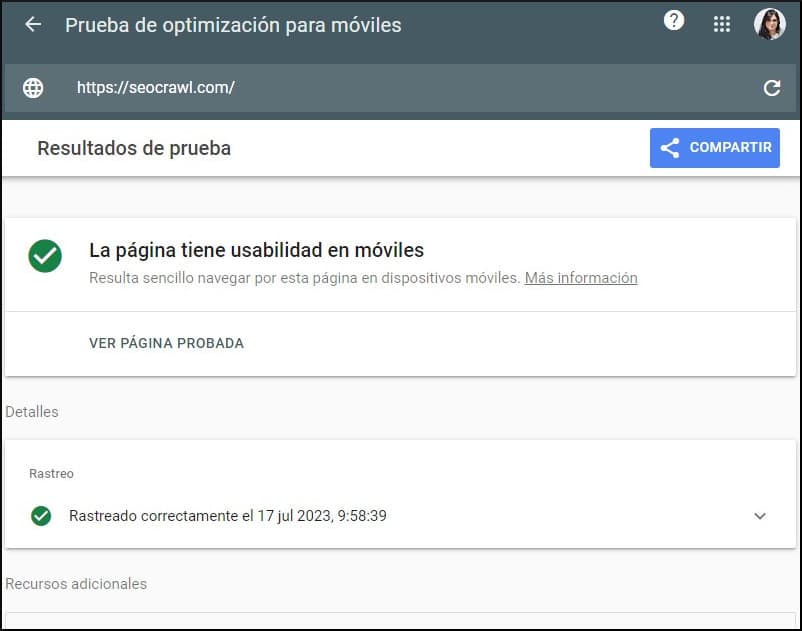
The Mobile Friendly concept refers to how our website will look on mobile devices, how the content, elements, user experience, etc., will adapt. A website is said to be responsive if it adapts to such devices and is therefore mobile friendly.
Google provides an official tool to validate whether our website complies with these mobile friendly guidelines, which we can find here.
The growth in the use of mobile devices across the entire digital ecosystem, compared to the so-called desktop devices, is a reality that has been happening in recent years and that, as you might expect, Google was not going to overlook.
This is why, a few years ago, it began to introduce a new concept known as Mobile First Index.
On the other hand, the Mobile First Index, as we have seen, is an indexing algorithm that prioritizes the content of the mobile version over the desktop version.
Best practices for mobile-first indexing
A website that wants to take advantage of the new Mobile First Index methodology must, of course, be Mobile Friendly.
But it must also be developed taking into account key elements that help the Smartphone-agent, or mobile smartphone user agent, make the most of our website and rank it correctly.
Best practices for optimal mobile-first indexing:
-
Use structured data, both on the desktop and the mobile version.
-
Include the same metadata in the mobile version as in the desktop version.
-
Keep the content elements in the mobile version (text content and graphic elements).
-
Take advantage of social metadata, both in the mobile and desktop versions.
-
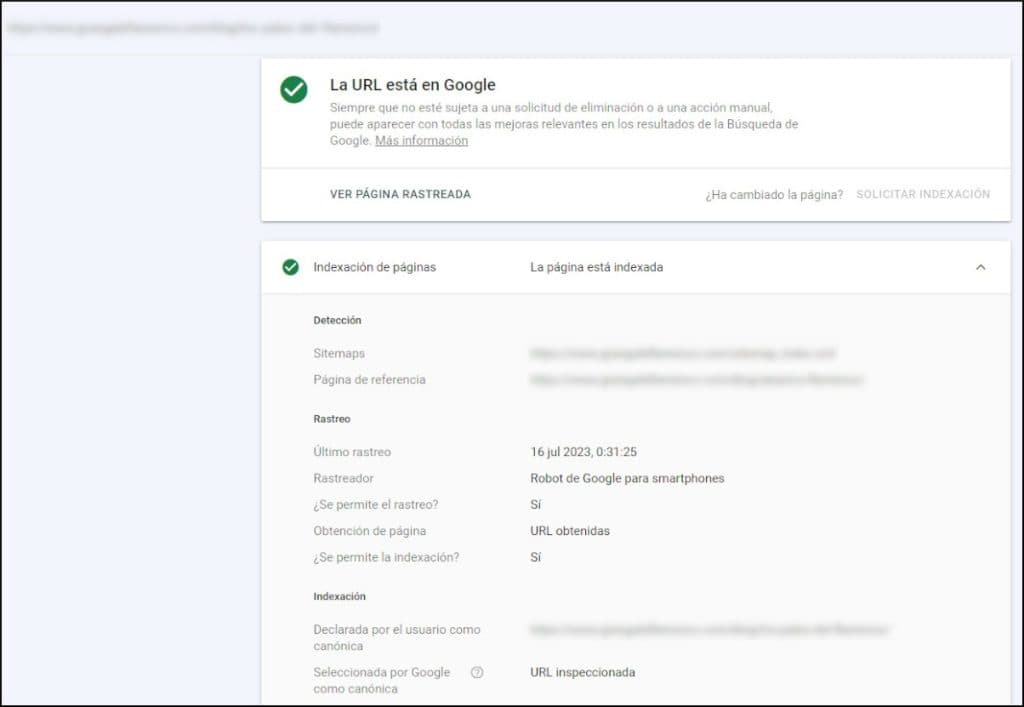
Check the mobile version in Search Console to facilitate its indexing.
-
Check your server's capacity. The website will have a higher crawl rate, and a too-limited hosting setup could cause problems.
-
Don't use different URLs for a desktop website and a mobile website. It should be the same URL, but properly adapted to each device.
How does the Smartphone-agent work?
To implement crawling using the Mobile First Index methodology, Google relies on the Smartphone-agent.
These "user-agents" are actually software applications used by Google to crawl websites. For the Mobile First Index, the so-called "Smartphone-agents" do all the work.
First, the crawler accesses the web page and identifies the coding that allows it to structure all the content. It then analyzes the applied "on-page" optimization factors, in order to later combine them with the "off-page" elements. Together, it can identify the site's level of popularity and relate the content to the target keywords.
Based on the existing competition and the strength of the site itself, it can establish a ranking of positions for each search.
Now, what happens if we don't have a mobile version? In reality, this crawler doesn't make a difference, as having a mobile website is not mandatory. The website will still be crawled and ranked.
However, the lack of adaptation to a mobile version implies a penalty in SEO ranking, something that has been established for some time now. Although today it would be quite rare to find websites in this situation.
Who would be affected by Mobile First Indexing?
We find 3 profiles of websites for which Mobile First Indexing affects differently:
-
Websites without a mobile version: They will not be affected, because they will continue to be crawled as before. But these websites will likely suffer a penalty for not being Mobile Friendly.
-
Websites with different desktop and mobile versions: In these cases, the mobile version will take priority in crawling. Its content and optimization will determine SEO ranking.
-
Websites with identical desktop and mobile versions: They will not be negatively affected, since they have prepared everything for optimal crawling. The mobile version (which will be the same as the desktop version) is the one that will determine the website's ranking.
When will MFI take effect for all websites?
As we mentioned at the beginning of the article, this will happen starting in September 2020. Google has officially announced this date on its official blog.
In the same announcement, it once again emphasizes the importance of NOT having two different versions of the same website, a domain for the desktop version mydomain.com and a subdomain for the mobile version m.mydomain.com, as this will cause a greater number of problems and confusion when indexing and classifying. Responsive web design and a single version are preferable.
Do you still have doubts, or is your website still using a different version for mobile? Don't worry! Send us a message and we'll help you leave your website flawless at the SEO level.
Author: Isabel Rubio

My story with the written word began long before I'd ever heard of SEO. I studied Journalism because I was obsessed with telling things properly, and from traditional newsroom writing I jumped — almost without realising — to copywriting and content marketing. That's where I discovered that writing for people and writing so Google understands you aren't opposing disciplines: they're two sides of the same coin.
I've worked at different media outlets and agencies, until in August 2021 I joined SEOcrawl AI as Content Director. Since then I write and coordinate the content of our projects, convinced that every article, every guide and every piece has to give the reader something useful and, on the way, rank where it needs to rank.
I split my life between León and Madrid, I dedicate every hour I can to writing and reading (though it never feels like enough), and without batting an eye I still defend that content is king.
Discover more content about this author