International SEO
Is your project ready to make the international leap? Before considering scaling your business to other countries, you need to ask yourself a series of questions and reflections, aimed at discovering whether it's truly the right time and what your chances of success are. Once you've decided to take your project international, having a partner capable of designing and executing the best international SEO strategy is essential. Do you want to know how we do it at SEOcrawl AI?
Can every project be internationalized?
This is the first and most important question you need to answer before starting. We've encountered it countless times throughout our history, and our opinion on the matter is very clear: NO.
Taking your brand to the top in another country, achieving good organic rankings and attractive financial results can require an investment (not just financial, but also in effort and resources) that may not be worthwhile. Or it may simply be that your product or service isn't of interest in the market you want to explore.
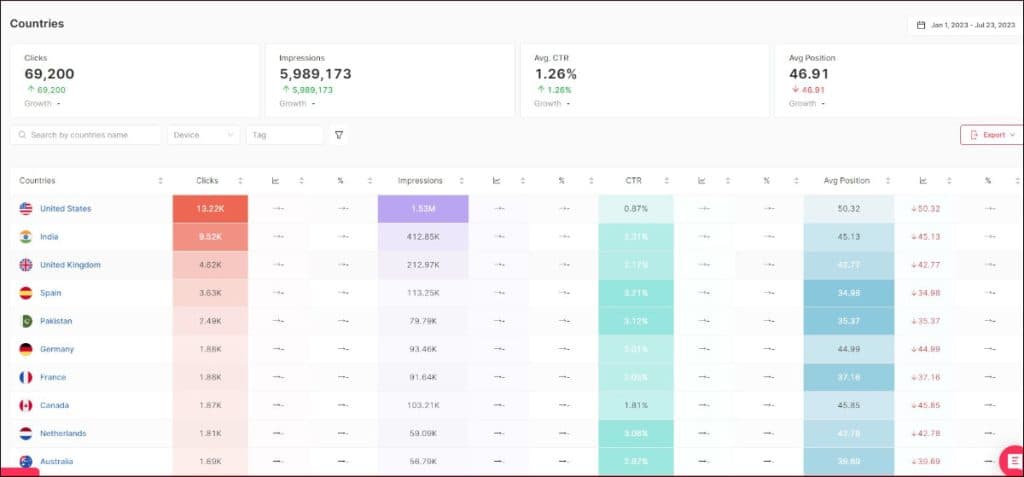
A simple review of your organic traffic filtered by country and language can help you sense whether making the international leap is a good idea or not. Did you know you can review this with SEOcrawl AI?
Business study
But how can I know if my business is ready to make the international leap? The market, target audience, competition… are relevant factors that must be studied before deciding to take the plunge. How do we answer these questions at SEOcrawl AI?
Market and target audience study
As a company, you already know that not all markets are the same. Before launching into business in another country, it's essential to understand the conditions of the local market and the type of target audience that makes it up (purchasing power and cultural level, aspirations, tastes, hobbies… everything that may impact how they will perceive your brand and what interest it will generate).
Local competition
Likewise, it's crucial to carry out a competitive analysis focused on the local market you're aspiring to enter. Are they local competitors, or is there room for foreign competition? How does your competition operate? Is this a saturated market, or can it absorb new players? Understanding all of these circumstances will help you make the right decision.
Legal requirements
For us, it's essential to know the legal requirements our clients will have to adapt to in the different countries where they'll compete: currency type, current legislation regarding sales and after-sales guarantees, payment methods… Not being aware of these issues can cause major business problems when establishing yourself in another country.

On-Page International SEO Strategy
Once the preliminary studies have been carried out, if the conclusion is positive, congratulations! Together we're going to embark on an adventure that will take your project to new heights of success. It's time to design a specific SEO strategy for the country we're going to land in.
Keyword research
We must orient keyword research not only to the country, but also to the specific region in which we want to rank: even if the search intent is similar, and even if it's the same language, the keywords users use to refer to the same service or product don't have to be the same.
This is especially important because it's often overlooked, when internationalization takes place in countries that share the same language: if you're going to expand to Mexico, it's essential to carry out research focused on that country, since, although we share the language, Mexican Spanish and Spanish from Spain have many differences that can ruin the ranking strategy if they're not taken into account.
Learn how to carry out good keyword research and take home a FREE template!
Web architecture
Closely linked to keyword research is the design of the web architecture of the page. The tree of categories and subcategories, as well as the writing of the URLs that compose it, must be unique and specific for each market we want to work in, so that Google can recognize them, index them, and rank them.
Search engines
Although we normally talk about Google, when it comes to internationalizing a project we must take into account that there are large regions of the planet where the Mountain View giant is nothing more than the secondary or even marginal option:
-
Bing: it's the second option in Europe and the United States, behind the omnipresent Google.
-
Yandex: this is the most used search engine in Russia.
-
Baidu: the Chinese search engine is a must if you're going to operate in Asian markets.
Domain type and hosting
When establishing the domain, we have several options:
- Generic domain with country indication via subfolders.
domain.com/es or domain.net/fr
- Generic domain with country indication via subdomain.
es.domain.com or fr.domain.com
- Domain with country code.
domain.es or domain.fr
Recommendation: we always advise our clients to work with subfolders, since they allow you to leverage the authority of the main domain when starting to develop the SEO strategy in another country.
Hosting is the physical space where your website will be stored, and depending on the type of domain you've chosen, some types of hosting are more suitable than others:
-
Choose local hosting, with servers in the country where you're going to work, if you've chosen a domain with a country code.
-
Opt for a CDN (Content Delivery Network) if the strategy involves working with subfolders. This way, copies of your website will exist on different servers in different countries, so when a user enters, they'll access the copy closest to their physical location, reducing wait time and improving download speed.

Hreflang
Hreflang is simply the tag that tells Google how many versions of a website there are based on language and which one should be displayed at any given time.
Using it correctly is crucial because, on the one hand, it improves the relationship with your users, allowing them to directly access the most appropriate version of the website based on their origin, while on the other hand, it eliminates possible duplicate content issues, as it informs Google that there are different versions of the same content.
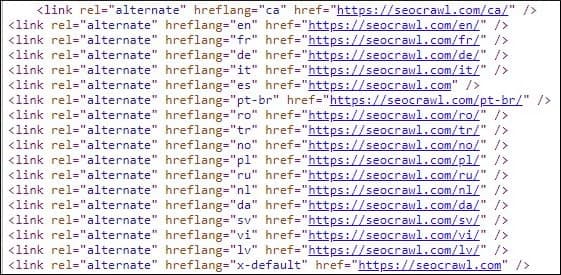
On the Internet, you have various online tools to check whether the hreflang attribute is correct at your disposal.
Specific content
This is one of the most common mistakes and, at the same time, one of the easiest to avoid when internationalizing a project: there are delays, the client gets impatient, and at some point, someone comes up with the brilliant idea. What if we translate all the available content instead of generating new content?
We've already explained above that, even within the same language, users have different ways of naming and searching for products and services… Keywords and long-tails don't have to be exactly the same, and a translation will never be as powerful content for organic ranking as original text optimized for a specific country or region.
When trying to rank in a new market, it's essential to design and execute a new original content calendar based on the keyword research we've conducted in the early stages of the strategy.
Off-page international SEO strategy
When you start working in a new market, you're starting from scratch. All the brand authority and organic positioning you may have had in your country of origin is diluted, and the strategy must begin anew.
The same happens with the social signals that Google (or whichever search engine) receives about your website: to succeed in a new country, we must deploy a new link building strategy, based on obtaining authoritative links from the country we've just arrived in and, as always, based on the naturalness of the profile.
How do we manage international link building at SEOcrawl AI?
-
We study the sector in depth. Who links to your competition and how do they do it?
-
We establish a budget: not all markets are equally expensive. Our goal is always to make the best possible use of resources.
-
We draw up a strategy based on naturalness: we want to obtain links, but at a pace that doesn't raise suspicions with bots about illicit practices that could lead to penalties.
Common mistakes in a multi-country strategy
At SEOcrawl AI, we've worked on international SEO since the beginning of our history, we've made many mistakes, and we've learned from all the projects we've worked on, which is why we're telling you about some very common mistakes you should not make:
-
Focusing only on Google. We've already mentioned it: before launching the SEO strategy, you need to know which is the most common search engine in the region where you're going to work and adapt to its rules.
-
Following a standard strategy: standards don't exist in SEO. Every project, every market, every business niche has its own characteristics and, therefore, its specific needs. Keep this in mind before starting to work.
-
Being unaware of local legislation: this is one of the most serious mistakes you can make, as it will not only affect your SEO strategy but the project as a whole. Skipping local legislation, even out of ignorance, can lead to anything from minor sanctions to significant fines that can drag down the entire project.
-
Translating instead of optimizing: we've also already mentioned this. The only way to ensure that your website's content is properly optimized for local users' search intent is to generate it from scratch based on the specific keyword research you've carried out.
-
Not allowing the user to choose the website version. Our recommendation is to notify the user that other versions of the website are available and always keep the dropdown with the flags visible, so they can choose the most suitable one at any time.
Monitoring and analyzing results with SEOcrawl AI
Do you want to know if your internationalization strategy is delivering results? At SEOcrawl AI, you'll find all the information you need for monitoring and analyzing the results of your international projects.
You can filter all the important KPIs for your project by country (keywords, URLs, visibility graph…) but you also have a specific dashboard to track your international strategy. You just have to access, from the side menu, the Countries option, and you'll discover a control panel similar to this one.
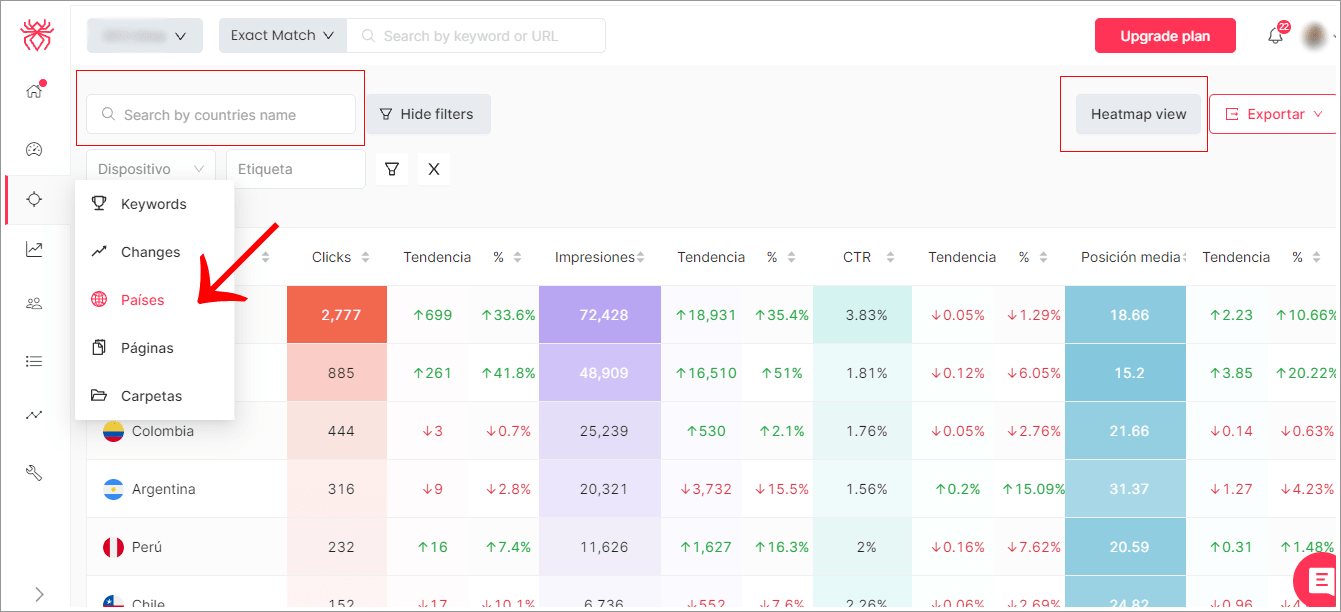
In it, you can choose the country that interests you most at any given moment or use the heatmap to discover in which countries your project's metrics are better and thus know which strategies are working best for you.
SEOcrawl AI success stories
International SEO is part of our DNA, it's a sector we've been working in since our origins, which we're passionate about and which has allowed us to grow, develop, and enjoy incredible successes. Below, we show you some of them.
Chess.com

Would you know how to increase organic traffic by more than 74 million visits in 3 years? We assure you it can be done, because we've achieved it for our client Chess.com. Find out how we did it step by step!
Semrush Chess.com Webinar

Our CEO, David Kaufmann, breaks down in this webinar for Semrush how to design and execute an international strategy for a company as powerful as Chess.com and achieve success. Don't miss it!
The Queen's Gambit
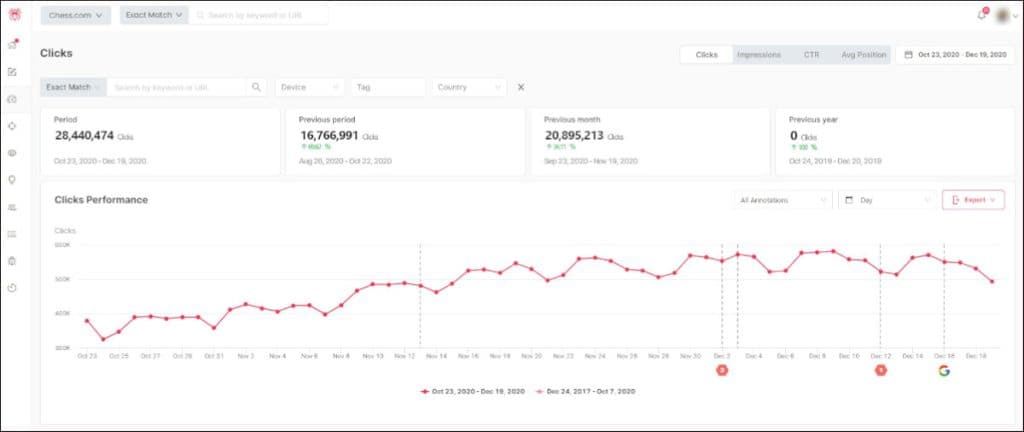
The Netflix series caused a revolution in the world of chess internationally that we took advantage of to increase the traffic of one of our most powerful projects. Discover how!
Author: David Kaufmann

I've spent the last 10+ years completely obsessed with SEO — and honestly, I wouldn't have it any other way.
My career hit a new level when I worked as a senior SEO specialist for Chess.com — one of the top 100 most visited websites on the entire internet. Operating at that scale, across millions of pages, dozens of languages, and one of the most competitive SERPs out there, taught me things no course or certification ever could. That experience changed my perspective on what great SEO really looks like — and it became the foundation for everything I've built since.
From that experience, I founded SEO Alive — an agency for brands that are serious about organic growth. We're not here to sell dashboards and monthly reports. We're here to build strategies that actually move the needle, combining the best of classical SEO with the exciting new world of Generative Engine Optimization (GEO) — making sure your brand shows up not just in Google's blue links, but inside the AI-generated answers that ChatGPT, Perplexity, and Google AI Overviews are delivering to millions of people every single day.
And because I couldn't find a tool that handled both of those worlds properly, I built one myself — SEOcrawl AI, an enterprise SEO intelligence platform that brings together rankings, technical audits, backlink monitoring, crawl health, and AI brand visibility tracking all in one place. It's the platform I always wished existed.
Discover more content about this author
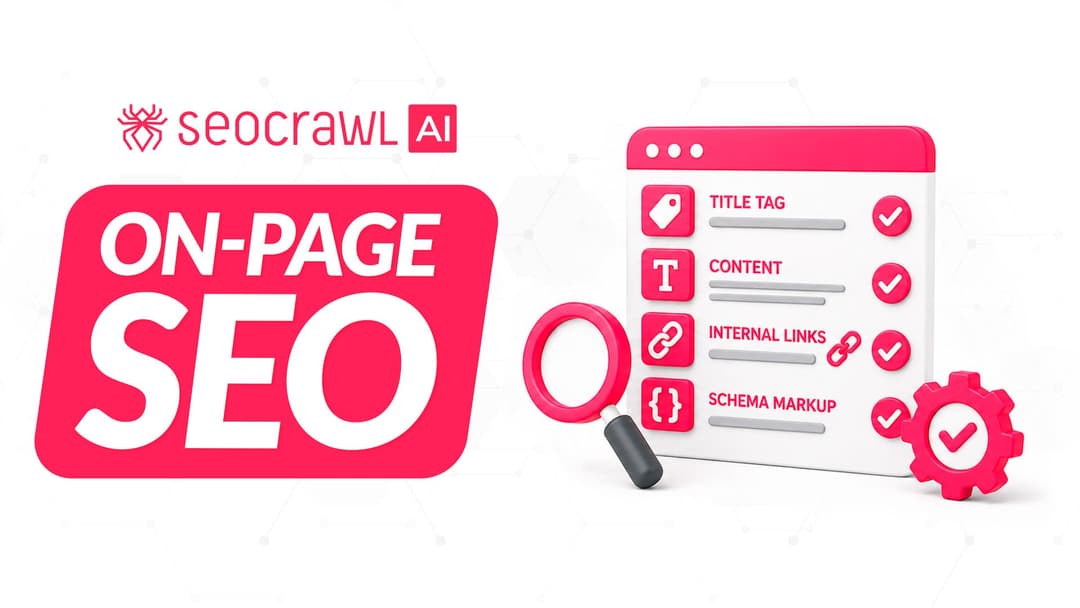
On-page SEO is everything you control on a page: content, title, meta description, headings, URL, images and internal links. Here is a checklist element by element, an audit process and what changes with AI Overviews and AI Mode.