5 SEO Benefits of HTTP/2 Technology
If you work in the internet world, you have surely heard about HTTP/2 at some point. It is the Hypertext Transfer Protocol in its version 2. It represents the evolution of the main communication protocol that has governed the World Wide Web, originally launched as version 0.9 back in 1991, while this second version has been operational since 2015.
In this article, we are going to see what this new revision of the HTTP protocol consists of, what the differences are compared to the previous version, and how it can benefit the SEO positioning of your website. Shall we get started? Let's go!
What is the HTTP protocol?
As we already mentioned at the beginning of the article, it is the communication protocol through which the whole internet works. This protocol is in charge of carrying out requests and responses between client and server, making communication flow and opening the pages we want to access. In this case, the client could be considered the user's browser, and the server would be where the website that returns a set of information is hosted. For example, one of the fields returned by these requests and which is used in SEO is the HTTP response code.
Differences between HTTP/2 and HTTP/1.1
HTTP/1.1 is a revision released in 1999 and is still the most widely used today. From the user's point of view, its operation is the same, but there are some processes that may change or be new in version 2. For example, in version 1.1, multiple requests are needed to load content, while HTTP/2 can process requests in parallel through a single request. It also achieves better latency by omitting information that is redundant in the processes.
We cannot forget the multiplexed stream, a feature that allows sending and receiving several simultaneous requests without waiting for the previous one to close before opening a new one. HTTP/2 introduces binary format instead of plain text. This eliminates errors and makes the data more compact. The last major difference is "Server Push," which works very similarly to cache, since it loads resources on its own, considerably reducing waiting times.
Benefits of HTTP/2 for your SEO
Although, as we mentioned, HTTP/2 has been working since 2015, lately it has become a hot topic among SEOs again, due to a publication on Twitter from Google on its webmasters blog:
Googlebot is learning a new HTTP dialect! Starting mid November you may see some of the Googlebot crawl to happen over HTTP2
Read more:https://developers.google.com/search/blog/2020/09/googlebot-will-soon-speak-http2
— Google Webmasters (@googlewmc) September 17, 2020
It seems that starting in November, Googlebot will also begin crawling over HTTP/2. It will do so gradually, but little by little we can expect this to be the push needed to make it the new standard and, once and for all, leave version 1.1 behind.
Recommended resource: Google's complete HTTP/2 guide Most likely, Google is doing it to save its own resources, since as you have been able to see, the differences mostly affect compression, latency, and speed. It is reasonable to assume that with the same resources, it will be able to crawl many more URLs. Interesting, right?
So, what are the benefits for SEO?
- Improves the overall speed of the website.
- Does Mobile First Index ring a bell? Well, mobile optimization will be much greater with this protocol.
- Increases the security of the website.
- The "conversations" between client and server become much more optimal.
- It avoids communication errors thanks to the switch to binary system.
HTTP/2 and WPO
One of the key factors to improve the load time and speed of a website is the so-called Web Performance Optimization (WPO). With the new revision of the HTTP version now called HTTP/2, the requests made with this protocol will significantly reduce the server response time, since as we mentioned earlier, several requests are processed in parallel, optimizing all client/server processes. Some of the benefits that this new HTTP/2 version can have are:
- Reducing the time of server requests. This will result in fewer blocked requests or requests queued to be resolved by the server.
- Improving DNS Lookups, since the browser will be able to identify the IP of the request more quickly.
- Improving waiting times, from the moment the request is sent until it is resolved by the server and the resource is received.
If you want to dive deeper into the topic, at SEOcrawl AI we have prepared a complete WPO guide that will help you optimize your website's load times. Don't miss it!
Recommended article: WPO guide to optimize your website's speed
How to check if a website has HTTP/2
There are tools to test the load speed of your website that can help you find out the version your site runs on. One of these is GTMetrix. When the crawl finishes, you open the "Waterfall" tab and click on any resource. You will be able to see whether it is HTTP/2 or 1.1 as shown in the screenshot below.
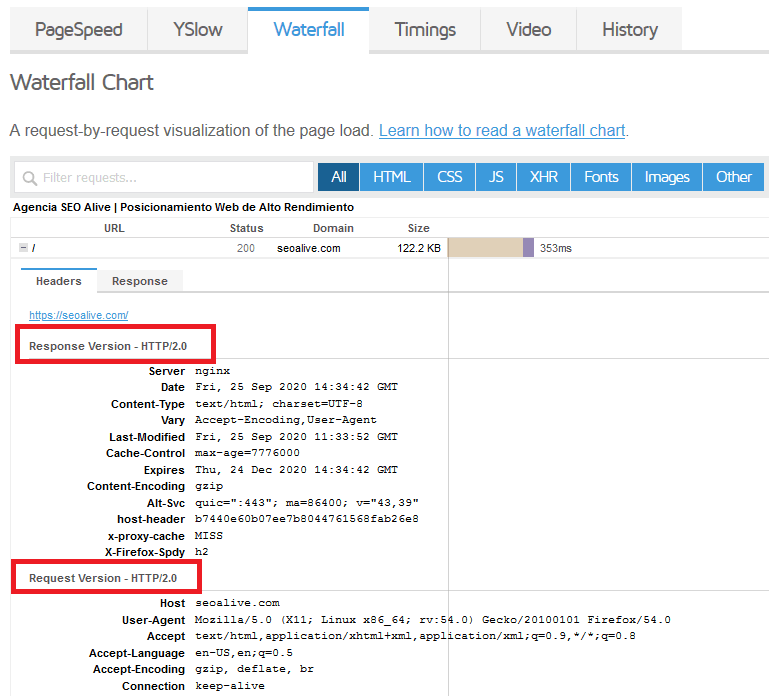
View of the HTTP/2 version in the "Waterfall" tab of GTMetrix
What is coming: HTTP/3
The successor to HTTP/2 has already been working since the end of 2018. It is not enabled by default in any browser, although some include support for it in their latest versions. Perhaps the biggest change will be that, for the first time, the TCP/IP protocol will no longer be used, giving way to a new open-source one called QUIC. One of the differences is that this protocol does not send confirmation of the packet's receipt, with the time savings that this entails. In short, one step further in the pursuit of resource optimization, latency reduction, and, in general, an improvement in the loading speed of websites.
Conclusions
Even though it has just been announced by Google, and will begin to be implemented starting in November, the HTTP/2 protocol is already a reality. From SEOcrawl AI we want to recommend its use, as it directly affects one of the factors that the search engine takes into account when weighting the rankings of websites: WPO. In addition, it will help you considerably improve the speed and SEO of your website!
And you, dear reader, were you aware of this new version of the HTTP/2 protocol? What do you think of the new improvements compared to the HTTP/1.1 protocol? Tell us in the comments box. See you next time!
Author: David Kaufmann

I've spent the last 10+ years completely obsessed with SEO — and honestly, I wouldn't have it any other way.
My career hit a new level when I worked as a senior SEO specialist for Chess.com — one of the top 100 most visited websites on the entire internet. Operating at that scale, across millions of pages, dozens of languages, and one of the most competitive SERPs out there, taught me things no course or certification ever could. That experience changed my perspective on what great SEO really looks like — and it became the foundation for everything I've built since.
From that experience, I founded SEO Alive — an agency for brands that are serious about organic growth. We're not here to sell dashboards and monthly reports. We're here to build strategies that actually move the needle, combining the best of classical SEO with the exciting new world of Generative Engine Optimization (GEO) — making sure your brand shows up not just in Google's blue links, but inside the AI-generated answers that ChatGPT, Perplexity, and Google AI Overviews are delivering to millions of people every single day.
And because I couldn't find a tool that handled both of those worlds properly, I built one myself — SEOcrawl AI, an enterprise SEO intelligence platform that brings together rankings, technical audits, backlink monitoring, crawl health, and AI brand visibility tracking all in one place. It's the platform I always wished existed.
Discover more content about this author