How to Improve Brand Visibility in AI Search Engines
To improve your brand visibility in AI search engines, make your brand a clear, consistent entity, write content that answers questions directly, and earn mentions on sites the models already trust.
The next step is tracking where you show up across ChatGPT, Claude, Gemini and Perplexity over time, then closing the gaps.
This guide walks through how AI search picks brands, what to fix, and how to measure your AI visibility so you improve on evidence instead of guesswork.
Why AI visibility matters now
Brand visibility in AI search is not the same as ranking on Google. A page can sit at position one in organic results and still never be mentioned when someone asks an AI the same question.
Industry surveys in early 2026 reported that around half of B2B buyers now begin their research inside an AI chatbot, and that buyers rate vendors more favorably when an AI names them in an answer. Perplexity's traffic has also grown sharply over the past year.
AI search is already rewiring how buyers choose. 51% of B2B software buyers now start their research with an AI chatbot more often than with Google, up from 29% a year earlier. 85% think more highly of a vendor when an AI chatbot names it in an answer. And 69% ended up choosing a different vendor than they had originally planned because of an AI chatbot's guidance — with 1 in 3 buying from a vendor they'd never heard of before.
Source: G2, "The Answer Economy: How AI Search Is Rewiring B2B Software Buying" (survey of 1,076 B2B buyers, March 2026).
Visibility is no longer only about clicks. It is about being in the conversation at the moment a decision is forming.
How AI search engines decide which brands to show
AI engines behave less like a catalog and more like a skeptical researcher. They build a picture of entities — brands, people, products, concepts — and how those entities relate, then they answer from sources they have already judged credible.
Once you understand that, the work becomes clear: become the clearest, most verifiable option in your category.
How to improve your brand visibility in AI search: the C.I.T.E. approach
You can organize the work into four areas. We call it C.I.T.E. because that is exactly the goal — to get cited.
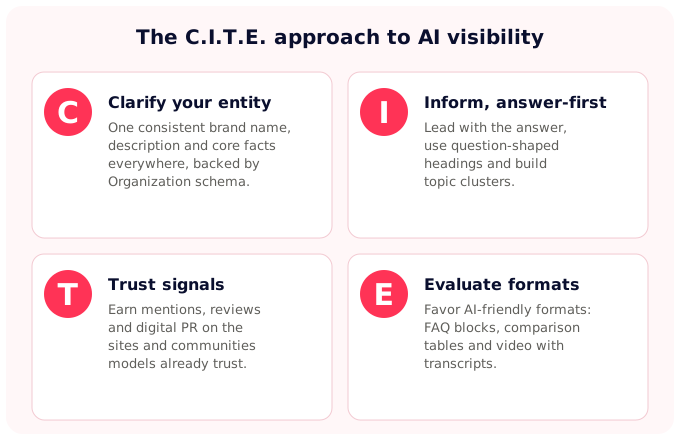
Clarify your brand as an entity
Keep your brand name, description, and core facts identical across your website, LinkedIn, Google Business Profile and any directory you appear in. Add Organization and Article/FAQPage structured data so machines read your facts instead of guessing them. Then write an About page that states plainly what you do, who you serve, and why you are credible.
Inconsistency — a different company description here, an old tagline there — is one of the quietest reasons a brand gets skipped.
Inform with answer-first content
Lead each page with the answer, not a warm-up paragraph. Use headings that mirror how people actually phrase questions, and build clusters of related content around a core topic rather than one isolated page, so the model sees depth across a subject.
Plain, declarative writing — definitions, short direct answers, comparison tables — is far easier to extract than dense prose.
Build trust with third-party signals
Earn mentions in industry publications, get listed where your category is discussed, and pursue digital PR so credible sites reference you naturally. Encourage genuine reviews by participating where your buyers already ask questions: Reddit and Quora threads on AI search visibility rank in these results, and the discussions there feed the models.
Unlinked mentions now carry weight close to links.
Evaluate AI-friendly formats
Add FAQ blocks that answer real buyer questions in a couple of sentences each — the format that maps most directly to how people prompt. Use structured comparison tables for "X vs Y" or feature breakdowns, which models extract cleanly and often lift whole. And publish video with transcripts, since AI engines pull heavily from video transcripts.
A handful of genuine question-and-answer clips, or one clear comparison table, can become citation fuel that a wall of text never will.
These four areas reinforce each other. A clear entity, with answer-first content and third-party trust, published in formats models favor, is what a citation is made of.
Mistakes that damage your AI brand visibility
Before implementing any changes, make sure your content isn't actively hurting your AI visibility. Some of the "AI SEO" advice circulating online will get your content filtered out entirely. Here are the mistakes to avoid, and what to do instead.
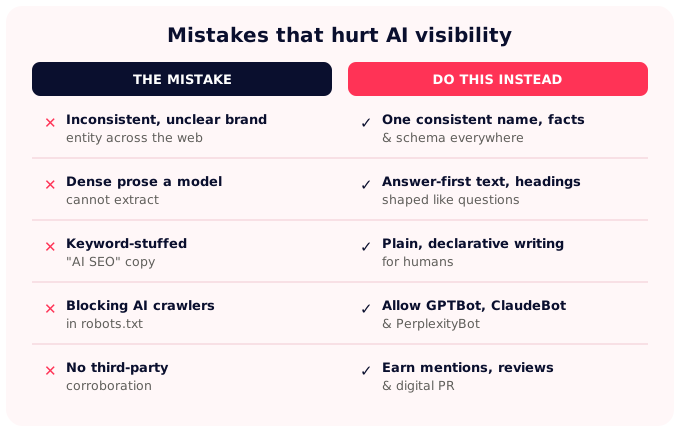
Why isn't my brand showing up in ChatGPT?
If you are invisible in AI answers, it usually comes down to the gaps above: an unclear brand entity, content a model can't extract, or too little third-party corroboration. The useful question isn't which of these is hurting you, but which one most.
That is why tracking consistently matters. Instead of guessing, you can see where your brand is mentioned, cited, or missing across ChatGPT, Claude, Gemini and Perplexity, and watch how that changes as you close each gap.
Don't just guess — track your AI visibility over time
You can't improve what you don't measure, and AI visibility is no exception. Opening ChatGPT to check if you appear is a fine first look, but it captures a single moment. AI answers shift by prompt, by model, and day to day, so what you really need is your share of AI voice over time: how often each model mentions or cites your brand, and how that compares to competitors. Without that, you're optimizing blind.
The metrics worth following:
- Brand mentions across ChatGPT, Claude and Gemini, tracked per prompt and against competitors.
- Citations in Perplexity and appearances in Google AI Overviews.
- Referral traffic from AI tools (for example,
utm_source=chatgpt.com).- Branded search lift after your visibility work.
SEOcrawl AI's Prompt Tracking lets you monitor your prompts by category and see whether each AI model mentions or cites your brand versus competitors over time.
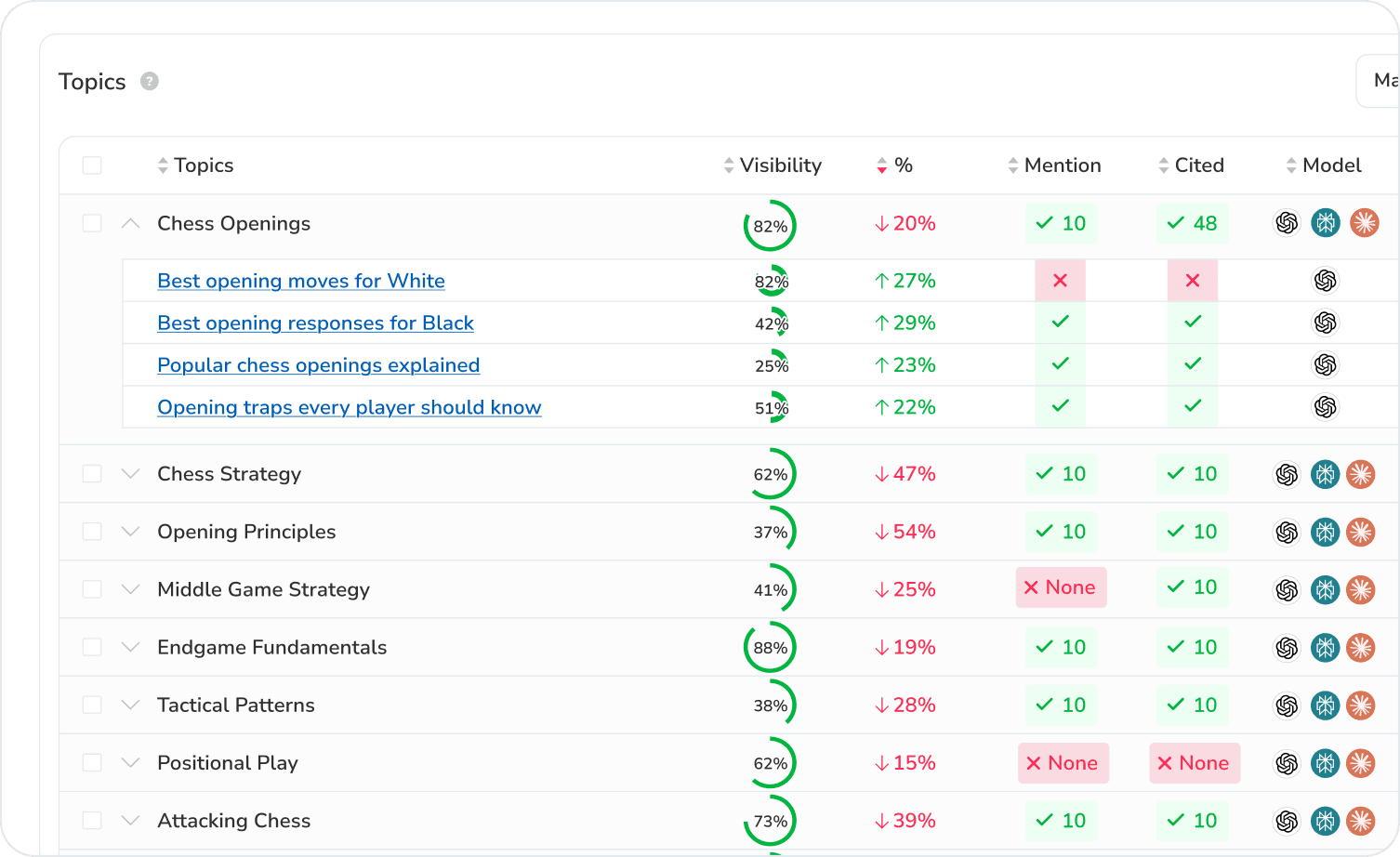
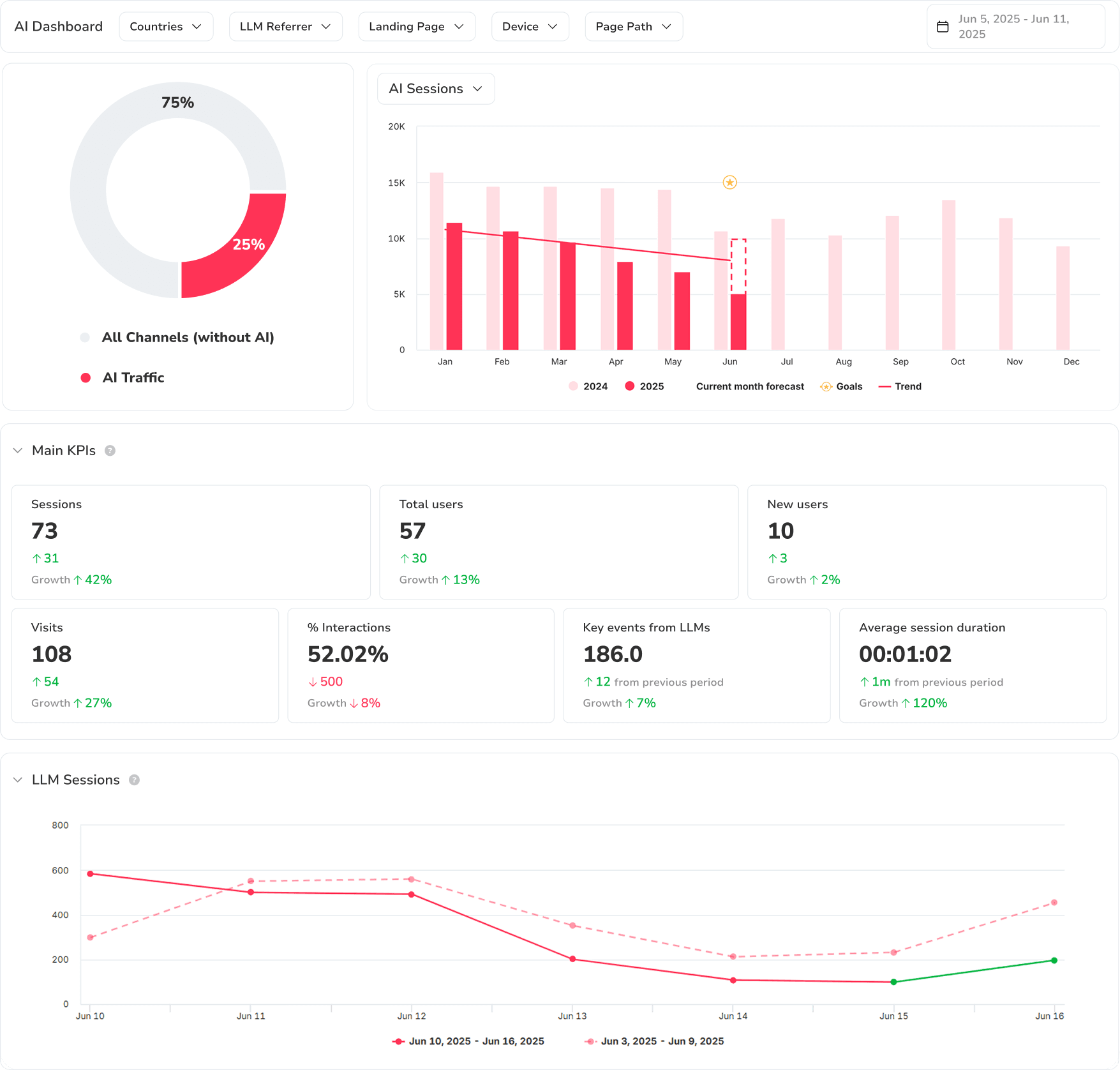
Our AI Tracker shows how much traffic AI models actually send you and how it compares with organic.
SEO + GEO: AI visibility doesn't replace SEO
Google's AI Overviews run on the same core ranking systems as regular search. That means crawlability, helpful content and clean structure still matter. The new layer adds to the existing optimization: structured data, answer-first content, topical authority and third-party mentions.
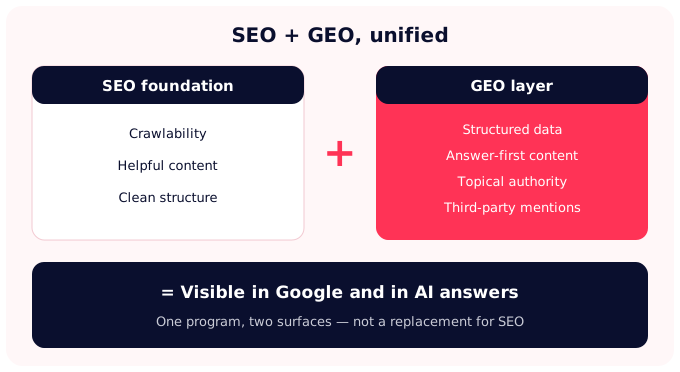
Brands that do both show up in Google and in AI answers. For the citation side specifically, see our guide on SEO citations and AI citations. The frame is simple: SEO + GEO, unified.
FAQs
What is brand visibility in AI search?
Brand visibility in AI search is how often your brand is mentioned, cited, or recommended in AI-generated answers from tools like ChatGPT, Claude, Gemini, Perplexity, and Google AI Overviews. You can rank on Google and still be missing from AI answers.
How do I check if my brand appears in AI search results?
Start with a manual test: ask ChatGPT, Claude, Gemini and Perplexity the questions your customers would ask, and note whether you appear and how you are described. To do this at scale and see a trend rather than a single snapshot, use a prompt tracking tool that monitors your brand across models over time.
Which AI search engines should I focus on first?
Begin with the engine your audience uses most — for many B2B buyers, that is ChatGPT — but don't optimize for one alone. Claude, Gemini, and Perplexity use different retrieval logic and may surface different brands for the same query.
How long does it take to improve AI visibility?
Technical improvements produce the earliest results. Consistent brand information, structured data, and unblocking AI crawlers can influence results within weeks. Building the third-party trust layer of mentions, reviews and content depth typically takes a few months before recommendations become consistent. Treat it as an ongoing program, not a one-time fix.
Can a small brand show up in ChatGPT, or is it only for big brands?
AI engines recommend brands with clear, consistent, well-structured information across multiple trusted sources, no matter their size. Large brands often have those signals by default, but a smaller brand can build that same foundation and appear in its category.
Can AI search make my brand visible without sending website traffic?
Yes. Much of the value is being named or cited inside an answer, even when the user does not click through. That exposure builds recognition and trust, and it often shows up later as an increase in branded searches.
Is traditional SEO still worth doing in 2026?
AI Overviews and AI Mode rely on Google's core ranking systems, so SEO fundamentals remain the foundation. GEO and AEO add requirements on top, but doing both is how brands stay visible in Google and in AI answers at the same time.
How do I measure brand visibility in AI search the right way?
Measure it as a distribution, since answers vary by prompt, model and date. Track brand mentions and citations regularly to keep a clear view of your presence. SEOcrawl AI's Prompt Tracking and AI Tracker are built to monitor exactly these signals over time and against competitors.
Author: David Kaufmann

I've spent the last 10+ years completely obsessed with SEO — and honestly, I wouldn't have it any other way.
My career hit a new level when I worked as a senior SEO specialist for Chess.com — one of the top 100 most visited websites on the entire internet. Operating at that scale, across millions of pages, dozens of languages, and one of the most competitive SERPs out there, taught me things no course or certification ever could. That experience changed my perspective on what great SEO really looks like — and it became the foundation for everything I've built since.
From that experience, I founded SEO Alive — an agency for brands that are serious about organic growth. We're not here to sell dashboards and monthly reports. We're here to build strategies that actually move the needle, combining the best of classical SEO with the exciting new world of Generative Engine Optimization (GEO) — making sure your brand shows up not just in Google's blue links, but inside the AI-generated answers that ChatGPT, Perplexity, and Google AI Overviews are delivering to millions of people every single day.
And because I couldn't find a tool that handled both of those worlds properly, I built one myself — SEOcrawl AI, an enterprise SEO intelligence platform that brings together rankings, technical audits, backlink monitoring, crawl health, and AI brand visibility tracking all in one place. It's the platform I always wished existed.
Discover more content about this author