In-House SEO: What It Is & How to Build a Team
In-house SEO is organic search work run by people on your own payroll, treating your website as their only client, rather than by an outside agency or freelancer. If organic search matters to your business, at some point you ask yourself: "Should we just hire someone for this?"
In-house SEO can be the right answer, but only under specific conditions. Here's what the model actually costs, who to hire first, and where it tends to break.
What in-house SEO is
In-house SEO is organic search work performed by employees on your payroll rather than by an external agency or freelancer. The team sits inside marketing, reports to your goals, and treats your website as their only client.
The difference is context. An in-house SEO knows why the product team shipped a change last Tuesday and can walk over to engineering to get a redirect fixed. They understand the sales cycle behind the keywords they're chasing.
That proximity is what makes this model worth it, but it's also its main weakness — one or two people can't cover every SEO discipline the way a full agency can.
In-house vs agency vs freelancer
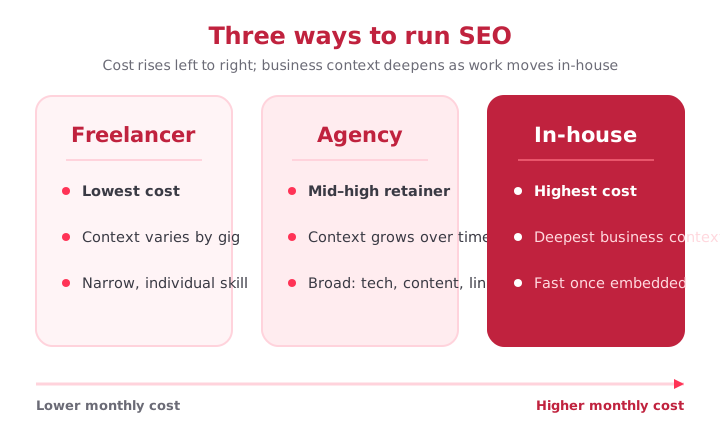
There's no universally correct answer here; the right choice depends on budget, in-house maturity, and how central organic search is to your growth. Here's how the three models compare on the factors that usually decide it:
| Factor | In-house | Agency | Freelancer |
|---|---|---|---|
| Monthly cost | Highest (salary + tools + overhead) | Medium–high (retainer) | Lowest (hourly/project) |
| Business context | Deep — lives inside the company | Shallow at first, grows over time | Varies by engagement |
| Breadth of expertise | Narrow early (one or two people) | Broad (technical, content, links, dev) | Narrow (individual specialism) |
| Speed of execution | Fast once embedded | Slower — depends on approval loops | Fast on scoped tasks |
| Scalability | Slow (hiring takes months) | Fast (agency reallocates people) | Limited |
| Continuity risk | One person leaving hurts | Low (team absorbs turnover) | High (single point of failure) |
A common (and often sensible) setup is a hybrid: one in-house lead who owns strategy and context, plus an agency or freelancer for the spikier work (technical audits, link building, content production at volume).
When it makes sense to bring SEO in-house
Bring it in-house when at least two of these are true:
- Organic is a primary channel, not a side bet. If a huge share of your revenue comes from search, you want someone whose only job is protecting and growing it.
- You ship changes constantly. Releases come with frequent SEO risk (broken redirects, deindexed pages, template changes). An embedded person catches these in days, not at the next quarterly audit.
- You've outgrown "just ask the agency." When every question needs a briefing call and you're the one explaining your own business back to them, the context tax has gotten too high.
- You can fund it for 12+ months. SEO compounds slowly. Hiring someone only to cut the role after two quarters wastes the investment before it pays back.
If none of these hold for your business, a freelancer or agency is usually the better first move.
Roles on an in-house SEO team (and your first hire)
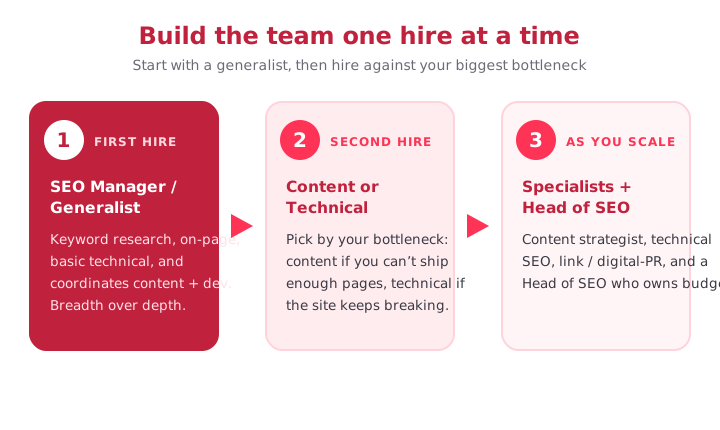
You don't build a team on day one. You hire one person and grow from there. A typical maturity path:
- First hire — SEO Manager / Generalist. One person who can do keyword research, on-page, basic technical SEO, and coordinate content and dev. Breadth over depth. This is the highest-leverage hire because they set strategy and triage everything else.
- Second hire — Content or Technical, depending on your bottleneck. If your problem is producing enough good pages, hire content. If your problem is a site that keeps breaking, hire technical.
- As you scale — content strategist, technical SEO, link/digital-PR specialist, and eventually a Head of SEO or Organic Growth who owns budget and reports to leadership.
The mistake most companies make is hiring a junior "SEO specialist" first to save money, then leaving them without strategic direction. A generalist manager who can own the roadmap is worth the higher salary.
The in-house SEO tool stack & budget
Budget for an in-house function has three parts: salary, tools, and training. Be honest about all three before you hire.
In-house SEO salary
US figures vary widely by source and seniority. Reported averages for an SEO Manager cluster around $81,000 base (roughly $89,000 total compensation per Built In), while ZipRecruiter puts the average near $86,000 and Glassdoor's total-comp estimate runs higher, around $144,000 at the median with top earners above $250,000.
A useful way to read the spread by seniority: specialists land roughly $55,000–$95,000, senior managers $95,000–$130,000, and directors $120,000–$160,000. Benchmark against your city and level rather than a single national number.
SEO tools
Industry surveys put typical SEO tool spend at $200–$500 per month per professional. A realistic starter stack:
- Search Console + Google Analytics 4: free, and the foundation of everything.
- A rank tracker + reporting/monitoring platform: where most of the recurring spend goes.
- A crawler for technical audits.
- A keyword/backlink research tool (Ahrefs, Semrush, or similar).
- An AI-visibility tracker: increasingly useful as buyers research inside ChatGPT, Claude, Gemini, and Perplexity before they ever hit Google.
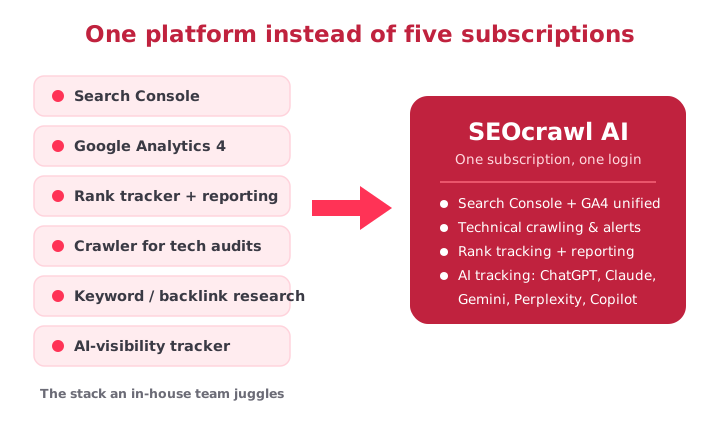
Notice how much of that stack overlaps. SEOcrawl AI folds Search Console, GA4, technical crawling, rank tracking, and AI tracking across ChatGPT, Claude, Gemini and Perplexity into one platform. Instead of paying for and juggling four separate tools, a small team can run them from a single subscription. See what's included on the pricing page.
Training for an in-house SEO team
Budget for at least one conference, a few courses, and paid communities. SEO changes faster than most other areas. A team that stops learning will fall behind within a year.
How SEOcrawl AI fits the in-house stack
Most of what an in-house team does by hand in its day-to-day SEO workflow — pulling Search Console and GA4 into one view, segmenting brand vs non-brand, building weekly reports, watching for indexing breakage — is exactly what SEOcrawl AI is built to automate. It unifies Search Console, Google Analytics 4, technical crawling and AI-visibility tracking across ChatGPT, Claude, Gemini, Perplexity and Copilot in one platform, so a one-person team spends its time on actual optimizations instead of stitching five tools together.
- Automated weekly and monthly reports pull real GSC + GA4 data. SEOcrawl AI acts as a data warehouse, storing Search Console and GA4 data without limits.
- Scheduled crawls and alerts mean you hear about a 404 spike before it becomes a ranking problem.
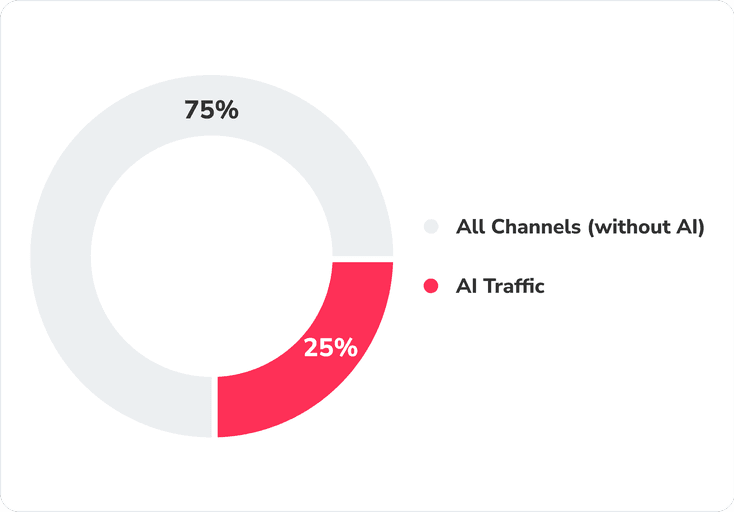
- The AI Tracker shows how your SEO and AI traffic split and which LLM sends the most, plus prompt tracking for how models mention your brand versus competitors.
- Segment keywords and URLs into smart views and clusters, and tag them by rules, manually, or over MCP straight from Claude or ChatGPT.
See how the pieces fit in the SEO tools hub, or compare plans on the pricing page.
Challenges of in-house SEO & how to solve them
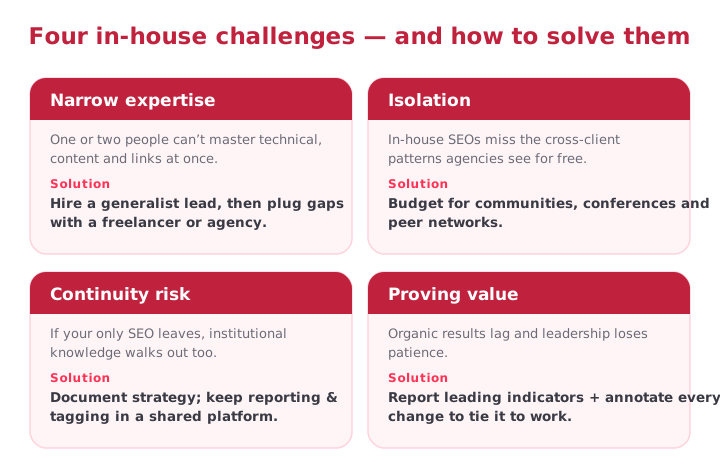
- Narrow expertise. One or two people can't be expert at technical SEO, content, and link building at once. Solution: hire a generalist lead, then plug gaps with a freelancer or agency for the specialisms you lack.
- Isolation. In-house SEOs miss the cross-client pattern-spotting agencies get for free. Solution: budget for communities, conferences, and peer networks so your team sees more than one website.
- Continuity risk. If your only SEO leaves, institutional knowledge walks out with them. Solution: document the strategy, keep reporting and tagging in a shared platform, and don't let all context live in one head.
- Proving value. Organic results lag, and leadership loses patience. Solution: report leading indicators (indexed pages, impressions, non-brand growth) alongside revenue, and annotate every change so you can tie movements to specific work.
Run your in-house SEO from one place. SEOcrawl AI unifies Search Console, GA4, technical crawling, rank tracking and AI tracking — so a small team reports, monitors, and catches breakage without juggling five tools. Try SEOcrawl AI or compare plans.
FAQs
What does an in-house SEO do?
An in-house SEO grows a company's organic search traffic from inside the business. That means keyword and content strategy, on-page and technical optimization, coordinating with content and engineering, and reporting results to leadership.
In a small team it's one generalist covering all of it; in a larger one, the work splits across content, technical, and link/digital-PR specialists reporting to a Head of SEO.
What's the difference between in-house SEO and an SEO agency?
Neither is universally better; it depends on your situation. In-house wins on business context and execution speed once someone is embedded, and suits companies where organic is a core channel and the site changes often.
Agencies win on breadth of expertise and scalability, and suit companies that need many disciplines fast without long hiring cycles. Many teams run a hybrid: an in-house lead for strategy and context, plus outside help for technical audits, links, or high-volume content.
What tools does an in-house SEO need?
At minimum, Search Console and Google Analytics 4 (both free), a rank tracker with reporting, a crawler for technical audits, and a keyword and backlink research tool.
An AI-visibility tracker is increasingly essential as buyers research inside ChatGPT, Claude and Perplexity. A platform like SEOcrawl AI combines GSC, GA4, crawling, rank tracking and AI tracking in one place, which keeps a small team from juggling five subscriptions and five logins.
When should you bring SEO in-house?
Bring it in-house when organic is a core channel, your site changes often, and you can fund the role for at least a year. Someone embedded in the business catches SEO risks in days and understands the context behind the keywords they chase.
If search isn't central to growth yet, or the budget only stretches to one short engagement, a freelancer or agency is usually the better first step.
How do you build an in-house SEO team?
Start with one hire, not a team. A generalist SEO manager who can own strategy, keyword research, on-page, basic technical work, and coordinate content and engineering is the highest-leverage first hire.
Add a content or technical specialist next, depending on your biggest bottleneck, then scale into link/digital-PR and a Head of SEO as organic grows. Keep strategy, reporting, and tagging in a shared platform like SEOcrawl AI so knowledge doesn't live in one person's head.
Author: David Kaufmann

I've spent the last 10+ years completely obsessed with SEO — and honestly, I wouldn't have it any other way.
My career hit a new level when I worked as a senior SEO specialist for Chess.com — one of the top 100 most visited websites on the entire internet. Operating at that scale, across millions of pages, dozens of languages, and one of the most competitive SERPs out there, taught me things no course or certification ever could. That experience changed my perspective on what great SEO really looks like — and it became the foundation for everything I've built since.
From that experience, I founded SEO Alive — an agency for brands that are serious about organic growth. We're not here to sell dashboards and monthly reports. We're here to build strategies that actually move the needle, combining the best of classical SEO with the exciting new world of Generative Engine Optimization (GEO) — making sure your brand shows up not just in Google's blue links, but inside the AI-generated answers that ChatGPT, Perplexity, and Google AI Overviews are delivering to millions of people every single day.
And because I couldn't find a tool that handled both of those worlds properly, I built one myself — SEOcrawl AI, an enterprise SEO intelligence platform that brings together rankings, technical audits, backlink monitoring, crawl health, and AI brand visibility tracking all in one place. It's the platform I always wished existed.
Discover more content about this author
CTR tells you how many of the people who saw your result actually clicked. Here's the formula, what a good CTR looks like in 2026 by channel and by Google position, and how to get more clicks from the rankings you already have.