Keyword Clustering: How to Group Keywords So One Page Ranks for Many
Keyword clustering is the process of grouping keywords that share the same search intent, then covering each group with one page instead of scattering them across separate URLs.
Most sites still build one page per keyword, then wonder why a dozen thin articles all stall on page two. Keyword clustering flips that, and the result is fewer pages competing with each other and more queries won per piece of content.
SERP-based vs semantic clustering: the two methods
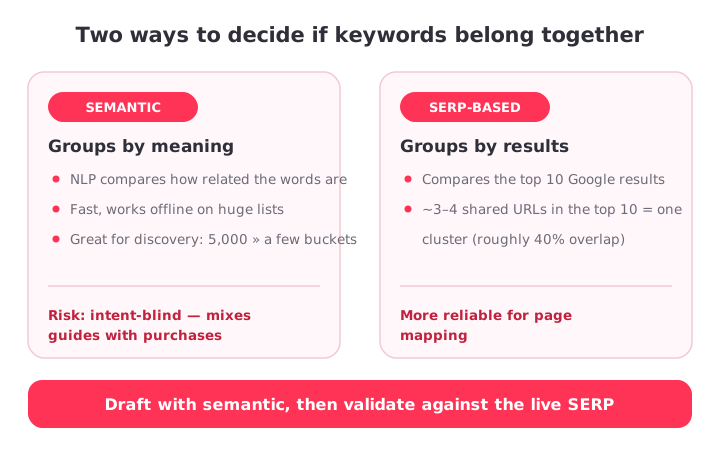
There are two ways to decide whether keywords belong together, and they answer different questions.
Semantic clustering groups keywords by meaning, usually with natural-language processing that compares how related the words are. It is fast, works offline on huge lists, and is great for discovery: turning 5,000 raw keywords into a handful of broad topic buckets.
Its weakness is intent blindness. A semantic model can group "how to roast coffee" with "buy roasted coffee" because they read as similar, even though one is a guide and the other is a purchase.
SERP-based clustering groups keywords by what Google actually returns. You pull the top results for each keyword and group the ones whose result sets overlap.
A common threshold is around 3 to 4 shared URLs in the top 10 (roughly 40% overlap) before two keywords count as one cluster.
SERP-based clustering is more trustworthy for page mapping because it catches cases meaning alone would miss.
Which to use?
Both. Use semantic clustering to draft the broad topic map quickly, then validate each group against the live SERP before you commit. Any keywords whose results diverge get split off.
How to cluster keywords manually: a worked example
The whole process is five steps. Say you are working on a running-shoes site.
- Gather a broad list. Pull keywords from your research tools, competitor gaps, and the queries you already rank for. Do not over-filter yet; the grouping does the sorting.
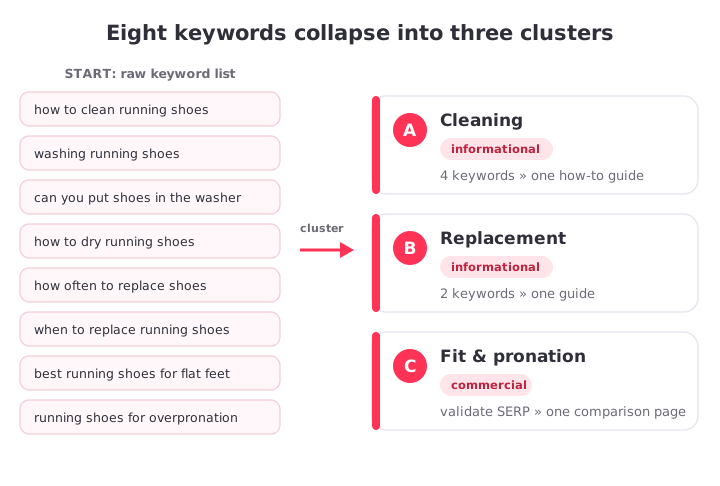
Say you start with: how to clean running shoes · washing running shoes · can you put running shoes in the washing machine · how to dry running shoes · best running shoes for flat feet · running shoes for overpronation · how often to replace running shoes · when to replace running shoes.
-
Label the intent of each. Mark every keyword as informational, commercial, or transactional. "Best running shoes for flat feet" is commercial (someone comparing products); "how to clean running shoes" is informational (someone with shoes they already own).
-
Group by meaning first. Rough buckets emerge quickly: a cleaning group, a replacement group, and a fit/pronation group.
-
Validate against the SERP. Search two keywords from the same draft group and compare the top 10. If "how to clean running shoes" and "washing running shoes" return mostly the same pages, they stay together. Check the edge case: "how to dry running shoes" often shares those results too, so it joins the cleaning cluster rather than becoming its own page.
-
Split where the SERP disagrees. "Best running shoes for flat feet" and "running shoes for overpronation" feel related, but if their results are product roundups with little overlap, keep them separate (or make one a pillar with supporting pages). This is the step that prevents cannibalization down the line.
You end with something like:
- Cluster A (informational): how to clean running shoes · washing running shoes · can you put running shoes in the washing machine · how to dry running shoes → one how-to guide
- Cluster B (informational): how often to replace running shoes · when to replace running shoes → one guide
- Cluster C (commercial): best running shoes for flat feet · running shoes for overpronation → validate SERP overlap, then one or two comparison pages
Eight keywords collapse into three or four pages, each with a clear primary keyword and a set of supporting terms.
How to cluster keywords with tools (and at scale)
Tools automate the two heavy steps: fetching the top results for every keyword and calculating the overlap.
At scale, the efficient workflow is the hybrid one: semantic pre-clustering to shrink a list of tens of thousands into a few hundred buckets, then SERP validation only on the representative head keyword of each bucket.
You can also use ChatGPT (or Claude) for the semantic pass. Hand it your keyword list and ask it to group by shared intent and label each cluster's primary keyword. Treat that output as a draft topic map, not a final one: an LLM groups by meaning, so you still validate the borderline clusters against the real SERP before publishing.
Where clustering pays off long-term is when your clusters live next to your performance data instead of in a throwaway spreadsheet.
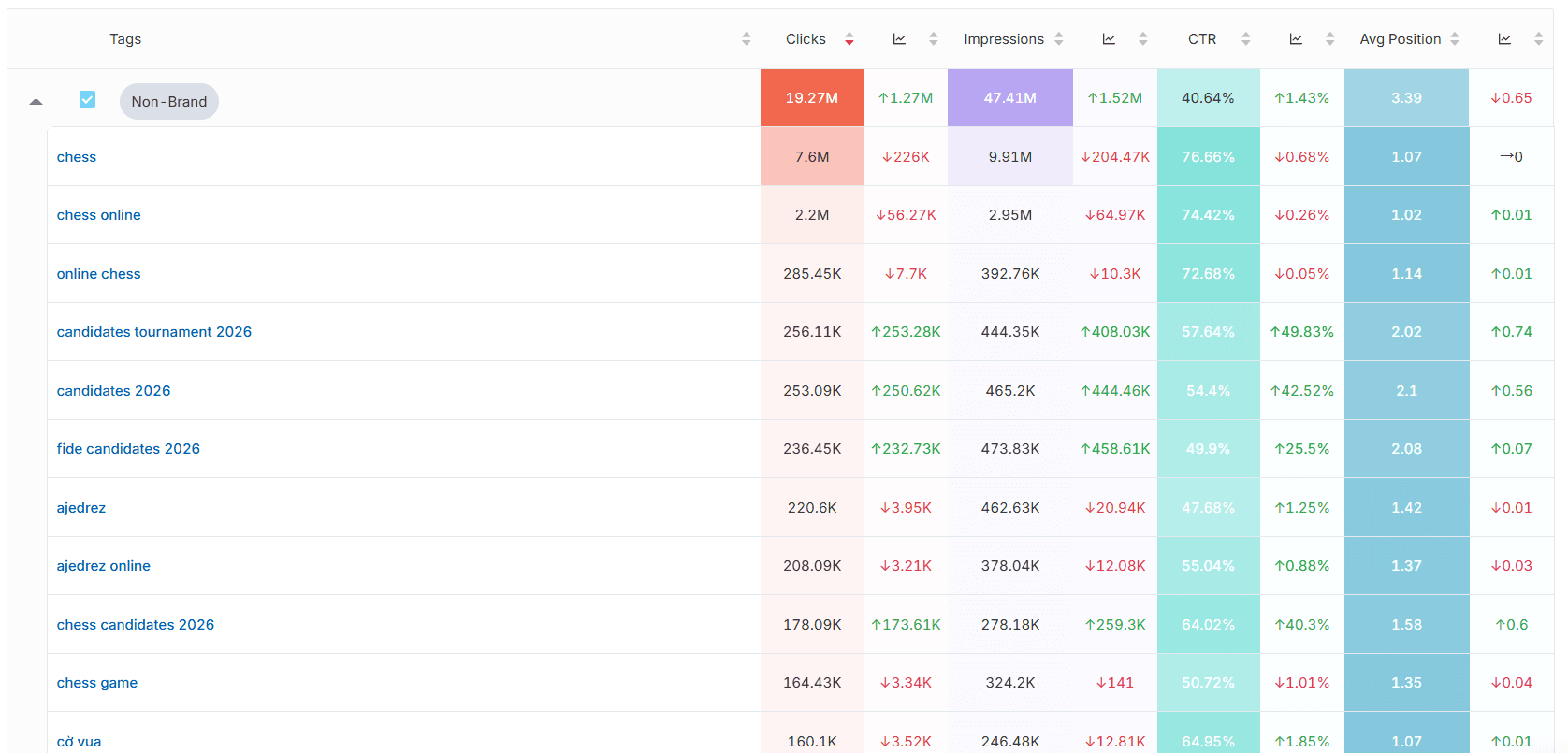
Google Search Console has no way to group queries by topic; it offers regex and "contains" filters but no saved taxonomy, so most teams export and tag by hand every week. SEOcrawl AI's Rank Tracker adds that missing layer: you tag keywords and classify them into custom clusters on top of your real Search Console clicks and impressions, and a Top Tags view shows aggregate performance per cluster so you can see which topics are gaining or slipping.
Because the data comes from your own GSC rather than a scraped panel, there are no keyword limits.
Mapping clusters to content: pillar and supporting pages
A cluster map doubles as a content plan. Each cluster becomes one brief: a primary keyword (usually the highest-volume term in the group), the supporting keywords it should also cover, and the target search intent.
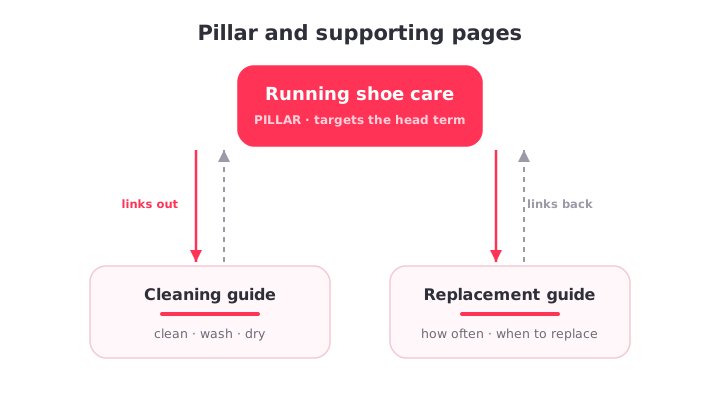
For broad topics, split the work into a pillar page and supporting pages. The pillar targets the head term and links out to focused articles that each own a sub-cluster; the supporting pages link back.
In the running-shoes example, a "running shoe care" pillar could link to the cleaning guide and the replacement guide, tying the cluster together and reinforcing topical authority.
Two rules keep this clean: use the primary keyword in the title and one page per cluster, and place supporting keywords as subheadings and natural variations inside that page rather than spinning up a new URL for each.
Common keyword clustering mistakes
- Cramming keywords with different intents into one page to "cover more" produces a bloated article that ranks well for none of them. If the SERPs disagree, split.
- Keeping near-identical queries on separate pages, which is how cannibalization starts.
- Grouping by words alone instead of by what the searcher wants mixes buyers and researchers on the same page.
- Trusting semantic output without SERP checks: similar meaning, different results. Validate before you build.
- Clustering once and forgetting it. SERPs shift. Re-check clusters periodically, especially after major Google updates.
Bring it together
Clustering can make the difference between a pile of thin pages and a handful of authoritative ones. Group by intent, use semantic clustering to draft and SERP overlap to validate, and map each cluster to a single page (or a pillar plus supporting pages).
Want your clusters attached to real performance data instead of a spreadsheet? Group and tag your Search Console keywords in SEOcrawl AI and track each cluster's clicks, impressions, and position over time.
FAQs
What is keyword clustering?
Keyword clustering is grouping keywords that share the same search intent and targeting the whole group with one page, rather than building a separate page per keyword.
A well-built cluster has a primary keyword and several supporting terms that all point to the same information need. The payoff is stronger topical authority and fewer pages competing with each other, so one page can rank for dozens of related queries instead of one.
What is the difference between SERP-based and semantic clustering?
Semantic clustering groups keywords by meaning using language analysis. SERP-based clustering groups them by how much their actual Google results overlap. SERP-based is more reliable for deciding what belongs on one page, because it reflects Google's real behaviour.
Can I use ChatGPT to cluster keywords?
Yes, for the semantic pass. Give ChatGPT or Claude your keyword list and ask it to group terms by shared intent and name each cluster's primary keyword. It is quick and good at spotting meaning-based relationships, which makes it a solid first draft.
Remember that LLMs group by meaning, not by live search results, so validate the borderline clusters against the actual SERP.
How many keywords should a cluster have?
A cluster can be two keywords or twenty, as long as they share one intent and can be answered well by a single page.
If a group is so large that the page would have to cover several different intents, split it. If two "clusters" would produce near-identical pages, merge them. Let the SERP overlap and the intent decide the boundaries, not a target count.
Can I cluster the keywords I already rank for in Search Console?
It is one of the best places to start, since those are queries with proven impressions. Search Console itself has no topic grouping (only regex and "contains" filters), so you normally export and tag by hand. SEOcrawl AI lets you tag and cluster your real GSC keywords in place, manually or with auto-tag rules, and even from Claude or ChatGPT through its MCP.
Author: David Kaufmann

I've spent the last 10+ years completely obsessed with SEO — and honestly, I wouldn't have it any other way.
My career hit a new level when I worked as a senior SEO specialist for Chess.com — one of the top 100 most visited websites on the entire internet. Operating at that scale, across millions of pages, dozens of languages, and one of the most competitive SERPs out there, taught me things no course or certification ever could. That experience changed my perspective on what great SEO really looks like — and it became the foundation for everything I've built since.
From that experience, I founded SEO Alive — an agency for brands that are serious about organic growth. We're not here to sell dashboards and monthly reports. We're here to build strategies that actually move the needle, combining the best of classical SEO with the exciting new world of Generative Engine Optimization (GEO) — making sure your brand shows up not just in Google's blue links, but inside the AI-generated answers that ChatGPT, Perplexity, and Google AI Overviews are delivering to millions of people every single day.
And because I couldn't find a tool that handled both of those worlds properly, I built one myself — SEOcrawl AI, an enterprise SEO intelligence platform that brings together rankings, technical audits, backlink monitoring, crawl health, and AI brand visibility tracking all in one place. It's the platform I always wished existed.
Discover more content about this author
CTR tells you how many of the people who saw your result actually clicked. Here's the formula, what a good CTR looks like in 2026 by channel and by Google position, and how to get more clicks from the rankings you already have.