The Importance of CTR in SEO Rankings
CTR is one of the most important organic performance KPIs in SEO, and anyone who works in search engine optimization needs to keep a close eye on it. In digital marketing it's well known that "what can't be measured can't be improved", so if you don't want your efforts and investment in an SEO campaign to go to waste, you have to dedicate some time to measuring your website's statistics.
In this article, we're going to explain what CTR is, how to measure it, share tips and tricks to increase its percentage, and look at how we handle this metric with our software at SEOcrawl AI. Ready? Let's get started! ?
What is CTR?
To explain what CTR is, we first need to consider its definition or what we mean when we talk about this metric.
Definition: In SEO, CTR or Click-Through Rate is the percentage of clicks that a website's links receive on search engine results pages, relative to the number of impressions. Its formula is calculated by dividing the number of clicks a link has received by the number of times it has been seen by users (impressions), multiplied by 100. CTR Formula: (Clicks / Impressions) * 100
Factors that influence CTR within the SERPs
Google knows exactly the percentage of clicks that users make on the first, second, third, fourth result and all the rest for each search. SEOs can also know this, through tools like Search Console or with our SEO Software, which pulls data precisely from Google's tool API.
Optimizing the title and meta description tags, which is what will have the greatest impact on CTR, is the most profitable and the fastest thing we can do in SEO. If we get more users to click on our result, we'll be getting more visits and more organic traffic (and this can be achieved without needing to improve rankings!) ?
SEO isn't about ranking first on Google. SEO is about ranking first on Google AND having users click on your results to reach you. If we rank first but don't receive clicks, we're not achieving anything at all. Therefore, the factors that influence CTR within the SERPs are:
1) An optimized URL, meaning one that contains the main keyword and does not exceed the maximum number of characters allowed by Google.
2) A meta title tag with the main keyword, which should be descriptive and attractive to the user (use of call to actions (CTAs), emojis, etc.).
3) An optimized meta description tag, which should again contain the main keyword and provide users with a brief summary of what the web page is about.
4) Enriched snippets, also called rich snippets, which make search results visually more attractive and contain very valuable information for the user. In the image example, the rich snippets are rating stars for the search term "carrot cake" on a recipe website.

Anatomy of a "rich snippet" in Google's SERPs
Measuring CTR with the SEOcrawl AI software
At SEOcrawl AI we want to make life easier for all those digital marketing professionals who work in SEO. That's why we've developed a software that helps you measure and control the main organic performance KPIs, among which is CTR. Here's how we do it! ?
CTR chart on the main Dashboard
Within the tool, and once you've selected the project you want to analyze, the first thing to look at is the main report or dashboard:
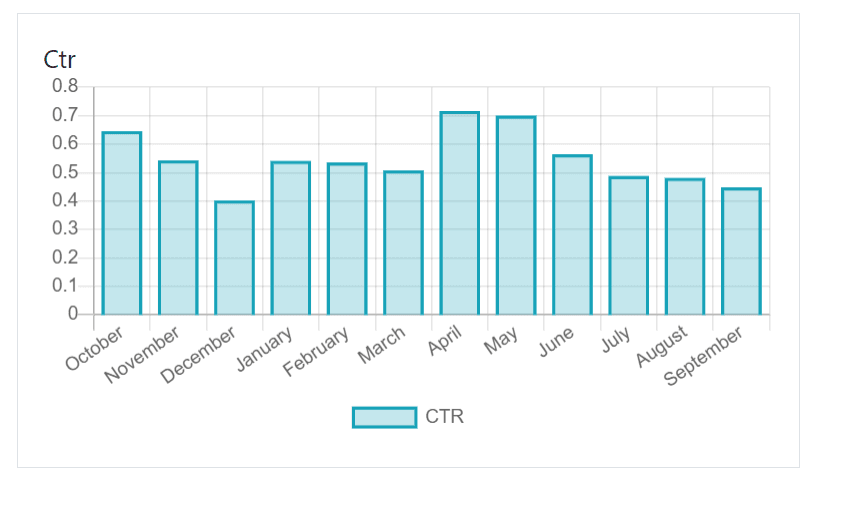
Annual evolution of the Click Through Rate (CTR) in the SEOcrawl AI software
With the annual chart of CTR evolution, we'll have a broad view of whether our project is performing optimally on this metric, as well as being able to clearly identify which months we received the most or least percentage of clicks on our website. This information is very valuable for analyzing the trend and, consequently, taking action accordingly.
Measuring CTR in the "Top Pages" report
The next very interesting feature for measuring CTR is in the "Top Pages" report. If we access it, we can see all the website's URLs listed with the main metrics: Clicks, impressions, CTR and average position.
One of the added values we offer in our software is the possibility to analyze the trend of each of these KPIs. If we focus on CTR, we can know at all times which pages need our attention:
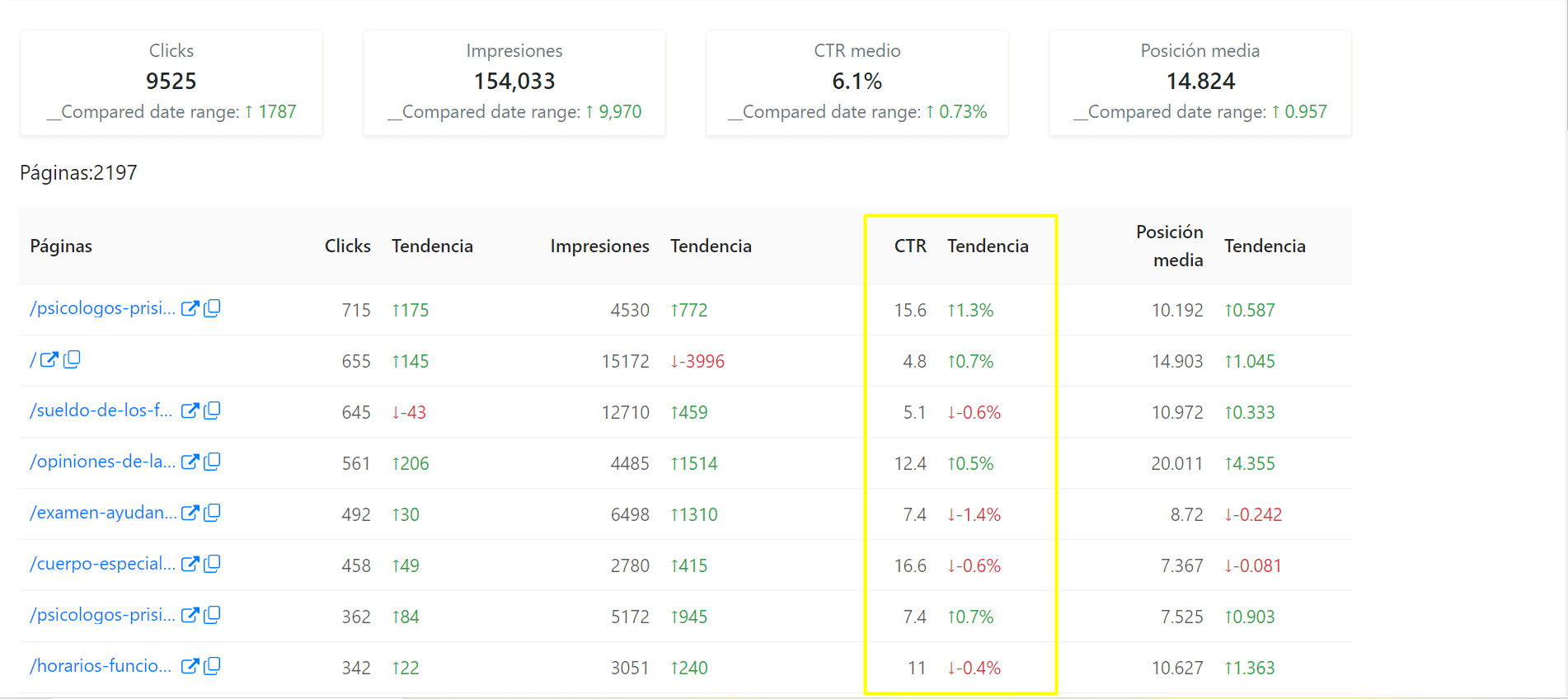
Analyzing the CTR trend in the "Top Pages" report of our SEOcrawl AI software
As shown in the image, pages with a negative trend are candidates for optimization. This is where we should ask ourselves: Have we properly optimized the titles? And the meta descriptions? What can we do to improve the CTR?
We'll answer these and other questions with a series of SEO tips to increase the CTR of a website. Don't go away, keep reading! ?
Measuring CTR in the "Top Keywords" report
The "Top Keywords" report is similar to "Top Pages", only in this case we analyze the CTR trend by keyword. As we see in the following image:
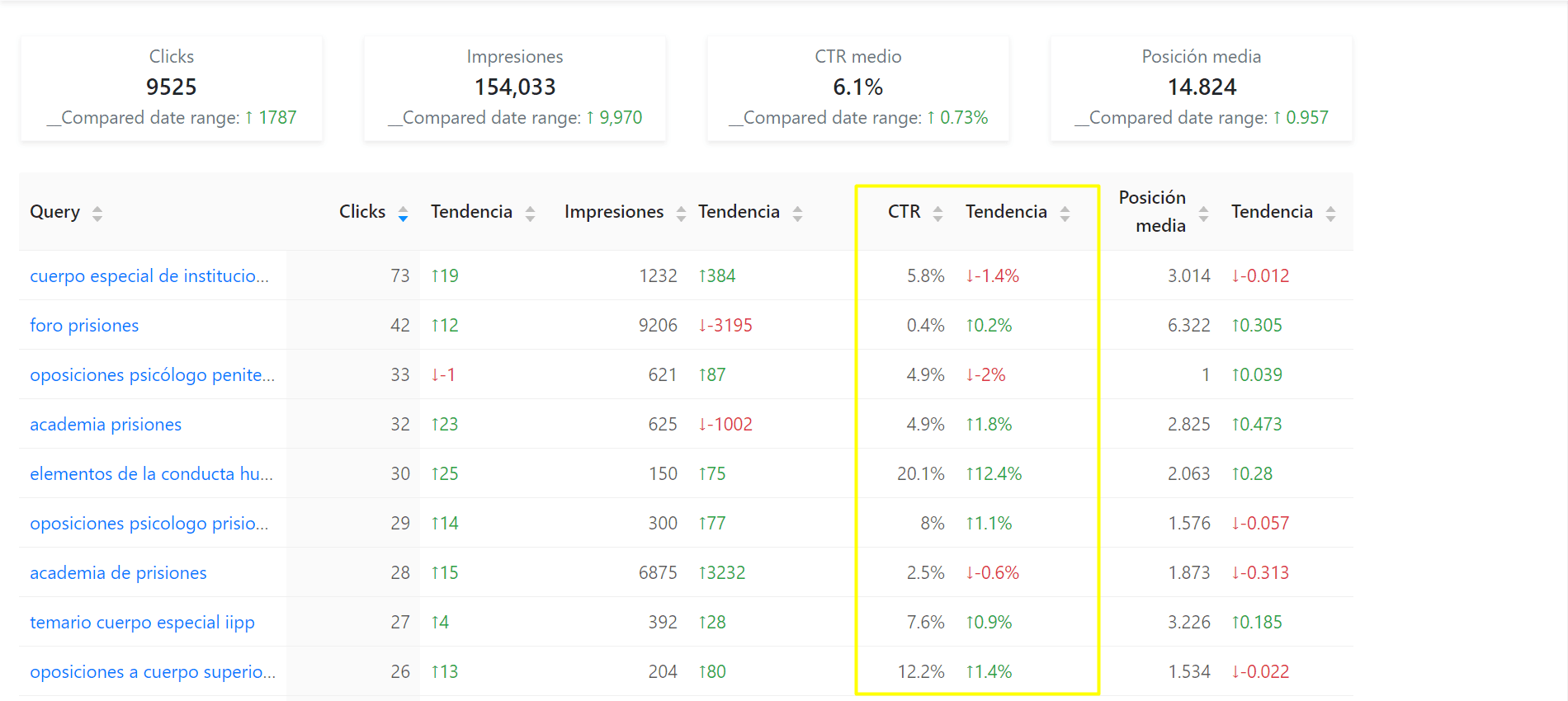
Analyzing the CTR trend in the "Top Keywords" report of the SEOcrawl AI software
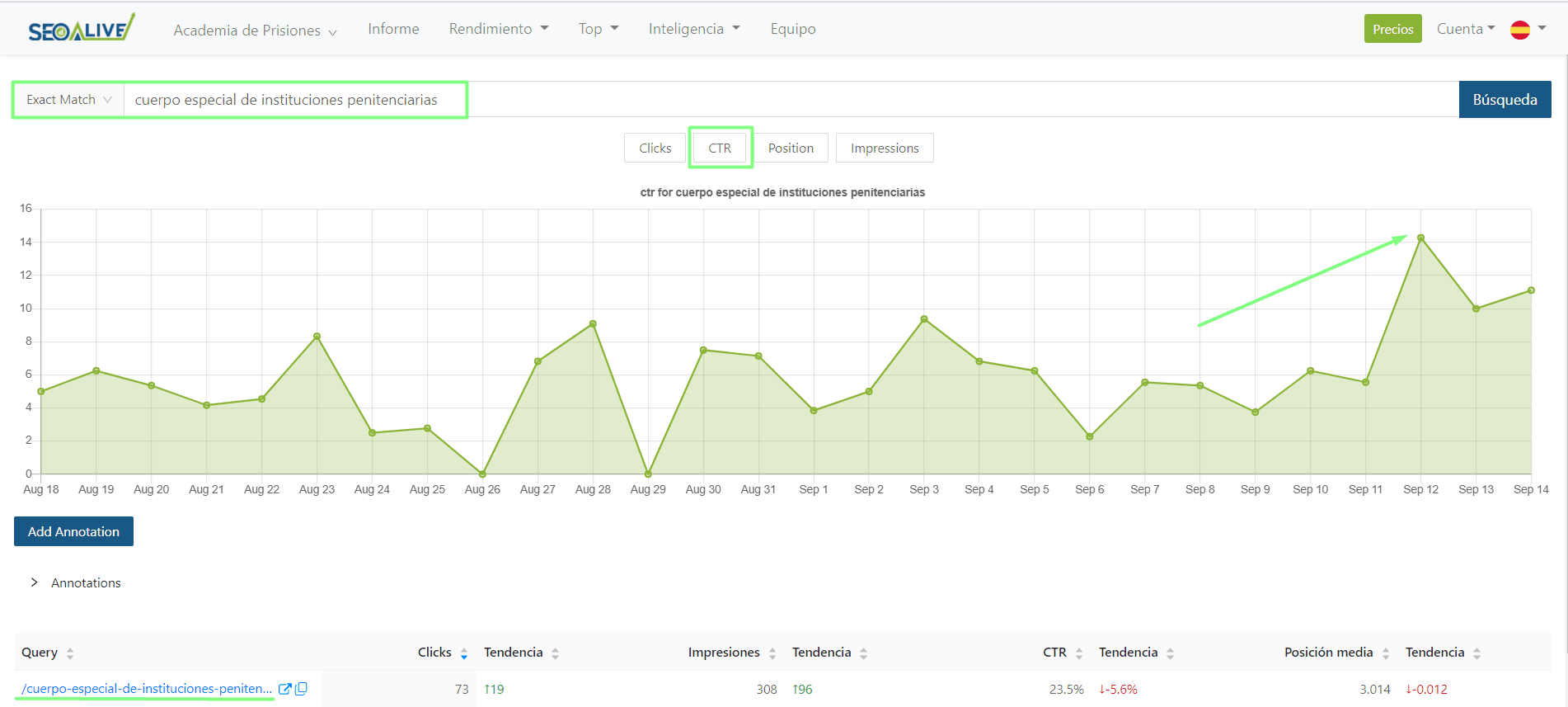
But that's not all! If we click on one of the keywords (for our example, "cuerpo especial de instituciones penitenciarias"), a window will open where we'll see:
- The exact query we are analyzing.
- An evolutionary chart of the CTR for the last month for the analyzed keyword.
- The URL where the keyword ranks, with its corresponding metrics of clicks, impressions, CTR and average position.
In addition, we've included an annotations system, so you can add milestones or Google algorithm updates. Pretty amazing, right? ?
Tips to optimize CTR and improve your website's SEO
Next, we're going to look at a series of tips that can be a great help for your projects in improving the percentage of clicks your website receives:
? Tip #1: Use enriched formats or Rich Snippets
As we mentioned at the beginning of this article, the use of rich snippets is a very important factor for improving CTR. Well implemented and used correctly following the Google guidelines on structured data markup, it can help your website gain better organic visibility and rankings on the results pages.
Currently there are more than 30 types of official rich snippets published by Google. Our CEO, David Kaufmann, has prepared an extensive and complete guide on this type of enriched format, and at SEOcrawl AI we recommend you take a look:
Recommended article: Rich Snippets, complete guide with 31 examples In short, some of the advantages of using rich snippets are:
- Achieving greater visual impact in the SERPs for those websites that have implemented it. In addition, it's a much more attractive format for users and can help you increase the click-through rate.
- Implementing rich snippets can help you improve your business's local SEO. Search engines like Google reward those websites with more organic visits, so if we have rich snippets generated with local geographic orientation, they will help you against your competitors in climbing positions on results pages.
- Brand image can also benefit from rich snippets, by adding images or company logos, it can place us in an advantageous position over organic competitors.
? Tip #2: Appear in featured results - position (0)
Reaching position 0 on Google means ranking above the Top-1 in the search engine SERPs. This is a form of Featured Snippet that significantly increases the CTR of a website, especially for sites that rank for keywords with a considerable search volume.
There are two very important ones:
- Direct answers: This type of featured results is related to the questions that users are continuously asking in the search engine, and it tries to provide the answer through featured snippets.
- Extracts or summaries: In this case, Google extracts a fragment of the page's content and displays it as a featured result.
? Tip #3: place links to sections of the same page
Another tip we give at SEOcrawl AI to improve CTR is to use anchor links, that is, internal links from one section of a page to another section of the same page. The HTML code for this type of link has the following syntax:
<ahref='#name'>
We just have to add the "#" character and the name of the page section we are linking to.
If we don't want to do it manually and we use a content manager like WordPress, we can use the plugin ? Table Of Content Plus which builds a table of contents taking each of the headers on our web page, and establishes anchor links to each of the sections. In the following image, we can see an example of a rich snippet from the infolibros.org website, which shows anchor links to the different subtitles of the content.

Example with sitelinks within a search result.
Conclusions
The Click Through Rate is considered one of the most important KPIs in web positioning. From SEOcrawl AI, we advise that for your SEO projects you track this metric and, as far as possible, establish an optimization strategy for those pages on your site that need CTR improvement. On the other hand, don't neglect the title and meta description tags, both well optimized can be a very powerful goldmine for achieving high click-through rates for your site in the search engine's SERPs.
And you, what kind of optimization strategies do you use to improve CTR? Tell us in the comments! We'll be happy to answer you. See you next time!
Author: David Kaufmann

I've spent the last 10+ years completely obsessed with SEO — and honestly, I wouldn't have it any other way.
My career hit a new level when I worked as a senior SEO specialist for Chess.com — one of the top 100 most visited websites on the entire internet. Operating at that scale, across millions of pages, dozens of languages, and one of the most competitive SERPs out there, taught me things no course or certification ever could. That experience changed my perspective on what great SEO really looks like — and it became the foundation for everything I've built since.
From that experience, I founded SEO Alive — an agency for brands that are serious about organic growth. We're not here to sell dashboards and monthly reports. We're here to build strategies that actually move the needle, combining the best of classical SEO with the exciting new world of Generative Engine Optimization (GEO) — making sure your brand shows up not just in Google's blue links, but inside the AI-generated answers that ChatGPT, Perplexity, and Google AI Overviews are delivering to millions of people every single day.
And because I couldn't find a tool that handled both of those worlds properly, I built one myself — SEOcrawl AI, an enterprise SEO intelligence platform that brings together rankings, technical audits, backlink monitoring, crawl health, and AI brand visibility tracking all in one place. It's the platform I always wished existed.
Discover more content about this author