Webflow Google Search Console Setup Guide: 2 Simple Methods
Connecting your Webflow site to Google Search Console gives you direct visibility into how Google crawls and indexes your site — which queries trigger your pages, which URLs are indexed, and which ones are blocked. Unlike platforms with one-click integrations, Webflow needs a manual verification step. This guide walks through the two reliable methods, how to submit your Webflow sitemap, and how to read the reports that matter most for Webflow sites.
How to add Google Search Console to Webflow
Unlike other platforms, Webflow requires a manual verification step. Here are the two methods:
1) Verify via HTML tag in Webflow Project Settings (Recommended)
- Go to Google Search Console > Add property, select URL prefix and enter your site URL.
- Under Other verification methods, select HTML tag.
- Copy only the verification ID (the string of letters and numbers after
content=, not the full tag). - In Webflow, go to Project Settings > SEO.
- Paste the ID in the Google Site Verification field.
- Click Save and then Publish your site.
- Go back to Google Search Console and click Verify.
Important: Do not close the Google Search Console verification page before completing step 7.
2) Verify via DNS Record
- Go to Google Search Console > Add property, select Domain as the property type and copy the TXT record.
- In Webflow, go to Project Settings > Hosting and click Manage next to your custom domain.
- If your domain is managed externally, log in to your registrar (GoDaddy, Namecheap, Cloudflare, etc.).
- Add a new TXT record — Host
@, Value[the code from Google], TTL3600. - Go back to Google Search Console and click Verify. Remember that DNS propagation can take up to 48 hours.
How to submit your Webflow sitemap to Google Search Console
Webflow generates a sitemap automatically, but you need to enable it first.
- Go to Project Settings > SEO and make sure Auto-generate sitemap is turned on.
- Publish your site. The sitemap will then be live at
yourdomain.com/sitemap.xml. - In Google Search Console, go to Indexing > Sitemaps.
- Enter
sitemap.xmland click Submit.
Important: Only submit your custom domain sitemap — never the
.webflow.iostaging URL.
How to use Google Search Console to improve your Webflow SEO
Once verified, two reports are directly useful for Webflow sites:
- Performance report. Shows which search queries bring users to your site, along with impressions, clicks and average position. If a page has many impressions but few clicks, your meta title or description may need updating — you can edit both directly in Webflow's page settings.
- Indexing report. Shows which pages Google has indexed and which it hasn't. If a Webflow page shows as Discovered but not indexed, check that it's not set to
noindexin Webflow's page SEO settings and that it's included in your sitemap.
Common problems adding Google Search Console to Webflow
- Verification tag not found. You published the site but the verification ID is not showing up. Confirm it's saved in Project Settings > SEO > Google Site Verification and that you published after saving.
- Sitemap returns 404. The sitemap is only available on your custom domain, not on
.webflow.io. Also check that Auto-generate sitemap is enabled in Project Settings. - Staging domain appearing in Google Search. Make sure you only verify and submit your custom domain in GSC. Webflow automatically adds
noindexto.webflow.iopages, but verifying the staging domain in GSC can cause confusion.
Take your Webflow SEO to the next level with SEOcrawl AI
Once verified, SEOcrawl AI pulls your Google Search Console data and turns it into actionable insights: keyword tracking, traffic drops, indexing issues and more, all in one place.
Want to take your SEO to the next level? Explore SEOcrawl AI's SEO Dashboard.
FAQs
How do I add Google Search Console to Webflow?
Add your site as a new property in Google Search Console using URL prefix, select HTML tag as the verification method, and paste the verification ID in Project Settings > SEO > Google Site Verification in Webflow. Publish and click Verify.
Does Webflow have good SEO?
Yes. Webflow gives you full control over meta tags, canonical URLs, sitemaps and page-level noindex settings. Google Search Console complements these native tools by showing you how your pages are actually performing in search.
How do I verify my Webflow site in Google Search Console?
The recommended method to verify your Webflow site in Google Search Console is the HTML tag via Project Settings > SEO. Paste only the verification ID (the string after content=) in the Google Site Verification field, save, publish and verify.
How do I submit my Webflow sitemap to Google Search Console?
To submit your Webflow sitemap to Google Search Console, enable Auto-generate sitemap in Webflow's Project Settings > SEO, publish your site, then go to Google Search Console > Indexing > Sitemaps and submit sitemap.xml. Only submit your custom domain, not .webflow.io.
How do I connect Google Analytics and Google Search Console to Webflow?
You cannot connect Google Analytics and Google Search Console to Webflow as a single integration — they are separate integrations. For GSC, use the HTML tag method via Project Settings > SEO. For GA4, add your Google tag via Project Settings > Integrations. Both can be active simultaneously.
Author: David Kaufmann

I've spent the last 10+ years completely obsessed with SEO — and honestly, I wouldn't have it any other way.
My career hit a new level when I worked as a senior SEO specialist for Chess.com — one of the top 100 most visited websites on the entire internet. Operating at that scale, across millions of pages, dozens of languages, and one of the most competitive SERPs out there, taught me things no course or certification ever could. That experience changed my perspective on what great SEO really looks like — and it became the foundation for everything I've built since.
From that experience, I founded SEO Alive — an agency for brands that are serious about organic growth. We're not here to sell dashboards and monthly reports. We're here to build strategies that actually move the needle, combining the best of classical SEO with the exciting new world of Generative Engine Optimization (GEO) — making sure your brand shows up not just in Google's blue links, but inside the AI-generated answers that ChatGPT, Perplexity, and Google AI Overviews are delivering to millions of people every single day.
And because I couldn't find a tool that handled both of those worlds properly, I built one myself — SEOcrawl AI, an enterprise SEO intelligence platform that brings together rankings, technical audits, backlink monitoring, crawl health, and AI brand visibility tracking all in one place. It's the platform I always wished existed.
Discover more content about this author
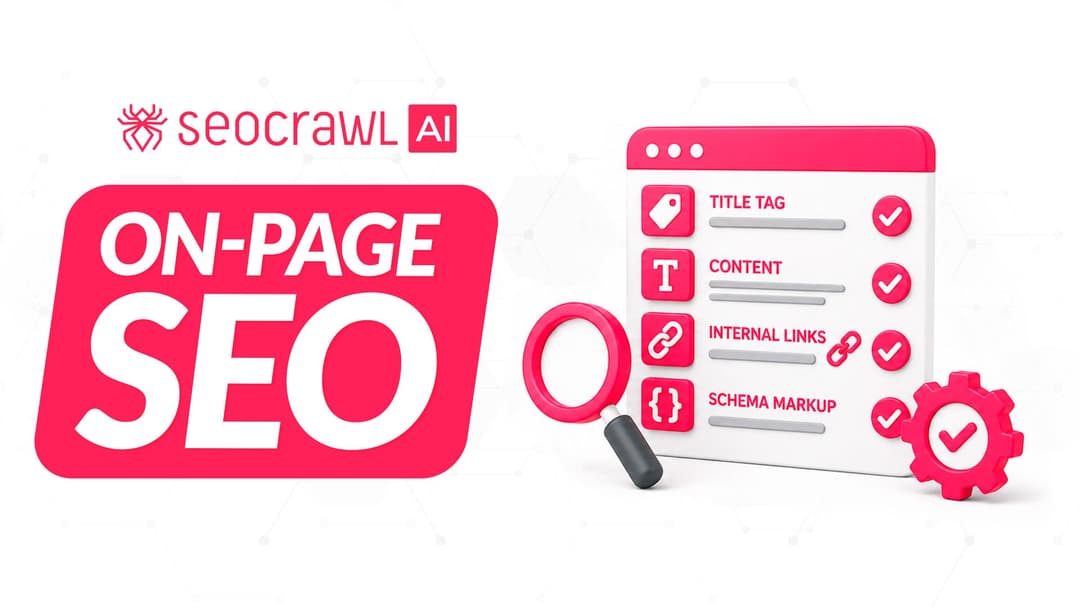
On-page SEO is everything you control on a page: content, title, meta description, headings, URL, images and internal links. Here is a checklist element by element, an audit process and what changes with AI Overviews and AI Mode.