Statistical Significance in SEO Testing: A Plain-English Guide
You changed the titles on 400 pages, and three weeks later clicks are up 8%. Did your change do that, or did a competitor slip, did demand rise, or did Google push a quiet update the same week?
Statistical significance is the check that answers that question. It tells you whether the gap you are looking at is a real effect or just the normal week-to-week wobble that every site has. It's the measurement discipline that sits underneath any SEO A/B testing program.
Why statistical significance matters in SEO testing
Search demand rises and falls, competitors publish and drop, Google reshuffles results, and Search Console itself reports with a two- to three-day delay.
The problem comes if you read a bump in traffic as proof your change worked, roll it out sitewide, and later find the traffic came from seasonality or a lucky week.
Statistical significance is the discipline that stops you acting on noise.
Key concepts in simple words
You only need a handful of terms to read an SEO test result.
Control vs variant: in SEO split testing you take a set of similar pages, leave one group unchanged (the control) and apply your change to the other (the variant).
The null hypothesis: this is the boring default assumption that your change did nothing. A test tries to gather enough evidence to reject it.
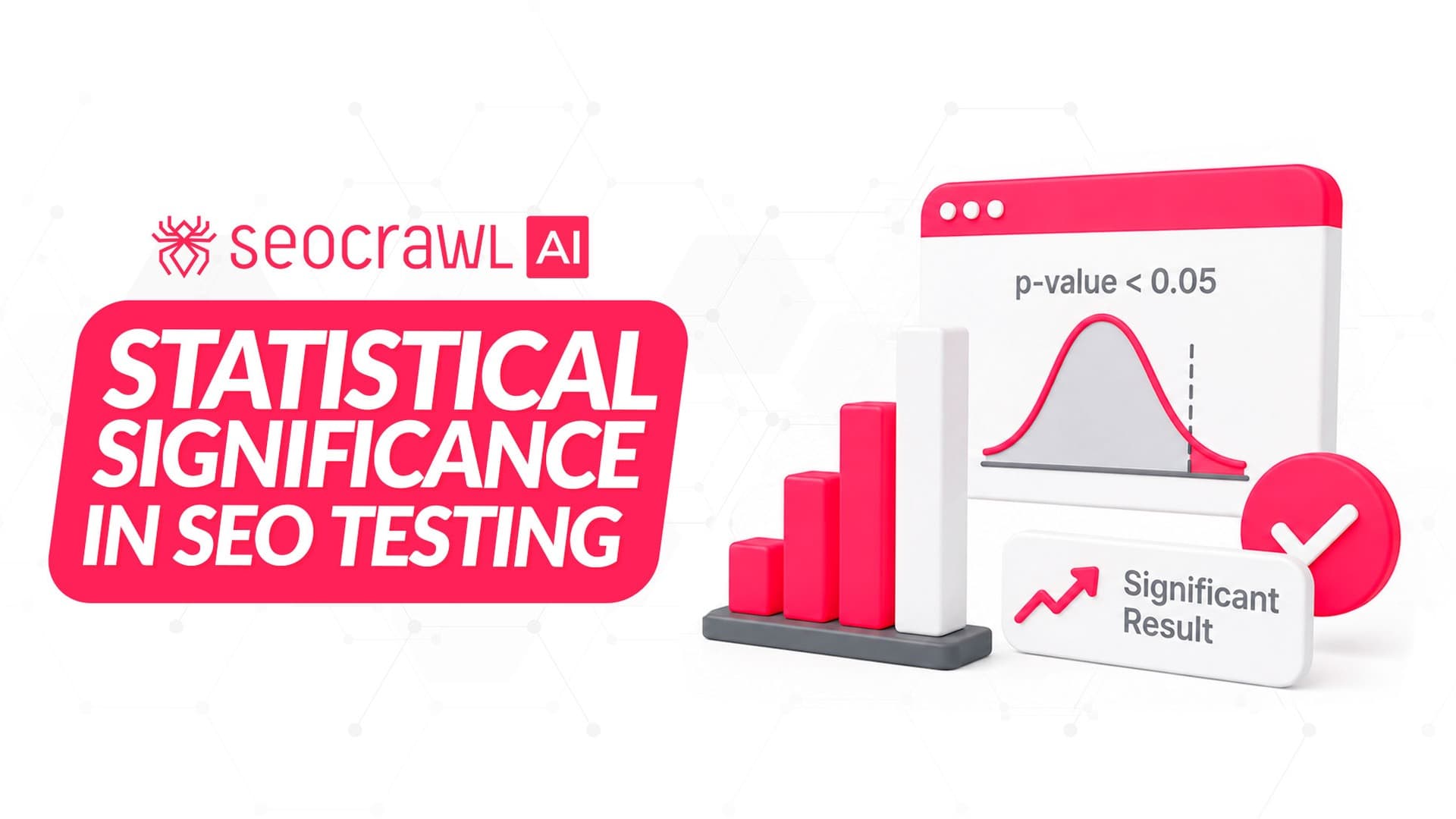
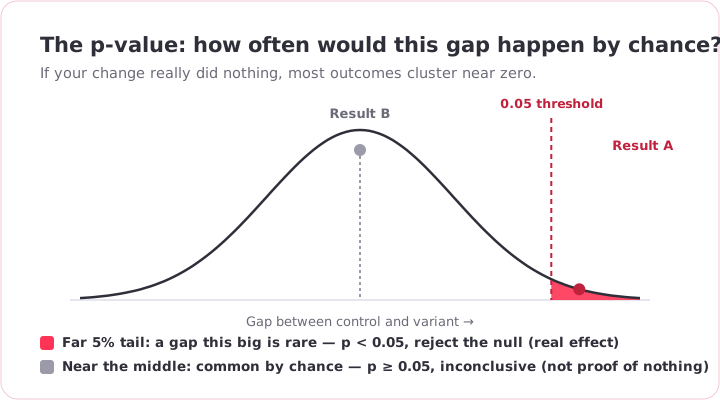
p-value: the probability that you would see a gap this large (or larger) if the change actually did nothing. A small p-value means "this would rarely happen by chance," so the result is unlikely to be a coincidence.
Confidence level and significance level: the mirror image of the p-value. A 95% confidence level pairs with a 0.05 significance level (often written as alpha). At that setting you accept a 5% chance of a false positive — that is, calling a winner when nothing really changed.
How much data you need: sample size and test duration
Two things decide whether a test can reach significance: how many pages you compare, and how long you run it.
For a classic split test, practitioners commonly aim for a sample size of a few hundred pages per group so the signal rises above the noise.
Fewer pages means a noisier, less trustworthy result. This is why templated sites (e-commerce, listings, large blogs) are the natural fit. If your site has only a handful of unique pages, a clean split is not possible, and the realistic alternative is a time-based before/after test on a single page or small set.
Google's own website testing guidance is to run a test only as long as you need to reach a reliable conclusion, and then remove the test elements.
In practice that means a test long enough to cover full weekly cycles and Google's indexing lag. Many SEOs plan for four to six weeks, and adjust up for low-traffic pages.
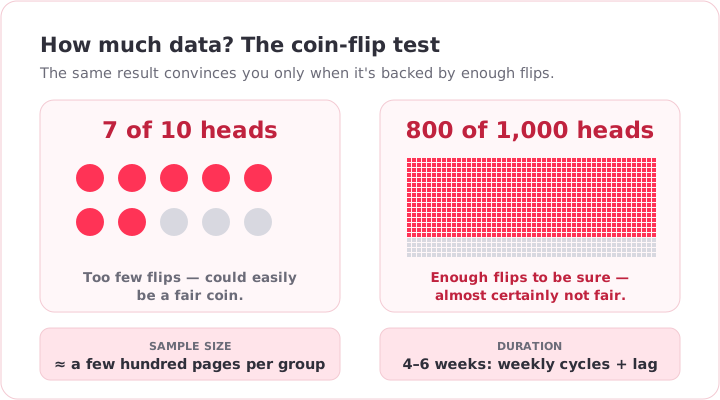
Here's a useful mental model: a coin that lands heads seven times out of ten could easily be fair. The same coin landing heads 800 times out of 1,000 almost certainly is not. More data makes a real effect stand out from randomness.
How to tell if a result is real (significant) vs random
Once the test has run its planned course, here's how to check the result.
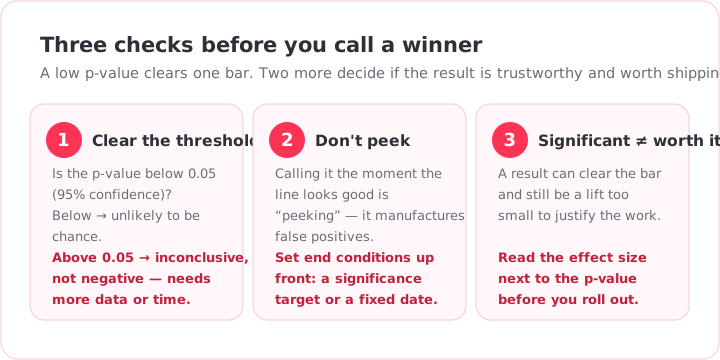
Compare against the threshold. If the p-value is below 0.05 (95% confidence), the gap between control and variant is unlikely to be chance. If it is above, treat the result as inconclusive rather than negative: you may simply need more data or more time.
Do not stop early. Watching a test and calling it the moment the line looks good is called peeking, and it manufactures false positives. Set the end conditions before you start — either a significance target or a fixed end date — and hold to them.
Separate "significant" from "worth it." Statistical significance only tells you an effect exists, not how big it is. A change can clear the significance bar and still deliver a lift too small to justify the engineering work. Look at the effect size alongside the p-value before you roll anything out.
Practical rules of thumb (keep them handy)
- Write a falsifiable hypothesis about one variable before you touch anything. Change several things at once and you cannot tell which one moved the needle.
- Aim for a few hundred pages per group on split tests. Use time-based before/after on smaller sites.
- Plan for several weeks and set the end conditions in advance.
- Use a 95% confidence level (p < 0.05) as your default bar.
- Check for core updates and seasonality inside your test window.
- Read effect size next to significance, and record the exact date the change went live so you can line it up against the data.
How to separate real, significant shifts from noise in SEOcrawl AI
Reading the organic impact against real Search Console data is a separate job from designing the test, and it is where most of the manual effort hides. SEOcrawl AI handles the measurement side.
You tag your control and variant pages, then read each group's trend on the SEO Dashboard, where the winners/losers view shows the biggest changes between two periods with the deltas already computed. SEO Annotations mark when a change shipped and generate a before/after report at the 7-, 14- and 30-day marks.
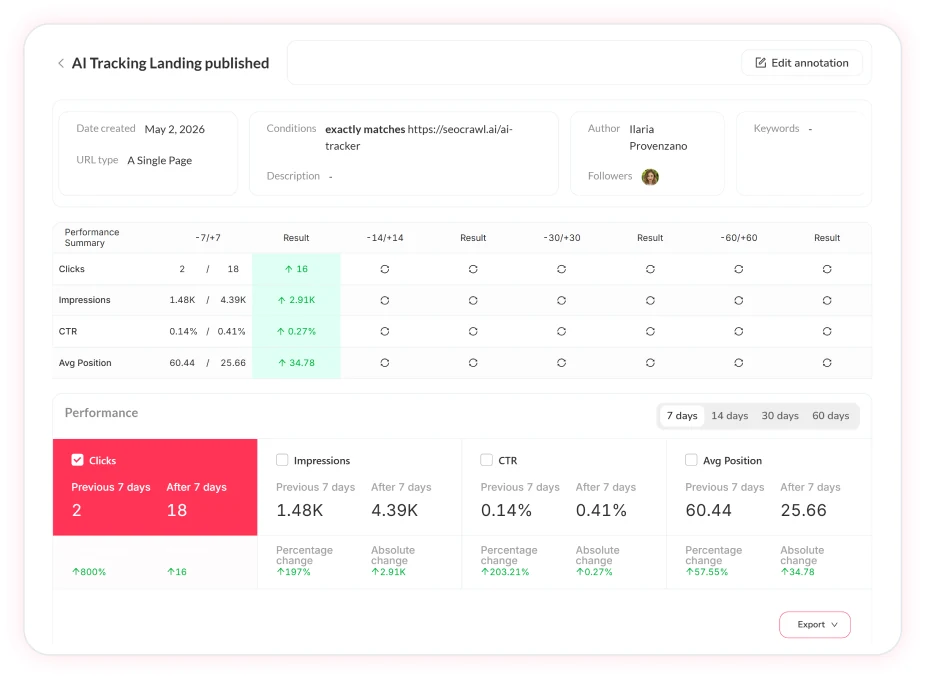
Google core updates are flagged automatically, so you can see whether one overlapped your test window, and because the data comes straight from Google Search Console with unlimited retention, you can compare full years to control for seasonality.
Measure the shift, don't guess it. SEOcrawl AI tags your control and variant pages, annotates when the change shipped, and flags any core update that overlaps your test window — so the gap you read is your change, not the noise. Try SEOcrawl AI or explore the SEO Dashboard.
FAQs
What is statistical significance in SEO?
Statistical significance is a way of judging whether a change in your SEO metrics is a real effect or just random variation. In practice it means the difference between your control and variant (or your before and after) is large enough, and backed by enough data, that it is unlikely to have happened by chance.
What p-value should I use for an SEO test?
The standard bar is a p-value below 0.05, which corresponds to a 95% confidence level. It means there is roughly a 5% chance you are seeing a false positive.
If you need to be more cautious, you can set a stricter level such as 0.01 (99% confidence), but 0.05 is the widely accepted default for SEO and marketing tests.
How long until an SEO test is statistically significant?
It depends on your traffic, but plan for several weeks. Many SEOs run tests for four to six weeks so the data covers full weekly cycles and Google's indexing lag, and low-traffic pages may need longer.
Set your end conditions before you start and avoid stopping early, since peeking at results inflates false positives.
How big a sample do I need for an SEO split test?
For a classic split test, aim for a few hundred pages per group so the signal stands out from noise. Templated pages (product, category, or location pages) make this realistic.
If your site is too small to reach that volume, skip the split and use a time-based before/after test on a single page instead, ideally compared year-over-year.
Author: David Kaufmann

I've spent the last 10+ years completely obsessed with SEO — and honestly, I wouldn't have it any other way.
My career hit a new level when I worked as a senior SEO specialist for Chess.com — one of the top 100 most visited websites on the entire internet. Operating at that scale, across millions of pages, dozens of languages, and one of the most competitive SERPs out there, taught me things no course or certification ever could. That experience changed my perspective on what great SEO really looks like — and it became the foundation for everything I've built since.
From that experience, I founded SEO Alive — an agency for brands that are serious about organic growth. We're not here to sell dashboards and monthly reports. We're here to build strategies that actually move the needle, combining the best of classical SEO with the exciting new world of Generative Engine Optimization (GEO) — making sure your brand shows up not just in Google's blue links, but inside the AI-generated answers that ChatGPT, Perplexity, and Google AI Overviews are delivering to millions of people every single day.
And because I couldn't find a tool that handled both of those worlds properly, I built one myself — SEOcrawl AI, an enterprise SEO intelligence platform that brings together rankings, technical audits, backlink monitoring, crawl health, and AI brand visibility tracking all in one place. It's the platform I always wished existed.
Discover more content about this author
CTR tells you how many of the people who saw your result actually clicked. Here's the formula, what a good CTR looks like in 2026 by channel and by Google position, and how to get more clicks from the rankings you already have.