The 8 Most Important SEO Factors
If anything has defined the SEO world in recent times, it has been uncertainty. We are talking about uncertainty due to the many sudden shifts seen in search results. Google has officially announced multiple major updates throughout the year, and as the official Google account itself points out, there are several updates every year, so these ranking movements we are discussing are justified by those updates.
What has been striking is how drastic these movements can be, which is why, whenever SEO professionals hear the word UPDATE, we start to tremble.
Now then... what does the future have in store for us? To help you prepare, our team has put together a roundup of the 8 SEO factors we believe will be most relevant, and why. We hope you enjoy them and find them very useful!
Content
Sooner or later there will be a major shift here, because Google still has a lot of room for improvement. Artificial processing of content is one of the great battles of the leading search engine.
Duplicate content, spun, translated and/or copied content are issues Google still has not managed to resolve 100% in its algorithms, so it will surely keep working until this type of content cannot be generated en masse.
Enriched content. Many people in the industry interpret content as text only, but we have many more resources at our disposal, and this may well be the year when the most complete articles in this sense gain greater recognition in the rankings. We are talking about articles that include: videos, original images, infographics, podcasts, tweets or third-party resources (statistics, etc.).
User metrics
We all speculate and throw out hypotheses about what kind of metrics Google is using to evaluate our website. But beyond speculation, even though some findings are related, it is very difficult to draw 100% reliable and proven conclusions.
This is an important point for measuring the quality of a website. Google has tools to know this data, but processing such a volume of information is no simple task.
That said, it will be an extremely important aspect to take into account, and in future updates this will be reflected in the rankings.
We are talking about metrics such as:
-
CTR
-
Bounce rate
-
Time on page…
Videos
The growth of videos in search results will undoubtedly be one of the most interesting points going forward. We will not fall back on the clichés we have been reading for years, because we all know -or should know- the importance of video content, both on YouTube and in search results. The two go hand in hand, since on many of the results Google returns, we can already see a video module.
If you are going to work on a search intent, pay attention to everything Google shows and try to be present in all of its information panels. Google not only uses videos in the carousel, but also in different modules such as "People also ask."
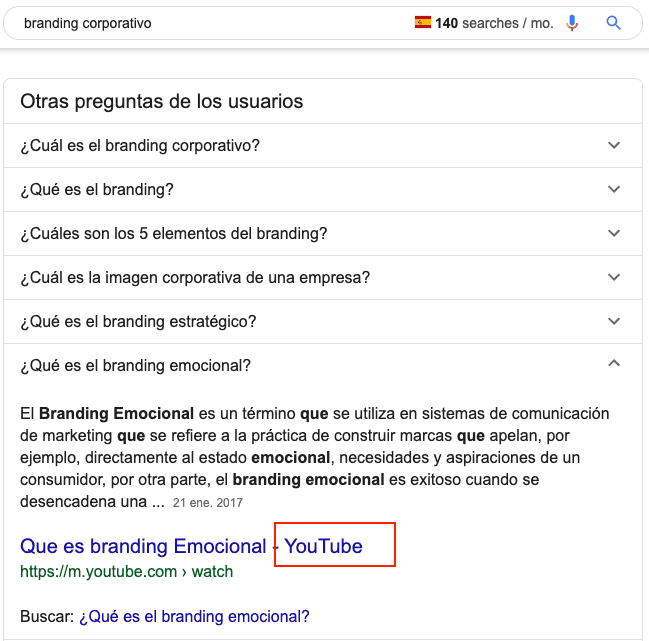
Example of a video in the "People also ask" module, where Google pulls a YouTube result and uses its description as the answer content.
Voice search
Voice searches are growing at a rapid pace thanks to smart assistants and smartphones.
We are currently in an early phase, but we should not waste the traffic opportunities that come with having a "new channel."
Even though we tend to think most voice searches are answering informational questions like "who won the last Champions League" or "when is Black Friday?", getting search results on the device screen is also an option.
Here, Google provides information (speakable) to start implementing the feature. Google itself mentions that it will soon roll out to other countries, so for now tests are being carried out in the US.
Semantic web
We have been talking about the semantic web for a while now, one of the important pillars Google is working on. Better understanding the content created by users. Since the Google Hummingbird update, the consideration of the semantic web has gained such relevance that, today, talking purely about keywords is talking about a different kind of SEO.
Google announced BERT a few weeks ago, which is a new open-source neural network. A system to improve the understanding and interpretation of natural language (NLP). Improving the interpretation of meaning, signifier and context to offer users the best possible result has the potential to change the search results ecosystem as we know it.
We cannot forget that, to improve this interpretation, we should already be using microdata markup or structured data (Schema.org).
When I refer to data markup, I am not only talking about the typical "Webpage", "LocalBusiness" or "Article" types, but also about the different markups by type of business or class of content.
Reviewing Schema is mandatory because it is updated and expanded continuously. When a client comes to the agency and we investigate, we are often surprised to find so many new markup types.
Podcast
Yes, you heard right, using podcasts for ranking on Google is already a reality. Even though Google still cannot index podcasts because they are an audio format, there are other alternatives and paths we can take at the SEO level to harness the potential of this interesting resource.
Before going further, we want to share some interesting data to contextualize why podcasts are going to become a relevant element when considering new acquisition channels:
-
The average listener consumes an average of 5 hours of podcasts per week, with more extreme users whose consumption exceeds 10 hours a week.
-
On average, each listener tunes into about 5 different shows per week.
-
Audio content consumption is growing exponentially thanks to the increasing capabilities that mobile devices put within our reach.
Now that we have established that podcasts are increasingly present, let's see how we can take advantage of them from an SEO point of view:
- Indexing content via transcriptions. That's right, we are not going to index the audio itself so it answers a user's search, but we can transcribe the podcast content, and that text IS eligible to be indexed by Google, becoming a source of text that is very rich in keywords and semantics and can match user searches. Not surprisingly, Google offers specific microdata to help us with indexing and encourage appearances in the SERPs.
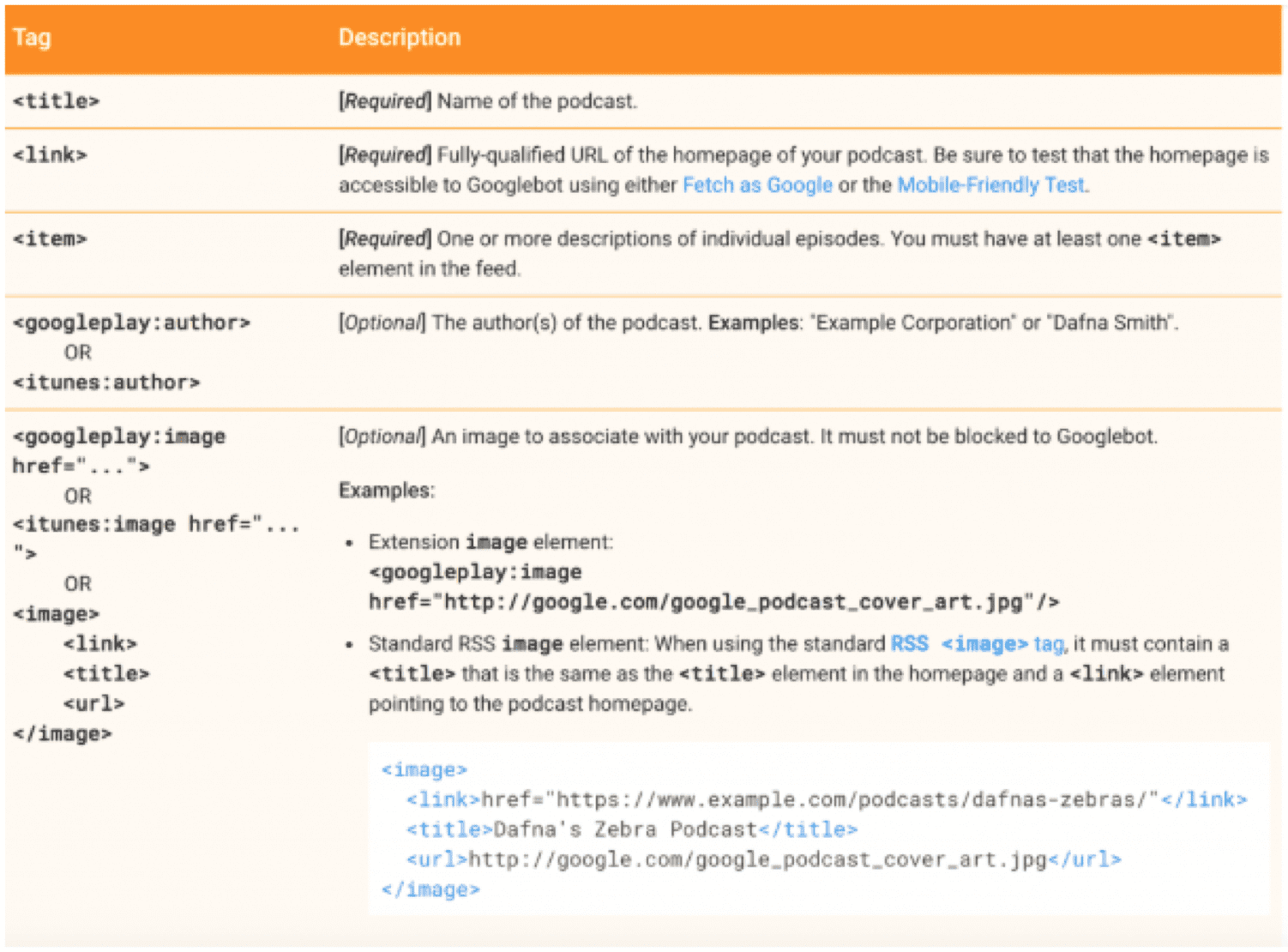
Example of podcast data markup documentation
-
Voice assistants: closely related to voice searches, which we also cover in this post. The use of these assistants is also growing, and one of the most in-demand services is listening to shows and content through them.
-
YouTube: it is common to upload podcasts on this platform to make consumption easier for users. One way to capture traffic is by uploading podcasts to YouTube, combined with this platform's own SEO actions.
-
Google Podcasts: yes, Google has also noticed the potential of podcasts and has launched its own app to listen to them. A good SEO strategy within that app will help us improve our brand image and build user loyalty, achieving that direct traffic that does so much to improve a site's SEO.
As we can see, podcasts offer great SEO potential, very little exploited to date, and one that will undoubtedly become a heavyweight factor going forward.
Search Intent
Search intent has become one of the main factors to keep in mind in modern SEO if we want to succeed in any search campaign we undertake.
Google's main goal in all the modifications and revisions to its algorithm is to offer users the most interesting and relevant information to satisfy their search intent. When a user performs a specific search, Google shows the available options in order of relevance, taking into account not only the quality of the information but also the page load speed and all those other factors that help Google rank our pages at the top of the list.
With this in mind, if we want to rank well it is essential to carry out a study of user search intents and adapt our content to their interests — in other words, anticipate their needs. Search Intent must be one of the main aspects to analyze and consider, since it has become decisive for Google. And there is more: the funnel as we traditionally knew it and its stages are changing and being reshaped by Search Intent. This is because today we use our devices to look for the most specific answer that best matches our needs or search intent.
Google wants to reward websites whose content adapts to the real needs of users, and this is far more relevant than lengthy content or abusive keyword use to try to rank.
Increasingly specific searches with connectors like "how," "what," "where," "best," "do," etc., are being better interpreted by Google's entire artificial intelligence algorithm, which tries to "get inside" the user's mind to offer content that solves their need.
Users are changing and marketing experts must adapt to these changes in order to offer content that is of interest and thereby support the SEO of websites.
E-A-T (Expertise, Authoritativeness, Trustworthiness)
Closely related to the previous point, Google is not going to show results that answer user searches if it does not consider them to come from a reliable and verifiable source. In its annual update of the Quality Rater Guidelines, Google has again emphasized the importance of taking care of what they call E-A-T.
-
Expertise
-
Authoritativeness
-
Trustworthiness
These are the three characteristics Google considers necessary to evaluate the quality of web pages and takes into account for ranking. E-A-T is now considered a unit of measurement; people talk about high or low E-A-T to categorize websites, and it is a significant part of Google's algorithm.
Google improves its algorithm several times a year, reinventing how it evaluates web content to surface those pages that offer higher quality to their visitors. For marketing and SEO experts, it is important to understand how Google evaluates so they can anticipate and adapt or improve websites to obtain the best possible ranking results.
Here are some tips to improve a website's E-A-T:
-
Earn good reviews from users to improve authority. Getting mentions on Wikipedia, forums or on pages with a high authority or PageRank is also very positive.
-
Take care of the quality, truthfulness and relevance of the information found on the site.
-
Have a real profile of a person or group of people with a biography or relevance in the niche or industry they write about.
** This article has been written by Alonso Abellán and Rocío Luque. *
At SEOcrawl AI, we wanted to go a little further, so below we share our team's opinion on what SEO has in store for us, and we also include opinions from some of the most respected SEOs in the industry.
SEOcrawl AI Team

Alonso Abellán: "Personally, I don't think 2020 is going to bring anything we don't already know. We all more or less understand the relevant points and the actions where we need to put more emphasis. The question is: will what we have been doing be enough, or will we need to improve further? Google will continue to polish the aspects it considers important, and the updates will follow that line."

Sara Gonzalo: "If I had to pick one thing, I would say that semantics is going to take on even greater prominence in 2020. This doesn't mean that SEOs aren't already taking it into account (and if not, you should get up to speed right now); it simply means that, after the arrival of BERT, the semantic web is a topic that will be emphasized even more, if that's possible. Once again, Google makes it quite clear that for years it has invested a lot of effort and resources in understanding how people search in order to offer them the best answers. And, although there is still work to be done on its part, it clearly shows it is still pursuing that goal: fully interpreting web content. With BERT arriving on Spanish-speaking sites in 2020, we'll be hearing over and over about the importance of leaning into an even more semantic SEO."

Rocío Luque: "SEO in 2020 will evolve. It will evolve because the way users search for and consume information keeps evolving, as shown by Google's much-talked-about update at the end of this year (BERT). It will keep the same foundational base as always (architecture, content and popularity), but the way we present that content and adapt it to new technologies will carry significant weight. Voice searches, which were already discussed some time ago, are taking on increasing importance, as demonstrated by the rise of voice assistants. Fundamentally, I think there will be greater evolution in how we build keyword research, giving more and more weight to semantics and search intent. That said, we mustn't forget the essentials and the basics of SEO that I mentioned earlier, which remain constant — without them properly structured, we can have very little evolution."
SEO Experts
Esteve Castells (Global SEO Manager at Adevinta and creator of SEOpatía)
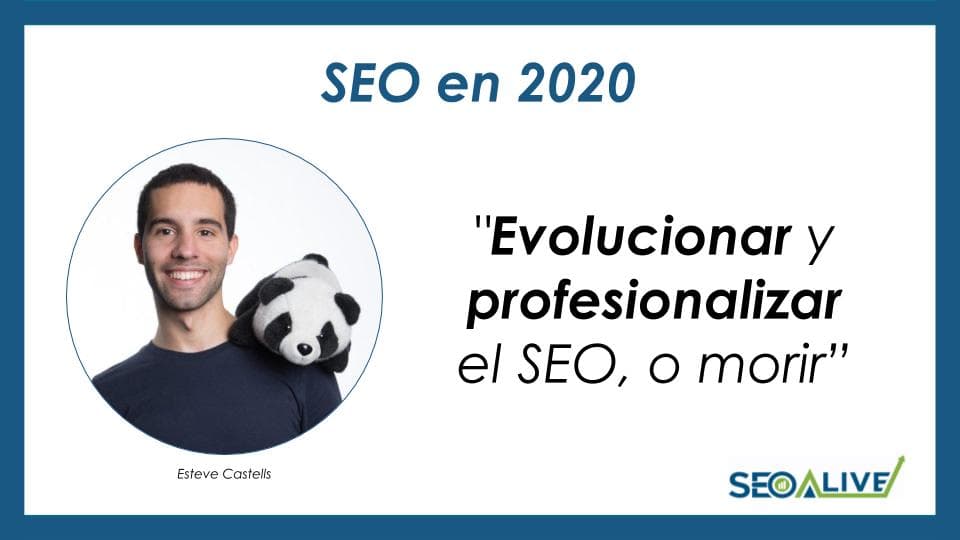
"I don't think we'll see big changes in 2020. SEO keeps evolving and it will be more obvious in 2020, as over time there will be more and more searches that don't lead to any clicks, more ads in the SERPs, more Google services embedded, tougher competition, more videos and images, as well as anything else Google's engineers can come up with. Our duty as SEOs will continue to be serving the opportunities that remain available through the same SEO we already know today, though we will have to be more rigorous and execute our work better, since the average level of SEO optimization grows every year and that forces us to be even better to stand out. When my company asks me to design the SEO role of the future, I always tell them it involves horizontal growth (covering more organic channels than just SEO: ASO, Content Marketing, Referral Growth, among others) as well as cross-functionality (knowing more about everything in order to push, from SEO, those growth enablers that often end up blocking SEO itself -- JavaScript, data, UX, marketing, etc.). And above all, in 2020 SEO will have to be more numeric and business-driven than ever. It's no longer enough to do SEO "just because"; if there are no clear ROI justifications, it will be increasingly hard to prove the value of our work, and the reality is that for many years the field has lived off optimizations and justifications that add no incremental value -- in other words: wasting time and money. Evolve and professionalize SEO, or die!!"
Juan González Villa (Director of USEO)
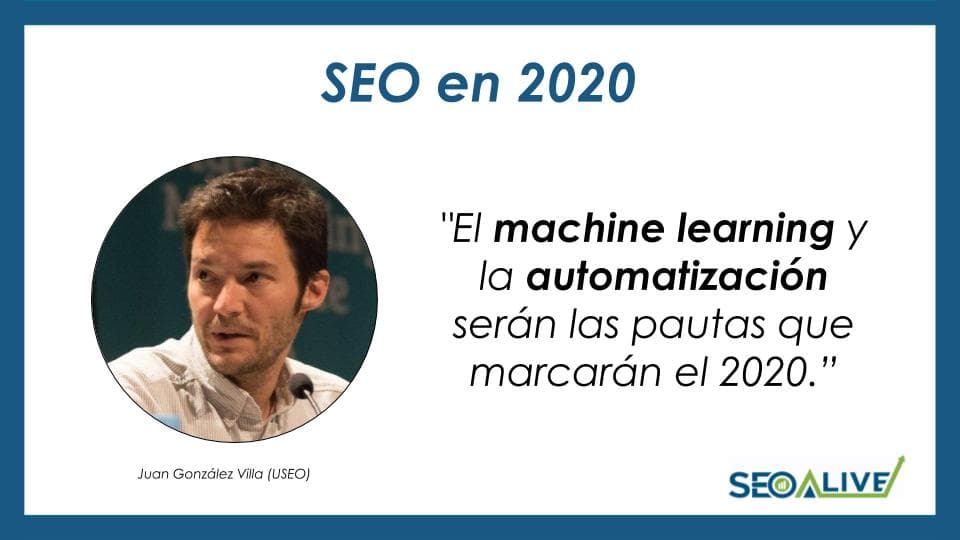
"I don't think there will be major changes compared to 2019 in the essentials. I do believe that Google's announcement of the use of BERT will trigger a renewed interest in the industry around semantics, entities and natural language processing (NLP). As for methodologies or tools, machine learning and automation (for example, applying Python or JavaScript to classic SEO processes such as keyword research or on-page optimization) will undoubtedly be the guidelines that mark 2020, and probably the difference between the most effective SEO agencies or consultants and the rest."
Jordi Ordóñez (eCommerce Consultant at JordiOB.com)
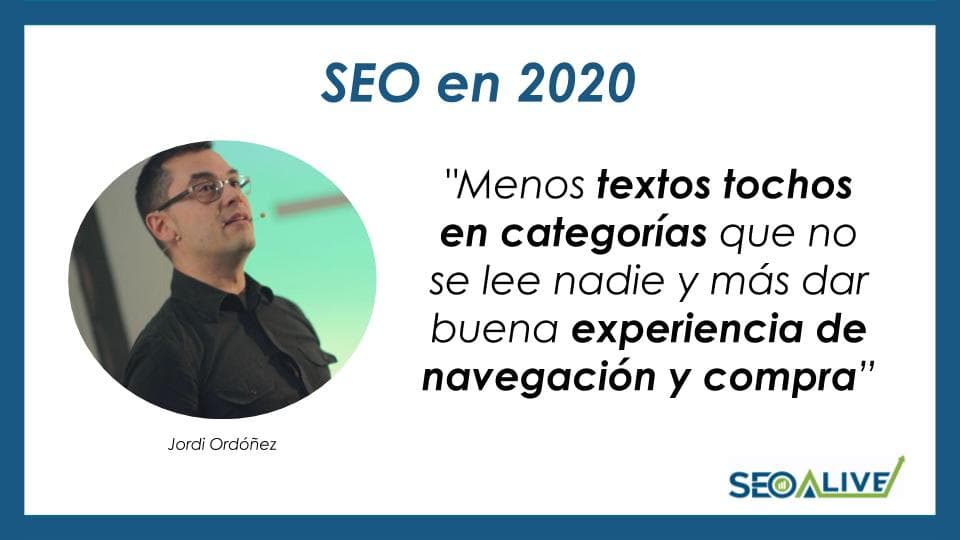
"I believe UX is going to have an even greater presence and weight within Google's algorithms. I'm not only talking about navigability, accessibility, page load and other factors that we already understand better today thanks to Lighthouse. I'm also talking about the response we give the user not just for a question -- although that counts too -- but for an action. Within my field, ecommerce, it is no longer enough to be top 1 for "extendable console table"; we must also give the user a satisfactory answer, not one where they land on a category page with 3 or 4 products, but where they find variety in the catalog depth we can offer them for that specific demand. So, fewer huge chunks of text in categories that nobody reads, and more focus on providing a great browsing and purchasing experience. For example, Amazon does not have good texts on category pages (only in the US, where they are now starting to), but it has an endless catalog depth and brutal authority within retail and each of the niches it sells in. The first part, we can match. The second is much more complicated xD"
Natzir Turrado (SEO Consultant)
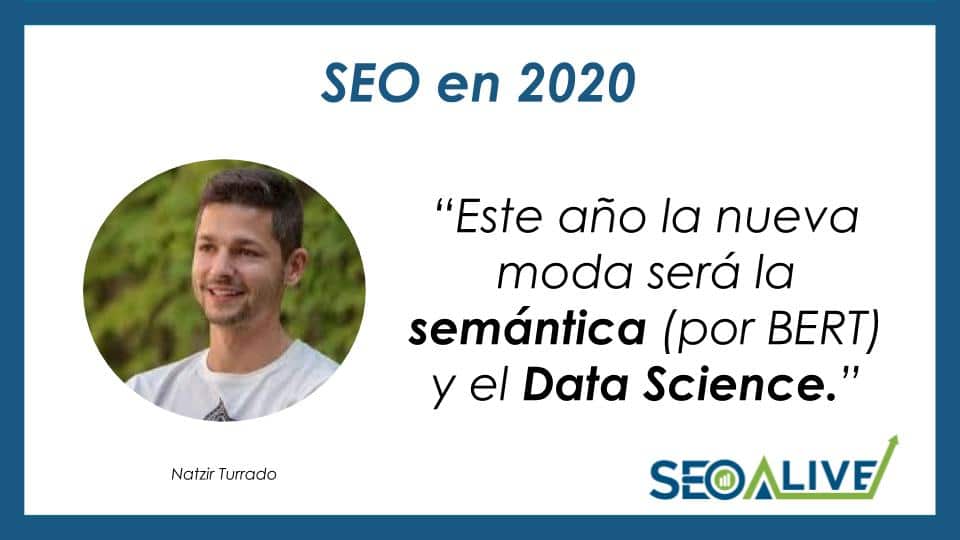
*"For 2020 I consider the essentials to be the same as in 2019, 2018, 2017, 2016... But SEO goes by trends: one year everyone is into "mobile," another year it's "speed," another it's "log analysis," another "information architecture" (although they were only talking about internal linking...), etc. Every year SEO gets simplified to a single concept, and new SEOs think SEO is just about that. There are also SEOs who think it's all about shortcuts and tricks, and they focus their efforts there. But none of the above works if you don't work on all of it together. *This year the new trend will be semantics (because of BERT) and Data Science, and that's all anyone will talk about. I personally became interested in semantics and NLP back in 2011, as you can see in an article on my blog (Analista SEO). And little by little I've been professionalizing and automating all of the above. I guess this is the bandwagon everyone will jump on now (a bit late in my opinion). Before BERT we had Hummingbird, and before that Google had already been trying for a long time to answer questions, not just links. So I think that, once again, what's going to become fashionable is something that should have been done a long time ago."
Sico de Andres (CEO of Link Affinity): "Lots of links, and affinity links. A safe strategy is to use Link Affinity."
We would love to hear your opinion in the comments section. We look forward to your feedback!
Author: David Kaufmann

I've spent the last 10+ years completely obsessed with SEO — and honestly, I wouldn't have it any other way.
My career hit a new level when I worked as a senior SEO specialist for Chess.com — one of the top 100 most visited websites on the entire internet. Operating at that scale, across millions of pages, dozens of languages, and one of the most competitive SERPs out there, taught me things no course or certification ever could. That experience changed my perspective on what great SEO really looks like — and it became the foundation for everything I've built since.
From that experience, I founded SEO Alive — an agency for brands that are serious about organic growth. We're not here to sell dashboards and monthly reports. We're here to build strategies that actually move the needle, combining the best of classical SEO with the exciting new world of Generative Engine Optimization (GEO) — making sure your brand shows up not just in Google's blue links, but inside the AI-generated answers that ChatGPT, Perplexity, and Google AI Overviews are delivering to millions of people every single day.
And because I couldn't find a tool that handled both of those worlds properly, I built one myself — SEOcrawl AI, an enterprise SEO intelligence platform that brings together rankings, technical audits, backlink monitoring, crawl health, and AI brand visibility tracking all in one place. It's the platform I always wished existed.
Discover more content about this author
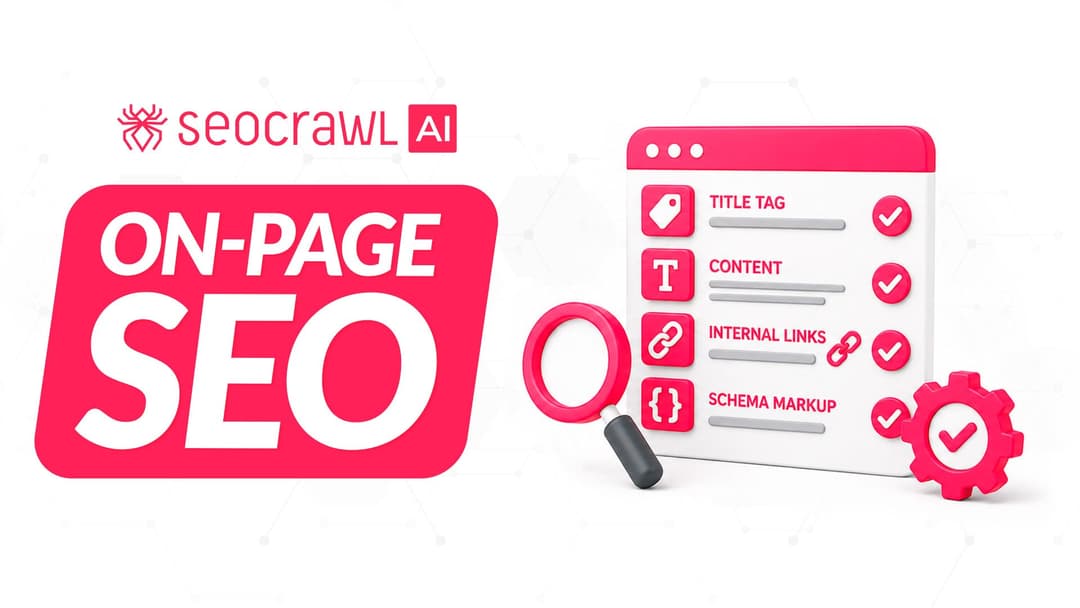
On-page SEO is everything you control on a page: content, title, meta description, headings, URL, images and internal links. Here is a checklist element by element, an audit process and what changes with AI Overviews and AI Mode.