Dwell Time: An SEO Indicator to Keep in Mind

For several years now, Dwell Time has been at the center of a heated debate across social media, articles, and specialized forums among Marketing professionals, web designers, UX experts, and the SEO community. The goal is to clarify whether Google takes into account those factors related to clicks on the SERPs (such as Dwell Time, "bounce rate", "time on page", and "CTR") and to see whether they directly influence its ranking.
But first, let's define the term and clear up any doubts so we know what we're talking about.
What is Dwell Time?
If we take a first look at the term from a position of total unfamiliarity, we'll come across a definition that refers to railway terminology. Dwell Time would be something like "the time elapsed between a train stopping at a station and its departure from that same station".
We're not far off.
If we look for the first time this concept was used from a marketing and user experience (UX) perspective, we have to go back to a 2011 article from the Bing search engine, which focused on how to build quality content for websites.
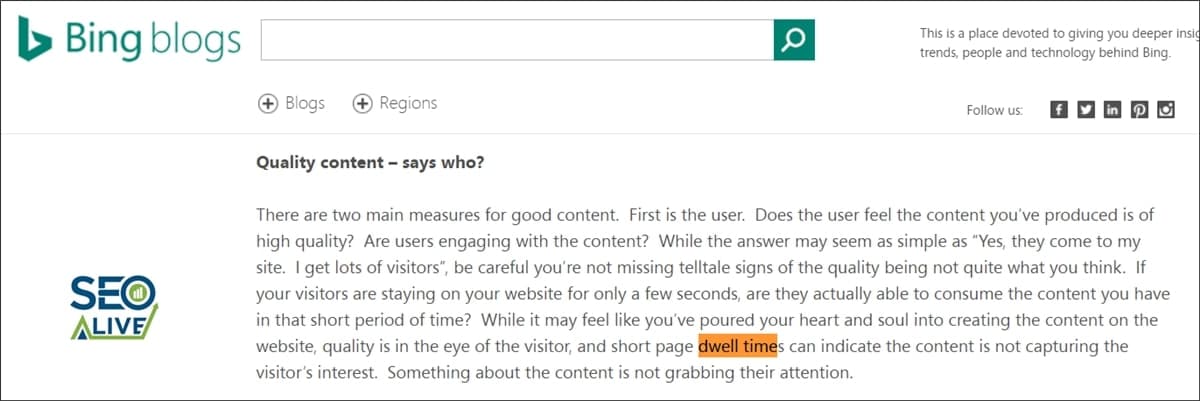
Bing was already referring to the concept of Dwell Time in one of its blog posts back in 2011.
Applied to the world of marketing, we could define Dwell Time as "the amount of time that passes from the moment a user selects a page in the organic search results until they return to the SERP (search results) and select a different page from that same listing".
What Dwell Time is NOT
- Dwell Time is NOT Bounce Rate.
- Dwell Time is NOT Time on Page.
- Dwell Time is NOT CTR.
It's very common to confuse these concepts with one another, since they're often related, so let's clear up any doubts right away:
- Bounce Rate is the percentage of users who land on our website and leave without clicking. According to Google:
"Bounce rate is calculated by dividing single-page sessions by all sessions, or the percentage of all sessions on your website in which users viewed only a single page".
- Time on Page is the amount of time a user spends on a given page before leaving it.
- CTR (or Click Through Rate) is the number of clicks a link receives relative to its number of impressions.
All of these are considered very important relevance indicators for SEO optimization and an excellent thermometer for assessing the health of your pages and the good (or not so good) user experience they provide. We could place the Dwell Time indicator somewhere between the first two metrics (bounce rate and time on page).
In this sense, the longer it takes a user to return to the search engine's SERP (or even better, if they don't return at all), the more clues we get about user satisfaction; what isn't as clear is whether we can claim that all these metrics are factors Google's algorithm takes into account when shaping its search rankings.
But then...
What variables could influence Dwell Time?
- The device used to access the information: users connecting from mobile devices or smartphones have lower time on page than those using desktop computers and tablets. (1)
- The type of article: users have lower time on page if the information is presented as a slideshow rather than as an article.
- The length of the content: users seem to linger longer on longer articles, up to 1,000 words. Beyond that limit, article length no longer has as much impact on time on page.
- The page topic: Articles focused on politics, science, and humanities increase time on page compared to those focused on food or entertainment.
As you can imagine, pages with a higher Dwell Time factor are more relevant to our business or our goals. The more time a user spends on a page, the more likely they've read and understood its content; one more indicator of whether the page is appealing to our audience and is working.
But...
Is Dwell Time a ranking factor for Google's SERPs?
The debate is still open. Dr. Peter Meyers claimed a few years back that if we have a high CTR and Dwell Time, we'll always get relevant, quality results. In this regard, Rand Fishkin (founder of MOZ) has been claiming for years that CTR and Dwell Time are determining factors in ranking classification, but that Google, for whatever reason, doesn't want to publicly acknowledge it.
MOZ's very own SEO, Britney Muller, in one of her tweets last February, backed Fishkin up by putting forward a document signed by Google itself:

In this Google Cloud article, it's stated that Google takes every click into consideration when ranking search results.
On the other hand, Google analyst Gary Illyes, taking advantage of a user's question on Reddit, dismissed these kinds of claims as nonsense and harshly responded to supporters of this theory:
John Mueller, another influential Google analyst, argued along the same lines in response to a user's question in the Search Console forum. Mueller makes it clear that Dwell Time is not a factor that impacts crawling, indexing, or Google's own ranking.
But in this regard, it's worth asking a question: would Google really not take Dwell Time values into account for a page that repeats this process hundreds of thousands of times for the same result? Who knows...
Regardless of whether we accept Google's official stance, our recommendation is not to obsess over factors like CTR or Dwell Time and instead focus on proper SEO optimization of the page:
- creating relevant, evergreen, and quality content
- working on the most interesting search intents for our goals, always taking the overall user experience into account.
We should focus on naturally adding more search value to the page through factors we know are taken into account, rather than obsessing over possible individual ranking factors.
What are they?
- Creating an accessible and secure website
- Page speed (of course, taking the mobile version into account),
- Betting on quality, SEO-optimized content
- Domain history
- User experience (UX)
- Taking care of internal linking
- Social media, etc.
That's how Google and other search engines will help us climb positions in the SERPs in the medium and long term.
What do you think about this? Do you believe it's a ranking factor or not? Have you seen any example in a project that proves it?
Please share whatever you'd like in the comments section.
References:
Author: David Kaufmann

I've spent the last 10+ years completely obsessed with SEO — and honestly, I wouldn't have it any other way.
My career hit a new level when I worked as a senior SEO specialist for Chess.com — one of the top 100 most visited websites on the entire internet. Operating at that scale, across millions of pages, dozens of languages, and one of the most competitive SERPs out there, taught me things no course or certification ever could. That experience changed my perspective on what great SEO really looks like — and it became the foundation for everything I've built since.
From that experience, I founded SEO Alive — an agency for brands that are serious about organic growth. We're not here to sell dashboards and monthly reports. We're here to build strategies that actually move the needle, combining the best of classical SEO with the exciting new world of Generative Engine Optimization (GEO) — making sure your brand shows up not just in Google's blue links, but inside the AI-generated answers that ChatGPT, Perplexity, and Google AI Overviews are delivering to millions of people every single day.
And because I couldn't find a tool that handled both of those worlds properly, I built one myself — SEOcrawl AI, an enterprise SEO intelligence platform that brings together rankings, technical audits, backlink monitoring, crawl health, and AI brand visibility tracking all in one place. It's the platform I always wished existed.
Discover more content about this author