10 SEO KPIs You Should Keep Under Control
Is my SEO strategy working? How do I know if I'm doing things right? The answer to all of this is SEO KPIs.
WHAT?! You don't know what they are? Don't worry, we've got the solution. Get ready, let's get started:
What are KPIs?
First of all, we should start by defining KPIs.
KPIs (Key Performance Indicators) are those metrics that, at a glance, allow us to understand the status of achieving the objectives set within our organization.
In other words, those metrics that let us know whether our company or organization is on the right track.
So, what are SEO KPIs?
SEO KPIs are those key metrics for our business that allow us to quickly assess the state of our search engine rankings. For example, organic conversion rate, number of organic sessions, bounce rate, and so on.
The SEO KPIs you should keep an eye on
Before we dive into this list, it's worth noting that these KPIs are our selection. It's important to keep in mind that KPIs will vary depending on the company you're working with and the person who has to interpret them.
A corporate blog is not the same as an online shoe store, and a CEO is not the same as a technician from the SEO department.
By this we mean that, as we mentioned earlier, the value of KPIs lies in providing a quick glance at the business. For this reason, we can't have a dashboard with 1,000 KPIs. That isn't efficient.
Moreover, if you're a CEO, you probably just want a quick overview of each area of your company, and from the SEO side you might only care about the number of sessions and the conversion rate. Meanwhile, if you're an SEO technician, you may need more data, such as dwell time or organic bounce rate.
With that said, let's get started with the list:
1) Organic clicks
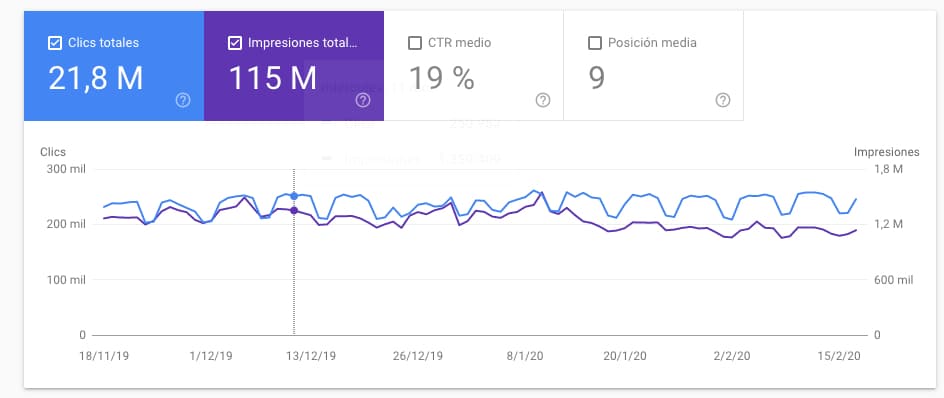
Another of the most important metrics to take into account within the SEO world. It refers to all the users who click on any of our organic results in Google to reach our website.
This metric can be obtained directly from Search Console.
With this KPI we must take into account the time of year we're in, since if our industry has many more searches in December, it's normal for our visits to increase. That doesn't mean our SEO strategy is working better.
In this section it could be interesting, if you see fit, to add some sub-KPIs to understand the quality of the traffic we're getting: dwell time, pages/session, etc. All this data can be obtained quickly from Google Analytics.
2) Organic conversion rate
How do we make money? Regardless of the type of business we have, there always has to be a goal: sales, leads, etc. With the conversion rate we measure the relationship between all the visits we're getting on our website and the goals those users are completing.
What good is it to receive 1,000,000 organic visits to our ecommerce if we don't sell a single t-shirt?
For this reason, it's vitally important to always keep it within our SEO KPI dashboard so we can carry out the proper investigations the moment we see it starting to trend negatively.
3) ROI or SEO revenue
A metric closely linked to the previous one. ROI (Return On Investment) is defined as the economic value generated as a result of running a campaign, in this case, an SEO campaign.
Its formula is:
ROI = (Gains - Investment) / Investment
Calculating it will allow us, first of all, to know whether the SEO campaign we've run or are running is being effective for the business. Then, with this calculation, we'll be able to justify the costs of our SEO campaign and demonstrate that our strategy is helping to achieve the company's objectives.
4) Bounce rate
You could say that the bounce rate (closely related to dwell time) is a ranking factor. Because if Google sees that many users click on our result, and then return to the SERPs to click on the next result, it will understand that our result isn't relevant for that keyword and will lower our position.
For that reason, it's always important to keep a little control over the average bounce rate of our page, as well as the pages with a higher-than-normal bounce percentage.
Why?
Imagine that for a category of your ecommerce the images have broken. That will scare off all your users.
By monitoring the bounce rate, we'll be able to notice issues like this and fix them before they cause a drop in our rankings.
5) Visibility index
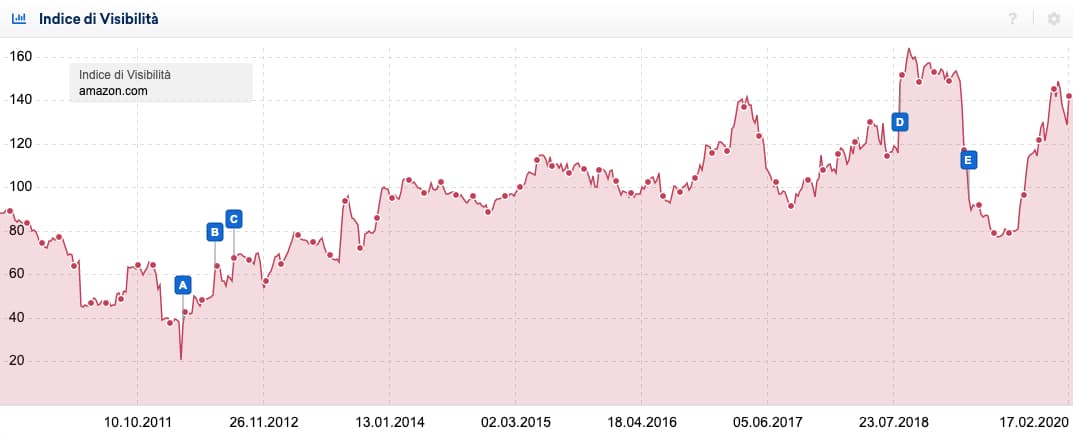
As we all know, the visibility index is a metric that measures the visibility of our website in search engines. The most common, and one of the best, is Sistrix, which measures our visibility on Google.
One of the factors that makes us lean toward this metric is that it's timeless, meaning it isn't influenced by the time of year we're in.
This fact gives us a clearer view of our SEO strategy since focusing only on organic sessions could mislead us if we don't take into account the seasonality of our service.
6) Backlinks
We all know that backlinks are among the top 10 SEO ranking factors. That's why, if we want to always keep them under control, it's best to add them to your SEO KPIs list.
Typically, this will be a metric with very modest growth, but what happens if we find ourselves, overnight, with a 1,200% increase?
It's common for some website to link to us, and if that link is in the footer, menu, or sidebar, the number of links will grow dramatically.
The best thing is to keep an eye on the number and make sure large increases/drops in the number of incoming links don't negatively impact our rankings.
(NOTE: also watch out for negative SEO attacks ?)
7) Ranking positions
Normally, every website has its SEO flagship, that is, that page or pages that are performing very well in terms of ranking and that bring in the majority of organic visits to the site.
Having these pages identified and monitored never hurts, since a slight drop in the positions of these keywords can mean a big loss for the website.
8) Branded vs. non-branded SEO traffic
Within this KPI we need to make a distinction, since depending on the industry, this KPI will be more or less important.
Although in most industries, branded organic traffic could be considered SEO traffic, for example:
"seo audit seocrawl"
Yes, they're looking for an SEO audit, but by adding SEOcrawl AI, they're specifically looking for SEOcrawl AI to be the company that performs that SEO audit. It's very hard for your site not to show up when someone searches for your brand, right?
Now look at this case:
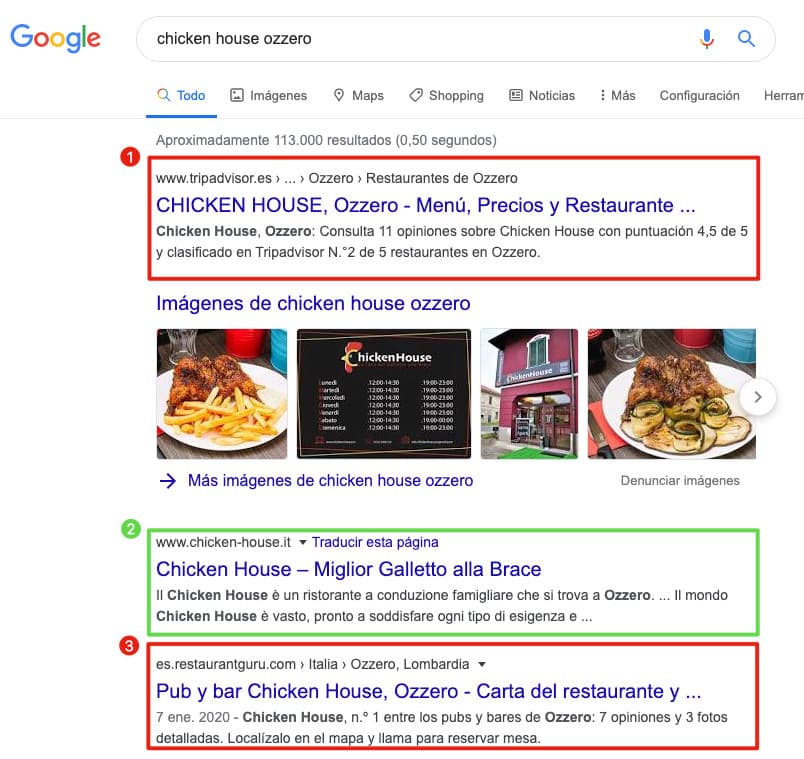
We find that for this restaurant's keywords, TripAdvisor and many others are trying to rank. This is especially common in the restaurant industry (with TripAdvisor, Deliveroo, Just Eat, ...) and in the hospitality industry (with Booking, TripAdvisor, ...).
There are times when they even bid on SEM for the brand name!
For this reason, it's important to always keep an eye on how much organic traffic we're managing to attract that isn't branded, as long as we're well-positioned for our brand keywords.
Finally, to calculate this SEO KPI, I recommend using the query filter available in Search Console:
Or, if you know how to work with spreadsheets and regular expressions, I recommend exporting the Search Console data and using the REGEXMATCH formula.
9) Top exit pages
Exit pages are the last page a user visits before leaving the site. Let's not get confused: sooner or later, the user has to leave our site. What matters is that they leave through the right door and not out the window ?
For this reason, it never hurts to keep a close eye on the top exit pages or those with the highest exit percentage. This way, we can ensure that people are leaving our site once they've completed the flow we've designed for users, and that there are no failures along the way (design errors, strange redirects, technical errors, etc.).
10) CTR
CTR or Click Through Rate is the ratio between the number of clicks our result gets in the SERPs and the number of impressions it receives. In other words:
CTR = Clicks / impressions
Obviously, the higher it is the better, since that will mean our website is being attractive to users. For this reason, it's important to include organic CTR within our SEO KPIs and monitor the CTR of the main sections of our website.
If you see it starting to drop, you'll have to go to the SERPs to check what's happening: new featured snippets, new players, the title or meta has been changed, favicon, etc. There can be many explanations!
Conclusion
We hope this short list of SEO KPIs has helped spark your curiosity and your desire to create a dashboard with the KPIs that are most effective for keeping your SEO strategy under control.
Remember, we're available in the comments for any questions or queries you may have.
Author: David Kaufmann

I've spent the last 10+ years completely obsessed with SEO — and honestly, I wouldn't have it any other way.
My career hit a new level when I worked as a senior SEO specialist for Chess.com — one of the top 100 most visited websites on the entire internet. Operating at that scale, across millions of pages, dozens of languages, and one of the most competitive SERPs out there, taught me things no course or certification ever could. That experience changed my perspective on what great SEO really looks like — and it became the foundation for everything I've built since.
From that experience, I founded SEO Alive — an agency for brands that are serious about organic growth. We're not here to sell dashboards and monthly reports. We're here to build strategies that actually move the needle, combining the best of classical SEO with the exciting new world of Generative Engine Optimization (GEO) — making sure your brand shows up not just in Google's blue links, but inside the AI-generated answers that ChatGPT, Perplexity, and Google AI Overviews are delivering to millions of people every single day.
And because I couldn't find a tool that handled both of those worlds properly, I built one myself — SEOcrawl AI, an enterprise SEO intelligence platform that brings together rankings, technical audits, backlink monitoring, crawl health, and AI brand visibility tracking all in one place. It's the platform I always wished existed.
Discover more content about this author
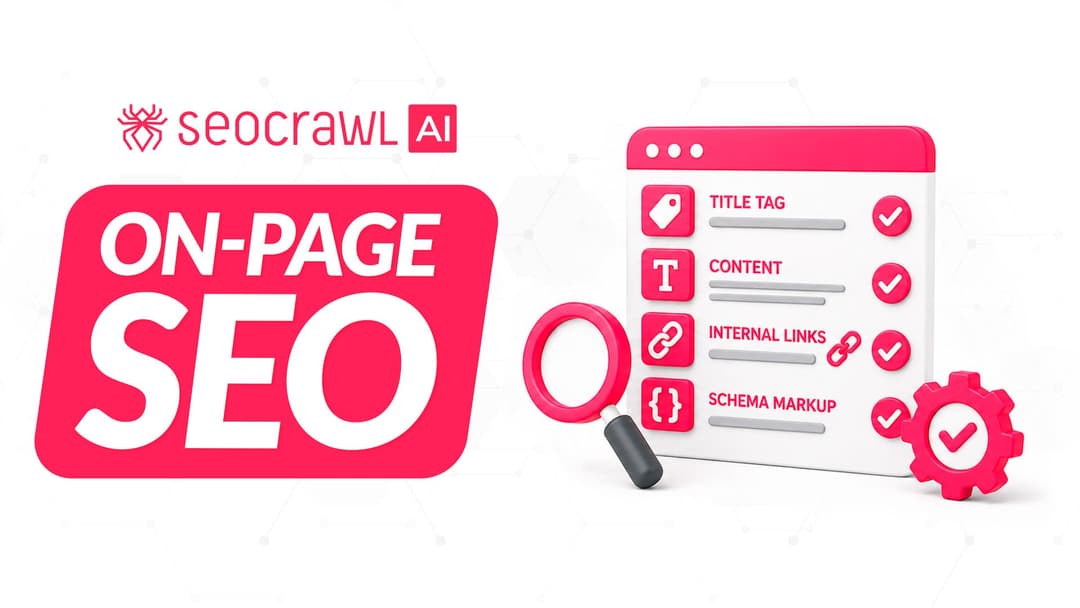
On-page SEO is everything you control on a page: content, title, meta description, headings, URL, images and internal links. Here is a checklist element by element, an audit process and what changes with AI Overviews and AI Mode.