SEO Emojis - Do they really work to improve CTR?
Today we're talking about emoticons, smileys, or emojis and their impact on SEO and CTR. More specifically, about using SEO emojis to make the title and meta description of any of our pages stand out more and, above all, stand out from the rest. Choosing the right SEO emoticons isn't always easy, but trust our experience: by the time you finish reading this article, you'll know which one to use in each situation. Got 3 minutes?
Why emoticons and CTR can benefit SEO
The first thing to make clear is that emojis on their own don't rank you better or worse. In other words, adding emojis to the title won't positively or negatively affect your SEO. So why does everyone say emoticons are good for SEO? Because of CTR (Click Through Rate), which is simply the ratio between the number of clicks and the number of impressions of a result.
Which of the following two search results catches your attention more? And which one would you click on?


The second one, right? This is the eye-catching effect emoticons have when we use them in the title and the meta description. The key is that CTR is a crucial ranking factor — let us explain it in a very simple way.
The more times users pick our result for a specific search, the more likely it is that the next time they search, we'll be higher up in the rankings. Is that all? Yes, in theory. Emojis catch more attention > Users click more > We improve our rankings. That said, remember that if you overuse them, you can come across as unprofessional and Google might even stop displaying them. You need to know how to choose wisely and be very selective.
But that's not all: SEO is a discipline defined by stacking hundreds of small optimizations. And while using emoticons or SEO emojis in our title and meta description helps… Remember! They shouldn't be the only thing we do to improve our rankings.
If, beyond emojis, you're thinking about reshaping your digital marketing strategy and professionalizing your SEO approach, we offer you a free SEO diagnosis of your website. It will be a pleasure to learn about your project!
What are the best SEO emojis
The best SEO emojis will be the ones that deliver the most CTR for you and your content. It's important to keep this in mind: every piece of content, every title, and every meta description is unique. So finding the best SEO emojis is a matter of experimenting and measuring the results you get.
That said, we're going to give you some recommendations for the SEO emoticons that have appeared and stood out the most in search results to date. If you like any of them, just copy and paste!
Emojis Unicode
1 ▶️ ▷
2 ➡️ 【 】
3 ☝ ➤
4 ☎️ ✪
5 ✅ 》
6 🥇 ✮
7 ⭐ ⓵ ⓶ ⓷ ⓸ ⓹ ⓺ ⓻ ⓼ ⓽ ⓾
8 ❗ ®
9 ❌ ■
10 ❤️ ✓
You'll have noticed that we've distinguished between standard emojis or emoticons (the typical WhatsApp ones) and "Unicode" ones. This is because the latter are part of a group of universal characters that existed before emojis and are a great alternative to emojis. Especially if you see that Google isn't showing the ones you want — but we'll talk about that later in this same article.
Quick access to every emoticon for copy and paste
Best SEO emojis for the title
Finding the best SEO emoji for the title isn't an easy task — as we said, it's a matter of experimenting (Google doesn't show all of them). But if you're looking for advice, these are our favorites and why:
- ▶️ = Ideal for placing between the main and secondary keyword.
- ➡️ = Same as the previous one, great for encouraging clicks.
- ▷ = Alternative arrow, less flashy but more elegant.
- ➤ = A bit more eye-catching than the previous one, ideal for closing the title.
- 【 】= Best for framing dates, e.g.: 【2021】.
Best SEO emojis for the meta description
When it comes to emojis for the meta description, things change — we have much more freedom to choose the one that best fits the content we want to highlight. But be careful! Don't overdo it — stick to 2-3 at most. If you're having trouble choosing, these are our favorites.
- ✅ = This emoticon works for almost anything you want to highlight.
- ☎️ = To indicate a phone number or quick contact.
- ⏳ = Great for highlighting fast delivery times.
- ❌ = Very eye-catching, but since it's a big red X, you have to be careful.
- 👉 = Great for sending the user toward a landing page or a specific offer.
Why don't SEO emoticons show up in the SERP?
Do you remember seeing search results packed with emojis everywhere? That was about a year ago, and Google recently "removed" almost all emoticons from search results. This was to prevent the abuse of emoticons in every title and description. Google rolled out an update where the algorithm decides when to show emojis and when not to.
When are they definitely not shown?
- The emoji doesn't match the content.
- The emoji is misleading.
- There are too many emojis.
Luckily, Google doesn't penalize you for using emojis, even if it doesn't end up showing them in the search results. All Google does in these cases is strip out the emoji and display only the text. So if you want Google to show some of the more special emojis you've placed in the title or meta description of your pages, make sure their meaning is relevant to the search context.
Which emojis always appear in the SERP?
The SEO emojis that will always appear are the Unicode ones (or at least until Google changes its mind). For Google, these emoticons are more like symbols than emojis, so it doesn't filter them the way it does with the others. This might seem disappointing at first glance, but it forces us to be more original when shaping our SEO emoji strategy for title and description.
Our favorite Unicode icons are ▶️ and ➡️, because, even though they're Unicode characters, Google renders them as if they were emojis. If you want a bit more variety beyond these two, we've left you some to hand. Otherwise, you can always browse all the arrow emojis in Unicode.
How do you add an SEO emoji to the title in WordPress?
Do you have or manage a WordPress site? When you paste an emoji into Yoast SEO or Rank Math and save, does it disappear? We have the solution. This happens because when you paste an emoji into your site's dashboard, it's in a very specific format that sometimes doesn't quite mesh with certain plugins. The fix is to convert the emoji into Unicode so it translates it for you — then you just paste that code into the title field and the emoji will display.
Emoticons for local SEO too
The last thing you can do with your emojis is use them in Google My Business to improve your local SEO. How? Under the same premise as Google search results: grabbing attention to improve CTR and, in turn, improve rankings.
In this case the rules of the game change: while we won't find any limitations when choosing which emoji to put in our business name, Google has expressed its complete rejection of this type of practice. Still, for now, nothing happens and we can take advantage of this trick. After all, which business would you choose at first glance?
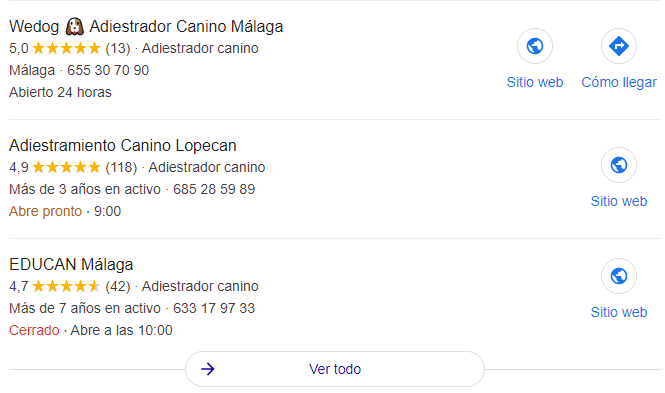
Examples of Google My Business listings with emojis.
To add the emoji, simply log into Google My Business > Info > Edit the Business Name > Add a striking emoji related to your business. It may take up to 24 hours to validate and change, but you shouldn't run into any issues.
If you want to stay on top of every Google update and discover new SEO strategies (like the one we just showed you on using emojis to boost CTR), don't hesitate to bookmark our Blog and follow us on our social media channels.
Author: David Kaufmann

I've spent the last 10+ years completely obsessed with SEO — and honestly, I wouldn't have it any other way.
My career hit a new level when I worked as a senior SEO specialist for Chess.com — one of the top 100 most visited websites on the entire internet. Operating at that scale, across millions of pages, dozens of languages, and one of the most competitive SERPs out there, taught me things no course or certification ever could. That experience changed my perspective on what great SEO really looks like — and it became the foundation for everything I've built since.
From that experience, I founded SEO Alive — an agency for brands that are serious about organic growth. We're not here to sell dashboards and monthly reports. We're here to build strategies that actually move the needle, combining the best of classical SEO with the exciting new world of Generative Engine Optimization (GEO) — making sure your brand shows up not just in Google's blue links, but inside the AI-generated answers that ChatGPT, Perplexity, and Google AI Overviews are delivering to millions of people every single day.
And because I couldn't find a tool that handled both of those worlds properly, I built one myself — SEOcrawl AI, an enterprise SEO intelligence platform that brings together rankings, technical audits, backlink monitoring, crawl health, and AI brand visibility tracking all in one place. It's the platform I always wished existed.
Discover more content about this author
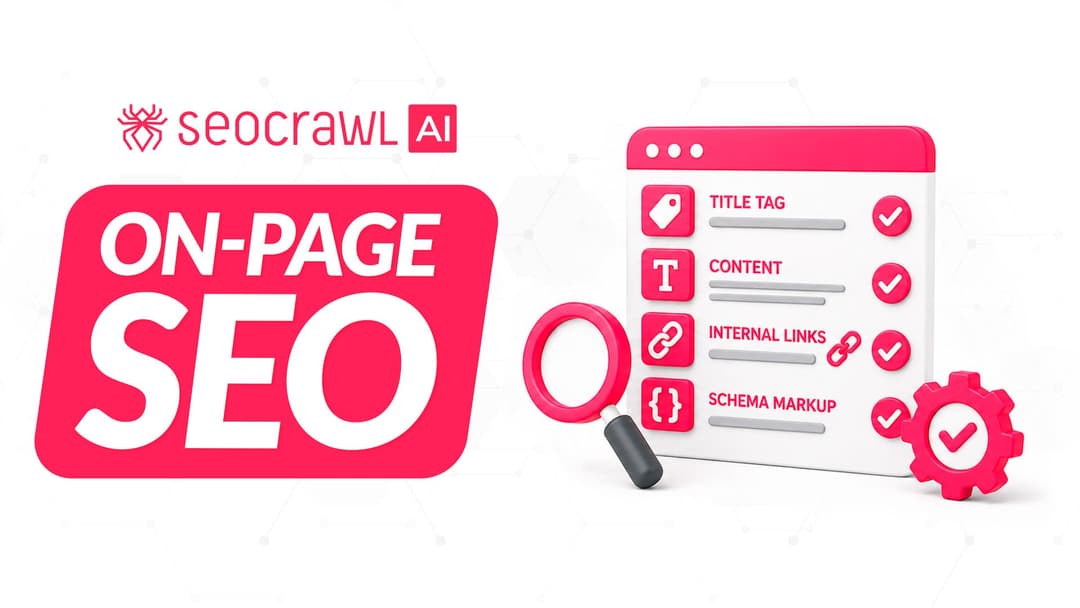
On-page SEO is everything you control on a page: content, title, meta description, headings, URL, images and internal links. Here is a checklist element by element, an audit process and what changes with AI Overviews and AI Mode.