SEO Copywriting: 9 Guidelines for SEO Copywriting

The internet is flooded with content. The competition is such that standing out among the millions of articles published every day has become a huge challenge that requires specific techniques to help us gain more visibility and get more clicks. On the internet, it's not just about knowing how to write, but knowing how to convey your message to reach your audience. So, whether we like it or not, we must adapt to the demands of this medium if we really want to rank our site on Google, attract more qualified traffic and, above all, make our investment in time and money worthwhile. To that end, today we'll focus on one of the fundamental pillars: SEO copywriting, also known as SEO copywriting. Are you ready to learn the 9 most important guidelines you should work on to rank your content? Pay attention, and take note of the following tips!:
How to write an article for SEO?
1) Keywords
They are the epicenter of any SEO-oriented article. Before you start writing about a topic, you must choose the keyword that best fits it, always paying attention to user search patterns.
After conducting a keyword study, we'll define which keyword we want to rank for in a search engine's results for a specific article. In this first SEO copywriting tip, it's recommended that this keyword be medium or long tail because, although they have lower search volume, they better respond to a direct search intent. This will result in more qualified organic traffic.
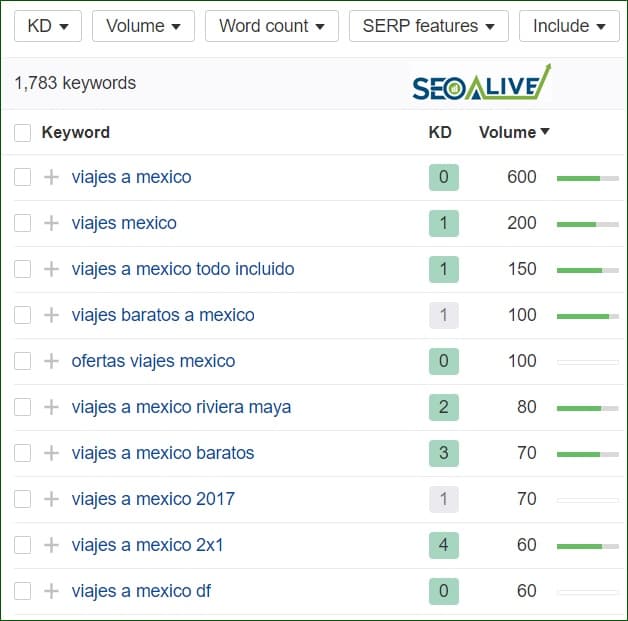
Once the main keyword has been determined, it should appear in the body of the text, naturally, repeating every 100 or 150 words, approximately. We can use semantic variants and synonyms to enrich the content.
2) Meta information: title and description
Metatags are tags added to the head (<head>) of the web to provide information to search engines. These are not visible at a user level within the pages but they are essential when indexing URLs and boosting their organic ranking. So, as you can see, it's important to work on meta information in any SEO copywriting.
The title is the tag that establishes the title of each page. It should reflect the main content of the page. Since the topic is original and unique for each page, each title must be different from all the others belonging to the same website.
Example: <title>SEO for Images | 9 Essential Elements | SEOcrawl AI</title>
When optimizing titles, the following guidelines should be taken into account:
-
Include the main keyword in the page's main title. Example: "Post title including the main keyword | Brand".
-
When writing the title for your SEO copywriting, it must be unique to avoid duplicates between URLs.
-
Its length should be between 40 characters (to have greater presence in the snippet) and not exceed 65 characters in length (if we want to avoid the snippet showing ellipses at the end in Google search results and giving the impression of being unfinished text).
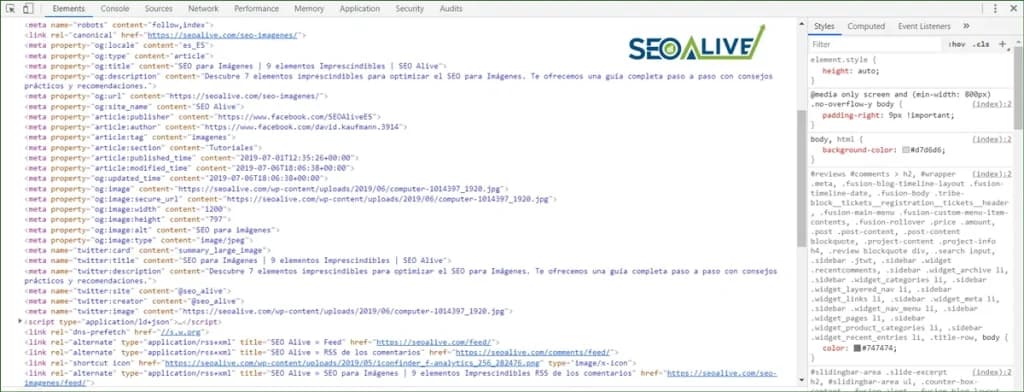
The description accompanies the title and is only visible in search results, just below the URL.
Example: <meta name="description" content="Discover 7 essential elements to optimize SEO for Images. We offer a complete step-by-step guide with practical tips and recommendations.">
As part of well-crafted SEO copywriting, the essential tips to optimize a meta description are
-
Unique and original text that includes the keyword we're going to target for a URL.
-
This field is an opportunity to attract more clicks to the page, so it's recommended to introduce a brief description using a sentence that draws the user's attention with the goal of increasing the Click Through Rate (CTR).
-
It should not exceed 155 characters, including spaces. Otherwise, ellipses will be shown at the end, giving the impression that it's unfinished.
Documentation= Google documentation on titles and meta descriptions
3) URL syntax
When building an SEO-friendly URL for a website, it's necessary to follow these basic SEO copywriting recommendations:
-
Add the keyword you're going to target the post with as far to the left as possible.
-
Use hyphens (-), trying to avoid symbols such as '+' or underscores to separate words. Example:
Bad: https://www.seocrawl.ai/posicionamiento+web
-
Good:
https://www.seocrawl.ai/posicionamiento-web -
The shorter, the better: there is no length limit for a URL, but if we avoid long URLs, they'll be easier for the user to understand. Also, the shorter it is, the further to the left the keyword will be and the greater its capacity to rank.
-
Don't use empty words (called stop words) or strange characters such as tildes, accent marks or question marks.
-
Avoid parameters whenever possible, as they increase the URL's length and hinder the opportunity to boost our ranking.
4) Headings
Headings are tags that help structure text correctly, making it easier for search engines to understand and process the information contained in a URL.
Essential optimization tips for headings in SEO copywriting:
-
Implement the main keyword and secondary keywords chosen for writing in the headings as far to the left as possible.
-
Reserve the H1 to implement the main keyword you want to rank for.
-
Rely on H2, H3 and subsequent headings to write secondary keywords and complementary ones to the main established keyword. And remember, if it doesn't make sense for these types of keywords to be in these tags, you don't have to force them.
-
Maintain order in terms of structure: that is, structure the text respecting the order of importance of these tags. First, the main H1 heading should appear; then, secondary headings (from second level up to sixth) will be used to organize the content.
-
For any type of copywriting (even if it's for SEO), it's recommended to use as many secondary headings as you need. This way you'll better organize the text into sections and sub-sections and help lighten and make any text more understandable.
5) SEO copywriting tips for the body of the article
When writing any article, we must always organize our ideas and then structure them in an orderly way, knowing how to convey them while keeping our readers' attention at all times. That's why it's important that both our title and the body of the text are attractive and always make clear what the central message we want to convey is.
But when writing for a digital environment, in addition to having to appeal to the user, we must know how to structure it to show it to Google so that we stand out from the competition and it provides us with more visibility among its search results. Therefore, we must keep in mind that there are certain elements that have to be shown in a specific way. Thus, for example, in your SEO-focused copywriting, it's recommended to include the most important keyword at the beginning of the text. This way, we'll tell search engines what the topic of our content is. And by implementing it at the beginning of the text, we mean doing so both in the H1 and in the intro, as these are the most important places for Google to take us into account when ranking. So, try to write the main keyword as far to the left of the H1 as possible and include it again in a brief intro that captures the most important ideas of the article.

Once we've defined both the H1 and the intro as we've indicated, we'll rely on H2, H3 and subsequent headings to structure the ideas of our generic message in an orderly way. This is where we'll take advantage of including secondary keywords and help our text acquire greater value.
Use of bolds: besides being elements we use to highlight main ideas, they're also used at the SEO copywriting level to give greater relevance to keywords. That's why it's recommended that the main keyword be bolded at least once or twice using the <strong> tag, either alone or accompanied by other terms if it makes more sense for the reading.
REMEMBER: It's essential to use keywords throughout the body of the text, implementing them naturally every 100-150 words. In order to avoid over-optimization and enrich the semantics of the text, it's interesting to use synonyms and variants of the main keyword used. The appropriate density of keyword use in SEO-oriented copywriting is around 1% or 1.2%. That is, if the article contains 500 words, we should repeat the keyword 5 or 6 times and, if, for example, the length is 600 words, it should appear 6 times.
6) Article length
There is no rule that establishes a minimum and maximum number of characters; however, as long as it's relevant and unique, it seems better to write texts of more than 500 words. This will help us provide greater semantic richness, implement the main keyword, complementary ones, synonyms and secondary keywords more times, and make search engines better understand what the central message of our content is, so we'll have more opportunities to rank better in search results.
7) Images
When writing a post, in SEO copywriting, images also count. These help to make a text much more attractive and entertaining, as well as becoming an opportunity to rank well in the 'Google Images' section.
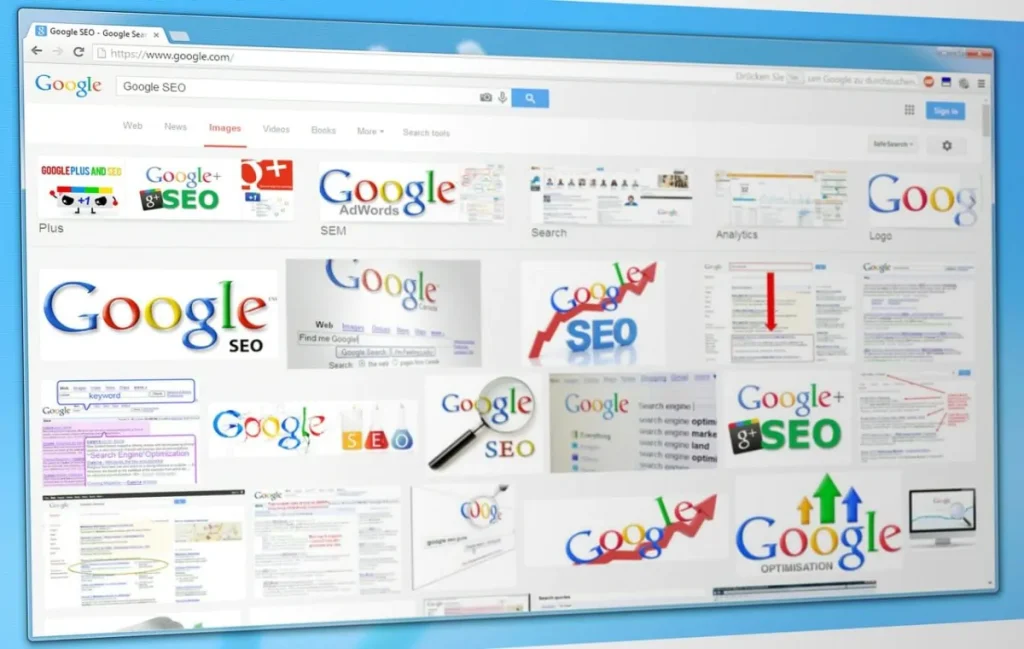
The key points that should always be taken into account when optimizing an image are:
-
Avoid uploading heavy images to the website to achieve fast loading time. If you don't have professional image editing and photography tools, use online tools such as tinypng.com to optimize them.
-
Save the file name including the keyword chosen for the post and referring to the content shown in the image.
-
Use hyphens (-) and not underscores (_) or any other character as a separator for image names.
-
Do not use special characters such as tildes, blank spaces or accent marks.
-
When writing from an SEO point of view also taking into account images, it's important to fill in the 'alt text' attribute on them, including the keyword we want to target through the post.
-
Write the 'title' field of the image implementing the main keyword again.
-
The 'alt' and 'title' attributes can have the same text, although slight variations between the two are recommended.
8) Internal linking
Google takes internal links on a website very much into account. These help it understand which content within the site is most important and what semantic relationship exists between the different pages that make it up. That's why it's important to develop an SEO strategy when establishing the links that the different URLs of the domain should have, since through proper implementation of internal linking we'll transmit SEO strength from some URLs to others. The ultimate goal of a well-developed technique is to give greater visibility to the URLs we're most interested in ranking.
9) Use of link anchor texts
In addition to knowing how to select which link we're going to insert to relate content, it's important to consider each anchor text. Google uses the Anchor Text to know the topic of a website, so this has great weight among the factors it considers for classifying and ranking a website's URLs.
From an SEO point of view, it's interesting that the writing of this text includes the keyword we wish to appear for the content we're linking to.
However, and preserving the premise that Google rewards naturalness, it's preferable not to introduce the same keyword in the link's anchor text, as Google's bots may penalize us for it. To avoid this practice, it's recommended to use related keywords, variants and synonyms. Even, in some cases, unrelated text can be written (such as, for example, "click here").
Likewise, it's important to add some external link pointing to another website that is not ours. This way Google will perceive that we link to other pages of other domains also relevant to the user. Now, in this case, it's preferable to remember to include the 'nofollow' attribute in each of these types of links, as we'll avoid passing our SEO to other domains.
What other elements do you think can help within our content strategy? Share your knowledge and ideas in our comment space that you'll see below ;-)!
Author: David Kaufmann

I've spent the last 10+ years completely obsessed with SEO — and honestly, I wouldn't have it any other way.
My career hit a new level when I worked as a senior SEO specialist for Chess.com — one of the top 100 most visited websites on the entire internet. Operating at that scale, across millions of pages, dozens of languages, and one of the most competitive SERPs out there, taught me things no course or certification ever could. That experience changed my perspective on what great SEO really looks like — and it became the foundation for everything I've built since.
From that experience, I founded SEO Alive — an agency for brands that are serious about organic growth. We're not here to sell dashboards and monthly reports. We're here to build strategies that actually move the needle, combining the best of classical SEO with the exciting new world of Generative Engine Optimization (GEO) — making sure your brand shows up not just in Google's blue links, but inside the AI-generated answers that ChatGPT, Perplexity, and Google AI Overviews are delivering to millions of people every single day.
And because I couldn't find a tool that handled both of those worlds properly, I built one myself — SEOcrawl AI, an enterprise SEO intelligence platform that brings together rankings, technical audits, backlink monitoring, crawl health, and AI brand visibility tracking all in one place. It's the platform I always wished existed.
Discover more content about this author
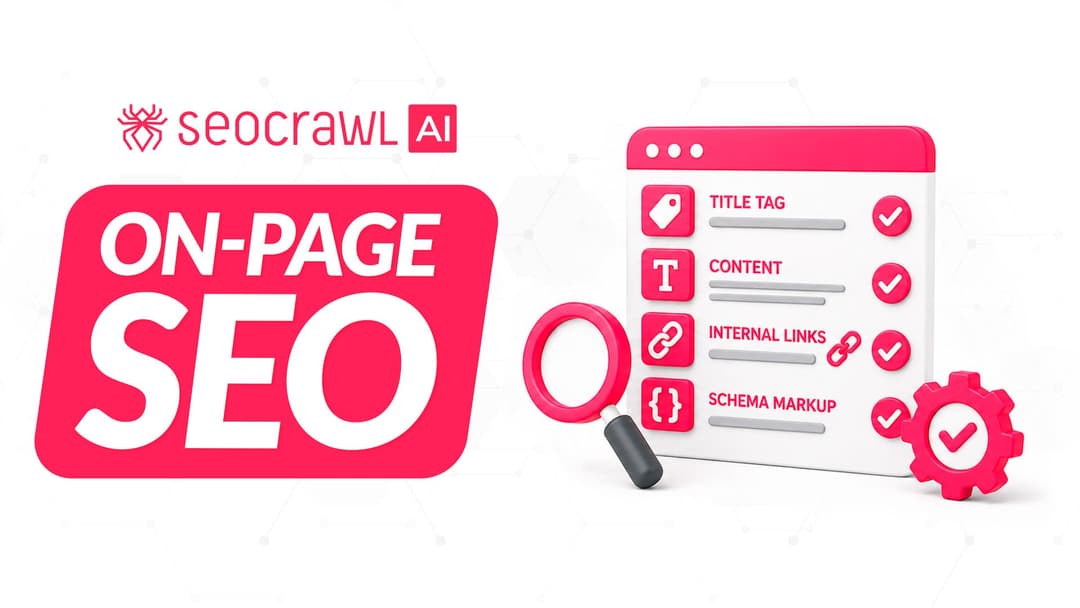
On-page SEO is everything you control on a page: content, title, meta description, headings, URL, images and internal links. Here is a checklist element by element, an audit process and what changes with AI Overviews and AI Mode.