Off-Page SEO: The Complete Guide
We often hear about SEO strategies, which fall into two broad groups: On-Page SEO and Off-Page SEO. It's important to understand what each one involves, how they differ, and the role they both play in any search ranking effort we undertake.
Throughout this article, we'll explain what Off-Page SEO is, the differences between On-Page and Off-Page SEO, and we'll also go over some strategies that we at SEOcrawl AI recommend you apply to your projects. Coming along? Let's get started!
What is Off-Page SEO?
Off-Page SEO can be defined as the set of techniques we carry out outside of our own website with the goal of improving organic rankings by boosting authority, strengthening our brand, driving traffic, and so on.
Differences between Off-Page SEO and On-Page SEO
Off-Page SEO and On-Page SEO can work together as a combined ranking strategy that delivers very satisfying results. However, the actions involved in each are very different and also require distinct professional profiles.
On-Page SEO consists of optimizing within the website itself in order to improve ranking factors that let us enjoy better positions in the SERPs.
It's work that covers factors we handle entirely on the site, from the most basic but essential layer (On-Page) to the more technical side (WPO, rendering, indexing, etc.) and, of course, the content side.
Off-Page SEO, on the other hand, consists of the work done outside the website to gain authority. Backlinks (link acquisition) are the best-known part, and the first thing that comes to mind when we try to define what Off-Page SEO is, but as we'll see, it isn't the only one. Link building is based on acquiring links from quality sites that will boost our page's chances of ranking in search results through an increase in our domain's authority.
When Off-Page SEO and On-Page SEO are done well, they achieve an indispensable symbiosis for our ranking goals. In fact, if either one fails, we may not get the results we want, since Off-Page SEO without proper internal optimization won't let us capitalize on the work, while good On-Page SEO without online authority won't outperform the competition.
If you want to know whether the Off-Page SEO you're running on your site is effective, be sure to use our SEO Software and get full control over everything happening on your website.
Why is Off-Page SEO important?
In practice, Off-Page SEO has always been important. From the very beginning of search ranking, acquiring links has been a key factor that helped identify a site's authority in search results.
Obviously, the methodology has changed, but the importance of this strategy remains very high.
A pivotal moment for Off-Page SEO came when the Google Penguin algorithm was released, identifying the quality of incoming links to our site as a determining factor for gaining authority.
What's more, if these quality criteria aren't met, the link we get can actually hurt us with a penalty. So today, Off-Page SEO isn't just more important, it's also far more complex.
There are countless studies out there; we'll cite this one from Backlinko, from 2020, which shows the correlation between rankings and incoming domains (understood to be quality ones).
Off-Page SEO Strategies
As we mentioned earlier, link acquisition is the most well-known and probably one of the most effective tactics for boosting our Off-Page SEO strategy, but it's not the only one. Below, we'll walk through the most popular approaches, including the backlinks we just mentioned.
Backlinks
Backlinks are the incoming links to our website. In the industry, a link acquisition strategy is known as link building and consists of selecting and configuring the links you obtain.
Backlinks must meet several quality factors of their own. For example, it's advisable not to always use the same anchor text or always point to the same URL; they should also be "dofollow" and included in the content in a natural way.
As you can see, getting a quality link isn't as easy as it was years ago, and it depends on many variables we need to consider even before making the request.
These types of backlinks can be categorized as free (organic) and paid (review purchases).
Organic Links - Free
The best backlinks we can get are organic links, as long as they meet the required quality criteria.
These are the ones obtained for free and inserted naturally into the content, for example when a site related to our website's topic links to us as a reference for something that has been written.
How to get free links? E-A-T
In theory, free links are earned naturally. As our site offers quality information or content, other sites will link to us to make it easier for their users to discover us.
This theory, however, clashes with the reality of an oversaturated web full of websites and SEO ranking rules that don't exactly encourage creating outbound links.
Therefore, the way to get free links is to find the best sites from which to request the inclusion of that backlink.
Given how saturated the web is, identifying the right sites isn't easy. There are many strategies you can apply, with E-A-T being one of the best known.
E-A-T stands for Expertise, Authoritativeness, and Trustworthiness. When a site meets these 3 factors, it can be considered ideal for getting a free link.
-
Expertise is related to the knowledge about the sector or topic our website covers. It's a relevant factor for identifying the quality of the site linking to us.
-
Authority is a key factor in Off-Page SEO and represents the weight that website carries online, especially in relation to the keywords we care about.
That weight is gained, among other ways, by acquiring incoming links itself, so a site is considered to have authority if many other quality sites have linked to it.
- Finally, trustworthiness is based on notions like the transparency or legitimacy of a site. If the site has quality, exclusive, non-duplicated content, without excessive outbound links, we can clearly identify it as a trustworthy site.
Artificial (paid) links
The difficulty of getting organic links, combined with how important this factor is, has driven a link-buying market that has spread around the world.
Google warns about the dangers of buying artificial links, since it undermines the principle of a natural backlink. Even so, this strategy is currently one of the foundations many websites rely on to gradually increase their online authority.
SEO factors to consider when buying links
When it comes to buying links on a website we're interested in, we need to take several SEO factors into account.
The first is the quality of that website, which we can assess using the E-A-T strategy mentioned above.
In addition, links must have the correct attributes, like dofollow, to be valid for SEO ranking purposes.
On the other hand, just because a link is bought doesn't mean it has to be placed artificially. It can be included naturally within the content, so it serves as a reference for users while we continue to meet the quality standards we've set.
As we mentioned earlier in the article, we also recommend links with varied anchor texts and pointing to different URLs, since if we keep an identical strategy when buying links, it will easily be detected and may even be penalized.
Types of incoming links
There are many criteria for classifying the types of incoming links we can obtain.
One is based on the location on the site where it's placed. So we have links that can appear at the top of the page, at the end of the content, in the middle with natural inclusion, or even in the footer.
We also distinguish between links that appear on a single page and those that appear on every page of the site. The latter case currently tends to cause more penalty problems than the former.
We can also distinguish types of incoming links by the tag applied to them. So we have "nofollow" links, which aren't decisive for SEO ranking, compared to "dofollow" links, which are.
More recently, Google announced the option to use alternative tags such as "sponsored" for sponsored links and "ugc" for user-generated content.
Reviews
When it comes to getting incoming links, reviews represent one of the best content strategies.
They consist of topical articles, usually informative in nature, in which links based on anchor texts we're interested in are naturally included.
The quality of the backlink and of the sites linking to us is decisive for the strategy to deliver favorable results.
Forums
The use of forums to get incoming links has fallen out of favor, especially after the launch of Google Penguin.
Some developers don't optimize their forum so outbound links count, given the changes set by this algorithm, since these platforms could be identified as "link farms."
Blog comments
Blog comments represent an attractive environment for placing links back to our site. The tricky part here is that the blog owner allows such link inclusion and that we do it in a natural way.
In any case, even if these two factors are met, we also have to look at the quality factors the blog must meet, such as being related to our topic or being an authority site.
Social profiles
Social profiles allow us to include links to our website for, at first, promotional purposes.
Some platforms validate these links for SEO purposes, which makes it very worthwhile to include them in any page or profile we manage.
In any case, they offer the chance to get direct visits from users or followers on that platform, so these links are always recommended.
Press releases
We can get links from authoritative media outlets with press releases. The difficult part in these cases is getting that press release picked up by the media and published while keeping the link back to our site.
To do so, we need a quality site, according to these outlets' criteria, and we need to offer content that's genuinely useful to users, because they'll only publish it if they see real informational value.
Footer or sidebar links
Footer or sidebar links are not recommended. The fact that they appear on every URL of a website raises red flags for Google's search bot, since besides being duplicated constantly, they don't respect the criteria of naturalness.
In these cases, a sponsored link without SEO benefits is more advisable, but one that offers strong traffic potential due to the popularity that site enjoys.
Content marketing
While earlier we focused on buying or acquiring links, content marketing from an Off-Page perspective will focus on creating quality content to offer it for publication on third-party sites with the goal of:
-
Building and improving our brand image.
-
Strengthening our image as an authority in the sector (E-A-T).
-
Driving referral traffic to our website.
This kind of Off-Page technique helps us build our reputation as experts in our niche, a very important factor for ranking on Google.
Link Baiting
This technique is aimed at not having to go out and chase links ourselves, but rather getting them to come to us. Although it could be considered an On-Page technique, given the ultimate goal of earning links, we'll classify it as Off-Page. Some of the content formats that tend to work best for this are:
-
Interviews with experts
-
Infographics
-
Creating online tools
-
Videos
-
News
-
Conducting studies or experiments
-
Creating guides or tutorials
Citations (Local SEO)
Among the factors affecting Google My Business listing rankings, there's one that particularly adds value: so-called citations.
When we talk about citations in Local SEO, we have to talk about the NAP concept (Name, Address, Phone). These are simply mentions of our business with its name, address, and phone number. The order can vary, but the idea is to always keep the same format when creating citations, so they're all exactly alike and deliver that Off-Page value to Local SEO rankings.
Branding: Influencer marketing
This technique is aimed entirely at improving our brand image, but not in the eyes of Google or search engines, rather in the eyes of users themselves. We all know that today, social networks play a fundamental role in our daily lives. More and more, the figure of the influencer is gaining weight, as people with great power to shape the perception of our brand.
This strategy, external to the website, will capture a solid boost in direct traffic to our site, which is an indirect factor in improving rankings.
Now that you know what Off-Page SEO is, keep it firmly in mind in your ranking strategy, and carry it out carefully, seeking advice from specialized agencies to avoid potential Google penalties.
Conclusions
As we've seen, Off-Page SEO is a structural piece within the SEO pyramid, and its strategies have to go hand in hand with On-Page SEO, since Google rewards both websites that have strong on-page SEO and those with a solid, quality link profile. What are you waiting for?
Start planning and developing your Off-Page SEO strategy!
Dear reader, did you already know about these strategies we've shared with you? Which ones do you use in your projects? Tell us in the comments! Until next time!
Author: David Kaufmann

I've spent the last 10+ years completely obsessed with SEO — and honestly, I wouldn't have it any other way.
My career hit a new level when I worked as a senior SEO specialist for Chess.com — one of the top 100 most visited websites on the entire internet. Operating at that scale, across millions of pages, dozens of languages, and one of the most competitive SERPs out there, taught me things no course or certification ever could. That experience changed my perspective on what great SEO really looks like — and it became the foundation for everything I've built since.
From that experience, I founded SEO Alive — an agency for brands that are serious about organic growth. We're not here to sell dashboards and monthly reports. We're here to build strategies that actually move the needle, combining the best of classical SEO with the exciting new world of Generative Engine Optimization (GEO) — making sure your brand shows up not just in Google's blue links, but inside the AI-generated answers that ChatGPT, Perplexity, and Google AI Overviews are delivering to millions of people every single day.
And because I couldn't find a tool that handled both of those worlds properly, I built one myself — SEOcrawl AI, an enterprise SEO intelligence platform that brings together rankings, technical audits, backlink monitoring, crawl health, and AI brand visibility tracking all in one place. It's the platform I always wished existed.
Discover more content about this author
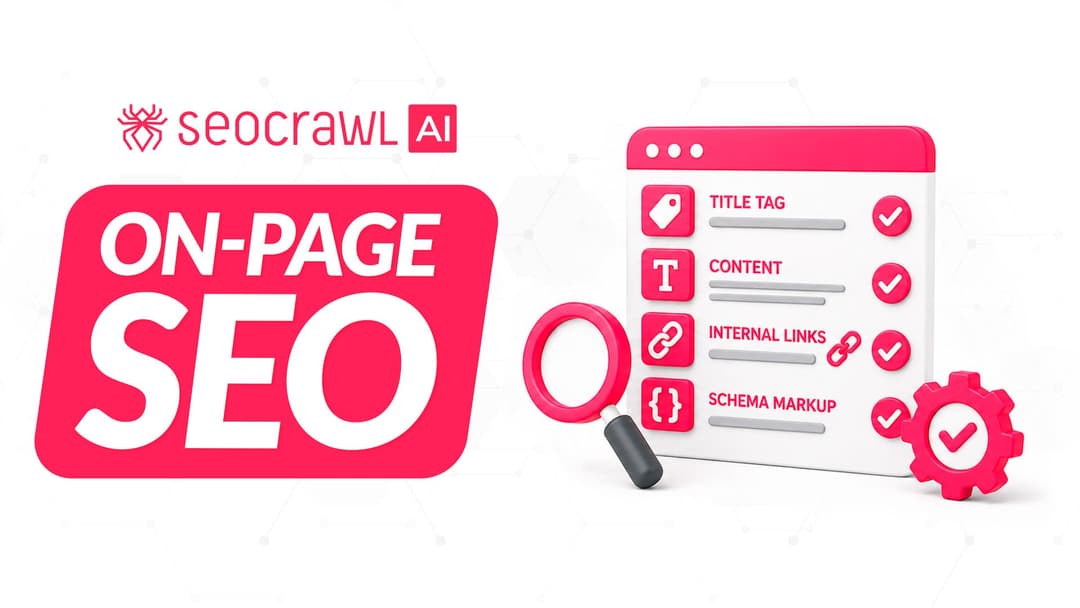
On-page SEO is everything you control on a page: content, title, meta description, headings, URL, images and internal links. Here is a checklist element by element, an audit process and what changes with AI Overviews and AI Mode.