10 Types of Google Penalties and How to Recover From Them
One of our most feared enemies in web positioning is SEO penalties. Being flagged by the great search engine can mean anything from a temporary drop in visits to the complete ruin of a digital project!
For that reason, at SEOcrawl AI we want to talk to you about what SEO penalties are, what they can entail and, most importantly, how to recover from a penalty. Will you join us? Let's go!
What are Google SEO penalties?
When we refer to penalties in relation to Google, we are talking about measures imposed by the search engine when it detects that a website is committing violations of the guidelines that the company has in place.
These guidelines, although sometimes somewhat difficult to interpret, are actually publicly accessible and are constantly being updated. They are the Google webmaster guidelines.
General types of Google penalties
Depending on various factors, we can find different types of penalties. In any case, these are the two general types of penalties that are usually imposed:
Algorithmic penalties
Algorithmic penalties are those suffered when you fail to comply with Google's guidelines based on the algorithm it currently uses for the search, crawling, indexing and positioning of search results.
The problem in these cases is that Google periodically changes its algorithm, in theory to improve its efficiency. On the other hand, sometimes webmasters face the challenge of also updating the optimization of their websites, so as not to suffer penalties related to the new algorithm.
Manual penalties
Manual penalties are those imposed by Google professionals, literally "by hand". There are no robots or algorithms involved in the action; rather, it occurs expressly after identifying a behavior or action on a website that violates the search engine's guidelines.
Algorithms responsible for detecting them
Google has always updated its algorithm. However, the year 2011 marked a before and after. The launch of the algorithm called Google Panda represented an unprecedented catalyst for some websites, but also the arrival of SEO penalties to other sites, at a level never imagined could be suffered.
Google Panda
It was 2011, and the phrase "content is King" had not yet spread. With Google Panda, this statement began to be taken seriously.
It was the first algorithm responsible for reviewing the content of websites and became famous for the quantity and severity of sanctions imposed on countless pages around the world. From then on, it was established as a general guideline in SEO that websites had to avoid having little content (thin content), duplicate content, or content that did not provide value to the user. If they did, Google Panda could act with its characteristic ferocity.
Google Penguin
In just one year, Google made all SEO professionals tremble with Google Penguin, an algorithm based on the analysis of off-page optimization. Specifically, on the incoming links to our website.
From then on, these links had to be of quality, a concept that has become more and more complex, turning linkbuilding strategies into a true art.
How do we know Google has penalized us?
At first it was difficult to identify a penalty. Therefore, if we noticed the slightest drop in our visits, we had to check that we were complying with Google's quality guidelines, in relation to the manual actions carried out by the search giant.
Google's Search Console tool made this task easier. For years, it has offered notifications of possible penalties that our site is suffering or could be suffering if we don't take appropriate optimization actions.
From SEOcrawl AI, we want to offer you our SEO Software with which you can, among many options, identify if you have been penalized on certain keywords thanks to its "lost keywords" functionality, with which we can detect keywords that are dropping and analyze if it is due to some possible manual or algorithmic penalty in a comfortable and simple way.
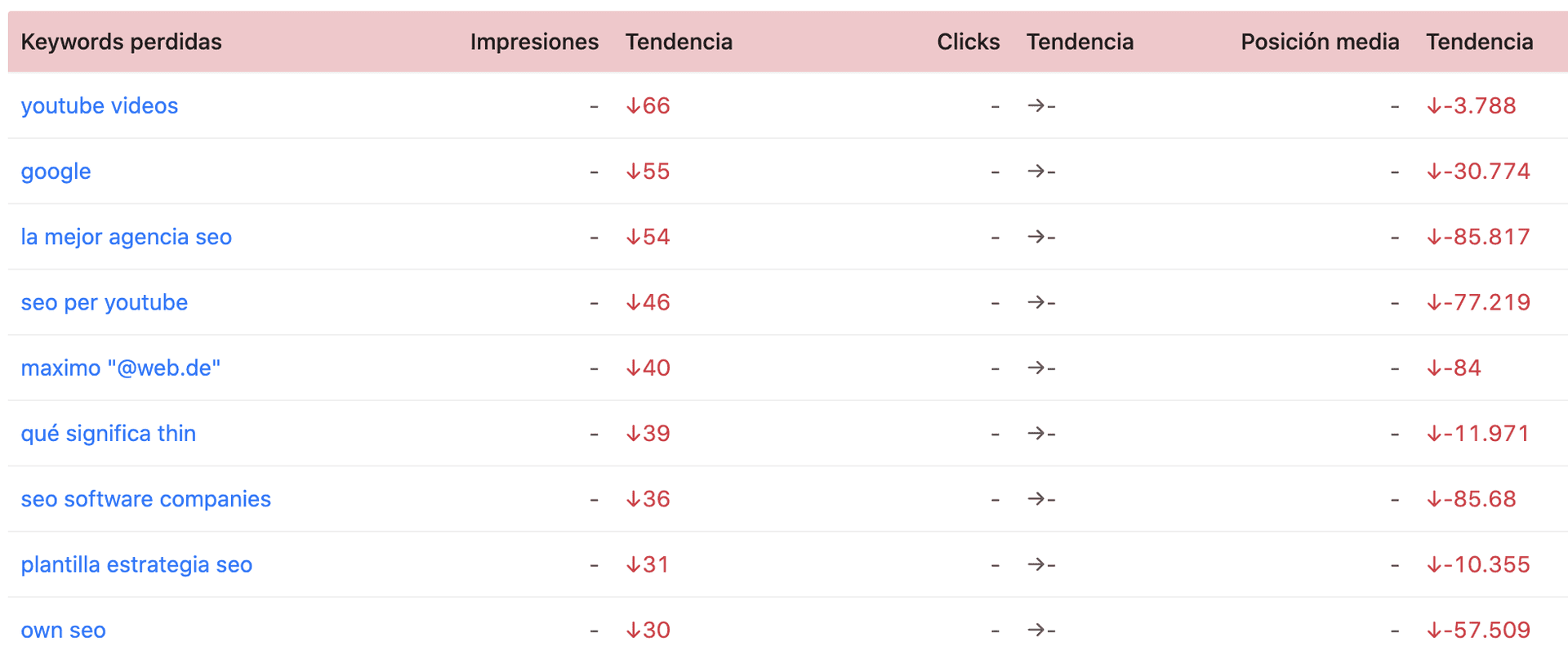
View of the "lost keywords" functionality of our SEO software
Do they penalize the whole website?
Google penalties have always been unfair. Not because they are responsible for sanctioning incorrect strategies (often carried out voluntarily to try to deceive the search engine), but because they did not distinguish between a page and a website.
The entire website was penalized, even if the infringement was limited to a small section of a web page. Obviously, this situation was unsustainable and today it has already changed.
Currently, Google has sufficiently developed its penalty system so that it is capable of penalizing only a path, a keyword, a section of the website or even a specific search result.
Most common SEO penalties
The quantity and variety of SEO penalties that we can suffer are considerable. However, the experience of SEO professionals allows us to easily identify which are the most common penalties:
Thin Content
Applied to pages with poor, scarce or low-value content. The most frequent example is that of online store product sheets, where there is barely a sentence describing what is being sold.
Unnatural links to your website
After Google Penguin we must take great care of incoming links. Their quality depends on many factors, including the naturalness with which they are produced. An unnatural link, which clearly may correspond to a purchased link, will be penalized as soon as it is detected.
Duplicate content
Duplicating content for SEO purposes has long since ceased to be a recommended strategy. It is clearly penalized by Google and, in fact, in an emphatic way.
Furthermore, it is important to emphasize that content is considered duplicate whether we copy it from content we have on our own website, or whether we copy it from another external website.
Cloaking
Cloaking is one of the first techniques used by webmasters to deceive the search engine and obtain SEO positioning that they did not really deserve.
It consists of offering different content to the user and to the search engine. Today it is still something that is penalized forcefully!
Image cloaking
One of the most recurrent variants of cloaking is the one that presents images to the user, but offers HTML content to the search engine.
The reason for this strategy is that images have fewer resources to rank than content, so they offer visually attractive elements to users, but the code-based content that Google theoretically requires from a web page.
Sneaky Redirects
Sneaky Redirects can be identified as "deceptive redirects". They are those that occur when content is offered to search engines, in order to have better options in the displayed results, that is not real.
When the user clicks on the result, thinking they will access content that interests them, they are actually redirected to a very different one.
Malicious content injection - Hacking
If Google identifies that a website is trying to install malicious content on a user, it immediately applies a penalty, to prevent it from appearing in search results.
Keyword stuffing
Some SEOs talk about Keyword stuffing, others talk about excess in keyword density. It doesn't matter how you want to define it, the fact is that the inappropriate use of keywords, with clear purposes of over-optimizing a web page, is punishable.
Hidden content
Another very old and not recommended SEO technique is trying to rank with hidden content.
Living up to its name, it consists of content (both readable and by code, for example links), which is hidden from the user, but is shown to the search robot.
Excessive use of SPAM
Many SEO penalties attempt to curb SPAM. We are talking about sites with an excessive amount of ads, banners, click-capturing systems and all kinds of advertising that can be considered too intrusive.
How do we recover from an SEO penalty?
If our website suffers a Google penalty, the main objective from now on should be to recover from said penalty.
The reason is that it can spread if we don't solve it and affect the entire website, especially if we repeat the factors that motivated said penalty.
Cleaning up our link profile
Since Google Penguin the topic of links is the most serious for an SEO, nobody jokes about it. Links must scrupulously respect the quality guidelines or we will have a significant problem.
If we identify a link-based penalty, the most logical strategy would be to remove said link. But it is not entirely necessary. We can take advantage of the disavow function in Search Console to simply tell Google not to take that link into account. Neither for good nor for bad.
Content curation
The most difficult penalty to face is the one related to content. The aftermath of Google Panda is still suffered to this day.
If we identify this type of SEO penalties and the pages to which it applies, we have two options: We can delete them or we can optimize them and try to obtain an organic return from them. The next time the search engine crawls our website, it can identify the content update (or the creation of new content) and not only remove the penalty, but could also offer us very favorable positioning.
Conclusions
From SEOcrawl AI we want to recommend that you follow Google's quality guidelines for webmasters if you are going to undertake a positioning campaign for your projects. In them, you will find all the necessary documentation to avoid falling into the dark pit that SEO penalties represent and from which it is difficult to get out since it directly affects your visibility, organic traffic and therefore your positions in the rankings of the results pages.
And you, dear reader, have you suffered any SEO penalty from Google? And if so, what strategy have you carried out to get out of it? Tell us in the comments box! We will answer as soon as possible. Until next time!
Author: David Kaufmann

I've spent the last 10+ years completely obsessed with SEO — and honestly, I wouldn't have it any other way.
My career hit a new level when I worked as a senior SEO specialist for Chess.com — one of the top 100 most visited websites on the entire internet. Operating at that scale, across millions of pages, dozens of languages, and one of the most competitive SERPs out there, taught me things no course or certification ever could. That experience changed my perspective on what great SEO really looks like — and it became the foundation for everything I've built since.
From that experience, I founded SEO Alive — an agency for brands that are serious about organic growth. We're not here to sell dashboards and monthly reports. We're here to build strategies that actually move the needle, combining the best of classical SEO with the exciting new world of Generative Engine Optimization (GEO) — making sure your brand shows up not just in Google's blue links, but inside the AI-generated answers that ChatGPT, Perplexity, and Google AI Overviews are delivering to millions of people every single day.
And because I couldn't find a tool that handled both of those worlds properly, I built one myself — SEOcrawl AI, an enterprise SEO intelligence platform that brings together rankings, technical audits, backlink monitoring, crawl health, and AI brand visibility tracking all in one place. It's the platform I always wished existed.
Discover more content about this author

On-page SEO is everything you control on a page: content, title, meta description, headings, URL, images and internal links. Here is a checklist element by element, an audit process and what changes with AI Overviews and AI Mode.