Googlebot Evergreen: Google's New Crawler
The SEO world has reason to celebrate thanks to the latest article published by the Google Webmasters team, announcing that the new version of their Googlebot, called GoogleBot Evergreen, will also be available for webmaster tools.
Below, we'll look at the implications this has at the technical implementation level from an SEO perspective.
1) What is GoogleBot Evergreen?
Until recently, Google's Bot (crawler) used Google Chrome 41 to analyze all the websites on the Internet. Considering that Google Chrome is now on version 78, you can imagine how far behind GoogleBot was compared to its browser. However, at the recent Google I/O event, they announced many improvements in this regard. The main one was that, from then on, not only would GoogleBot use the new version of Chrome, but its update would be linked so it would always use the latest versions.
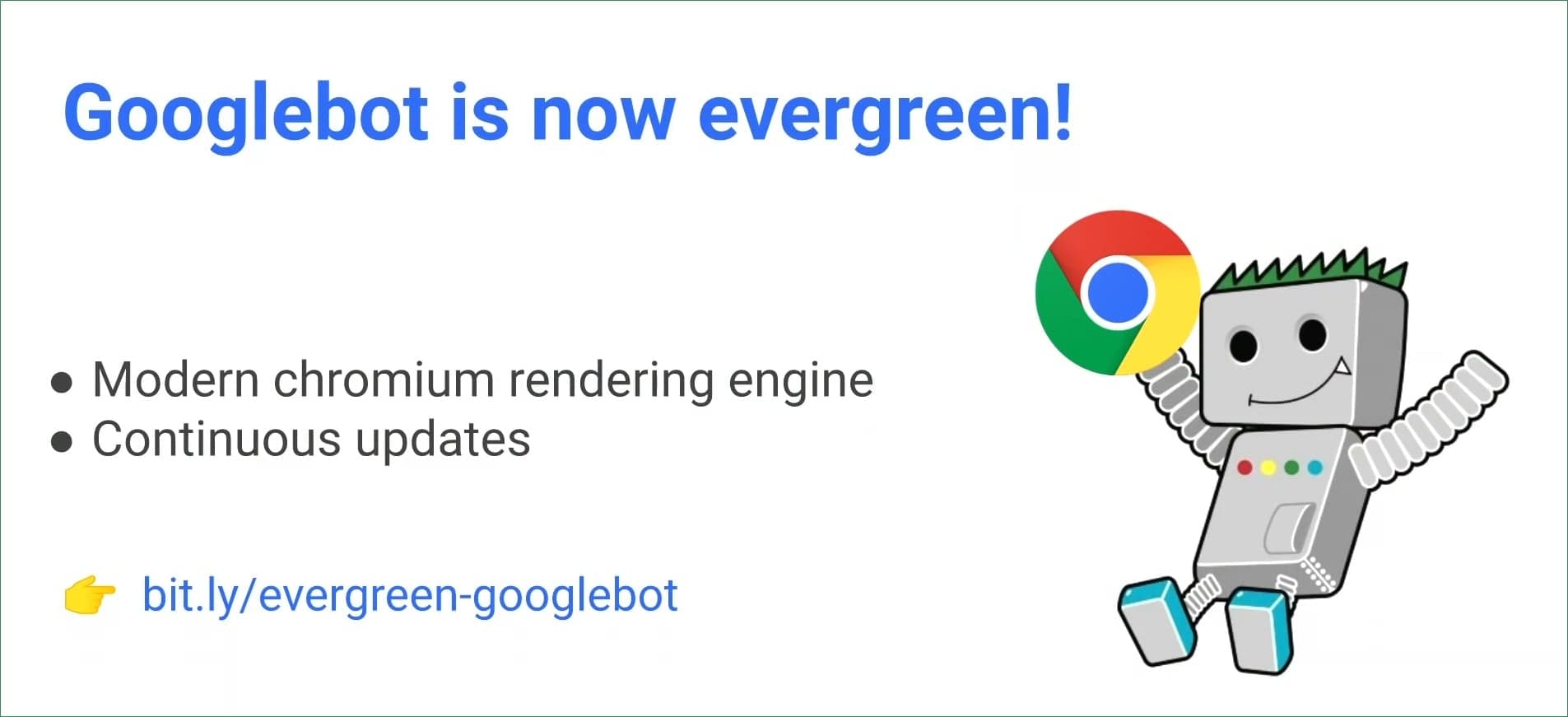
Google announces its new rendering engine: GoogleBot Evergreen
Below, you can watch the video from the Search team, in which they made the big announcement of GoogleBot Evergreen and also discussed statistics about the SEO world and Google's plans for their upcoming projects and improvements in 2019.
It's a 40-minute video but it's really worth watching. First, because it features what are probably 2 of the biggest SEO experts at Google, and second, because they focus on the evolution of the SEO world and how we can adapt to serve the best content to users.
2) Implications
The fundamental and most important change in moving from Chrome 41 to Chromium (latest versions) is that from now on, GoogleBot can execute Javascript and render pages. Until now, this process was much slower or even impossible unless certain tools were used to create static pages for the bot (Prerender.io, Puppeteer...) if the site was built with modern JavaScript software (Vue...). However, with this improvement, Google will be able to understand many more sites that were previously inaccessible.
In the following image, you can see how the old GoogleBot with Chrome 41 understood a site and how it processes content with the new version.
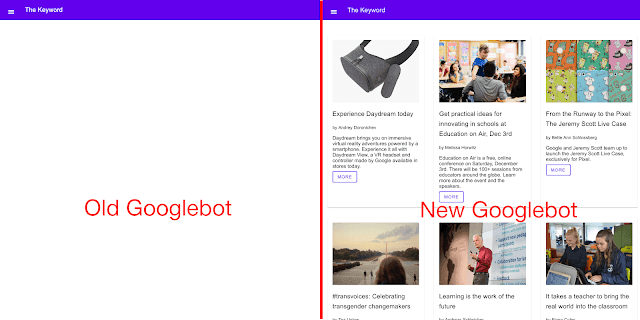
Example of how GoogleBot viewed a page before and after the change.
For large companies with extensive technical teams, this wasn't a major problem since they could allocate the necessary resources. However, for small and medium-sized businesses, this could be a real headache. That's why this change can help many companies ensure their content can be properly crawled and indexed.
Now, if you're thinking about your site and wondering how it may affect you, note that according to the Google team itself, the answer is "it shouldn't," since in principle the changes shouldn't even be noticeable. Why?
- This technology has been thoroughly tested.
- Analyses have been carried out over several months on many websites.
- The user-agent will not be changed without prior notice to avoid breaking your tracking/logging schemes...
One of the major changes announced this week is that this new rendering engine has also been applied to SEO tools for Webmasters so that all SEO professionals can perform all kinds of tests and analyses:
3) Mobile First Index
Another major piece of news that came alongside the GoogleBot Evergreen announcement was the announcement of changes related to the Mobile world.
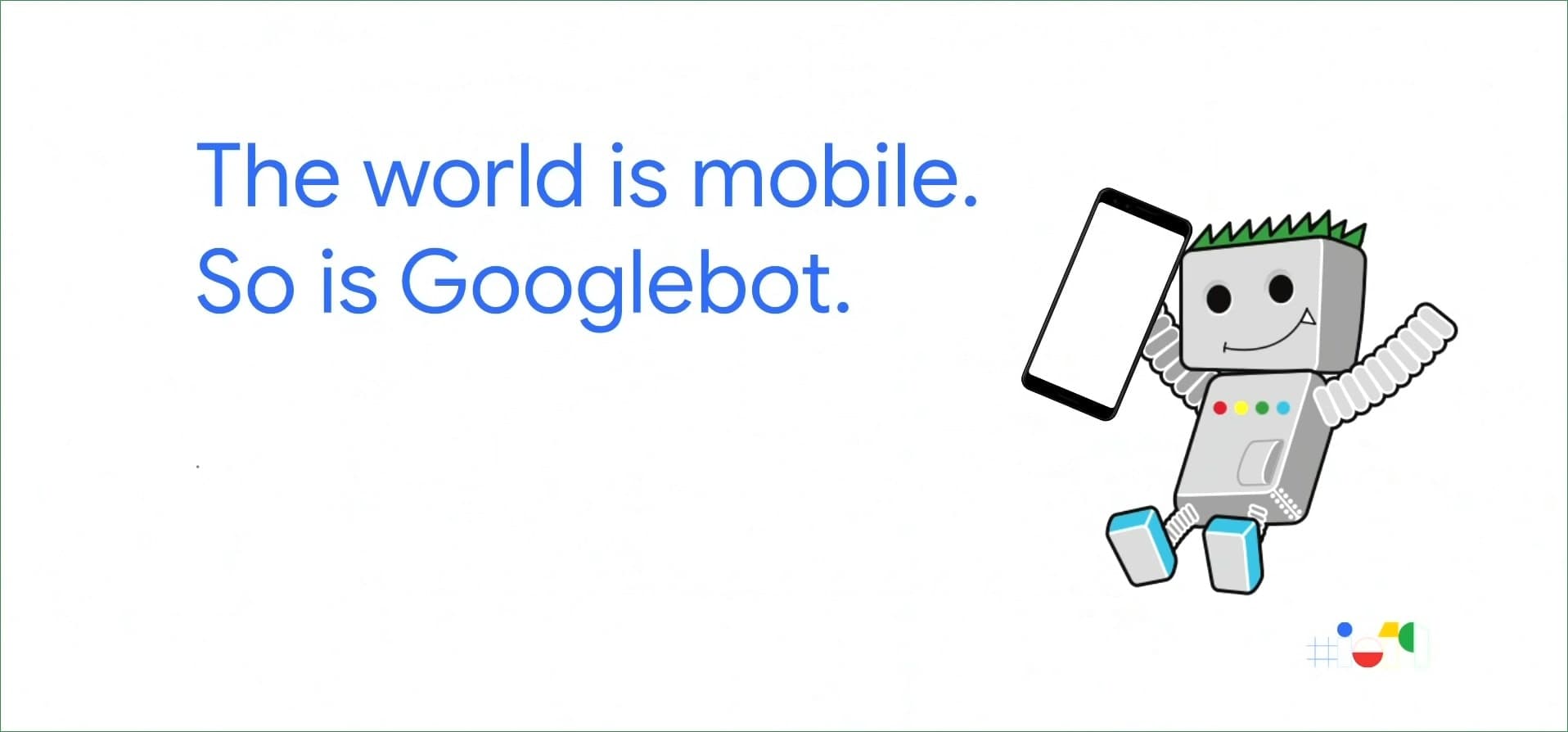
Probably, by the end of 2019, all websites on the Internet will be crawled via GoogleBot Mobile.
The Google Search team revealed some truly impactful statistics:
- More than 50% of websites are being analyzed with GoogleBot Mobile.
- By the end of 2019 or beginning of 2020, Google could be analyzing 100% of the Internet with GoogleBot Mobile.
- GoogleBot crawls +130 trillion pages.
- Your site's speed on mobile devices is a ranking factor and has a direct impact on conversions, time on page, and other critical factors for any business.
4) Updates
Since this is an ever-changing topic, we've created this section to publish all the news related to Google's engine.
October 2, 2019: Google announces that starting in December 2019, the GoogleBot user-agent will be adjusted to reflect the latest version of the browser and will be updated according to the latest versions of Chrome.
These are the current user-agents:
- Mobile:
Mozilla/5.0 (Linux; Android 6.0.1; Nexus 5X Build/MMB29P) AppleWebKit/537.36 (KHTML, like Gecko) Chrome/41.0.2272.96 Mobile Safari/537.36 (compatible; Googlebot/2.1; +http://www.google.com/bot.html)
- Desktop
Mozilla/5.0 (compatible; Googlebot/2.1; +http://www.google.com/bot.html) Starting in December, however, the new user-agents will be the following:
- Mobile
Mozilla/5.0 (Linux; Android 6.0.1; Nexus 5X Build/MMB29P) AppleWebKit/537.36 (KHTML, like Gecko) Chrome/W.X.Y.Z Mobile Safari/537.36 (compatible; Googlebot/2.1; +http://www.google.com/bot.html)
- Desktop
Mozilla/5.0 (compatible; Googlebot/2.1; +http://www.google.com/bot.html) ** The symbols "W.X.Y.Z" will be replaced with the Google Chrome versions as they are released. *
Do you have questions, doubts, or suggestions about what you just read? We'd love to hear your opinion! Thank you so much for contributing to shared knowledge in the SEO world.
** All images are courtesy of Google (YouTube video). *
Author: David Kaufmann

I've spent the last 10+ years completely obsessed with SEO — and honestly, I wouldn't have it any other way.
My career hit a new level when I worked as a senior SEO specialist for Chess.com — one of the top 100 most visited websites on the entire internet. Operating at that scale, across millions of pages, dozens of languages, and one of the most competitive SERPs out there, taught me things no course or certification ever could. That experience changed my perspective on what great SEO really looks like — and it became the foundation for everything I've built since.
From that experience, I founded SEO Alive — an agency for brands that are serious about organic growth. We're not here to sell dashboards and monthly reports. We're here to build strategies that actually move the needle, combining the best of classical SEO with the exciting new world of Generative Engine Optimization (GEO) — making sure your brand shows up not just in Google's blue links, but inside the AI-generated answers that ChatGPT, Perplexity, and Google AI Overviews are delivering to millions of people every single day.
And because I couldn't find a tool that handled both of those worlds properly, I built one myself — SEOcrawl AI, an enterprise SEO intelligence platform that brings together rankings, technical audits, backlink monitoring, crawl health, and AI brand visibility tracking all in one place. It's the platform I always wished existed.
Discover more content about this author