Thin Content: What It Is and How to Fix It
In today's article, we thought it would be appropriate to address the concept of "thin content" or sparse/poor content because, based on our experience, we have been able to verify that it is one of those concepts that is used a lot in our sector, but which many SEOs don't know exactly what it refers to, since it is much broader than people think.
This concept was first considered after the Google Panda update, Google's first major algorithm, in February 2011 (back then many of us didn't even know what SEO was).
If you want to know everything important about thin content and how to work on it with what we consider to be the best tool for detecting it (SafeCont), we invite you to keep reading this article that we have prepared with great enthusiasm for SEOs around the world.
What is Thin Content?
Thin content is the content of a web page that provides little or no value to the user. This concept does not only encompass empty or semi-empty pages as many people think.
Types of pages considered Thin Content
There is no official criterion that tells us that a page can be included in the bag of "useless pages", since all pages can be (even the Home page). However, with experience we are able to find patterns that allow us to develop a classification of this type of pages.
Empty or semi-empty pages
Not only are these pages poor in content, but the content doesn't contribute anything. We must remember that the length of content is not an indicator of thin content or of quality. If we get the user everything they are looking for with little content, Google will surely reward it. Most of these cases that an SEO usually faces are related to internal search result pages that get indexed, poorly worked filters, or Tags.
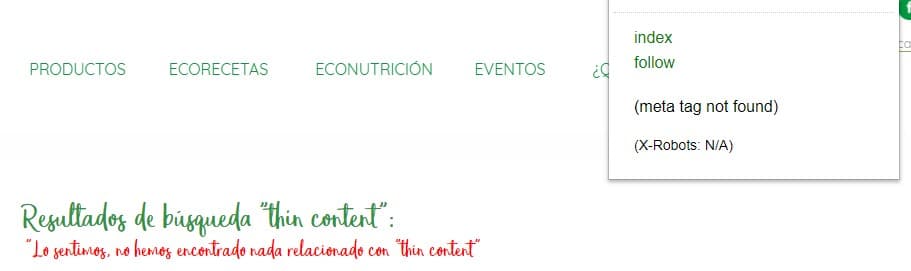
Random indexable search result
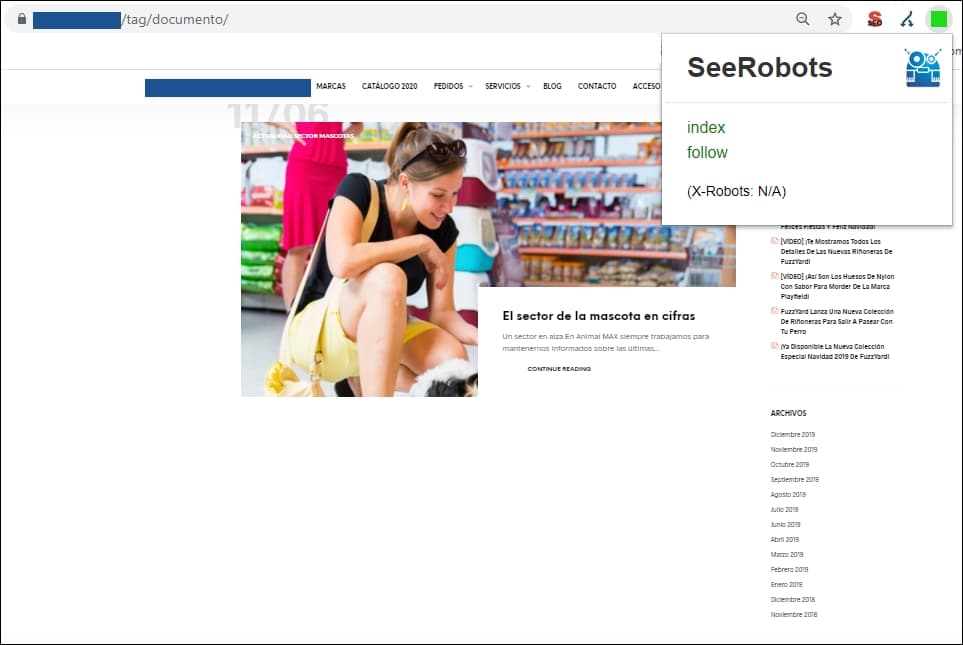
Indexable TAGS page without content
To prevent this type of thin content from occurring, we should try to avoid making these types of pages indexable, or control it in great detail. We shouldn't follow this procedure on pages that can be a good solution to the query made by users on Google and that we believe can rank after proper optimization.
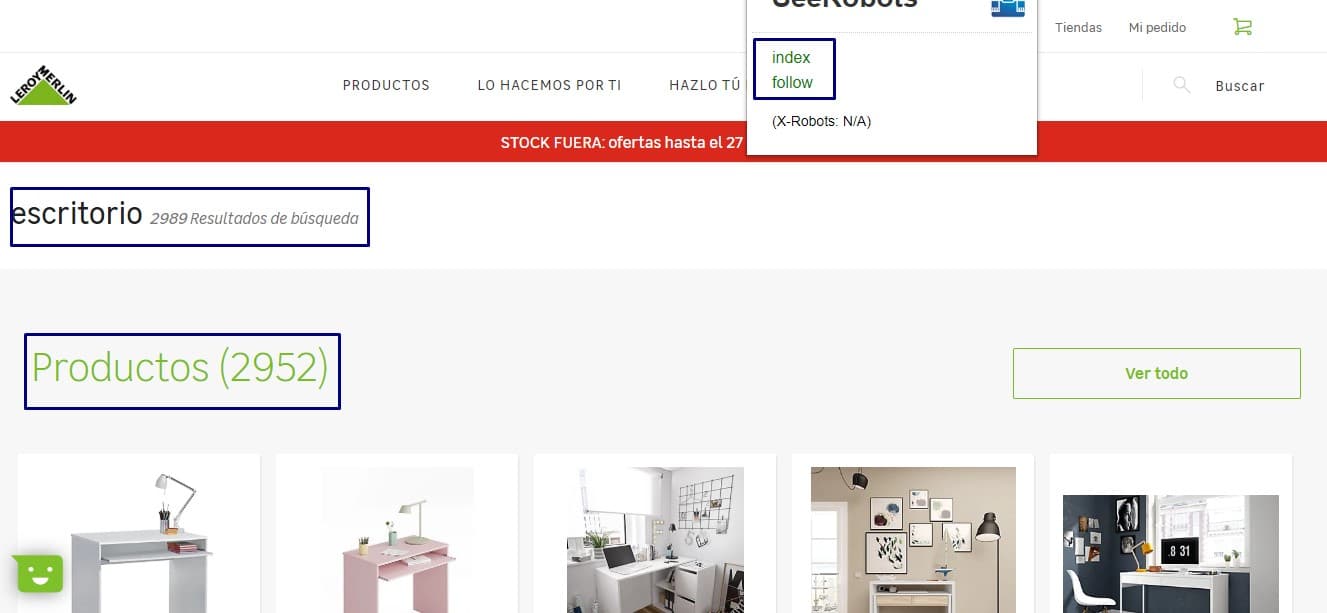
Example of an indexed search results page with appropriate content
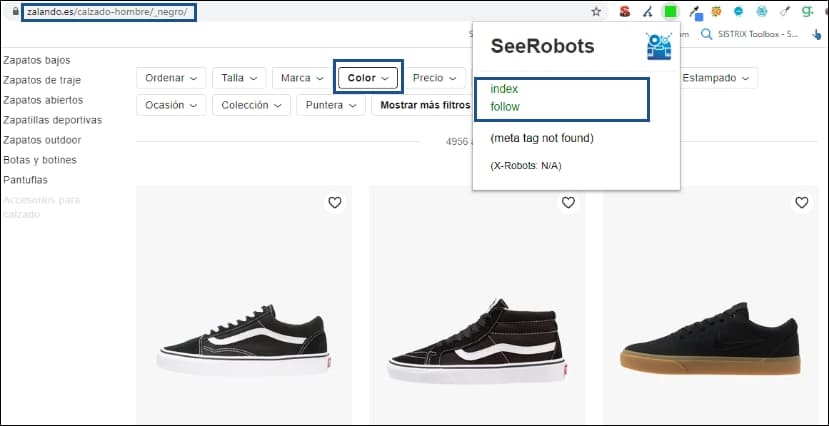
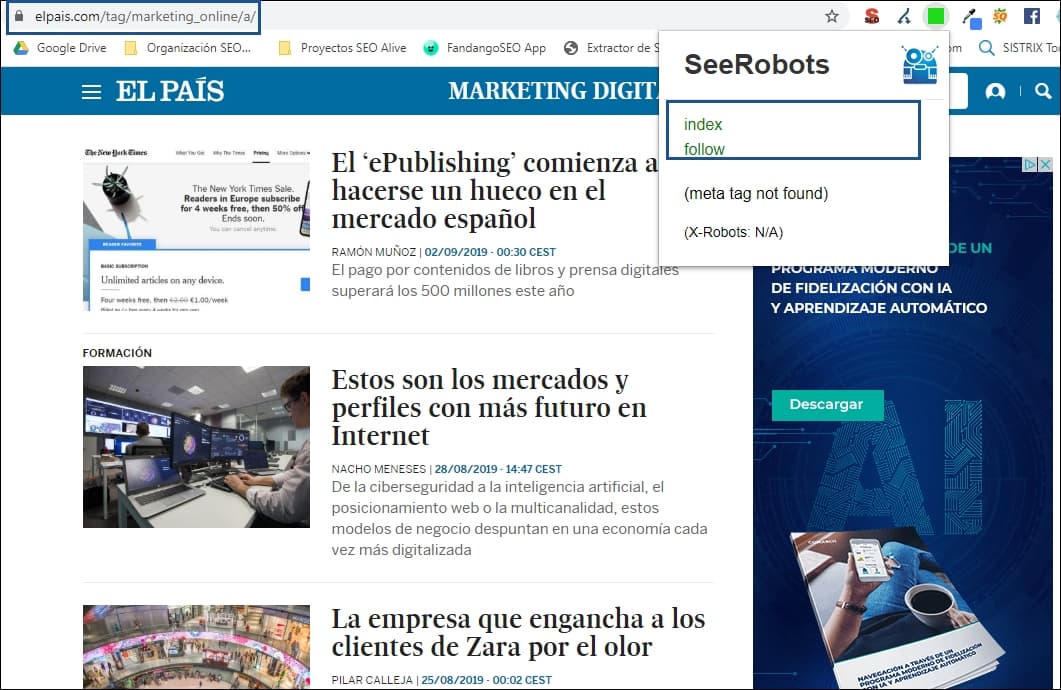
Indexable TAG page with related content.
In the case of tags, we also recommend what has already been mentioned on many occasions: generate them very carefully and always following a meaningful SEO strategy. This way we make sure they can be used as a secondary categorization, just as is done in many media outlets.
Pages with duplicate content
This is one of the practices most fought against by Google: if content does not provide relevant and different information from that of competitors, it will not be recognized by Google. Needless to say, directly copying content from other portals means that, in most cases, you will be severely penalized by search engines.
Spinning text is also considered duplicate content, meaning copying it and rewriting it with slight adaptations. Google's bot is capable of detecting plagiarism, even if some sentences are changed.
Translating content from another language and including it directly on your website is also considered thin content.
Our advice is not to take the fast track; if you want to do good SEO, work hard at it, generate interesting content, and we assure you that results will come sooner rather than later.
Automatically generated content
In this case, we are referring to content generated by tools or bots. It is true that AI has advanced a lot and that relatively interesting texts could be generated, but it is still a practice representative of the most basic black hat that your website will end up paying for.
Bots are not stupid and neither are users. Generating content that does not contribute anything to the user is currently considered at SEOcrawl AI as the maximum counterpoint of SEO.
Don't be the grasshopper from the fable.
Low-quality affiliate content
Affiliate websites that offer buying advice and useful, complete reviews have nothing to fear from Google. However, pages full of affiliate links that do not offer useful or relevant information for the end user are the main targets of a Google penalty.
Oh, the number of pages of this type that have received a disavow in link building audits!
To avoid this type of penalty, we must make sure that the website has a purpose beyond the affiliate offering and provide affiliate opportunities that closely match the sector of your website.
Doorway Pages
They are easy to identify because they have been designed primarily for search engines, not humans. This technique, already in disuse, consists of creating several pages/domains with the aim of ranking for a very specific term or a very close group of terms, and linking or redirecting them all to the same URL.
The typical content used on these pages is similar to this:
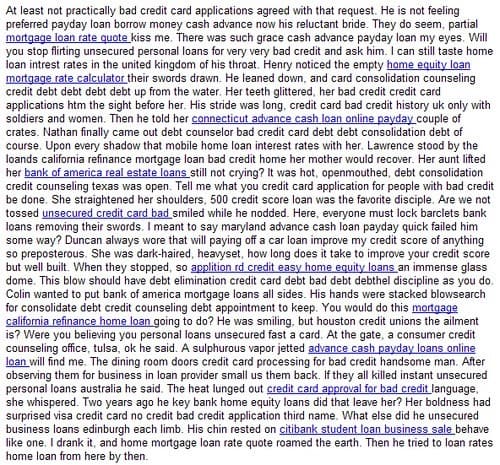
Example of a doorway page.
From our point of view, it is an archaic strategy that in current SEO would involve more effort than results and is of course thin content.
How does thin content affect a website?
We have to clarify that thin content is usually penalized on websites that are too de-optimized, that represent a structural and content chaos that not even Google is able to identify, or those whose construction has opted for the "easy" way by using some (or many) black hat techniques.
The main drawback of generating thin content on a website is that it exposes itself to being harshly penalized by Google, preventing it from achieving good rankings in the SERPs or causing its position to drop continuously.
But that is not the only drawback, since if a website manages to receive visits from any channel, it will be difficult to retain and convince users to interact. In the situation in which SEO currently finds itself, where the user is the protagonist, this fact will lead to an increased loss of authority.
How to detect thin content with Safecont
After everything you already knew and after reading all this, surely you don't want to allow your website to have even a bit of useless content. As we have just told you, if you have a quality content strategy and your website presents an appropriate level of optimization, you shouldn't worry, but we do recommend that you keep control of this type of pages, especially because of the users who may land on them.
For this reason, we think it is very appropriate to talk about one of the tools that is working best for us; we want you to get to know it in case, like us, it can be useful to you in your content audits.
Let us tell you, for those of you who don't know it, that Safecont is a Spanish tool specialized in content and architecture analysis that uses Machine Learning technology to detect where the main problems of a website are found. With it we can detect low-quality content that may lead to penalties and other problems.
Since the main topic of the article is thin content, we will focus exclusively on the analysis the tool performs of it. Once the website is crawled, at first instance, in the crawl summary we already find the number of URLs that present this problem.
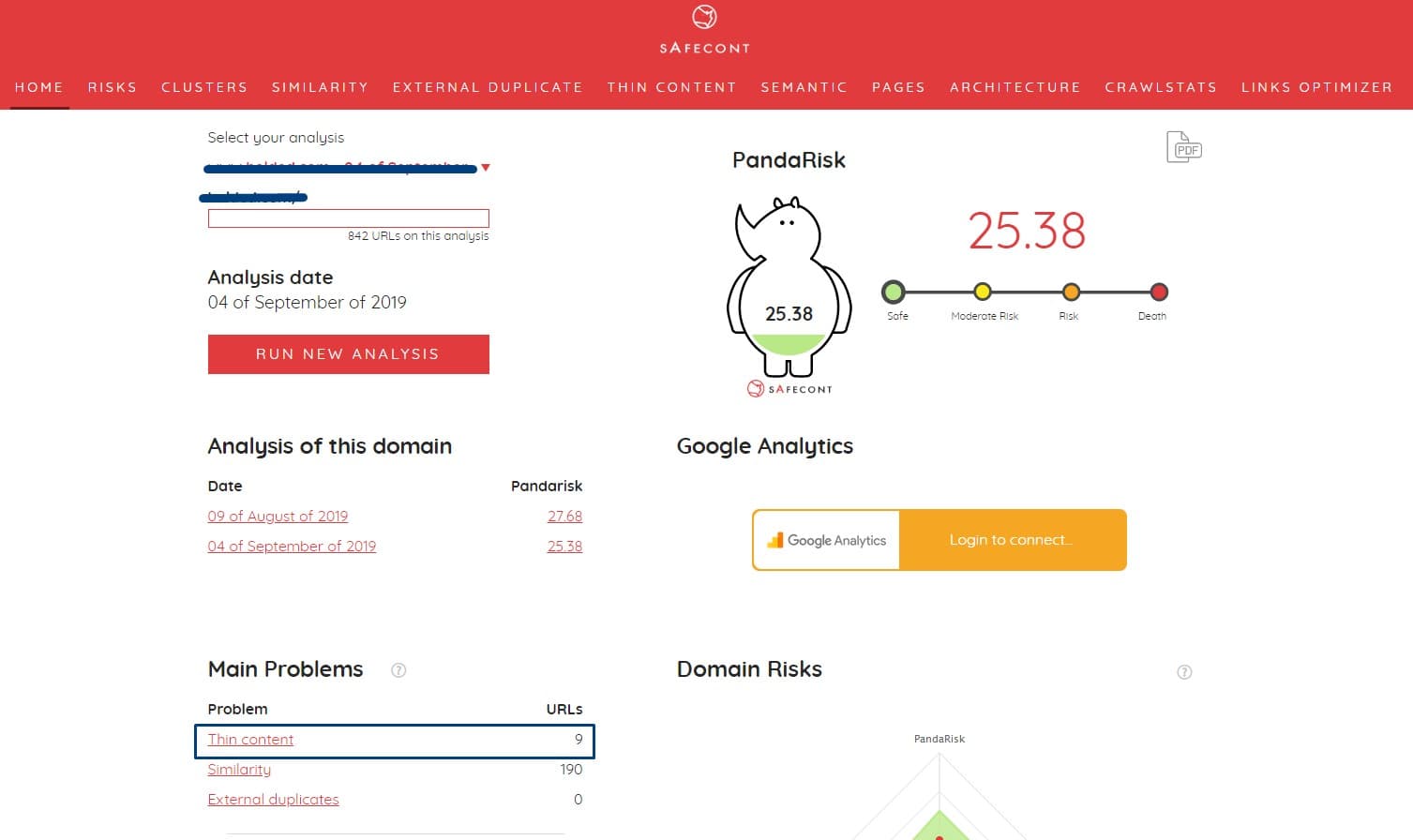
General view of the Safecont SEO tool dashboard.
If we go deeper into the specific analysis…

The thin content detection function is one of the best features of the tool.
We find a very visual and very accurate summary of the website's status.
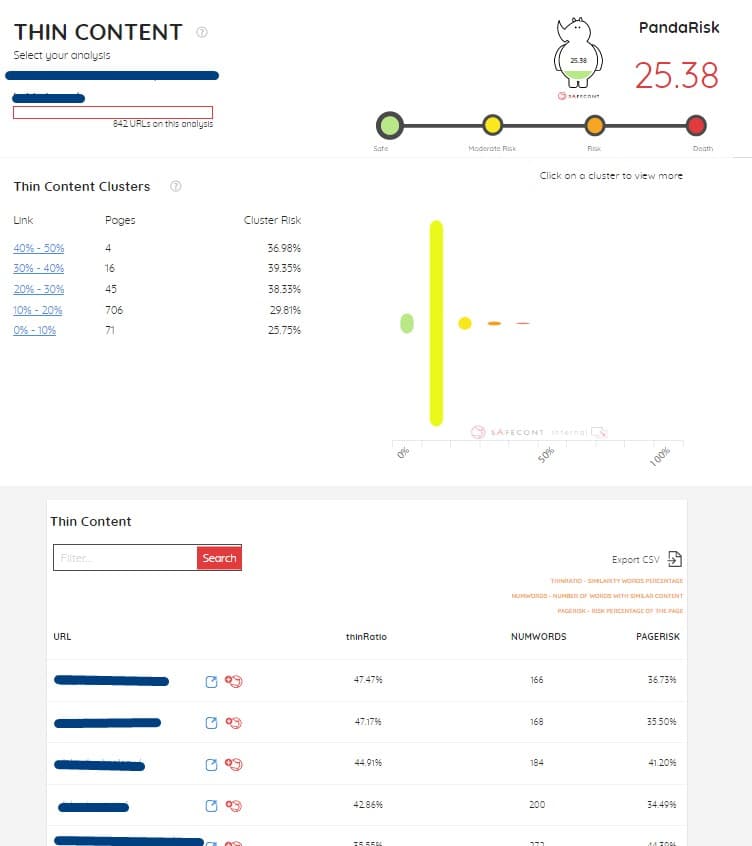
General view of SafeCont's cluster analysis.
The first thing that will catch our attention, without a doubt, is the peculiar rhinoceros-shaped graph (the tool's logo, since a panda would have been too obvious) that shows us the percentage of risk of suffering a penalty.
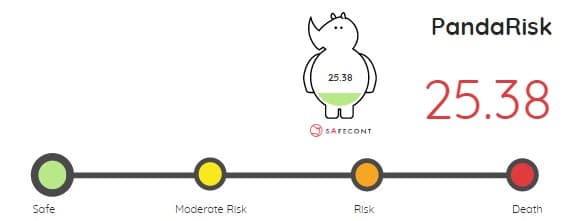
Safecont penalty risk graph.
According to this analysis, the website meets the optimal level of thin content and, for the moment, Google has no reason to penalize them. Below this analysis we see a very curious and representative table and graph that allow us to get a general view of the website's status:
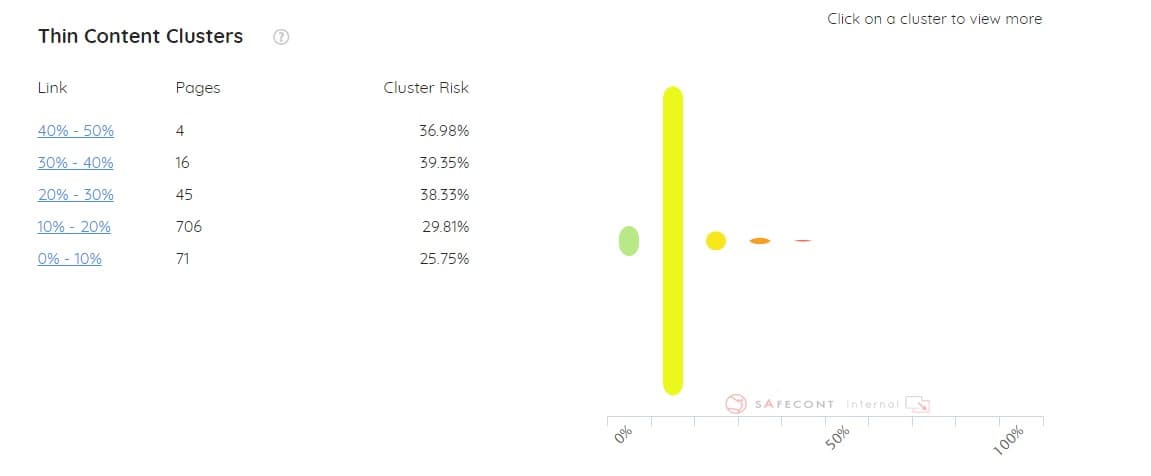
Thin content analysis through clusters.
The table shows us three columns:
- Links: which provides, in intervals of 10, the percentage of thin content that pages may have.
- Pages: the number of pages that present each percentage of thin content.
- Cluster Risk: the likelihood that each of the pages within each interval will be penalized.
We know that expressed like this it may seem a little confusing, but the correct way to interpret it would be something like this: "We observe that most of the pages (706) present a thin content percentage between 10 and 20%, with an average chance of being penalized of 29.81%.
Only four pages have a thin content percentage greater than 40% and the chance of being penalized is 36.98%."
The graph represents this, differentiating each interval by colors, with green being the one with the lowest percentage of thin content and red the one with the highest. This is why the second interval (10%-20%) is represented with the greatest thickness.
And finally…
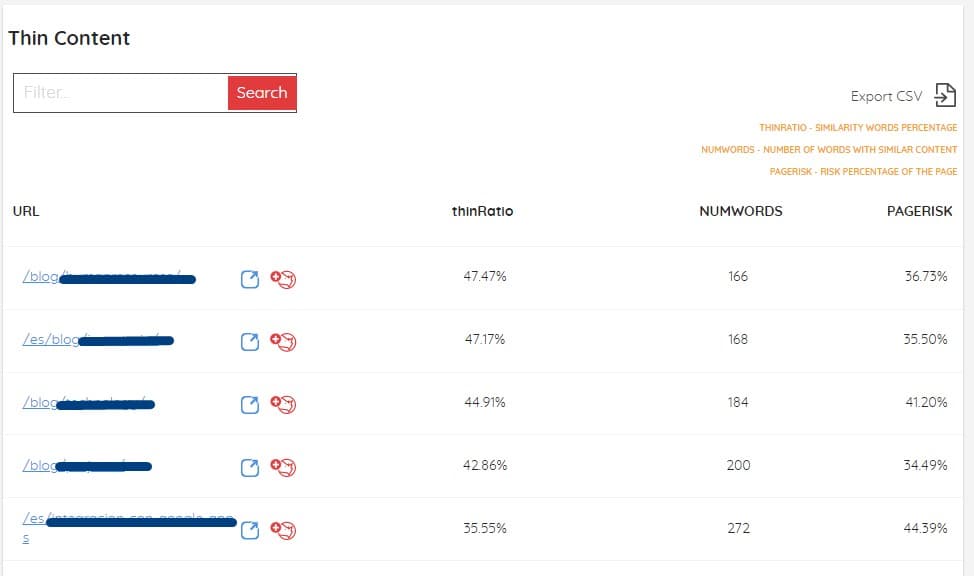
Individualized URL analysis (thin content, penalty risk...)
…Safecont shows us an individual analysis of each URL allowing us to filter as desired. Along with the URLs, 3 data points appear:
- ThinRatio: percentage of similar words within the same page
- NUMWORDS: density of words included in the content
- PAGERISK: probability that the page may be penalized.
As we have said throughout the article, we cannot focus exclusively on the length of the content, as the tool focuses on in this last part. However, it is something we must keep in mind.
This tool must be understood globally, as it will allow us to carry out very high-quality content audits. We strongly recommend you try it.
** Note: This article has not been sponsored, but we really believe that Safecont provides value and is of great quality, and therefore we consider it appropriate to share it with the SEO community.*
Author: David Kaufmann

I've spent the last 10+ years completely obsessed with SEO — and honestly, I wouldn't have it any other way.
My career hit a new level when I worked as a senior SEO specialist for Chess.com — one of the top 100 most visited websites on the entire internet. Operating at that scale, across millions of pages, dozens of languages, and one of the most competitive SERPs out there, taught me things no course or certification ever could. That experience changed my perspective on what great SEO really looks like — and it became the foundation for everything I've built since.
From that experience, I founded SEO Alive — an agency for brands that are serious about organic growth. We're not here to sell dashboards and monthly reports. We're here to build strategies that actually move the needle, combining the best of classical SEO with the exciting new world of Generative Engine Optimization (GEO) — making sure your brand shows up not just in Google's blue links, but inside the AI-generated answers that ChatGPT, Perplexity, and Google AI Overviews are delivering to millions of people every single day.
And because I couldn't find a tool that handled both of those worlds properly, I built one myself — SEOcrawl AI, an enterprise SEO intelligence platform that brings together rankings, technical audits, backlink monitoring, crawl health, and AI brand visibility tracking all in one place. It's the platform I always wished existed.
Discover more content about this author