Content Marketing: The Complete Guide
Content continues to be king within SEO and, like any other factor that makes up the success of a website, it cannot be generated randomly: prior research and the design of a strategy that allows us to make decisions and measure results are essential. Do you want to know how we design and execute content marketing strategies at SEOcrawl AI?
What is content marketing?
We can define content marketing as the set of strategies aimed at acquiring a greater number of customers through the generation of high-quality, original and useful content for the user, capable of attracting and engaging a community around our brand or product that can grow the business volume.
What is content marketing for?
A well-oriented and well-designed content marketing strategy will allow you to attract your potential customers at stages of the conversion funnel so early that they don't even know yet that they are potential customers.
Imagine you have an e-commerce store for farming products (tools, chemical products, seeds, etc.) and, within your strategy, you launch a blog in which you resolve all kinds of doubts or problems that can arise for gardening and horticulture enthusiasts, but also for professionals in the field: pests, sowing times, crop diseases…
Little by little you will position yourself in the community's mind as a leader and expert in your field, generating a loyal community around your brand. The day members of your community need a new tool, professional machinery or any other type of product, who do you think they will turn to?
How do we work on content marketing at SEOcrawl AI?
At SEOcrawl AI we are very aware of the importance that content strategies have within SEO actions and, for that reason, we give them maximum importance. When we receive a new project, we follow a series of proven and predefined steps that help us achieve success in generating new content.
Audit of own content
Generally, all projects (unless they start from scratch) have some generated content, although on many occasions it has been created without any clear objective and without focus.
The first step is to analyze the quantity and quality of the content generated, through the following questions:
-
What type of content attracts the general audience of the project? A beauty blog is not the same as that of a pharmaceutical laboratory aimed at professionals.
-
What type of content achieves better results? Although we generally refer to written content (blog posts, ebooks, etc.), in certain sectors a podcast, video or infographic may be much more relevant.
-
What parameters should we improve? It may be that the content generated so far is of very good quality, but the update rate is so slow that it drags down results or, on the contrary, it may happen that a lot is being written, but without taking into account quality or objectives.
Definition of SMART objectives
The definition of SMART objectives (specific, measurable, achievable, relevant and time-bound) is the second major step in defining our content strategy.
The specific objectives change depending on the type of project, but they are always oriented towards one of the following two goals (or both):
-
Improve brand or company awareness, enhancing its social relevance and positioning it as experts in its sector.
-
Increase the number of leads received and, with it, increase the business volume (understood as sales, subscriptions, downloads or whatever the ultimate objective of the project is).
Creation of the buyer persona
How do we know who our target audience is and, therefore, who all our efforts should be directed at? At SEOcrawl AI we firmly believe that creating the buyer persona is an essential part when drawing up a content strategy.
As you know, the buyer persona is a fictional representation, but as close to reality and as detailed as possible, of your ideal customer. If you need to create it and want us to give you a hand, don't hesitate to contact us.
The most important thing when creating the buyer persona is to simplify the characteristics of your ideal customer as much as possible, go down to the minimum detail and give them a first name, last name and their own personality: this is what will make you connect deeply with their needs.
Keyword research and search intent
Every content strategy must start from this research, which can be summarized in knowing what your customers are looking for (search intent) and how they search for it (keywords).
Do you want to know how we do keyword research at SEOcrawl AI? We have a complete post to tell you EVERYTHING.
With all the information in our hands, we establish a calendar to prioritize attacking the keywords that interest us most, based on the strategy and objectives of each specific project.
Competition study
Once you know the keywords you want to rank for, you must ask yourself who currently appears for those searches on Google? The answer to this is your online competition, and knowing what they do and how is essential to map out your own strategy.
WATCH OUT: you don't want to know what your competitors are doing in order to copy them, but to guide yourself in the direction you should work, always trying to improve their strategy.
Definition of the SEO-friendly editorial calendar
Now yes: we have a series of clear objectives, we have defined our buyer persona, we know what they are looking for and how, and we have looked at what the competition is doing to try to do it even better than them.
It is time to capture our strategy in a document that allows us to organize our priorities and measure their results over time: the editorial calendar. You can use SEOcrawl AI's Task Manager, with which you will be able to paint all the available information on a dashboard that is easy to read, in which you can involve the entire team and manage priorities in the most productive way possible.

To make it really practical, each of the tasks must include:
-
Keyword and traffic volume.
-
Title or H1 of the content.
-
Type of content.
-
Status
-
Publication date
-
Comments
Types of content
We have already noted this before: there is not a single type of content that you should include in your strategy, but rather it will depend on the target audience, the sector or even the moment in which the project is. Some of the most common types of content we usually work with are:
-
Categories: they correspond to the transactional keywords that you have extracted from your keyword research, such as "women's shoes".
-
Posts: the blog is designed to work on informational content, which is not related to direct purchase, but which will help you position yourself as an expert in front of your target audience, such as "how to care for leather shoes".
-
E-book: are you an expert in a specific area of your sector? Can you offer your audience original, exclusive and high-value content? A downloadable e-book is the best option for that.
-
Infographics: on many occasions, especially when we deal with complex data or processes, an infographic is the best way to capture all our knowledge in a clear, simple way that is easily understandable by readers.
-
Videos: whether as support for a piece of written content or on its own, audiovisual content is easier to go viral on social networks, although it may require a greater investment (equipment, time, effort…).
Content generation: originality and quality
Maxim at SEOcrawl AI: any content generated must be original and of high quality
What do we mean by this? With originality, we refer to the fact that it must be unique content: Google has tools to detect both possible plagiarism and rehashes of more or less recent texts and can penalize you heavily for it. In addition, copying colleagues in the sector and passing off their work as your own is quite ugly, don't you think?
On the Internet you have free tools, such as Siteliner, that can help you detect duplicate content on your website.
To generate quality content we only have to put the focus on the user: does it respond to their search intent? Is it useful for them? Does it solve their doubts or problems? If the answer is yes, you are meeting the objective.
Content distribution
But the work does not end there: it is useless to have the best content on the web if nobody sees it. In very large and established projects, it is possible that each new post goes viral at the very moment it is published, but this is not the norm.
Some of the things you can do to promote your content are:
-
Distribute it through a mailing list.
-
Paid distribution campaigns on social networks or Google Adwords.
-
Share it on your corporate social networks.
-
Include it within the general SEO strategy (internal linking, link building, etc.)
-
Maintain an optimal publication frequency: if every time a user enters your website they find news, you are encouraging their visits to become more and more frequent.
Measurement and analysis
All this is very well, but how can I know if so much effort is reporting benefits? Measuring the results of your content marketing strategy is essential, not only to justify it in front of the client, but to know if the objectives are being met or, on the contrary, changes need to be introduced in it.
With SEOcrawl AI you can easily check the success of your content strategies:
-
The SEO Visibility report allows you to check the general trend of the project, as well as make annotations (publication dates, algorithm changes, etc.) with which to draw conclusions over time.
-
The Rank Tracker report helps you control the ranking of keywords, both those you are already working on and those new ones that correspond to new content. In addition, through the tagging system you can filter them by campaigns, topic, typology…
-
Likewise, you can control the KPIs of the urls you are working on, which you can also tag to filter by cluster, for example, so you always have a clear picture of what consequences your efforts are bringing.
Our recommendation? Take the opportunity to put an annotation at the very moment you move the task to the Done or completed state and, automatically, the system:
-
Will create a personalized SEO report on that URL, whether it is newly created or an optimized content.
-
Below the graph, you will be able to observe the detail of the impact that the action has had after 7, 30 and 60 days.
-
So you don't forget, you will receive by email a report with the summary of the effects of said action on the mentioned dates.
Client reporting
If you work with your own project, this phase is less important, but it is crucial if you work for third parties: knowing what the fruit of your efforts is is as important as knowing how to transmit it to your clients.
We report to the client periodically using SEOcrawl AI's SEO Reports function, which also allows us to automate them according to the KPIs that interest us most in each project, saving a lot of time in manual data collection:
-
Top keywords and their variations in a given period of time
-
URLs that drive the greatest amount of traffic and latest changes
-
Forecasting - predictions based on data
How do you work on content marketing strategies? We would love to read you in the comments!
If you want us to design and execute the content strategy of your project, consult us!
Author: David Kaufmann

I've spent the last 10+ years completely obsessed with SEO — and honestly, I wouldn't have it any other way.
My career hit a new level when I worked as a senior SEO specialist for Chess.com — one of the top 100 most visited websites on the entire internet. Operating at that scale, across millions of pages, dozens of languages, and one of the most competitive SERPs out there, taught me things no course or certification ever could. That experience changed my perspective on what great SEO really looks like — and it became the foundation for everything I've built since.
From that experience, I founded SEO Alive — an agency for brands that are serious about organic growth. We're not here to sell dashboards and monthly reports. We're here to build strategies that actually move the needle, combining the best of classical SEO with the exciting new world of Generative Engine Optimization (GEO) — making sure your brand shows up not just in Google's blue links, but inside the AI-generated answers that ChatGPT, Perplexity, and Google AI Overviews are delivering to millions of people every single day.
And because I couldn't find a tool that handled both of those worlds properly, I built one myself — SEOcrawl AI, an enterprise SEO intelligence platform that brings together rankings, technical audits, backlink monitoring, crawl health, and AI brand visibility tracking all in one place. It's the platform I always wished existed.
Discover more content about this author
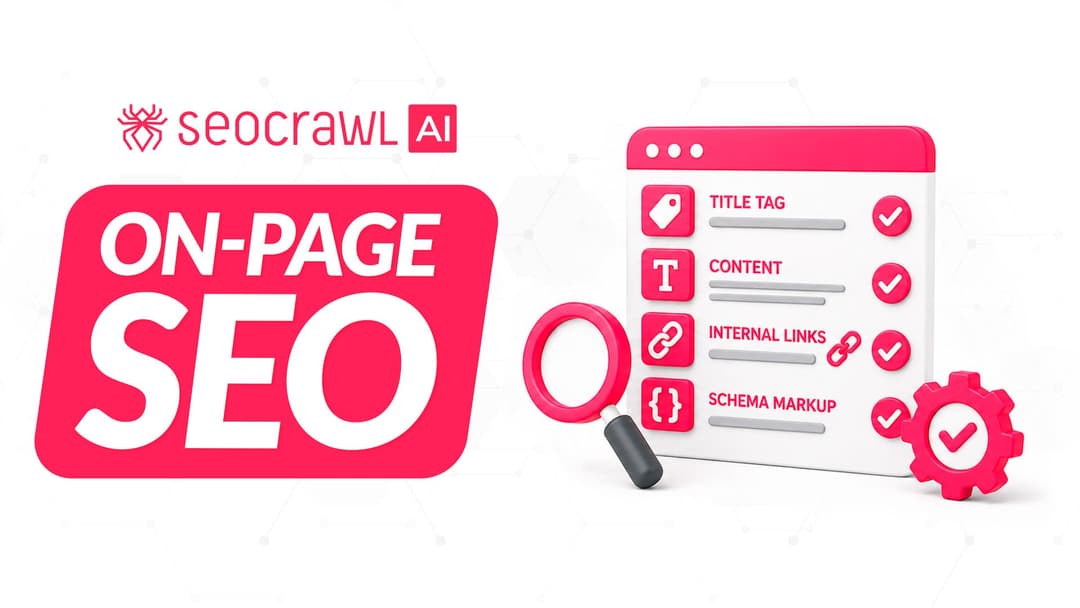
On-page SEO is everything you control on a page: content, title, meta description, headings, URL, images and internal links. Here is a checklist element by element, an audit process and what changes with AI Overviews and AI Mode.