AMP (Accelerated Mobile Pages)
AMP technology represented a huge revolution when Google officially introduced it to the world on October 7, 2015. Since then, the project has evolved enormously and has seen major improvements. However, it hasn't all been rosy. AMP has caused many sleepless nights for countless SEO professionals and, of course, a big impact on millions of companies.
While some companies are cited on the case-studies page of the official site announcing improvements in response times, conversions, and so on, many others have seen how this technology simply created sky-high bounce rates and ultimately delivered no real value.
Below, we've tried to provide a complete guide to this technology, covering all its main features and, in particular, a comparison of the advantages and disadvantages it offers. We hope you enjoy it as much as we enjoyed compiling all of this information for you!
1. What is AMP?
AMP (Accelerated Mobile Pages) is defined as a new technology created by Google which aims to provide an accessible framework for users to create new content, much faster and easier for users to consume.
In Google's own words:
"AMP is a web component framework that makes it easy to build user-first sites, stories, emails, and ads."
2. How does AMP work?
The way it works is relatively simple. Basically, AMP creates a much lighter, faster page with fewer design elements for our content. Initially, it was developed for articles, blogs, news, and other types of "media" content, but it has gradually been developed to the point where there are now websites built 100% with this technology.
If we have our own code, the implementation will require a few more steps. Even so, if we have Wordpress, the implementation process will be a matter of seconds. Wordpress may have many disadvantages, but one of its great strengths is the ability to carry out implementations quickly and very easily.
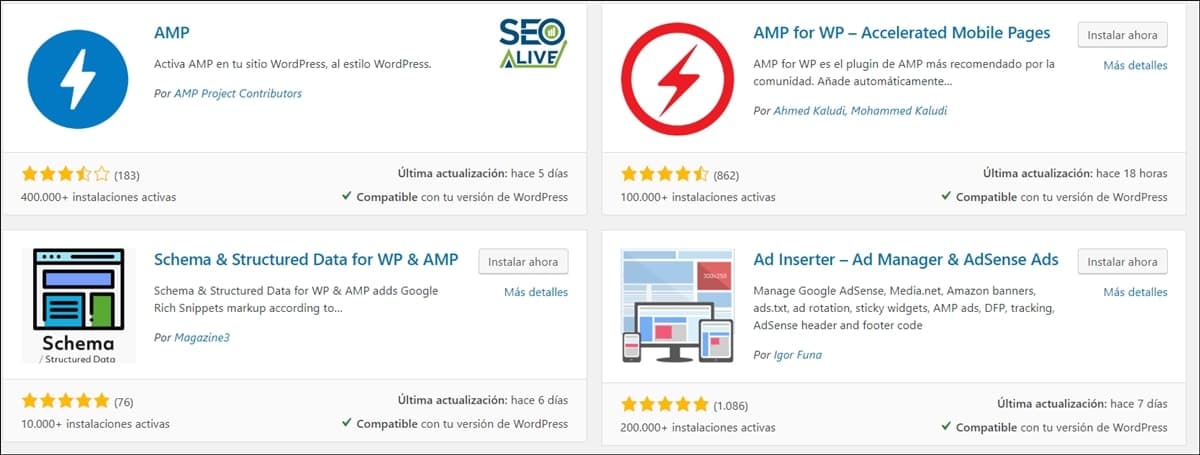
Discover all the plugins that will let you implement it in Wordpress.
While some plugins provide a very simple and fast implementation, others are much heavier and more complex. It will all depend on what you want to achieve.
Resource: Official Wordpress plugin
Now then, what does AMP actually do to be so much faster than classic web loading?
- It runs all javascript asynchronously
- It doesn't allow extensions to block rendering
- It moves all JavaScript elements out of the critical path
- It requires CSS to be "inline"
- It minimizes style recalculations
- It prioritizes resource downloads
Below, you can see all the formats in which you can implement AMP technology and their main uses:
Formats:
- AMP web
- AMP stories
- AMP ads
- AMP email
AMP Web
Creating fast and friendly experiences on the web, both on desktop and mobile, is quite a challenge. With AMP for web, we can carry out this process and let our users enjoy excellent usability and website speed.
An example of this is the BMW website, which has full AMP support and also features excellent design.

An excellent example of how a giant like BMW adapts its website.
AMP Stories
Until now, users have been accustomed to consuming content through articles, whether in blogs, news, press releases, etc. However, the "Stories" format is a revolution. In it, the same content is shown with a much better design and with the performance characteristics of AMP, that is, spectacular usability and speed.

Examples of some Stories from leading publishers.
As usually happens, some of the biggest publishers in the world, such as CNN, The Washington Post, USA Today, and others, tested this technology and produced news pieces and reports.
Example: CNN report on Antarctica using Stories
AMP ads
Creating content seems like a simple task, but it's not. To create quality content, you need a lot of time, effort, and above all a great team to carry out all the research, writing, and related tasks. To make all these efforts profitable, the AMP team created AMP-ads, which would be the equivalent of Google Adsense.
With this extension, we can add ads to our content and thus monetize every impression we generate. Since implementing this technology will likely generate an increase in impressions and clicks on our content but, at the same time, a high bounce rate, at least we can monetize all those visits.
AMP email
AMP-email has been one of the latest experiments launched by the team. It's about being able to show AMP content directly in email, as its name indicates. What's the big difference compared to classic email?
Emails with AMP content are interactive, and we can get the user to interact with them. It's no longer necessary to send users to our website, for example, to confirm an appointment or reserve a date on the calendar.
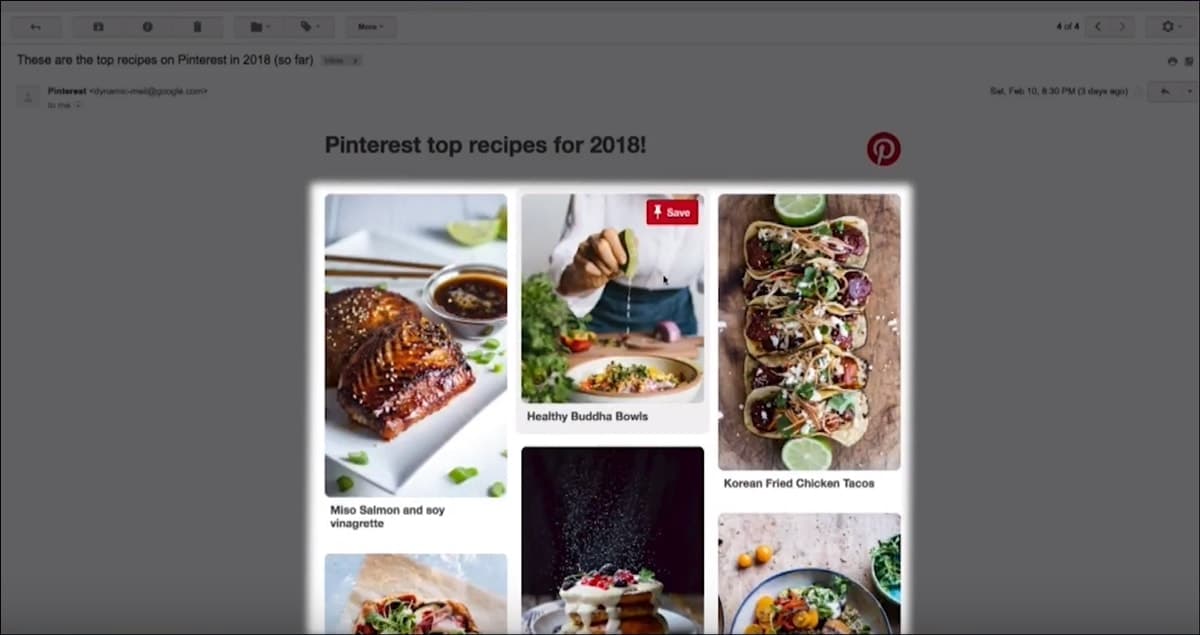
Preview of the content in email, which allows us to interact with it.
Below, you can see an example of how AMP works in email, allowing the user to save interesting pins from their Pinterest account:
3. AMP Advantages
Once we've analyzed all the main products, we need to ask ourselves: does it really add value to our business? There will be cases, especially in media companies, where the impact may indeed be very large due to the close relationship between AMP and Google News and, above all, because of the type of content produced. There will be other cases where there really is no value and there is no need to dedicate valuable resources to its implementation.
However, we wanted to make a small compilation of the main advantages that AMP offers and, of course, also its disadvantages.
-
Speed: The #1 advantage, and the reason many companies are seduced by this technology, is the speed it offers. Compared to traditional websites, it can mean a load time 2 or 3 times shorter, so the user experience changes radically.
-
Visibility: If you perform a search for a specific term from a mobile device (phone or tablet), the Google News carousel that appears at the top is full of AMP pages. Although Google officially says it does not give priority, reality is very different and it seems almost a requirement to implement it in order to appear there. The same happens with the recently created Google Discover section. The only way to access it is from mobile devices, and most of the news that appears consists of Accelerated Mobile Pages.
-
Monetization: By having greater visibility, it's easier to monetize all those visits and therefore obtain another source of revenue. Until now, the classic version was the only way to have accessible content. However, now companies can monetize both their classic version and their AMP version.
-
Connection with other Google features: AMP, being a Google product, not only gets constant development but also has great integrations with other products from the giant. While we recently saw the AMP for Email feature, another notable characteristic is the recent incorporation of AMP into Google Images. All users on mobile devices in Google Images could visit the AMP version of the article with a swipe of a finger.
4. AMP Disadvantages
So far, everything seems to look great. However, not everything is advantages. The implementation of AMP also has a series of drawbacks that are worth keeping in mind:
-
High implementation cost: While the installation process is very simple when done with Wordpress, things change a lot if the implementation is done on another platform. The team must dedicate valuable resources and several people from the development team to research, run tests, validate the implementation, etc., which represents a significant investment.
-
Ridiculous CTR: While the number of impressions can grow considerably after implementing AMP, the real value — that is, the number of clicks we get on our content — usually doesn't go hand in hand. Below, you can see a real example of the CTR that Google Images provides for AMP content in Search Console.
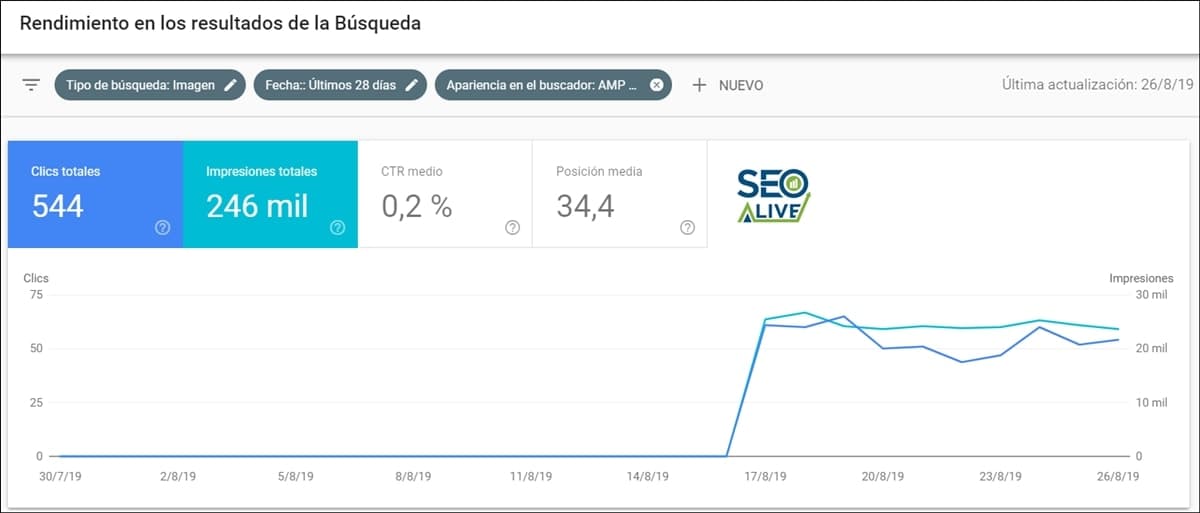
Example statistics of AMP's impact in Google Images.
-
Dependence on Google: Although Google recently announced that AMP pages could now be served from your own domain instead of going through Google's cache, the dependence on Google is still enormous. Any change, no matter how small, has a huge impact on many companies, and that creates an unprecedented strength and bargaining power on Google's side. In other words, Google can do whatever it wants with this technology as long as it continues to generate income for companies. What happens if suddenly Google started charging all companies to use it?
-
Astronomical bounce rate: If we talk about CTR, the numbers are really harsh. However, if we talk about bounce rate, the figures can be downright scary. It is said that many companies are experiencing a bounce rate greater than 90%. For any business, this is truly crazy. From AMP, it is recommended to implement the AMP menu, try to adapt as many pages as possible to create a joint AMP experience... However, this not only makes its implementation more expensive and increases dependence on this technology, but also raises the question of whether the speed gained really compensates for losing so many users in each session...
5. Conclusions
Making a definitive statement about whether or not it's worth implementing AMP is almost impossible. Each business has unique characteristics, and that's why it's worth analyzing each situation in depth, comparing the investment with the potential benefits, and only then deciding whether AMP is really a path to follow.
Do you have doubts about whether AMP technology could help your business? Don't worry! We can help! Discover all our SEO Services and we'll see how we can help you.
6. News & Updates
In this section, we'll keep updating with all the news the AMP team announces so you can stay up to date on this technology.
7. References
Sources:
Official guides:
** All photos are courtesy of the official AMP website.*
Author: David Kaufmann

I've spent the last 10+ years completely obsessed with SEO — and honestly, I wouldn't have it any other way.
My career hit a new level when I worked as a senior SEO specialist for Chess.com — one of the top 100 most visited websites on the entire internet. Operating at that scale, across millions of pages, dozens of languages, and one of the most competitive SERPs out there, taught me things no course or certification ever could. That experience changed my perspective on what great SEO really looks like — and it became the foundation for everything I've built since.
From that experience, I founded SEO Alive — an agency for brands that are serious about organic growth. We're not here to sell dashboards and monthly reports. We're here to build strategies that actually move the needle, combining the best of classical SEO with the exciting new world of Generative Engine Optimization (GEO) — making sure your brand shows up not just in Google's blue links, but inside the AI-generated answers that ChatGPT, Perplexity, and Google AI Overviews are delivering to millions of people every single day.
And because I couldn't find a tool that handled both of those worlds properly, I built one myself — SEOcrawl AI, an enterprise SEO intelligence platform that brings together rankings, technical audits, backlink monitoring, crawl health, and AI brand visibility tracking all in one place. It's the platform I always wished existed.
Discover more content about this author