Is AI-Generated Content Good for SEO? The Honest Answer in 2026
It's no secret that AI-generated content is everywhere. But does it actually help your search rankings, or does it sink them without your notice? Google has been clear that it rewards helpful, high-quality content regardless of how it was produced — yet many have watched their traffic collapse after scaling AI output. So what is actually going on? This guide breaks down what the evidence shows, what Google's policies actually say, and how to use AI in a way that builds your organic visibility rather than undermining it.
Fully AI-written vs. AI-assisted content
Fully AI-written content is copy generated and published with no meaningful human editing. The model writes, and someone just hits publish. AI-assisted content, by contrast, uses AI as a drafting or research tool while a human editor shapes the final output, adds original insight, and fact-checks claims (the crucial step). The most common tools in content workflows right now are ChatGPT (OpenAI), Gemini (Google), and Claude (Anthropic). Each produces different output quality depending on how the prompt is structured, and none of them guarantees content that ranks. The variable that matters is the editorial process applied afterward.
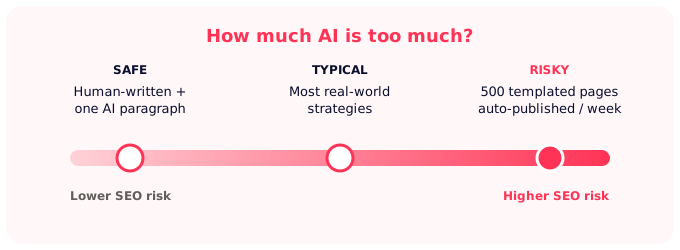
AI involvement is a dial. A human-written piece with one AI-generated paragraph sits closer to the safe end. A site that auto-publishes 500 product pages a week using templated prompts sits at the risky end. Most real-world strategies fall somewhere in the middle.
What is Google's official stance on AI-generated content?
Google's helpful content system
Google incorporated the Helpful Content System into its core ranking systems in March 2024. Unlike other updates that affect individual pages, this one evaluated entire websites and can impact all your rankings if substantial "unhelpful" content (like content written for search engines, not people) is detected.
The 'written by AI' vs. 'helpful to humans' distinction
Google's ranking systems aim to reward original, high-quality content that demonstrates E-E-A-T: expertise, experience, authoritativeness, and trustworthiness. Their focus on the quality of content, rather than how content is produced, has helped them deliver reliable results for years.
Google's spam policies applied to AI content
Using AI to generate content with the primary purpose of manipulating ranking in search results is a violation of Google's spam policies. That said, not all use of automation, including AI generation, is spam. Automation has long been used to generate helpful content, such as sports scores, weather forecasts, and transcripts.
Can AI-generated content rank on Google?
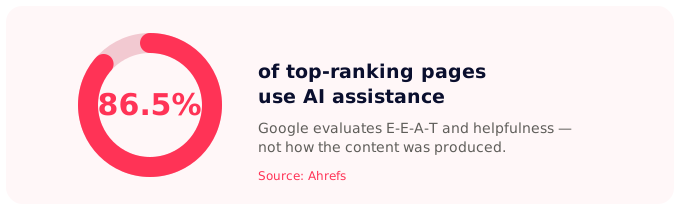
According to an Ahrefs study, 86.5% of top-ranking pages use AI assistance. Google evaluates E-E-A-T signals and helpfulness, not production method.
Why some AI content fails to rank
The failures tend to follow the same patterns: thin content with no original perspective, factual inaccuracies left unchecked, and near-identical output that ends up drowning in a sea of AI-generated pages covering the same topic in the same words.
The role of E-E-A-T in AI content performance
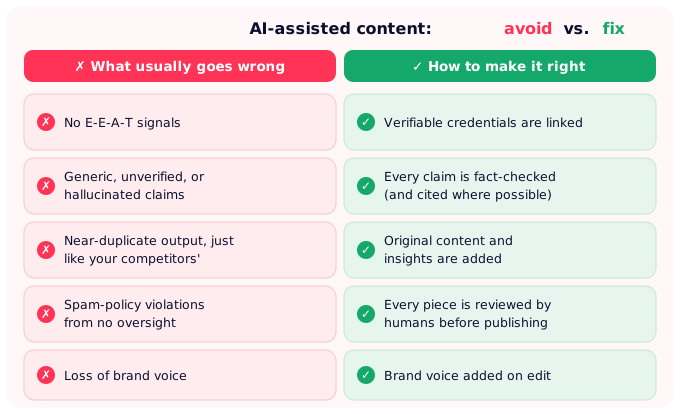
Content should be unique and provide an original perspective beyond schematic, AI-generated answers to common questions. Case studies, real-life examples, research, and analyses are highly recommended. Content that meets these criteria tends to rank higher.
SEO risks of using AI-generated content
Thin and repetitive content penalties
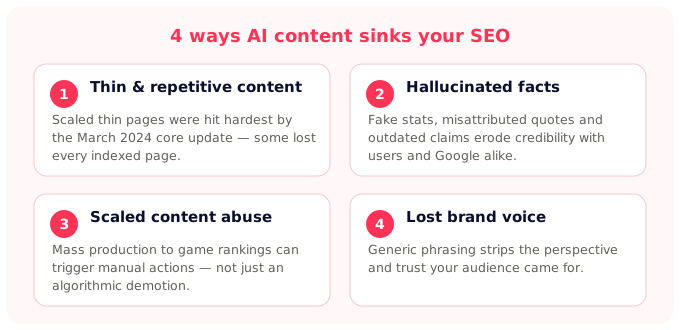
Sites using AI at scale to produce thin content were the most impacted by the March 2024 core update. Many gaming sites, recipe sites, and product review sites saw dramatic ranking drops. Some even lost all indexed pages. By 2026, we should all know better: AI tools can support content creation, but human oversight and original expertise are non-negotiable.
Factual inaccuracies and hallucinations that hurt credibility
AI models are getting better by the minute, but there's still a risk of hallucinations. Publishing hallucinated statistics, misattributed quotes, or outdated information damages credibility with both users and Google's quality signals. Every factual claim in AI-drafted content needs human verification before it goes live. This is not optional.
Scaled content abuse and manual actions
Google's March 2024 core update specifically focused on reducing the visibility of websites engaging in scaled content abuse. This includes mass content production to boost search ranking, regardless of whether that creation involves AI or not. Sites that crossed this line faced manual actions, not just algorithmic demotions.
Loss of brand voice and trust signals
Unedited AI output tends toward generic phrasing and will likely lack the perspective that builds audience trust over time. AI-generated content isn't the enemy — it's a tool. But if you want to rank, never publish AI content as-is. Make it unique, engaging, and undeniably human.
SEO benefits of AI-generated content done right
Scaling content production without sacrificing structure
AI tools dramatically cut the time from brief to first draft. For teams managing large content calendars, that speed advantage is real.
Faster keyword research and topic clustering
AI tools can process keyword lists, group related topics, and surface structural patterns in minutes. When used for research and ideation rather than final output, they free up time for the editorial work that actually moves rankings.
Filling content gaps at scale
Building topical authority means covering a subject comprehensively. AI-assisted drafting makes it possible to address supporting topics at a faster pace than would be practical with a purely manual workflow.
How to use AI content without hurting your SEO
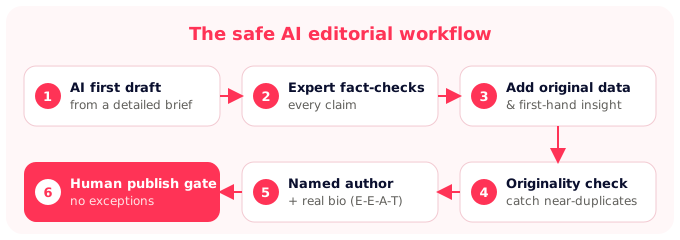
The safest approach treats AI as a drafting layer, not a publishing pipeline. Here is a practical editorial workflow:
- Use AI to generate a structured first draft based on a detailed brief.
- Have a subject-matter expert review every factual claim and add a first-hand perspective.
- Add original data, proprietary insights, or customer quotes that competitors can't replicate.
- Run a plagiarism check to catch near-duplicate passages.
- Add a named author with a genuine bio — E-E-A-T requires identifiable expertise.
- Check every internal link before publishing.
Optimize AI drafts for E-E-A-T. Author bios, cited sources, original research, and specific examples all strengthen E-E-A-T signals. Generic statements like "AI tools improve efficiency" carry no weight. You need specific claims, with numbers, context, and a source.
AI content detection: should you worry?
Tools like Originality.ai and GPTZero attempt to detect statistical patterns associated with AI output. Their error rates are significant enough that a high "AI score" is not reliable evidence that content is AI-generated — and a low score doesn't guarantee your content's quality either.
Google has also not confirmed using any specific AI detection system. According to its statements, Google doesn't care who or what writes your content. What matters is whether it's helpful. Chasing a low detection score is a distraction from the actual goal: producing content that serves users.
Best practices for AI-assisted SEO content in 2026
- Choose tools that fit your workflow. ChatGPT, Claude, and Gemini produce different output quality for different task types. Test prompts against your actual editorial standards before committing to any tool.
- Brief the AI properly. A vague prompt produces generic output. Specific prompts — with target audience, key points to cover, tone, and sources to reference — produce more useful drafts.
- Establish a quality gate. Every piece of AI-drafted content should pass through human editorial review before publishing. No exceptions.
- Measure what matters post-publish. Track ranking velocity, engagement rate, and organic CTR for AI-assisted content separately so you can identify what's working and cut what isn't.
What does the future of AI content and SEO look like?
Most content published online in 2026 involves AI assistance at some stage. But the sites winning in search are not those using AI the most; they're the ones with the tightest editorial standards. As more competitors publish AI-assisted content, original perspective and demonstrable expertise become the actual differentiators.
Google's AI Overviews (formerly SGE) play a fundamental role in the landscape of AI content and SEO. When an AI Overview answers a question directly, clicks to the underlying pages drop. This means the content that earns a citation in an AI Overview holds more value than content that merely ranks below one.
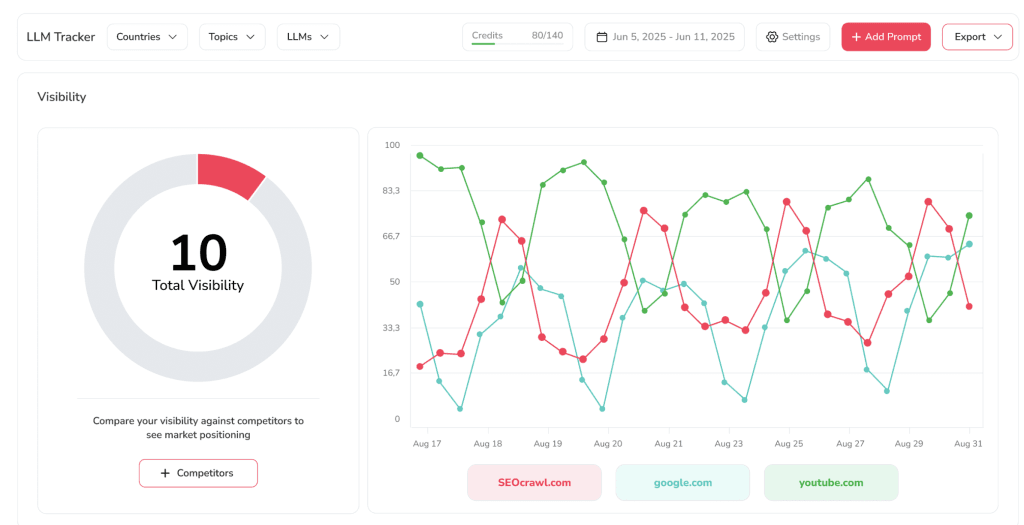
In this context, AI visibility tracking becomes a practical necessity. If your content gets cited by ChatGPT, Claude, or Gemini when users ask product-evaluation questions, that's measurable brand exposure separate from Google rankings entirely. SEOcrawl AI's AI Tracker monitors brand mentions, sentiment, and share of voice across ChatGPT, Claude, Gemini, Perplexity, and Copilot, so you can see exactly where your content surfaces — and where it doesn't.
FAQs
Does Google penalize AI-generated content?
Google does not penalize content for being AI-generated. It penalizes low-quality, unhelpful, or spammy content regardless of origin. The deciding factors are quality and genuine helpfulness to the user, not the production method.
Can AI-written content rank on the first page of Google?
Yes. AI-assisted content ranks regularly. The condition is that the content meets Google's quality standards, demonstrates E-E-A-T, and provides genuine value. Editorial oversight is the variable that separates pages that rank from pages that don't.
How does Google detect AI-generated content?
Google has not confirmed a specific AI detection system. It evaluates quality signals: originality, depth, user engagement, and demonstrated expertise. A content team focused on those signals will outperform a team optimizing for a low AI-detection score every time.
What is the best way to use AI for SEO content?
Use AI for structure and drafts, then have a human editor add expertise, original data, and brand voice before publishing. That human-in-the-loop step is what separates content that builds authority from content that doesn't.
Will AI content hurt my website's E-E-A-T?
Unedited, generic AI content can weaken E-E-A-T signals if it lacks author credentials, original insight, or factual accuracy. Adding expert bylines, citing verifiable sources, and including proprietary data directly address this risk.
Is AI content considered duplicate content by Google?
AI tools trained on similar data can produce near-identical output across sites. Google treats this as a quality issue rather than a technical duplicate-content penalty, but the practical effect on rankings is the same. Customize every AI draft and run an originality check before publishing.
How much of my content can be AI-generated without SEO risk?
Google has not set a percentage threshold for AI-generated content. The quality of the final published piece is what's evaluated, rather than the ratio of AI to human input.
Author: David Kaufmann

I've spent the last 10+ years completely obsessed with SEO — and honestly, I wouldn't have it any other way.
My career hit a new level when I worked as a senior SEO specialist for Chess.com — one of the top 100 most visited websites on the entire internet. Operating at that scale, across millions of pages, dozens of languages, and one of the most competitive SERPs out there, taught me things no course or certification ever could. That experience changed my perspective on what great SEO really looks like — and it became the foundation for everything I've built since.
From that experience, I founded SEO Alive — an agency for brands that are serious about organic growth. We're not here to sell dashboards and monthly reports. We're here to build strategies that actually move the needle, combining the best of classical SEO with the exciting new world of Generative Engine Optimization (GEO) — making sure your brand shows up not just in Google's blue links, but inside the AI-generated answers that ChatGPT, Perplexity, and Google AI Overviews are delivering to millions of people every single day.
And because I couldn't find a tool that handled both of those worlds properly, I built one myself — SEOcrawl AI, an enterprise SEO intelligence platform that brings together rankings, technical audits, backlink monitoring, crawl health, and AI brand visibility tracking all in one place. It's the platform I always wished existed.
Discover more content about this author
On-page SEO is everything you control on a page: content, title, meta description, headings, URL, images and internal links. Here is a checklist element by element, an audit process and what changes with AI Overviews and AI Mode.