University SEO

Wondering whether SEO for universities is actually a thing? No sector escapes SEO, and universities are no exception. Just like many other levels of education, whether formal or informal, the website is a source of traffic and, therefore, of business.
Want to know how important SEO is for universities? Let's get started!
Why is SEO important for universities?
As we said before, a good SEO strategy is synonymous with business. With the high CPCs (cost per click) on ads related to education, organic rankings become an extremely important conversion channel thanks to their low acquisition cost.
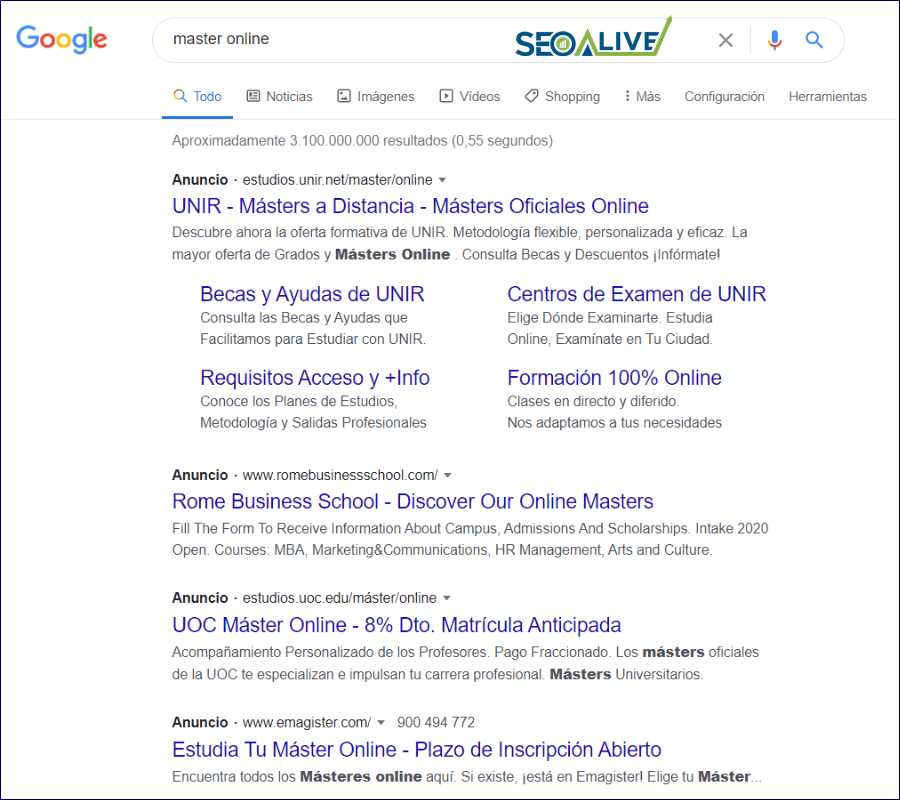
Top search results for the keyword "master online". As we can see, the SEM competition is truly intense.
But that's not all. SEO, as is well known, brings visibility. In the eyes of prospective students, this visibility can turn into authority. Seeing a university appear in the top positions for all the searches a future student performs on Google adds a point of authority and trustworthiness.
Organizing Topic Clusters on a University Website
But a university website can be very large and, if SEO has never been worked on before, a real mess. Dozens or hundreds of subdomains, truly important pages that are orphaned or more than 10 clicks away from the homepage, completely different organizations depending on the field of study...
As an example, here you have the sitemap of a small Spanish university. Keep in mind that it has several subdomains, but in the image only the main domain is included:
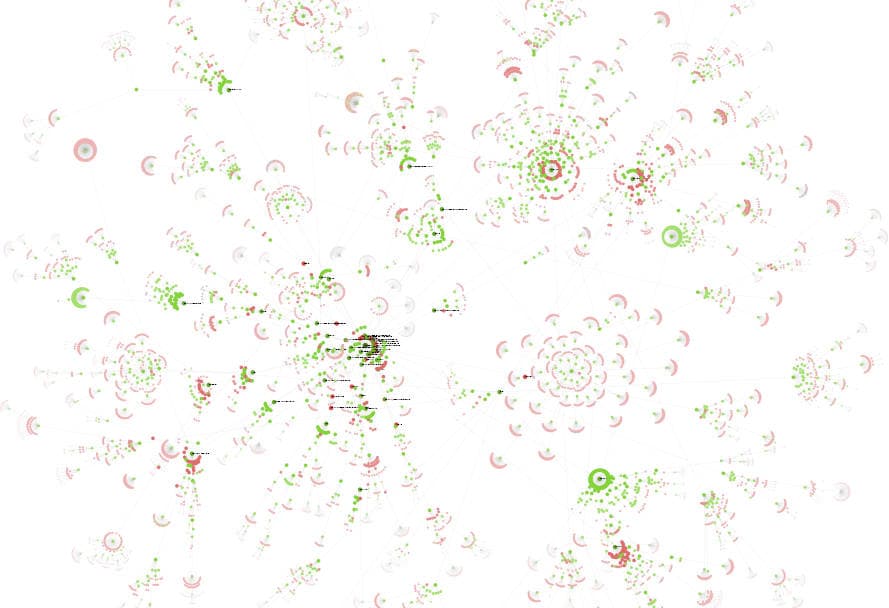
Sitemap of a university
In the end, the structure we find is a complete mess without any order. For more information, we have the summary figures given to us by Screaming Frog:
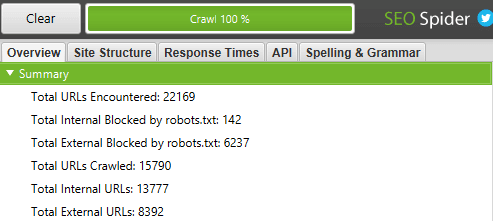
Overview from the crawler tool, Screaming Frog
Now imagine for a moment this same scenario across each of the at least 15 subdomains we've detected for this particular university.
To start working on SEO for universities, the first thing we need to do is group content by topics or subject areas. For example, in the educational offer section, you can group by field of knowledge: economics and business, health sciences, engineering, etc. From there, we need to organize all the dependent URLs to start drawing a new sitemap, better structured and fully accessible.
Organizing URLs by grouping content clusters will help you visualize the website and structure your work.
SEO challenges that may arise during implementation
Working with an institution like a university can be tricky. Your freedom to act as an SEO will be reduced within its hierarchical structure and bureaucratic processes. However, within a university there are several hierarchical structures and some are independent of others. For example, within each faculty or department there are hierarchies, and you, as an SEO professional, will have to talk to all of them.
But things move slowly in big institutions. You might write to a department head to ask about certain issues, but between them being busy and the fact that what you're asking doesn't matter to them in the slightest, the process can drag on. That's why it's a good idea to have a solid set of planned actions. Thanks to these, you'll be able to move forward on easy-to-implement tasks while those unavoidable pauses and waits get resolved.
To make progress on university SEO, you'll need patience and a good handful of planned alternative tasks. In addition to these logical waits, since these people's main job is something else, other types of problems can also arise. Some of the most common include:
- Contradictory opinions and/or task resolutions. If it's not well organized and it's not made clear who the main liaison between the university and the SEO professional or agency will be, someone may approve something while another person thinks the opposite.
- Design issues that are hard to tackle. Studying university websites to write this article, we came across some that aren't mobile-friendly. That's right, in 2020 and with a pandemic that has accelerated these centers' shift to remote learning.
- Carrying out actions with the web or IT department. University centers are not used to very drastic changes in their IT systems. Imagine how traumatic it can be when you ask them to move those 25 subdomains and their content to subfolders within the main domain and set up the appropriate redirects.
Trying to understand Webometrics and its importance
The concept of Webometrics is very interesting and closely linked to university SEO. But... what is Webometrics?
What is Webometrics?
It's a ranking of the best universities in the world. For its classification, it takes into account factors such as online visibility, number of documents, scientific publications, and citations. It's an independent ranking produced by the CSIC Cybermetrics Lab and updated every 6 months.
Can we say it works like Google? Yes, we can say it works like Google! Allowing, of course, for the differences and complexity of the algorithms.
It's a quantitative ranking that takes into account several factors, some of which come from tools that are very well known to all of us. Webometrics gives you extra visibility, and in the eyes of someone who doesn't know its classification system, it may seem that one university is academically better than another, but no, it's only better in terms of web visibility, citations, author prominence, and publications (which is no small thing).
Let's see how Webometrics distributes the importance of these indicators and where it obtains the data:
Indicators Meaning Methodology Source Weight
Presence Shared public knowledge Size (number of pages) of the institution's main web domain. Includes all subdomains sharing the same web domain. Google 5%
Visibility Web impact of content Number of subnets linking to the institution's web pages (normalized value and then average). Ahrefs / Majestic 50%
Transparency Most cited researchers Number of citations of the top 210 authors (excluding the top 20 outliers). Google Scholar Profiles 10%
Excellence Most cited articles or documents Number of articles in the top 10% most cited in each of the 26 disciplines of the complete database. Scimago 35%
University professors: Key to visibility
As can be inferred from the Webometrics indicators, there is a significant impact coming from scientific publications and their authorship, measured through mentions on Google Scholar and Scimago. But you can help grow on these two platforms through activity on article-sharing platforms like the well-known Academia.edu or the social network for scientists and researchers ResearchGate.
Research staff activity on these social networks speeds up indexing on other platforms, provides visibility, and creates interactions with other researchers and research centers that can result in an increase in citations. Everything is connected, and getting professors and departments involved in this content dissemination work is a great help in university SEO.
Conclusions
SEO for universities and higher education centers has many angles to cover. Some of them will be easy to access, and many others will pose challenges beyond your knowledge of search engine optimization. As in most SEO work, getting the client involved will be essential to success, and in this case, each department or area head may be a client with different needs and concerns. Staying organized is key, and you must always have a plan B for each action, because bureaucracy carries a lot of weight in university systems.
And you, do you have experience working with university centers and want to share it? We're all ears!
Author: David Kaufmann

I've spent the last 10+ years completely obsessed with SEO — and honestly, I wouldn't have it any other way.
My career hit a new level when I worked as a senior SEO specialist for Chess.com — one of the top 100 most visited websites on the entire internet. Operating at that scale, across millions of pages, dozens of languages, and one of the most competitive SERPs out there, taught me things no course or certification ever could. That experience changed my perspective on what great SEO really looks like — and it became the foundation for everything I've built since.
From that experience, I founded SEO Alive — an agency for brands that are serious about organic growth. We're not here to sell dashboards and monthly reports. We're here to build strategies that actually move the needle, combining the best of classical SEO with the exciting new world of Generative Engine Optimization (GEO) — making sure your brand shows up not just in Google's blue links, but inside the AI-generated answers that ChatGPT, Perplexity, and Google AI Overviews are delivering to millions of people every single day.
And because I couldn't find a tool that handled both of those worlds properly, I built one myself — SEOcrawl AI, an enterprise SEO intelligence platform that brings together rankings, technical audits, backlink monitoring, crawl health, and AI brand visibility tracking all in one place. It's the platform I always wished existed.
Discover more content about this author
On-page SEO is everything you control on a page: content, title, meta description, headings, URL, images and internal links. Here is a checklist element by element, an audit process and what changes with AI Overviews and AI Mode.