The Best Techniques for SEO Benchmarking
Benchmarking is a process used across a wide range of business and production sectors. SEO was not going to be left out, and applying these processes to our search engine optimization strategy can deliver great results. In this article, we'll walk you through what SEO benchmarking is, along with some techniques to approach it. Want to join us? Let's dive in!
What Is SEO Benchmarking?
SEO benchmarking is a competitive analysis in which you identify the differentiating values, products, or services of the market-leading competitors. They are compared with your own company to pinpoint competitive advantages and to drive improvements and new implementations. Thanks to this study and comparison, we can identify our own strengths and weaknesses, as well as those of the competition. This helps us spot areas for improvement that we can use to define an optimal SEO strategy.
Below we'll go through the different steps to carry out proper SEO benchmarking. Keep reading!
How to Do SEO-Focused Benchmarking
SEO benchmarking is all about being able to compare websites in order to gain competitive advantages. For this, we need two basic things:
- know our own website, and
- analyze the competition.
Benchmarking can vary depending on needs and it isn't always done the same way, but we're going to try to guide you through this type of analysis.
Get to Know Your Website
The first step is to get to know ourselves from an SEO standpoint, and to do that we can ask ourselves several questions:
- Do we know our conversion rate from organic traffic? Is it significant relative to total revenue?
- Is our off-page SEO in good shape?
- Do we have a solid website architecture?
- Do we have quality content that satisfies the search intent of our potential customers?
- Where do we stand within our market?
Identify Your Competitors
Now we know who we are, and next it's time to find out who they are: our competitors. Here you have several options to identify those competitors and prepare for SEO benchmarking actions.
- Google searches. If you know your main target keywords, you can run searches and pull, for example, the top 10 results for each query. Be sure to focus only on organic results.
- SEO tools like Ahrefs or SEMrush, can be very helpful at this stage. They let you see the keywords you share with various competitors, which allows you to identify them. Another option is that, when you analyze your site, they directly identify several of your competitors. You can go as deep into this research as you want, even looking for competitors of your competitors.
Segment by Page Type, Then Classify
Not every Google result or every competitor returned by the tools is actually your competition. Perhaps one of those sites only competes with you in one of its categories or sections. Distinguish between full competitors and partial competitors, but keep them all on your radar.
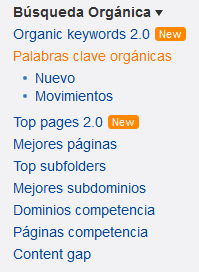
Now it's time to classify them, and SEO tools will be of great help here thanks to their traffic estimates. At SEOcrawl AI, we use Ahrefs and it's as easy as downloading the "organic keywords" report, or reviewing it page by page using the "top pages" option. With the top pages option, if it's a partial competitor, you'll need to select only the pages that actually compete with yours.
Define Value Points and Set a Strategy
We now have a lot of data on all of our competitors (estimated visits, list of inbound links, visits per URL, keywords they rank for, how much estimated traffic each keyword brings in...). We can also go further and, using a crawler like Screaming Frog, pull additional data such as inbound links, meta tags, identify headings, and much more.
Every professional has their own strategy; we're going to share ours, but there are plenty of equally valid approaches:
- Organize the data. Spreadsheets are your friends and will help you organize all the information.
- Break it down into sections. Depending on the project, this can be by keyword or by URL. One idea is to put each keyword (or cluster of keywords) at the start of a row, followed by each competitor's data for that keyword, leaving a final column where you note whether you have a page on your site targeting that query. If you don't have one and it's an important search, you've just identified your first task: create that page or section.
- Step back and tackle specific tasks. Now that you have all the information classified, focus on the points you've identified as most important. They can be important because of search volume, because they're a core focus of your business, because you're already ranking close to your competitors, and so on.
- Where are they better than us? Identify the metrics where they beat you and draw up a plan to improve them. Study the reasons why they are up there.
- Not everything is about focusing on specific tasks for particular keywords. You also need to look for broader patterns. For example, if your competitors have a blog and you don't, it would make total sense to focus your efforts there. The same goes if you notice that certain patterns keep repeating in the way they categorize things; perhaps you can target searches by adding a new product category that you've been overlooking.
Conclusions on SEO Benchmarking
Benchmarking is an ongoing process that works well for practically any type of company looking to identify areas for improvement. It can be adapted to organic search to uncover aspects to improve or actions that can drive growth. At SEOcrawl AI, we are fully in favor of this practice, and you can take advantage of its benefits whether you're an established online business or you're planning to launch a new project.
And you, how do you approach SEO benchmarking? We invite you to leave us a comment and share your experience. Thanks a lot, and see you next time!
Author: David Kaufmann

I've spent the last 10+ years completely obsessed with SEO — and honestly, I wouldn't have it any other way.
My career hit a new level when I worked as a senior SEO specialist for Chess.com — one of the top 100 most visited websites on the entire internet. Operating at that scale, across millions of pages, dozens of languages, and one of the most competitive SERPs out there, taught me things no course or certification ever could. That experience changed my perspective on what great SEO really looks like — and it became the foundation for everything I've built since.
From that experience, I founded SEO Alive — an agency for brands that are serious about organic growth. We're not here to sell dashboards and monthly reports. We're here to build strategies that actually move the needle, combining the best of classical SEO with the exciting new world of Generative Engine Optimization (GEO) — making sure your brand shows up not just in Google's blue links, but inside the AI-generated answers that ChatGPT, Perplexity, and Google AI Overviews are delivering to millions of people every single day.
And because I couldn't find a tool that handled both of those worlds properly, I built one myself — SEOcrawl AI, an enterprise SEO intelligence platform that brings together rankings, technical audits, backlink monitoring, crawl health, and AI brand visibility tracking all in one place. It's the platform I always wished existed.
Discover more content about this author
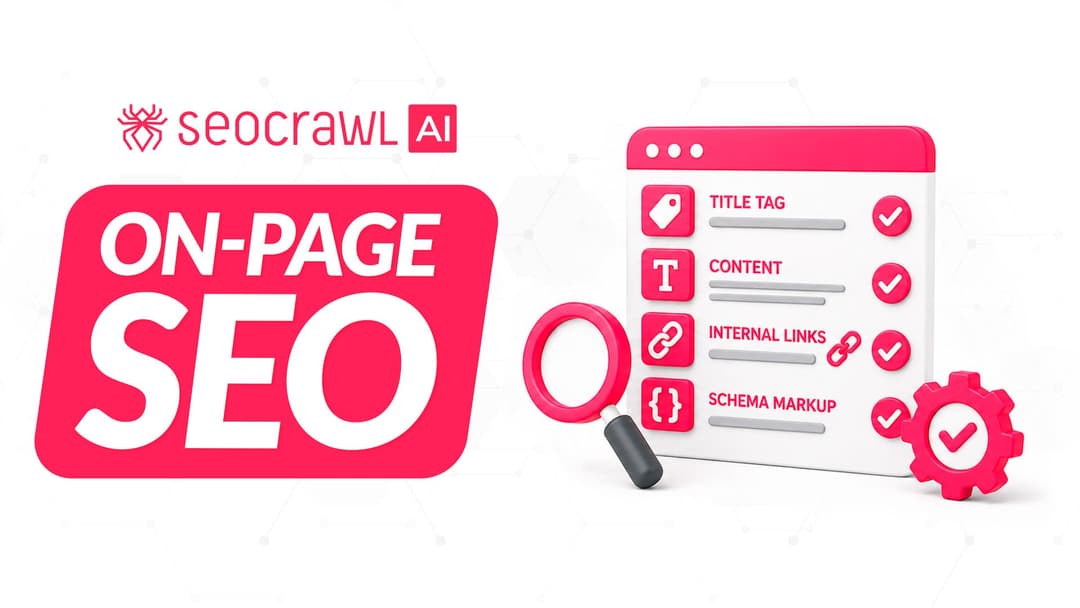
On-page SEO is everything you control on a page: content, title, meta description, headings, URL, images and internal links. Here is a checklist element by element, an audit process and what changes with AI Overviews and AI Mode.