Google FAQ Rich Results Removed: What Changed and What to Do Now
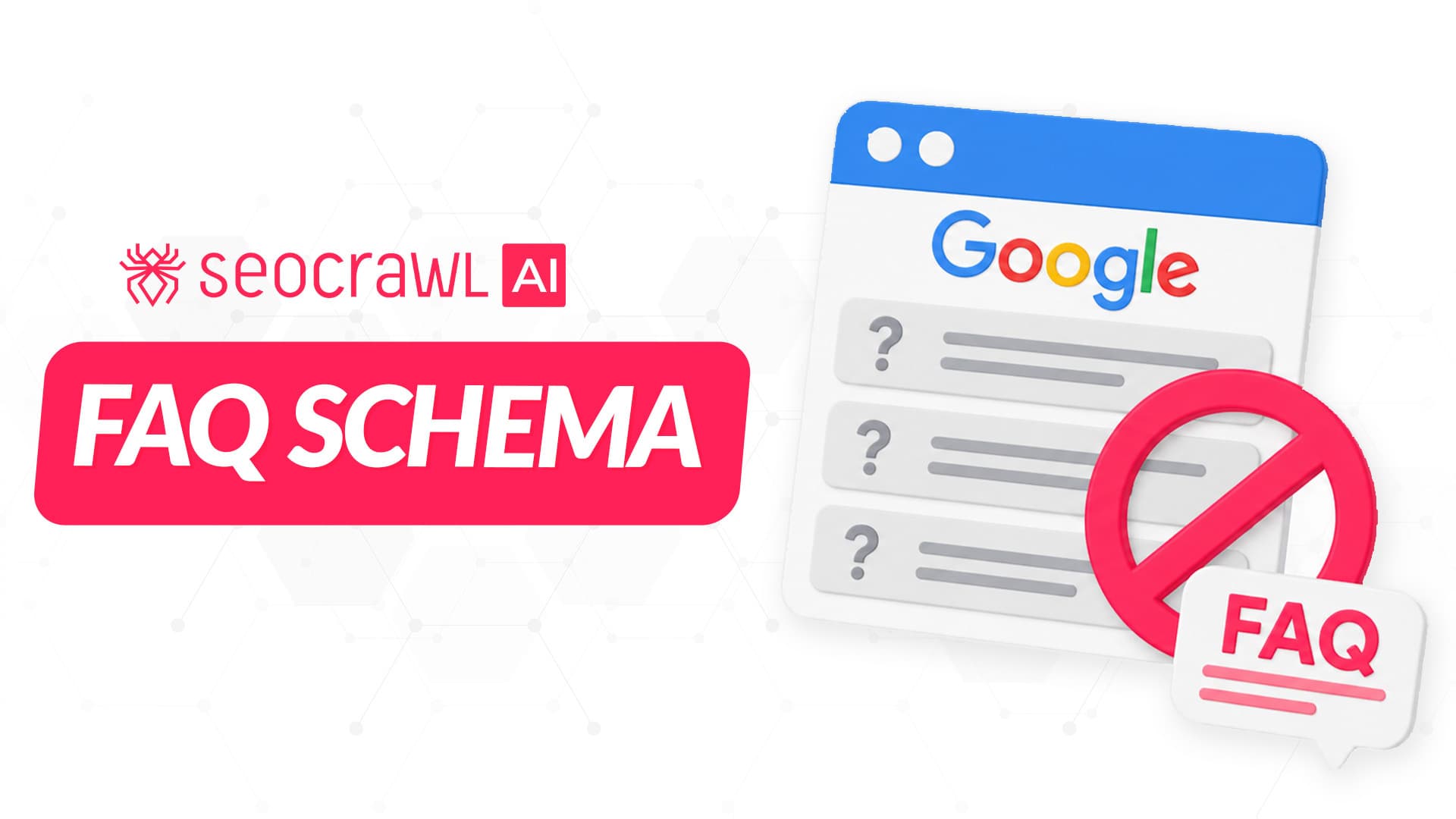
On May 7, 2026, Google quietly published a note in its official documentation that caught many SEO professionals off guard: FAQ rich results are going away. Since then they've stopped appearing in search results; the corresponding reports will be retired in June and support in the Search Console API will be removed in August.
This news may look like a crisis, but it's really a signal. And we need to read it smartly before deciding what to do with all that FAQPage schema many of us have accumulated over the years.
The three key dates
- May 7, 2026: FAQ rich results stop showing in the SERP. That expandable accordion that took up several extra lines below your result, with folded questions and answers, no longer appears. Run a search today and compare it to a screenshot from a month ago and you'll see it clearly.
- June 2026: The FAQ rich results report in Search Console is retired and support is removed from the Rich Results Test tool. From that point on, you won't be able to check whether your schema was properly implemented through these tools.
- August 2026: Support is removed from the Search Console API. If you have integrations that pull FAQ rich results data for your dashboards or reports, it's time to update them before that date.
What many are overlooking
There's an important detail worth mentioning: for most websites, FAQ rich results had already disappeared back in August 2023, when Google restricted them exclusively to recognized government and health sites. The May 2026 announcement simply finishes the job for that last group of sites. If your site is commercial, a blog or an agency, you've probably gone almost three years without seeing them.
It's the second time we've seen this pattern. Google retired HowTo rich results in 2023 on an almost identical timeline that those who've been in the industry for a while know by heart.
Why is Google doing this?
Visual SERP saturation
The main reason is that Google wants to simplify the SERP. And, to some extent, that's true. For years the results page has filled up with modules: featured snippets, People Also Ask, videos, products, Discussions, AI Overviews. When too many results carry expandable FAQs, the whole listing looks like a stack of accordions. Wanting to simplify it isn't crazy.
Schema abuse
The second reason is to improve results quality. The abuse of FAQPage on sites that don't have a real FAQ section has been a problem for a long time. Service pages with five made-up questions at the bottom just to grab more space in the SERP. And Google tolerated it until it was no longer convenient.
The space migrates to AI Overviews
This reason is the most relevant for our industry: Google is migrating that space to AI Overviews and AI Mode. Every section it frees up by removing traditional rich results is space it can fill with generative answers. While "question-answer" is still the dominant format of search, what's changing is who serves it.
The real impact on your traffic
The first question you might ask is: how much is this going to hurt?
It depends on the type of site. If you're a commercial site or an agency, you probably already absorbed it in 2023. For government and health sites that still had the rich result active, expect a CTR drop on pages where the accordion was driving extra clicks. To quantify it precisely, it's key that you review your own Search Console data before the report disappears in June.
Rankings, on the other hand, don't move. FAQPage schema was never a ranking signal and Google has been repeating this for years. Your URL will stay where it was; what changes is how it looks in the SERP.
What you can do this week is download the FAQ rich results report from Search Console while it's still available and save the list of affected URLs with their CTR from the last quarter. It's the baseline you'll need if a few months from now you want to measure the impact of this change.
Why you shouldn't touch your schema
There's a mistake being repeated a lot in the articles about this news: assuming Google is the only one reading the schema. Five years ago that was practically true. Today it isn't.
ChatGPT, Claude, Perplexity and Gemini read structured data when they index web pages. The JSON-LD format is designed for machines: clean, predictable and easy to parse. When an LLM cites a specific answer about a topic, there's a fair chance that the data came from well-structured content.
FAQPage schema isn't going away, it's changing audience. When the recipient was Google's rich result, answers had to be short, almost telegraphic.
But if the recipient is now an LLM, the priority is different. A more complete answer, with context and concrete data, has a better chance of being cited directly or used as the basis for a longer model response.
If you look at the sites being cited most often in ChatGPT and Perplexity lately (at SEOcrawl AI we measure it with the AI Tracker) you can see that those with well-structured FAQ schema and answers between 80 and 150 words tend to appear more than those with 30-word answers built for Google's accordion.
What to do now: three concrete steps
- Export the FAQ rich results report from Search Console this week. Remember it disappears in June. Save the affected URLs and their historical CTR since you'll need them to measure the real impact of the change.
- Audit which FAQs you have and what shape they're in. Identify pages with FAQPage active and classify them: which have real, useful FAQs and which have forced questions added just to win the rich result. The former stay. The latter are worth improving or removing if they don't add value.
- Start measuring your presence in LLMs. If you only measure visibility in Google, you're missing half of what's happening.
The most important takeaway
If you take one idea away from this article, let it be this: Google is admitting that the traditional SERP is losing weight. FAQ rich results aren't being retired because they're bad, but because that space is worth more for something else.
AI Overviews, AI Mode and, outside of Google itself, the entire generative search ecosystem. ChatGPT answers 800 million queries a week, Perplexity cites all its sources, Claude tackles long questions with its own research and Gemini (Google's own AI) is integrated into Workspace.
Brands that in 2026 only measure visibility in Google aren't seeing the full picture. At SEOcrawl AI we built the AI Tracker precisely for this: to measure your brand's mentions in ChatGPT, Claude, Perplexity and Gemini with the same rigor you measured keywords in Google. It isn't the future of SEO, it's what's already happening.
FAQs
Will my current FAQPage schema generate errors in Search Console?
No. The schema is still valid; what's being retired is the specific FAQ rich results report in Search Console and the visual appearance in the SERP. schema.org validators will still mark your JSON-LD as valid.
Does this affect other schema types like HowTo or Product?
HowTo rich results were already retired in 2023 on a very similar timeline. Product, Recipe, Review, Article, Event and BreadcrumbList remain fully active. It's important to understand that Google is reducing rich results progressively, so depending strategically on any rich result makes less and less sense.
Could Google reverse this decision?
It's unlikely they'll change course. When Google retired HowTo rich results in 2023, they didn't come back. The goal is fewer traditional rich results and more space for AI Overviews.
What if I use plugins like Yoast or RankMath that add FAQ schema automatically?
Nothing. The plugin keeps working exactly the same. The only thing that changes is that the output no longer produces a rich result in the SERP. You don't need to deactivate anything.
Does it apply to all countries or only some markets?
It's a global change. FAQ rich results disappear from every version of Google Search, in every language and country.
The retirement of FAQ rich results isn't a crisis but it should remind us that SEO is bifurcating: on one side, a Google SERP with fewer and fewer traditional enriched elements; on the other, a generative search layer that grows week by week and where the rules are written by LLMs, not Google. The brands that keep their schema and start measuring both layers are the ones that will have visibility in 2027. Those that remove it because "Google no longer uses it" are looking at only part of the picture.
Author: David Kaufmann

I've spent the last 10+ years completely obsessed with SEO — and honestly, I wouldn't have it any other way.
My career hit a new level when I worked as a senior SEO specialist for Chess.com — one of the top 100 most visited websites on the entire internet. Operating at that scale, across millions of pages, dozens of languages, and one of the most competitive SERPs out there, taught me things no course or certification ever could. That experience changed my perspective on what great SEO really looks like — and it became the foundation for everything I've built since.
From that experience, I founded SEO Alive — an agency for brands that are serious about organic growth. We're not here to sell dashboards and monthly reports. We're here to build strategies that actually move the needle, combining the best of classical SEO with the exciting new world of Generative Engine Optimization (GEO) — making sure your brand shows up not just in Google's blue links, but inside the AI-generated answers that ChatGPT, Perplexity, and Google AI Overviews are delivering to millions of people every single day.
And because I couldn't find a tool that handled both of those worlds properly, I built one myself — SEOcrawl AI, an enterprise SEO intelligence platform that brings together rankings, technical audits, backlink monitoring, crawl health, and AI brand visibility tracking all in one place. It's the platform I always wished existed.
Discover more content about this author