Complete Guide to Backlinks in SEO
Backlinks are today one of the most important pillars in the SEO ranking of a website.
They also represent one of the most complex strategies to be developed by professionals in the sector, partly because an error or a misapplication can be penalized by Google.
This guide explains what a backlink SEO strategy consists of, why it is so important, and how you can leverage it to improve the ranking of your website.
What are backlinks?
Backlinks, or inbound links, are those links that come from an external website to the one we want to rank. Both the source and the destination can be of any type (website, blog, forum). However, these links must follow specific rules if we want them to be effective.
Syntax of a link
Before moving on, let's look at how the syntax of a link is built, what elements make it up, and how important they are.
In essence, it is composed of:
- Link tag (orange color)
- Destination URL (green color)
- Anchor text (blue color)
- Attribute (red)
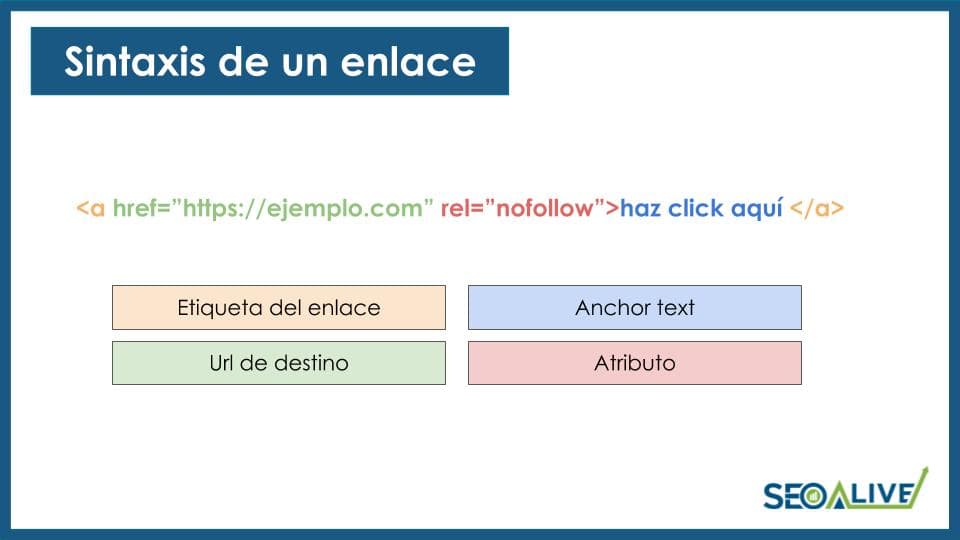
Main elements that make up the syntax of a link.
We previously talked about the nofollow tag and the different ways to use it, its advantages, the difference from dofollow, etc.
To summarize briefly without going into detail again, in general, nofollow usually does not pass authority (we say "usually" because Google has recently officially changed the rules of the game, saying that it "may" pass authority as they interpret it), while dofollow does.
Therefore, in our backlink acquisition strategy we must keep in mind the difference between both attributes and the impact in terms of popularity transfer that they can have on our website.
The syntax of the link used is therefore composed of two sections: the visible part and the code.
In the visible part we have the "anchor text", which is the keyword on which we apply the link.
This element is very important, as it will be related to the SEO ranking of that backlink. In other words, the keyword we use for the link is the one we want to be ranked for in user searches so that our website appears.
The correct or incorrect use of anchor texts in our backlink strategy can provide great benefits or lead to a Google penalty.
We must remember that when doing off-page SEO, we must do it in a "natural" way in Google's eyes. Do you think it would be natural for everyone who links to SEOcrawl AI to do it with the exact anchor text "SEO positioning agency"? No one would believe that's natural, right? Much less Google...
Importance in today's SEO
The backlink strategy for SEO ranking is known as link building. It could be described as the strategy of generating optimal inbound links to our website for ranking purposes.
Therefore, when we refer to a link acquisition strategy, we will be referring to link building.
We should not neglect this part of any web optimization process, because we would be missing the "fuel" once we have the website ready. A website perfectly optimized at the on-page level, but without a solid off-page strategy, will likely fall short of achieving the goals set.
But let's better understand why doing good link building is so important:
- It helps Google discover and crawl new pages. If we get a link on a page that already has traffic and is crawled by Google, that link to a new page of ours will help Google "discover" it earlier. This will begin the crawling, indexing, and ranking process, which would otherwise possibly be slower.
- They pass authority. As we said earlier, these links transmit authority (popularity) from external sites to the one they are pointing to. The higher the quality and authority of these pages that link to us, the more authority they pass to us.
- Trust. Another parameter Google takes into account is trust. A website with an optimal number of links from prestigious sites is, in Google's eyes, a website that can be trusted.
Who is responsible for controlling the quality of backlinks?
We already know how much Google likes to name certain parts of its algorithm. And how could it not do so with one of the most prominent: links. We are referring to Google Penguin.
This friendly animal was responsible for reviewing our link profile and raising its hand if it saw unnatural behavior, thereby proceeding with the corresponding penalty for low-quality inbound links. In this other post we explain how to lift a penalty of this type.
Previously, this algorithm only reviewed websites at specific times throughout the year, so while this was happening, one could do somewhat more aggressive and careless link building, since until that next review, "they wouldn't catch you".
Until Google decided to carry out one of the biggest updates along these lines, known as Penguin 4.0, which acts in real time. Therefore, we must be very careful to have a highly optimized backlink acquisition strategy.
Fundamental characteristics of backlinks
Both the SEO benefits and the dangers of penalties force professionals in the sector to comply with a series of essential and fundamental characteristics for inbound links.
In summary, these are currently the most important characteristics:
- The link must come from a site with a related topic.
- The link must be natural, included in the context of the content and useful to the user.
- The anchor text must vary for each backlink, as a demonstration of its naturalness.
- The link must be properly categorized.
- The number of links is important, as it is a clear sign of their naturalness or artificiality.
- Trying to pass sponsored links off as natural links is penalized.
- On a website, the linked pages should be varied; if it's always the same one, they would be identified as unnatural backlinks.
Types of backlinks
Backlinks can be obtained from multiple sources and receive different optimization. In addition, depending on their origin, they can be more or less important for the ranking of our website.
Dofollow / Nofollow
We have already seen this at the beginning of the post, but we are recapping it to keep the list more organized. This first distinction of types corresponds to the authority of the link. Until recently, we had only two types:
- Dofollow: Links with authority, which are considered valid for SEO purposes.
- Nofollow: Links without authority, except for the caveat seen at the beginning of the post.
Recently this distinction of types and their importance has been modified. On one hand, we have different link attributes:
- "UGC" attribute: For user-generated content.
- "Sponsored" attribute: For promoted/paid content.
As we mentioned earlier, Google has announced new changes in which it will count all attributes, considering by context the individual importance of each link. In this way, a sponsored backlink could become relevant, despite not originally being a natural link.
Reviews (contextual)
The most recommendable backlinks are those present in reviews, since they are included naturally in the context of the content.
They should be the basis of our SEO strategy. By being within a context, they will help Google identify us as relevant in that sector, as long as they meet the condition of being of the same topic as our website. A very common mistake is to rely only on metrics and ignore this important aspect, linking to us from portals that have nothing to do with our niche.
For some time now, companies selling this type of link have proliferated. They basically consist of directories where webmasters upload their blogs so that advertisers can contact them to directly hire a link. It's a very convenient system, it's like going "shopping". Through a filter system, you select what you're looking for, see your budget, and buy them.
Its advantage is precisely the ease of search and use, but its major weakness is that anyone can access them and therefore have the same links as us.
Forums
Most forums allow links, but limit their SEO potential through attributes. Backlinks in these cases can be placed directly in posts or always be present in each user's signature.
They are quite interesting, because apart from giving naturalness to the profile, if we do it well and respond to some user questions, we will not only be getting the authority of the link itself but possibly also high-quality referral traffic.
Comments
Blog comments have always been an important source of backlinks. However, the abuse by SPAM has motivated many developers to limit or even nullify their relevance.
Links in comments will work as long as the developer authorizes it. Furthermore, for them to be considered valid, they must be truly important for the user who accessed the page looking for information on a specific topic.
We recommend taking them into account, as long as the comment adds value, and not doing so massively without criteria just to "take the authority".
Web 2.0
Web 2.0 backlinks have been losing relevance in favor of social networks, but they are still important if you want a complete link building strategy.
We are referring to portals where you can create your website, without needing to have a hosting plan or a domain, taking the authority of the domain itself. The best known are mydomain.wordpress.com or mydomain.blogspot.com although there are quite a few and some with very interesting topics such as health, sports, leisure, etc. You just have to look for them, easily create a website on that platform, and feed it with content to then use as a link source.
Social Profiles
The vast majority of social profiles allow the inclusion of a link to our website, blog, or forum. There is only one problem: in most cases they are nofollow.
In any case, this presence of the link is important, because it can always bring us visits, either directly from followers of the profile or page, or indirectly, from users who reach the social network through a Google search.
Footprints
Footprints are advanced commands that can be applied in the Google search engine to find websites where it is possible to generate authorized links to our website.
In these commands, we basically look for a typology of sites and keywords that are relevant in them. This way we can find sites with a topic related to ours and place our backlinks more accurately.
Most common metrics to evaluate backlinks
The growing importance of backlinks has motivated the development of various platforms to assess the relevance of each link obtained.
Below, you can see a list of the most common metrics present in many of these platforms:
- Citation Flow (CF): Number of existing links. It is rated from 0 to 100 by the company Majestic SEO.
- Trust Flow (TF): Quality of the existing links. Companion to Citation Flow. It also ranges from 0 to 100 from the company Majestic SEO.
- Domain Authority (DA): Strength of a domain (from 0 to 100). Exclusive to the MOZ platform.
- Page Authority (PA): Complement to the previous metric, exclusive value for a single page of the entire domain.
- Domain Rating (DR): SEO value scale of the links on a domain (from 1 to 100). Rated by the company Ahrefs. It takes into account the value of inbound links to a website.
- URL Rating (UR): SEO value scale of the links on a specific page (from 1 to 100). Complement to Domain Rating, also by Ahrefs.
- Referring domains: Number of domains with inbound links to our site. It is usually provided by several of the tools mentioned.
Types of penalties
As we have mentioned previously, since the change in Google's algorithm, inappropriate backlinks generate a penalty on the linked page.
In general, we distinguish two important types of penalties:
- Manual penalties: Although it may sound strange, they are the easiest to lift, since they send you a notice to Search Console informing you that they have detected suspicious links. Thus, through a disavow, this problem can be solved.
- Algorithmic penalties: More difficult to detect. They can affect a part of the website or the entirety of it. The problem with these is that Google does not notify you in any way. You can start to see your results drop in the SERPs for a specific part of your website, and not know that it is caused by this.
Errors to avoid when acquiring backlinks
If you do not want the backlinks you obtain to trigger a penalty on your page or website, these are the most common errors you should avoid:
- Don't link from sites that are not of a related topic.
- Don't get artificial links, outside the context of the source page.
- Don't always use the same anchor text.
- Don't always indicate the same destination page.
- Avoid links in sidebar or footer.
- ALWAYS check the quality of the site that links to us.
Checklist for reviewing the quality of a backlink
Before obtaining or requesting a backlink on an external page, it is important to carry out an analysis of the potential quality that link can offer.
For this, a checklist can be the best way to consider different determining factors in link creation.
In general, there are two areas you should analyze:
- Quality of the content.
- Quality of previous links.
Within each section, the list of variables can be infinite. But in practice, common sense prevails in order to know which site is really recommended to include as a link to our website.
Here are some points you can include in your checklist to assess the quality of the backlink:
- Is the page thematically related to yours?
- Is the existing information of quality?
- Does it generate interaction among users?
- Does it have an excessive amount of sponsored or affiliate links?
- Does this same page have backlinks obtained from external sites?
- Does the website look natural with all the normal sections such as "about me", "Contact", social networks, etc.?
- Does it publish frequently? What is the ratio of publications with links pointing to other websites?
- Age of the domain.
- Analyze what that domain has had throughout its history (for this use archive.org).
- DA / PA
- TF / CF
- DR
- Degree of indexing (site:domain.com)
- Traffic volume (Semrush, Sistrix, Similar Web).
- Link profile of that website.
Conclusions
Backlinks are an essential element in any SEO strategy. However, it is also one of the most difficult areas of this profession.
When you look for sites from which to obtain inbound links, always value the quality of that site and plan a varied strategy.
But above all, naturalness prevails. The important thing is that the links are natural, related to the context, and useful for the user.
For this, you must start with your own website. If you generate quality content, other sites on related topics will link to it so that their users can obtain more complete information. That is the perfect generation of backlinks you can get.
Author: David Kaufmann

I've spent the last 10+ years completely obsessed with SEO — and honestly, I wouldn't have it any other way.
My career hit a new level when I worked as a senior SEO specialist for Chess.com — one of the top 100 most visited websites on the entire internet. Operating at that scale, across millions of pages, dozens of languages, and one of the most competitive SERPs out there, taught me things no course or certification ever could. That experience changed my perspective on what great SEO really looks like — and it became the foundation for everything I've built since.
From that experience, I founded SEO Alive — an agency for brands that are serious about organic growth. We're not here to sell dashboards and monthly reports. We're here to build strategies that actually move the needle, combining the best of classical SEO with the exciting new world of Generative Engine Optimization (GEO) — making sure your brand shows up not just in Google's blue links, but inside the AI-generated answers that ChatGPT, Perplexity, and Google AI Overviews are delivering to millions of people every single day.
And because I couldn't find a tool that handled both of those worlds properly, I built one myself — SEOcrawl AI, an enterprise SEO intelligence platform that brings together rankings, technical audits, backlink monitoring, crawl health, and AI brand visibility tracking all in one place. It's the platform I always wished existed.
Discover more content about this author