How to Build an Editorial Calendar for a Blog
Objectives. Delivery dates. Planning. These are some of the nightmares every writer faces when they don't have a roadmap to help them work as efficiently as possible. Whether or not the content being produced is aimed at search engine ranking in Google, it is essential to have, from the very beginning, a basic and indispensable tool: the editorial calendar.
Thanks to creating a complete content calendar, we will have the ability to plan ahead and stay aligned with the goals we previously set.
If you're looking to maximize visits to your website and still don't know how, here we show you how we usually create and manage editorial calendars at SEOcrawl AI that help us project our content marketing strategies with SEO value. Take note — here we go:
? Small spoiler: at the end of this article you will find the EDITORIAL CALENDAR TEMPLATE we use at SEOcrawl AI.
What is a content calendar and what is it for?
If you are just getting started in the world of marketing and communications, we'll take a short pause to first explain what a content calendar is and what it's for.
This is a fundamental document where we will put in writing what content is going to be published over a given period of time based on the objectives we have set.
The importance of a good content calendar lies in the fact that it is essential for organizing, monitoring, and later analyzing our SEO content strategy. Thanks to it, we will know what we should publish and when is the best time to do so. Moreover, needless to say, it will allow us to get content ready ahead of time (even for content tied to specific dates of the year), and we will reduce our stress levels from not knowing what to write about!
What should you keep in mind before starting your editorial calendar?
Before you start filling out an editorial calendar, think: what is the purpose you want it to serve? Who is your content aimed at so it has the greatest possible success? How should you present it so it gets the maximum visibility? In other words, first of all, set out to define the following concepts from the very start:
- Pin down the SEO objectives
It's not the same to want to gain visibility as to aim to get more leads. That's why, before you start working on any content calendar, you must establish what you're trying to achieve: do you want more visits each month? Do you need to improve the conversion rate? "That is the question" ?
- Define the buyer persona
This is one of the pillars of any strategy worthy of the name. If we don't know who our ideal customer is and what they're like, we won't know how to reach them, which translates into a strategy destined to fail. No matter how well you work on the editorial calendar, if you haven't oriented it properly toward your target buyer persona, you won't achieve your objectives.
- Keyword research
Once we know what we want to achieve and we understand the personality of our buyer personas, it will be essential to decipher how those target users search on Google (or the corresponding search engine) for the products or services of the main territories of our business. You must also conduct keyword research related to the core topic of your market niche, since both will define the main categories of how you want to be known online — both transactionally (website) and informationally (blog):
** We don't want to dwell on this point any longer so we don't stray from the main topic, but if you want to know how to do a complete keyword research, click here on the post "Keyword Research: complete guide".**
Practical tips: techniques to extract ideas to write about
Before focusing on filling out an editorial calendar, you need to know what you're going to write about. There are many different ways to come up with topic ideas, whatever the niche. At SEOcrawl AI, we mostly use two tactics:
"Stealing" keywords from the competition
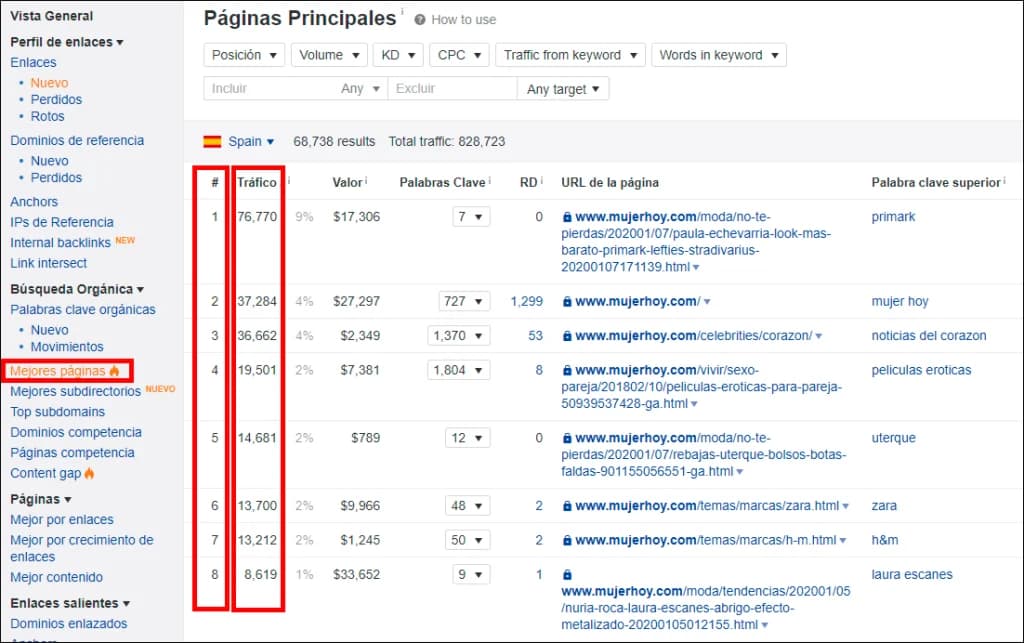
It sounds bad, we know, but the truth is that this is the most accurate concept... This method consists of, first, getting to know who your organic competitors are and writing them down. Once you've identified them, you can use Ahrefs, enter each domain separately in the tool, and analyze "the best pages" (a sub-section that appears inside "Organic search"). This way, you'll be able to see which URLs of your competitor are receiving the most organic traffic, as well as the keywords they use.
Locating long tail keywords
Some great allies to develop a promising strategy are long tail keywords.
The big difference between generic keywords and long tail ones is that the latter are less important, since they have fewer searches per month. However, they are also easier to rank for, since they are less competitive. And if we have more room to maneuver in order to rank in the search results of Google or any other search engine, we'll have more opportunities to get more organic visits. That's why it's worth betting on this type of keyword.
Now that we're clear on why we care about long tail keywords, let's get to the point: how do we look for them? There are many and varied ways to pull 'long tail' keyword ideas for your editorial calendar, but here we'll show you how, again in Ahrefs, we extract them:
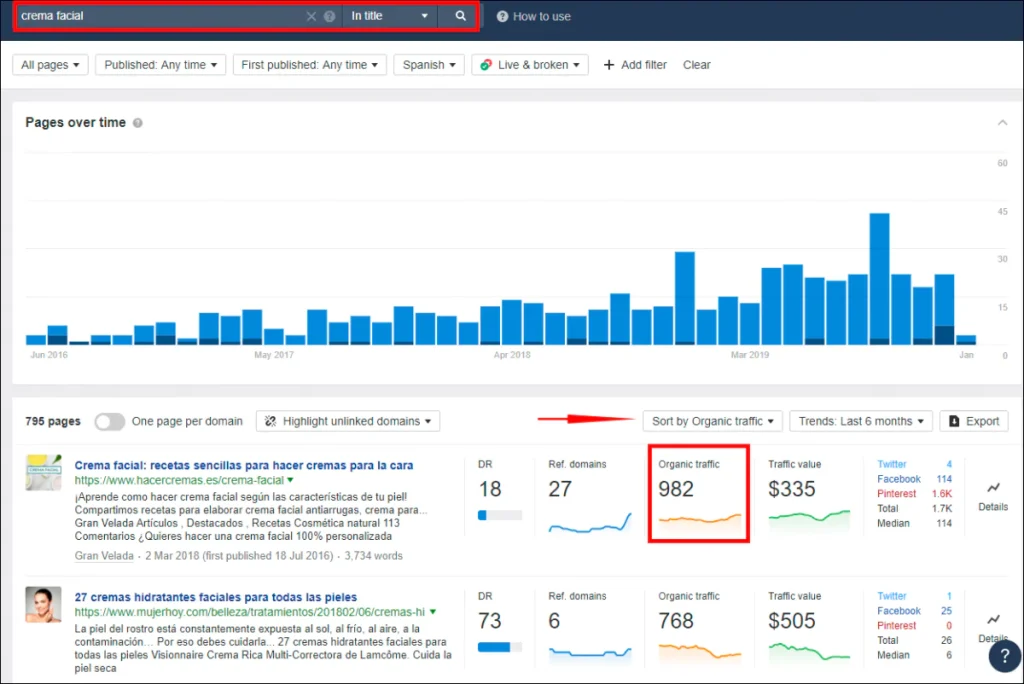
To do so, first of all, we have to enter the keyword we want to analyze in the main menu section 'Content Explorer'. Then we'll filter to show only those URLs where the keyword appears solely in the title. We'll get a list of pages whose information will let us see which of them has captured the most organic traffic.
In this way, we will not only determine whether a long tail keyword is worth working on, but we'll also be able to analyze each particular page and pull ideas about what we think they did well on the SEO optimization side in order to get so many organic visits.
How to build an SEO-oriented editorial calendar?
We've reached the important part, what brought us to this post: how to build an editorial calendar aimed at improving a website's SEO?
The answer can be somewhat ambiguous, since there is no magic formula for finding the best option; for some, one proposed model will be better than another. And vice versa. For others, a second model will be chosen over the first, as it will better fit their needs. For our part, an editorial calendar should always include the following fields:
Delivery date
It's a calendar, so the main idea is to indicate when a page should be written for its subsequent publication.
Author/person in charge of the article
This information is necessary only if there are several writers. That way, everyone involved can plan their work ahead of time.
Publication status
In order to know what stage each piece of content is in, we will indicate in this section of the editorial calendar whether it is still pending, in progress, already saved as a draft, or finally published with the SEO optimization included.
Nature of the article
Brand new articles are just as important as the curation of those we already had published. Both represent an opportunity to rank better. For that reason, in this section we must consider whether the work to be carried out relates to new articles or, on the contrary, to existing ones.
Indicate the main keyword
For SEO, it's essential to never lose sight of which keyword is the ideal one to work on when writing about any topic. That's why, within the editorial calendar, we'll reserve a specific space to indicate which keyword works best when conveying our messages. This way we'll make sure we're always aligned with how users search for a topic on search engines.
Don't forget the secondary keywords
Knowing the main keyword of a piece of content is just as important as knowing its variants, synonyms, and secondary keywords. Indicating those we consider most important to enrich the semantics of a text will help us, through their implementation, so that Google better understands what each of our writings is about.
SEO friendly URL
Many times it's not taken into account that a URL should be friendly. That's why we often see strange characters, phrases with words that add no value, etc. within their syntax. For SEO, within the editorial calendar, it will be important to indicate which SEO friendly URL is the most appropriate, including (of course) the main keyword and trying to keep it as close as possible to the root of the domain, as well as ensuring it is as short as possible.
Suggested SEO title
To begin with, it must be made clear that the title of an article is not the same as the 'Title' tag. As far as Google is concerned, it is the 'Title' that shows up in the SERPs, and not the headline. We can force both to be identical — that's no problem. However, it will be even better to differentiate them by using in the 'title' the keyword we want to rank for, and in the article's headline, some synonym. That way you'll increase the semantics of the content and have more opportunities to rank for several queries related to the topic you're writing about.
Internal links
Depending on the type of content, it may be of interest to indicate through internal links which other pages are related to that text and which we want Google to understand are also important and relevant for our domain.
Whether it's a blog post or a landing page that we anticipate will get a lot of visibility and organic traffic, these are the perfect types of pages to act as anchors for other URLs of interest to rank.
Category it belongs to
At the SEO level, we will have to balance the scale between existing categories so that the URLs acting as listings for specific categories don't become low-quality pages (also known as thin content).
We may be interested in working on one category in particular to rank more keywords, but we have to maintain a balance and not forget that we must also work on all the others the project has. This tab of the editorial calendar reminds us how many categories we are working on and how many times we should work on each and every one of them.
Comments
Not everything we want to appear in a text can always be reflected 100% through the previous sections. That's why we'll always leave a space to comment on other issues that we think should be kept in mind when working on a specific piece of content.
Comments: there can be as many as you want; this is the space where you can leave everything well defined. That said, try to be concise.
In this section you can, for example, indicate whether you want the text to include lists, infographics, or any element that you think will add value to the final text. You can also add reminders about whether or not tags should be included, etc.
Example of an editorial calendar template
Having made it this far, as a bonus, you can download the editorial calendar template we use at SEOcrawl AI. Interested?
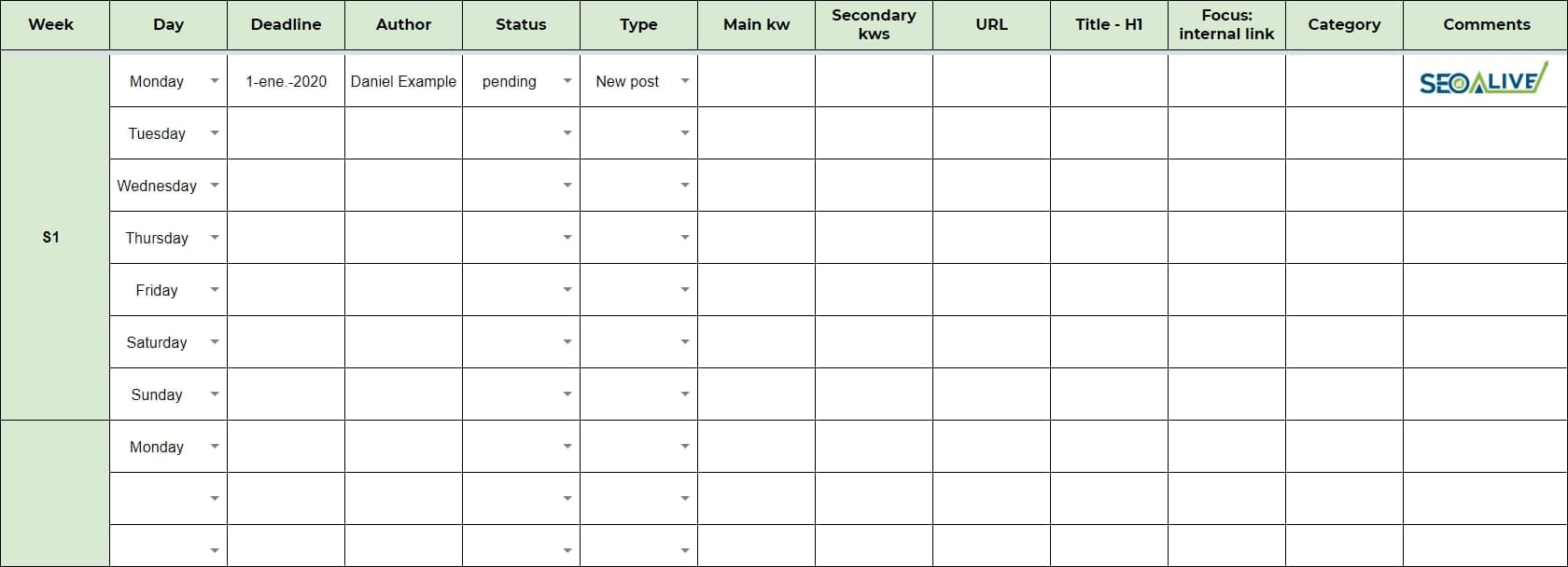
FREE EDITORIAL CALENDAR TEMPLATE
Now you can start working on your own content calendar. Is something missing? Would you like to add anything else? In our 'comments' section, which you'll see a little further below, you'll be able to do so. Go ahead — we'd love to hear from you!
Author: David Kaufmann

I've spent the last 10+ years completely obsessed with SEO — and honestly, I wouldn't have it any other way.
My career hit a new level when I worked as a senior SEO specialist for Chess.com — one of the top 100 most visited websites on the entire internet. Operating at that scale, across millions of pages, dozens of languages, and one of the most competitive SERPs out there, taught me things no course or certification ever could. That experience changed my perspective on what great SEO really looks like — and it became the foundation for everything I've built since.
From that experience, I founded SEO Alive — an agency for brands that are serious about organic growth. We're not here to sell dashboards and monthly reports. We're here to build strategies that actually move the needle, combining the best of classical SEO with the exciting new world of Generative Engine Optimization (GEO) — making sure your brand shows up not just in Google's blue links, but inside the AI-generated answers that ChatGPT, Perplexity, and Google AI Overviews are delivering to millions of people every single day.
And because I couldn't find a tool that handled both of those worlds properly, I built one myself — SEOcrawl AI, an enterprise SEO intelligence platform that brings together rankings, technical audits, backlink monitoring, crawl health, and AI brand visibility tracking all in one place. It's the platform I always wished existed.
Discover more content about this author
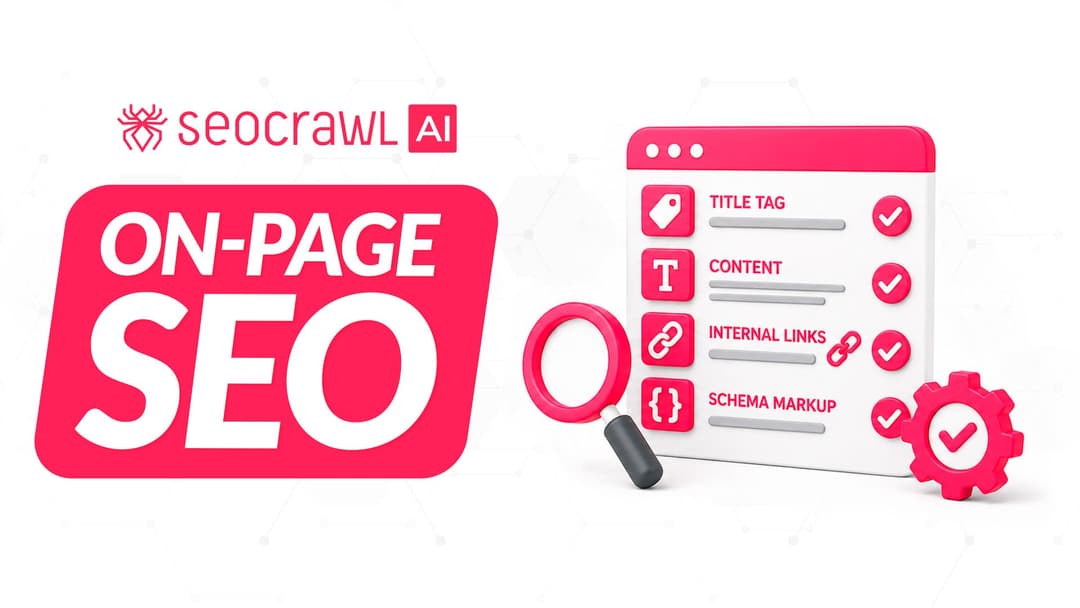
On-page SEO is everything you control on a page: content, title, meta description, headings, URL, images and internal links. Here is a checklist element by element, an audit process and what changes with AI Overviews and AI Mode.