Long Tail Keywords: What They Are and How to Find Them
Those of us who work in SEO come to understand what the Long Tail is, but often not completely. This article is here to explain, in a simple and productive way, what this term means and why it is so important in digital marketing.
What is the Long Tail?
The 'Long-tail' is a term that was coined in 2004 by Chris Anderson for the American magazine Wired. In that magazine, the term was used to explain the impact the internet has had on all traditional distribution models, such as Spotify, Netflix or Amazon.
Chris Anderson developed the concept of the 'Long-tail' in his book ''The Long Tail: Why The Future of Business is Selling Less of More'', where he explained that selling a small amount of many products is better than betting solely on hit products or 'best sellers'.

Cover of the book "The Long Tail: Why The Future of Business is Selling Less of More" by Chris Anderson.
More traditional businesses focus on turning a few products into top sellers in order to maximize profits, but this only captures 20% of demand. Here lies the conflict: we always want to reach a greater share of demand, which is only logical. How does this concept fit into online marketing? Well, the 'long tail' is used to describe a web positioning strategy that targets more specific keyword niches and appeals to a much more concrete audience. In other words, going after small niches in order to, from there, reach everyone.
How does this affect keywords and why is it so important?
Keywords always affect what you want to rank for, and of course, their influence on every SEO strategy is significant. With the 'Long-tail' concept, we will refine the text toward a more exact search by using two or more very specific words in order to target a very concrete segment.
This affects every current business because the strategy must pursue what the competition has not achieved. For that reason, we need to carry out in-depth keyword research on all competitors and on the type of audience we want to bring our business closer to. The success of the entire business depends on the results we achieve through our 'Long-tail' keyword positioning strategy, so including this strategy within our overall positioning plan becomes very necessary.

Representation of keyword distribution. The vertical axis shows search volume, while the horizontal axis shows the number of keywords. As you can see, a few head keywords concentrate most of the searches and traffic. However, a huge number of keywords belong to the mid and long-tail group, which have a relatively low search volume but, because there are so many, they can be very interesting in terms of both traffic and conversions. | Public domain image created by Hay Kranen.
SEO, or web positioning, is therefore oriented toward taking advantage of the 'long tails' to go from general to specific and achieve greater capture of visits and leads to convert into future sales.
The 'Long-tail' accounts for a fairly high percentage of a domain's traffic within an SEO strategy, because we usually believe that by attacking the main keyword we have everything covered. However, words that are more specific or related to the main one often don't have as much traffic, but they are much less competitive to rank for, which means we have a greater chance of success.
Why apply the 'Long Tail'?
Within our SEO strategy, we should apply the long tail in order to have several slightly longer keywords and thus target a smaller market instead of betting on a general term.
For example, we can use the term 'book', but it is easier, and more effective, to use 'cheap books in Alicante'. The general public, when turning to Google, carries out a much more specific search on the internet, and using a single keyword is a mistake we should avoid.
In short, if we want to select many small market niches, it is better to use the 'long-tail' concept because we will get better results, rather than trying to cover the entire market, which will be impossible. The website may receive fewer visits, but searches will be more effective and you will be able to attract more clients or buyers.
How do you identify Long Tail Keywords?
Once we have defined the long tail concept, you are probably wondering... how do I identify long tail keywords in my keyword research? The process is actually quite simple, and the only difference will be the tool you use, since the methodology applied will be the same.
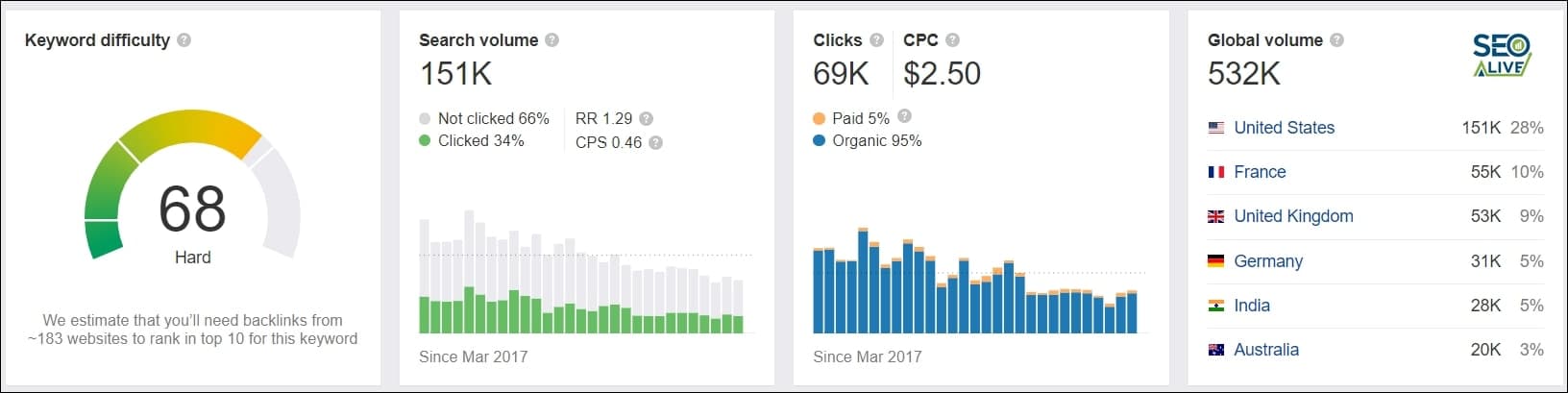
If we only analyze the main keyword, we will see that it is a highly competitive and difficult keyword.
Let's look at it step by step!
1. Download all the keywords
The first step is to download all the keywords from tools like Ahrefs, Sistrix, Semrush or similar. When downloading them, it will be very important to include a number of values such as the monthly search volume and the difficulty.
2. Clean and refine the list
Once you have the list, analyze keyword by keyword, remove duplicates, and add conditional formatting to the cells to quickly identify those with a difficulty lower than 10, for example.
3. Study the keywords with low difficulty
Once the low-difficulty keywords are marked, we can analyze them and see whether they are really long tail keywords we want to target or, on the contrary, unrelated keywords that won't bring us any value.
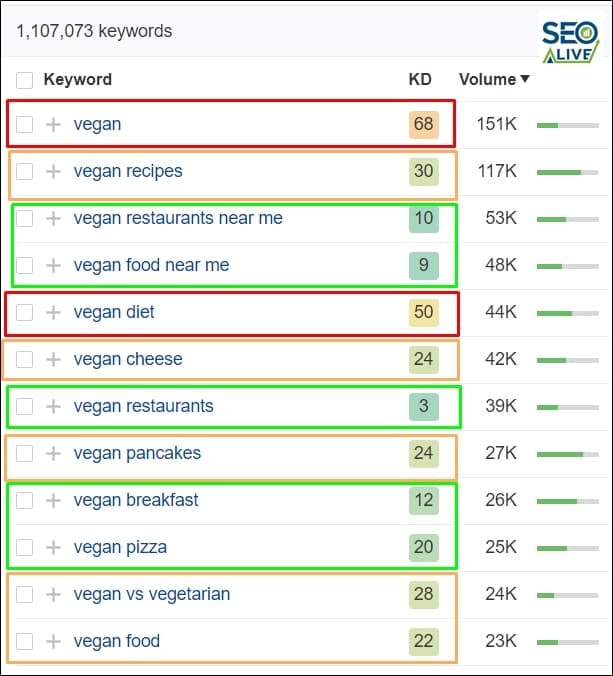
Example of a classification of searches by type for the keyword "vegan" in the USA.
In this case, for the keyword "vegan" in the United States, we can see how we can classify the main keywords as follows:
Head Keywords (high difficulty):
- vegan
- vegan diet
Mid-Tail Keywords (medium difficulty):
- vegan recipes
- vegan cheese
- vegan pancakes
- vegan vs vegetarian
- vegan food
Long-Tail Keywords (easy difficulty):
- vegan restaurants near me
- vegan food near me
- vegan restaurants
- vegan breakfast
- vegan pizza
Attacking the main keyword would almost certainly take many months, and the results would not be guaranteed due to the high level of competition. However, if we go after the long tail keywords, we have many more chances of success. In this case, we could create articles, recipes, restaurant listings and other types of pages that would have a high probability of ranking well.
And you... have you followed any long tail identification and positioning strategy that has worked for you?
Feel free to share your experience in the comments section.
Author: David Kaufmann

I've spent the last 10+ years completely obsessed with SEO — and honestly, I wouldn't have it any other way.
My career hit a new level when I worked as a senior SEO specialist for Chess.com — one of the top 100 most visited websites on the entire internet. Operating at that scale, across millions of pages, dozens of languages, and one of the most competitive SERPs out there, taught me things no course or certification ever could. That experience changed my perspective on what great SEO really looks like — and it became the foundation for everything I've built since.
From that experience, I founded SEO Alive — an agency for brands that are serious about organic growth. We're not here to sell dashboards and monthly reports. We're here to build strategies that actually move the needle, combining the best of classical SEO with the exciting new world of Generative Engine Optimization (GEO) — making sure your brand shows up not just in Google's blue links, but inside the AI-generated answers that ChatGPT, Perplexity, and Google AI Overviews are delivering to millions of people every single day.
And because I couldn't find a tool that handled both of those worlds properly, I built one myself — SEOcrawl AI, an enterprise SEO intelligence platform that brings together rankings, technical audits, backlink monitoring, crawl health, and AI brand visibility tracking all in one place. It's the platform I always wished existed.
Discover more content about this author

On-page SEO is everything you control on a page: content, title, meta description, headings, URL, images and internal links. Here is a checklist element by element, an audit process and what changes with AI Overviews and AI Mode.