Types of Domains: TLDs, ccTLDs and gTLDs Explained
When we browse the internet, we often don't pay attention to the URL we are visiting. It might seem like an unimportant topic, but the structure of a domain is a very important element when tackling an SEO strategy. Deciding whether we will only target one country with a specific structure (.es for Spain), carry out an international expansion with a (.com) and a subfolder structure by countries (.com/es) or instead use subdomains are decisions that, if made correctly from the start, can save us a lot of time, resources and headaches.
Below, you will discover all the types of domains that exist and their importance at the SEO level:
Available types of domains
There is not just one type of domain with which a website can be referenced. In fact, there are several of them and, depending on the intention of the platform, place of origin, function and other characteristics, the domain related to it can be of one type or another, and usually several of them are included in the URL address to access the site.
For example, if we take the URL address www.seocrawl.com.mx, three different types of domains are present in it, which are hierarchical by DNS and their importance is ordered from right to left, with the most relevant always on the right and the next one to its left.
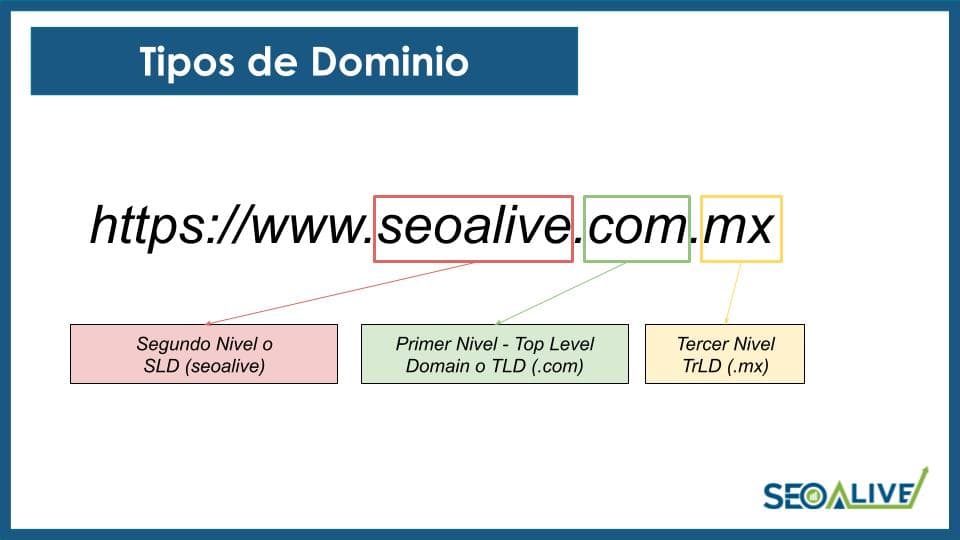
Example of how the structure of a domain is distributed.
In this case:
- ".com" would be the top-level domain or TLD for its acronym in English
- "seocrawl" would be the second-level domain or SLD
- while ".mx" is the third-level domain or TrLD.
Let's describe them in much more detail so that no doubts remain:
Top-level domain or TLD
The top-level domain or Top Level Domain is the one with the highest hierarchy according to the DNS, with more than a thousand existing and the most common being .com, .org, .net, .edu, among others. For example, sites ending in .com used to be for business, while .org is used by organizations. Now the use of top-level domains is much more flexible. TLDs have two sub-divisions:
Generic Domains (gTLD or Generic Top Level Domains)
Generic domains or (gTLD or Generic Top Level Domains), which include .com and .org and the most general ones, as well as others of specific use such as .info, .name, .pro, .mil, among others, are considered generic domains.
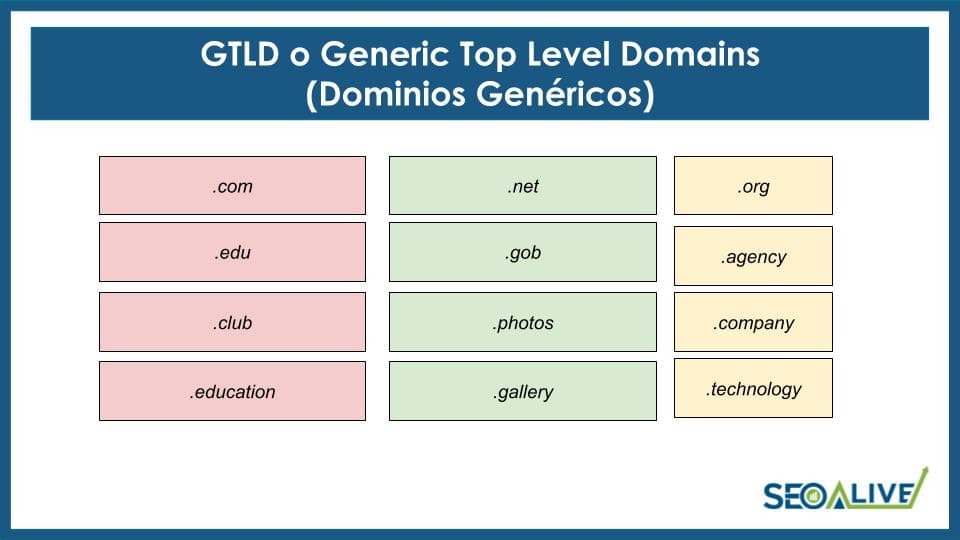
Over time, generic domains have grown enormously and now the range of possibilities is very wide.
Country Code Top Level Domain (ccTLD)
Country code top-level domains (ccTLD or Country Code Top Level Domains) are those used by established brands, organizations or corporations, as well as governments where the country is represented.
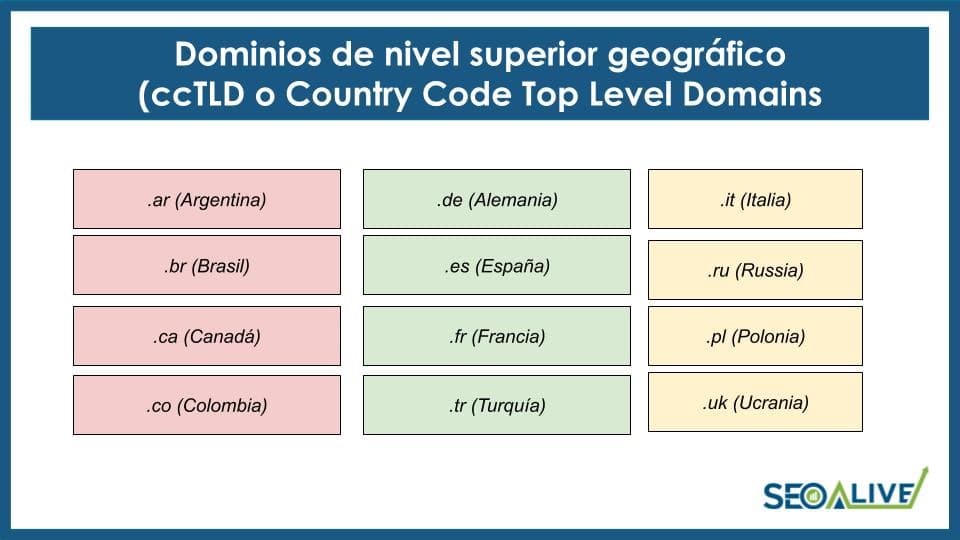
Examples of country code top-level domains (acronyms by country).
They are usually initials or endings of country names such as:
- .ve for Venezuela
- .co for Colombia
- .us for United States
- and so on with all countries...
They are normally used when the brand or organization wants to specialize in that country and provides specific content for it. There are also different types of combinations for language variations. For example, if we use the "Portuguese" language with the url "/pt" and we want to differentiate it for users from Portugal and Brazil, we can use /pt for Portugal and /pt-BR for Brazilian Portuguese. The same happens with other languages such as Chinese or Spanish (Spain vs Mexico or Argentina) for example.
Second-level domains or SLD
The second-level domain or Second Level Domain is located directly to the left of the top-level domain, usually being the name of the brand, organization or person on which the site focuses. For example, in the URL address www.seocrawl.com, "seocrawl" would be the SLD, acting as an identifier as far as the user is concerned.
Third-level domains or TrLD
The third-level domain or Third Level Domain in English, is one that mixes a generic domain or gTLD (example: .com) with a country-specific domain or ccTLD (example: .mx).
For example, the domain ending .com.mx would indicate that it is a generic domain but specific for users in Mexico.
Other examples:
- .org.es
- .edu.es
- .gob.es
Subdomains
In addition to the hierarchical domains, subdomains also exist, which can be described as annexes or sub-parts, usually of the second-level domain.
For example, if we have the site www.xboxone.com but within the site there is an important section such as a blog, it is possible to include a subdomain in the general URL that leads directly to the page of that blog, being: www.blog.xboxone.com.
Importance of domains in the SEO field
Domains in general and their different types are considered a relevant SEO factor from the point of view of search engine optimization, since it is an element that search engines such as Google, Bing, among others, take very much into account.
Therefore, according to the characteristics of the site, its focus and purpose, it is always recommended to optimize domains so that they provide the site with the best positions in search results:
-
First, if you have a site with regional or national characteristics and which is locally focused, it is always recommended to use the ccTLD of the corresponding country. It has the drawback that its results in search engines will not be shown in other countries, although that is what the local approach is about. However, when a site goes from being local to wanting to be international, the ccTLD is useful when you want to offer the platform in different languages. For example, if the site
www.nike.comappears in English,www.nike.eswill appear in Spanish. The language change can also be done through folders and subdomains, which using the example would bewww.es.nike.comorwww.nike.com/es. -
Second, if the site is focused on a specific niche or new product, it is best to include it in the domain, whether you can combine the keyword with the brand or whether we are targeting a very specific niche, for example for an affiliate website, targeting the main keyword in it.
-
Although there are more and more possibilities, it is recommended to stay with the most well-known top-level domains, such as ".com".
-
Finally, it is recommended that the second-level domain name that describes the product, brand and niche should not be too long to help search engine robots crawl and recognize them better. According to Google, a general domain in a URL address should never exceed 64 characters. On the other hand, for well-known and established brands and businesses, it is recommended to use the name of the brand in the domain, without including anything else unless the purpose is to make language changes, include folders or focus the product locally and geographically.
Do you still have any doubts about the structure of domains? We are happy to help you!
Author: David Kaufmann

I've spent the last 10+ years completely obsessed with SEO — and honestly, I wouldn't have it any other way.
My career hit a new level when I worked as a senior SEO specialist for Chess.com — one of the top 100 most visited websites on the entire internet. Operating at that scale, across millions of pages, dozens of languages, and one of the most competitive SERPs out there, taught me things no course or certification ever could. That experience changed my perspective on what great SEO really looks like — and it became the foundation for everything I've built since.
From that experience, I founded SEO Alive — an agency for brands that are serious about organic growth. We're not here to sell dashboards and monthly reports. We're here to build strategies that actually move the needle, combining the best of classical SEO with the exciting new world of Generative Engine Optimization (GEO) — making sure your brand shows up not just in Google's blue links, but inside the AI-generated answers that ChatGPT, Perplexity, and Google AI Overviews are delivering to millions of people every single day.
And because I couldn't find a tool that handled both of those worlds properly, I built one myself — SEOcrawl AI, an enterprise SEO intelligence platform that brings together rankings, technical audits, backlink monitoring, crawl health, and AI brand visibility tracking all in one place. It's the platform I always wished existed.
Discover more content about this author
On-page SEO is everything you control on a page: content, title, meta description, headings, URL, images and internal links. Here is a checklist element by element, an audit process and what changes with AI Overviews and AI Mode.