3 types and 8 phases of content curation
"Content is king" is without a doubt one of the most frequently heard phrases across the SEO landscape over time. And we couldn't agree more, content is one of the most important pieces within any SEO strategy, but what happens when that content is no longer useful to us?
Today we will discover the wonderful world of content curation!
What is content curation?
From an SEO point of view, content curation consists of leveraging, improving, optimizing and boosting those pieces of content on our website that have become useless or underutilized for organic positioning purposes.
In other words, we are going to "cure," to revitalize, to get those old, outdated posts or posts without organic traffic to return to prominent positions on Google and become a useful resource for us.
Why is content curation so important?
First, because it is a strategy that does not involve an excessive outlay, since we are talking about content we already have on our website. Improving an existing piece of information will always be cheaper than creating one from scratch.
Second, because we clean up our website. What happens if we keep leaving articles and content without value, without paying any attention to them? Imagine a huge closet in our house. If every time a piece of clothing gets too small we just leave it stored away, there will come a time when we open the closet and are unable to distinguish the current, good clothes from those that no longer serve us.
Something similar happens to Google. If the spider crawls static content over and over again, content that has no traffic and does not spark user interest, it will be missing out on paying attention where it is really needed.
Third, it allows us to stay at the forefront of information in our niche, since, as we will see later, all curation goes through a phase of information and updating to then adapt it to our specific case.
Fourth, the benefits for SEO are of great value. We are updating content, something Google loves, we are adapting it to the current needs of our users, and we are refreshing the website, which means spiders will have to come see that new content, increasing the crawling of our site. Ultimately, it's all advantages.
Types of content curation in SEO
Among the possible content curation techniques out there, we want to highlight the most relevant ones and those that add the most value to any web positioning strategy:
Curation of old posts or information
The most effective and most used. It consists of carrying out a phase of searching for content without traffic or without current value, in order to make improvements and relaunch it. Later, in the phases of the curation process, we will see this in more detail.
Redirecting posts with traffic towards products.
A very good technique to increase the number of conversions. If we have a post with an optimal volume of traffic and we have a related product that is not receiving traffic, we can perform a 301 redirect from the article to the product. This highly effective technique requires keeping a series of points very much in mind:
-
We have to look for a post with a decent volume of traffic. Keep in mind that conversions, at best, will be between 0.5%-0.7%. So we are interested in a post that generates good visits for us.
-
It has to be related to the product. If we redirect visits from a post to a product that has nothing to do with it, the user response would be terrible, and the bounce rate and rejection by the user very high.
-
It's not just about doing a 301, we have to try to adapt some of the post content, which worked well and generated visits, to the product page, to increase the user response.
Removal of posts without value
There will be some pieces of content that simply won't be worth curating, since the work won't pay off. We locate these as follows:
-
Posts with no organic traffic for more than a year
-
Posts with no external links
-
Posts of content or news that are already out of fashion, that have had no continuity over time and cannot be adapted
Phases within content curation
Identification of content likely to be curated
For this we recommend making use of Data Studio. We will simply connect Data Studio to our Google Analytics source. We will add a time filter, another acquisition channel filter, and we will create a table that crosses landing page with sessions.
This way we can filter whatever time period we want and sort in descending order from fewer sessions to more. This way we will have, in a comfortable and visual manner, a table with the entries that have no traffic, marking the acquisition channel we want and the date range we deem appropriate.
Specialized keyword research
We say specialized, because we will not have to do an extensive keyword research like when we create content completely from scratch. Instead, we will rely on keywords we already use in the content, to, by using tools such as ahrefs, obtain new keywords and ideas to complete our content.
Imagine we want to optimize a post that talks about "natural shampoo." Within ahrefs we have two options, one by entering the keyword itself in the keyword explorer option:
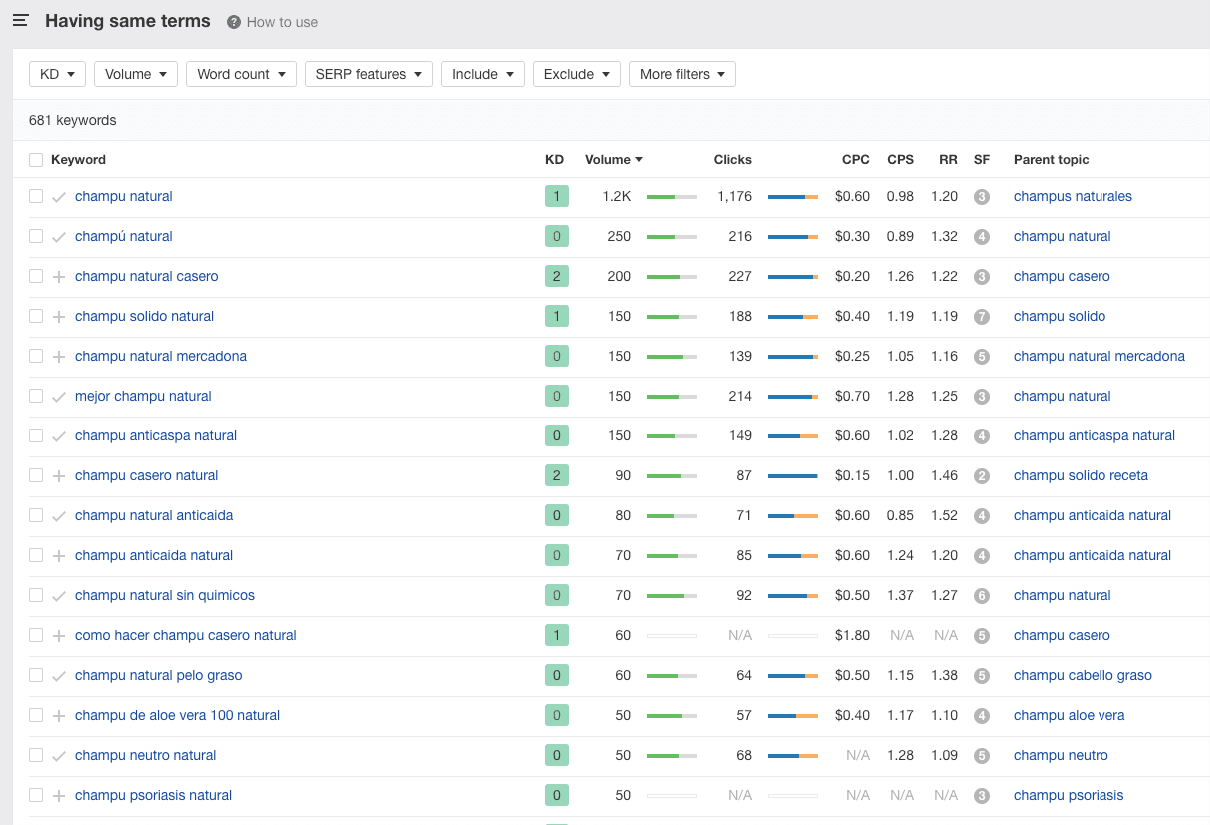
As we can see, it suggests a series of interesting keywords that we will take advantage of for our curation. Either by creating new text sections or by adapting some of the existing ones.
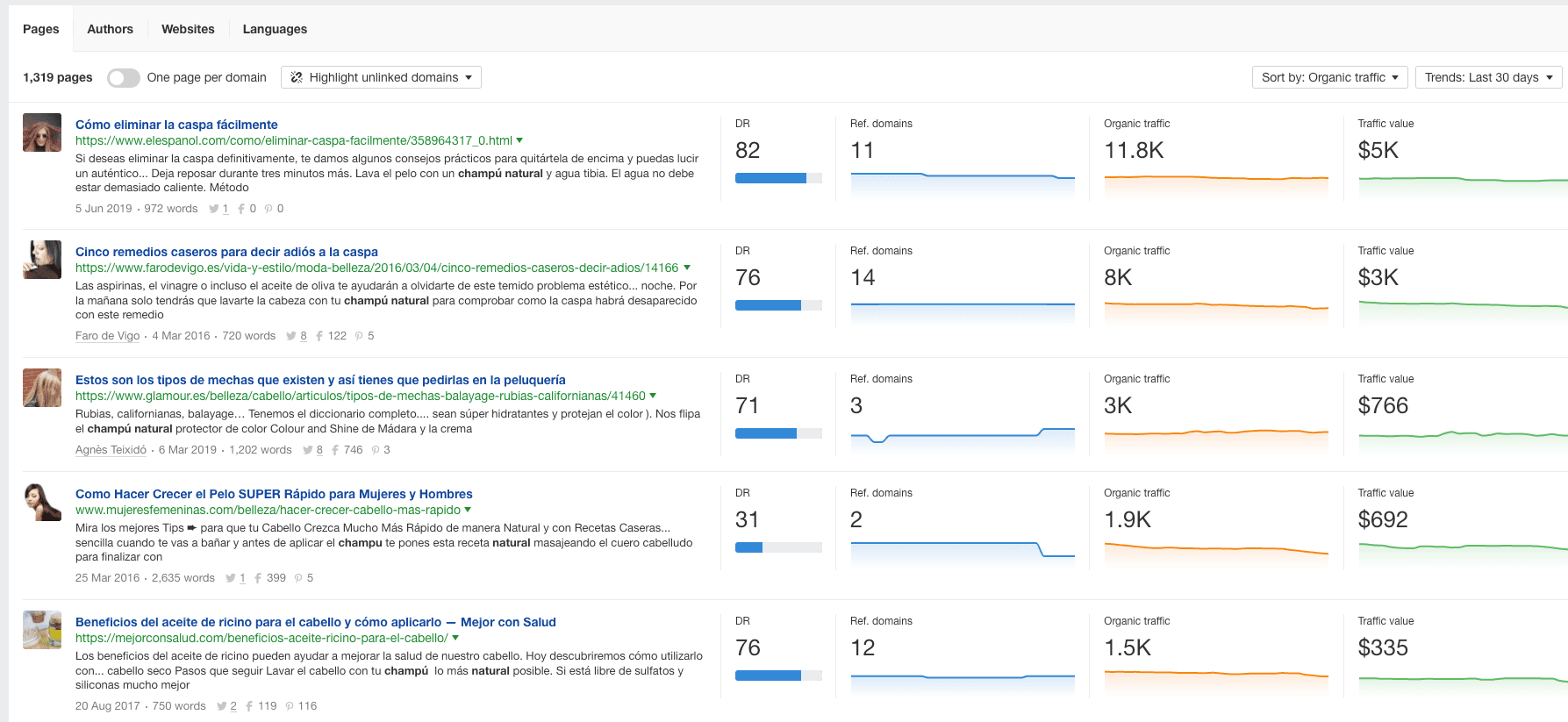
If we want to gather new related ideas, we can use the Content Explorer option, in which, by adding the topic in question, it will tell us the hottest and most shared topics of the moment. In combination with the previous point, it will give us a great opportunity to improve our content:
Optimization of meta tags
We are now starting with the actual content curation part. We already have the selected posts, the adapted keyword research, the most trending content of the moment located... We proceed to curate the content.
First, a review of:
-
the meta title tags and
-
meta description.
Many times the most essential and basic is the most effective. It is a quick win, easy and fast to implement, and the results in many cases would surprise us.
URL review
It will also be subject to review. As long as it does not involve a drastic change, if we can improve the URL through some new keyword, or by refining the existing one, we will act on it.
Creation of new content blocks
This part will contain the bulk of our curation. We will generate a new content block or adapt some of the existing ones. For this we must take into account:
-
The keywords we have selected
-
The type of content we want to generate (informational, transactional, corporate, etc.)
-
The target audience it is aimed at
-
The very purpose we pursue with content curation (generating more visits, more sales, etc.)
Review of headings
Within this content creation, we will possibly have to create new headings that provide a logical structure to the new content, or adapt the existing ones, making them more SEO friendly.
For example, if we want to add question-and-answer type texts, it can be a good idea to create an H2 with the user's question, and the text as the answer.
Internal links
If we manage to generate more traffic, it is important to take advantage of this through internal links to other content, so that the success of our action radiates to more content. It is therefore necessary, within the curation process, to review internal links, both to add and to remove them.
ALT tags
They tend to be the great forgotten ones when doing SEO, and they have a very high value. Reviewing whether they are being used correctly will not only help us target Google image results, but also enhance the semantics of our content.
Important elements
Within content curation, we not only have to stick to creating text blocks; there are elements that work very well, and for which Google has a special predilection:
-
Any table that may contain relevant data carries a lot of weight. Google takes them very much into account, and on top of that we can apply data markup to improve them.
-
Linked to the creation of tables. Google understands all comparative data as adapting to the users' search intent.
-
Graphic material, such as videos, gifs, infographics, etc.
By applying all these points, we will undoubtedly achieve a substantial improvement in that forgotten content that contributed little to our website. A very important point is to always measure everything, since otherwise, we won't be able to evaluate whether the curation has been worthwhile.
And you... what curation techniques do you use and work for you? Or, on the contrary... which ones have you seen are a disaster? :)
Author: David Kaufmann

I've spent the last 10+ years completely obsessed with SEO — and honestly, I wouldn't have it any other way.
My career hit a new level when I worked as a senior SEO specialist for Chess.com — one of the top 100 most visited websites on the entire internet. Operating at that scale, across millions of pages, dozens of languages, and one of the most competitive SERPs out there, taught me things no course or certification ever could. That experience changed my perspective on what great SEO really looks like — and it became the foundation for everything I've built since.
From that experience, I founded SEO Alive — an agency for brands that are serious about organic growth. We're not here to sell dashboards and monthly reports. We're here to build strategies that actually move the needle, combining the best of classical SEO with the exciting new world of Generative Engine Optimization (GEO) — making sure your brand shows up not just in Google's blue links, but inside the AI-generated answers that ChatGPT, Perplexity, and Google AI Overviews are delivering to millions of people every single day.
And because I couldn't find a tool that handled both of those worlds properly, I built one myself — SEOcrawl AI, an enterprise SEO intelligence platform that brings together rankings, technical audits, backlink monitoring, crawl health, and AI brand visibility tracking all in one place. It's the platform I always wished existed.
Discover more content about this author
On-page SEO is everything you control on a page: content, title, meta description, headings, URL, images and internal links. Here is a checklist element by element, an audit process and what changes with AI Overviews and AI Mode.