Black Hat SEO

Black Hat is a set of techniques and actions aimed at forcing search results by bypassing the quality guidelines of the different search engines (Google, Bing, Yandex).
Within the SEO community there is still debate about which types of techniques are considered Black Hat and which are not.
In the end, everyone is entitled to their own opinion, but it is the quality guidelines that set the rules of the game. And as in any game that has rules, each person is free to decide how far they can or want to go.
What do Google's quality guidelines say?
To find out whether we are following the rules of the game, the first thing I recommend to anyone getting started in SEO is, of course, to read all the quality guidelines Google provides:
For Webmasters
- General
- Content
- Quality
In these documents we can see what Google considers quality, what a website should look like and which actions you shouldn't take.
Here you can read all the information Google provides on this topic, but you can already take away this: what Google doesn't want is for you to manipulate or deceive its algorithm.
First of all… Is Black Hat illegal?
When we talk about SEO, no, it is not illegal; it simply goes against Google's quality policies, against its rules. To be more precise, however, there are techniques used to harm other people's websites that may break current legislation.
We're talking about other techniques that affect computer security and that is a different story altogether.
Most popular Black Hat techniques
Automatically generated content
As we all know, Google wants to offer quality results to the user performing a given search, and to do that it needs to have unique, quality content to provide.
Automated content is fed by previously created content, whether in the same language, a foreign language, or by taking parts of something that already exists.
Even though Google has evolved a lot, this type of technique still works today.
A very simple technique is to take content created in a different language than our website's, translate it and re-upload it as if it were a brand-new article.
To be a little more precise, several actions are performed:
- The content is scraped in the language you want.
- That content is translated into the publication language.
- The entry/post is created with the translated content.
- It is published on your blog.
Note: The term scraping refers to a programming technique that extracts part of the information from a given location, in our case URLs.
There are currently WordPress plugins that perform all of these functions automatically, but be aware that Google is working to detect these actions and may penalize you.
Text Spinning
Another very popular technique used in automation is text spinning.
The goal of this technique is to turn copied text into original text, at least for the bots that crawl our content.
Its operation can be simple or complex because it requires some manual work, since you have to create a variation syntax based on synonyms, so that the text changes without changing its meaning.
Here's an example:
Her house in London is beautiful
Syntax of a text to spin:
Sara has started (begun | initiated) the construction of her house (home | residence) in London
In the end we would have X different sentences, depending on the variety of options we fed in.
- Sara has begun the construction of her home in London
- Sara has initiated the construction of her residence in London
Link Building
Without a doubt this is the technique that sparks the most controversy in the SEO industry. Why?
Google assigns a kind of score based on the quality of the websites it evaluates, and external linking, that is, the links a website receives (backlinks), is one of the key variables when it comes to improving search rankings.
For Google, links to your website have to arrive without any kind of direct influence (purchase, exchange, creation on free sites, or automation tools); in other words, your content should only be linked through quality content that users reference.
This is where the controversy comes in: can you do SEO without creating links?
Ultimately, there are many projects in which SEO works differently, so sometimes all you need is perspective to put the controversies to rest.
Around mid-2012, an algorithm update called Penguin turned the SEO ecosystem upside down.
This algorithm tries to regulate offpage factors, and you have to be very careful when running a "Link Building" strategy.
What do we call link building or paid links?
Within link building there are numerous techniques to improve the PageRank of a page or domain, and following Google's guidelines, some of the most popular techniques it dislikes are:
- Paid links in press or on websites (exchanges are also included)
- PBN (private blog network): a network of your own blogs created to link to your own projects.
- Link exchange: you link to me and I link to you.
- Guest Posting: articles as a guest on other blogs linking with exact keywords (Google uses this nuance to define what it doesn't like)
- Placing links in widgets that are offered to third parties.
- Press releases with exact anchor text.
- Etc...
In short, if you have to do Link Building, try to be as natural as possible in the eyes of the user.
Cloaking and Keyword Stuffing
I'm grouping these two techniques together because they are techniques that used to work in the past but nowadays I don't know anyone who is using them successfully.
- Cloaking aims to trick Google's bots by showing different content than what is shown to users. The bot is shown an optimized page and the user is shown a different one.
If Cloaking is old, talking about Keyword Stuffing today is going back at least 10 years.
- Keyword Stuffing is the over-optimization of a keyword with the intention of giving more relevance to your page. Forcing the keyword you want to rank for into every paragraph, putting it in every heading, ALT tags… are examples of what this technique used to look like and how outdated it has become.
Negative SEO
As I mentioned earlier, Black Hat is not illegal when we talk about SEO, but this kind of techniques we are about to mention go more against computer security than marketing.
DDOS Attacks (Denial of Service)
This technique aims to crash the server by sending a large amount of traffic, overwhelming the server, exhausting its resources and bandwidth.
Negative SEO through Link Building
In the latest Penguin updates we were already told that low-quality backlinks would not influence our site either positively or negatively.
Even so, this technique consists of sending thousands of low-quality links with the intent of harming you in the search results.
This is when we use the tool that Google provides to report backlinks we don't want it to take into account; in this article we tell you everything you need to know about the Disavow Tool
Negative SEO with duplicate content
One of the most annoying ones. It consists of copying your content and publishing it on different domains with the intention of confusing Google about the original content.
Hotlinking
Many may not consider this technique Negative SEO, but you have to be careful.
Hotlinking consists of making calls to a resource that is available on your website without having to host it on your own server. It is currently used a lot with images; the URL of the image hosted on your site is taken and published on a third-party website.
So far there shouldn't be any problems, but what if the image is published on a high-traffic website, and what if instead of one image it's 100 or 1,000?
As I said before, there are many more techniques, and others will surely emerge because Black Hat is alive — as the saying goes, "Where there's a law, there's a loophole."
Author: David Kaufmann

I've spent the last 10+ years completely obsessed with SEO — and honestly, I wouldn't have it any other way.
My career hit a new level when I worked as a senior SEO specialist for Chess.com — one of the top 100 most visited websites on the entire internet. Operating at that scale, across millions of pages, dozens of languages, and one of the most competitive SERPs out there, taught me things no course or certification ever could. That experience changed my perspective on what great SEO really looks like — and it became the foundation for everything I've built since.
From that experience, I founded SEO Alive — an agency for brands that are serious about organic growth. We're not here to sell dashboards and monthly reports. We're here to build strategies that actually move the needle, combining the best of classical SEO with the exciting new world of Generative Engine Optimization (GEO) — making sure your brand shows up not just in Google's blue links, but inside the AI-generated answers that ChatGPT, Perplexity, and Google AI Overviews are delivering to millions of people every single day.
And because I couldn't find a tool that handled both of those worlds properly, I built one myself — SEOcrawl AI, an enterprise SEO intelligence platform that brings together rankings, technical audits, backlink monitoring, crawl health, and AI brand visibility tracking all in one place. It's the platform I always wished existed.
Discover more content about this author
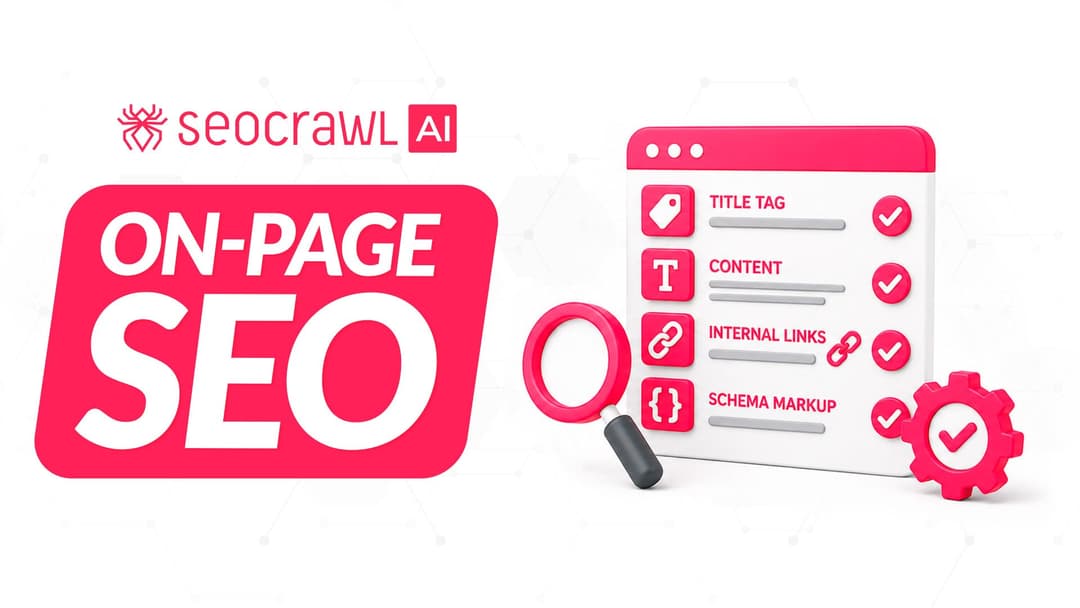
On-page SEO is everything you control on a page: content, title, meta description, headings, URL, images and internal links. Here is a checklist element by element, an audit process and what changes with AI Overviews and AI Mode.