What is the Google Sandbox and how to get out of it?
Have you recently published a website on a new domain and Google is ignoring you? Do you have lots of quality content and feel that Google isn't ranking you the way it should? Dear friend, I'm sorry to tell you that you are inside the sandbox.
What, you have no idea what I'm talking about?!
Don't worry, in today's post we'll explain what the sandbox is and what you can do to get out of it.
Let's get started:
What is the sandbox and why does it exist?
Sandbox is a concept that within the SEO world is used to describe the period of time Google takes to validate that your content really isn't spam. In other words, it is completely normal to experience visibility issues when a new domain has just been published until you "earn" Google's trust.
The goal of this, as always, is to be able to offer the best content to the user. This way, it prevents new websites from appearing for big terms from the very first month, and it makes it impossible for spammers to "scam" users with low-quality information.
But, is what we're telling you actually true? Keep reading and find out.
Is it officially confirmed?
As you can see in the video, in response to a related question, John Mueller tells us how it can take up to a year for Google to "get an idea" of which keywords a new website should rank for. Therefore, it is normal to have fluctuations in our rankings during the first year of life until they start to settle.
It is true that these comments from Mueller contrast a bit with these other ones from some time ago:
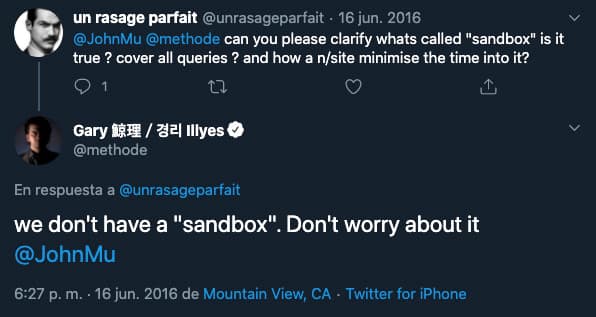
Tweet asking about the existence of the Sandbox
In this one they assure us that they don't have a "sandbox" but that there is a part of the algorithm that works in a similar way and whose goal is to understand which queries a website answers correctly.
After this information, we can conclude that a sandbox does exist, but instead of calling it "sandbox", they have called it "an algorithm to understand which keywords your site should rank for".
How long can the sandbox last?
Well, this question is harder to answer, because as is usually the case in the SEO world: it depends.
But what does it depend on? It depends on what you consider "getting out of the sandbox" to mean.
- If getting out of the sandbox for you means Google starting to index you, then it's not common for it to take more than 5 days.
- If, on the other hand, you want to start appearing for low-competition keywords, it's common for it to take approximately 1-2 months.
From there on, everything will depend on keyword competition, your domain authority, the backlinks you build...
How to get out of the sandbox?
This is where things get serious. As you'd expect, there is no official guide on how to get out of the sandbox, but we have compiled these tips that are sure to help you mitigate its effects:
Quality backlinks
Obviously, a good injection of link juice will make your domain gain trust in Google's eyes. Careful though, because it's not usual for a website to receive thousands of links from day one. The best approach is to carry out a solid Link Building strategy so it goes unnoticed by the algorithm or any reviewer.
If you need help with this, remember you can contact us for any questions related to Link Building.
Quality content
As we saw earlier, John Mueller told us that the algorithm leaves our website a bit aside until it fully understands it and knows which keywords it should show us for, right? So let's make it easy.
The idea is to try to publish lots of relevant and quality content for our buyer persona. This way, we'll get Google to perfectly understand which type of user to show us to and which keywords it should rank us for.
Social signals
Creating profiles on social networks that link to your site and driving traffic through them can cause Google's trust in your site to increase. Since it may not be easy at first, the recommendation is to publish the latest blog content and then invest in a small campaign to promote it.
Example
The tips and analysis we can do can help us understand our situation a bit better. However, do you know what's the best way to understand it? A close, visual example:
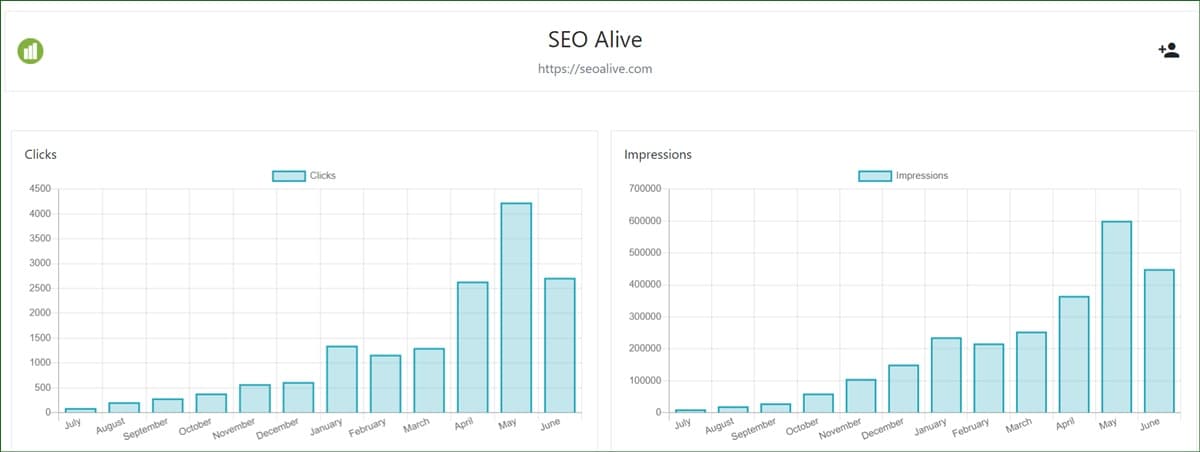
Example of the Sandbox period of our own project and visualization of the data month by month in our SEO software.
In the case of our own project, we started in June 2019 with 0 visits per month :) Little by little, we started regularly publishing 3 articles per week, well-structured, trying to publish the best possible content, sharing these articles on social media and linking everything with a good site structure, among thousands of other things... At the beginning, ranking was really tough. However, we are now achieving +4000 organic visits per month and we have managed to rank really powerful keywords at #1 or #2, such as:
- seo footprints
- ahrefs
Register for Free on our Software to see the monthly evolution of data
Conclusion
Being in the sandbox for a long time can cause your company to lose faith in SEO or allow your competitors to take the lead. That's why we hope these tips can help you make this "wait" much shorter.
For any questions, as always, we are at your disposal in the comments.
Author: David Kaufmann

I've spent the last 10+ years completely obsessed with SEO — and honestly, I wouldn't have it any other way.
My career hit a new level when I worked as a senior SEO specialist for Chess.com — one of the top 100 most visited websites on the entire internet. Operating at that scale, across millions of pages, dozens of languages, and one of the most competitive SERPs out there, taught me things no course or certification ever could. That experience changed my perspective on what great SEO really looks like — and it became the foundation for everything I've built since.
From that experience, I founded SEO Alive — an agency for brands that are serious about organic growth. We're not here to sell dashboards and monthly reports. We're here to build strategies that actually move the needle, combining the best of classical SEO with the exciting new world of Generative Engine Optimization (GEO) — making sure your brand shows up not just in Google's blue links, but inside the AI-generated answers that ChatGPT, Perplexity, and Google AI Overviews are delivering to millions of people every single day.
And because I couldn't find a tool that handled both of those worlds properly, I built one myself — SEOcrawl AI, an enterprise SEO intelligence platform that brings together rankings, technical audits, backlink monitoring, crawl health, and AI brand visibility tracking all in one place. It's the platform I always wished existed.
Discover more content about this author
On-page SEO is everything you control on a page: content, title, meta description, headings, URL, images and internal links. Here is a checklist element by element, an audit process and what changes with AI Overviews and AI Mode.