Google Launches New Tags to Control Featured Snippets
As users, we are very used to running certain searches and finding results that give us the answer without needing to visit the page, directly showing us a large amount of information extracted from our website in the search results. Although the first thought may be one of joy at having more visibility, this is not always the case, as Google is managing to retain users by extracting information from our website and taking away valuable clicks to our business.
To address this, a few days ago Google published an article with a guide to HTML fragments and meta tags we can use in our articles to control what Google displays in featured snippets.
Let's take a closer look!
What are featured snippets?
Featured snippets, also known as position #0, are a type of rich result that aims to give part of the answer to the user without the need for them to click on the article.
According to Google, the goal of showing featured snippets and a content preview to the user is the following:
"Google automatically generates a content preview to help the user understand why the results are relevant to their search and why the user might want to click on them." However, as we mentioned, what often happens is that Google has resolved the user's query with our content and the benefit for us has been 0 (zero visits and of course zero conversion or ad revenue).
How can we limit the visibility of featured snippets?
Until now, the most we could do was define the "nosnippet" meta tag, which prevented Google from generating a rich snippet. However, Google has gone a step further and added several additional options to give us more control:
Control via meta tags
<meta name="robots" content="nosnippet">
This meta tag will prevent Google from showing a rich snippet for this particular content.
<meta name="robots" content="max-snippet:[number]">
The max-snippet meta tag allows us to limit the number of characters we want to be shown.
<meta name="robots" content="max-video-preview:[number]">
The max-video-preview meta tag allows us to limit how many seconds of our video we want to be shown.
<meta name="robots" content="max-image-preview:[setting]">
And finally, the max-image-preview meta tag allows us to limit the maximum size of the image to be shown, with 3 options: "none", "standard" and "large".
One thing to keep in mind is that all of them can be combined into a single tag to use the properties of several at once:
<meta name="robots" content="max-snippet:50, max-image-preview:large">
As Google announces on its blog, the changes to these snippets are expected to take effect in mid-to-late October.
Control via HTML attributes
If, instead of limiting the visibility of all our content, we want to restrict only a part of it, we can use these HTML attributes to add them within sections.
The fragment is called "data-nosnippet" and can be used in the "span", "div" and "section" HTML attributes. An example makes it much clearer:
<p><span data-nosnippet>Harry Houdini</span> is undoubtedly the most famous magician ever to live.</p>
For this particular case, Google has announced that it would start supporting these implementations by the end of this year.
Reflections
The first thing you'll be thinking, and what has surely crossed many of our minds, is the following: Why would we want to limit our visibility in the search engines for our own brand? The idea isn't to hurt ourselves, but rather to offer a little less content to encourage the user to click.
Additionally, one of the major sections that still has great potential and is just getting started is Google Discover, which currently has over 800 million users per month. Can you imagine being able to somehow customize the way your content appears there?
Let's look at an example to see if it convinces you:
- A user is searching for "how to tie a tie." From their mobile, they find a featured snippet with "How-To" markup and therefore see all the steps with images, use the content, and close the phone. Benefit for the site that built all the content? Zero! However, if we managed to restrict the content a bit, for example by removing the final step or limiting the content shown, the user would click, finish viewing all the steps, and while doing so, not only would they leave some valuable impressions (likely monetized), but there would also be a chance to build loyalty.
The final bombshell?
Most of the SEO community saw this news, shared it, and assumed that Google intended to give us more control. However, yesterday Xataka released a big bombshell article announcing the disappearance of "content previews" in search results in France, due to an approved copyright law.
This represents a massive shift and a total change in search results!
And according to this source, since it's a European law, this could happen in Spain. Is Google trying to remedy this with small solutions? Will we once again see search results with only titles?
The big battle between Google and data protection has only just begun...
Author: David Kaufmann

I've spent the last 10+ years completely obsessed with SEO — and honestly, I wouldn't have it any other way.
My career hit a new level when I worked as a senior SEO specialist for Chess.com — one of the top 100 most visited websites on the entire internet. Operating at that scale, across millions of pages, dozens of languages, and one of the most competitive SERPs out there, taught me things no course or certification ever could. That experience changed my perspective on what great SEO really looks like — and it became the foundation for everything I've built since.
From that experience, I founded SEO Alive — an agency for brands that are serious about organic growth. We're not here to sell dashboards and monthly reports. We're here to build strategies that actually move the needle, combining the best of classical SEO with the exciting new world of Generative Engine Optimization (GEO) — making sure your brand shows up not just in Google's blue links, but inside the AI-generated answers that ChatGPT, Perplexity, and Google AI Overviews are delivering to millions of people every single day.
And because I couldn't find a tool that handled both of those worlds properly, I built one myself — SEOcrawl AI, an enterprise SEO intelligence platform that brings together rankings, technical audits, backlink monitoring, crawl health, and AI brand visibility tracking all in one place. It's the platform I always wished existed.
Discover more content about this author
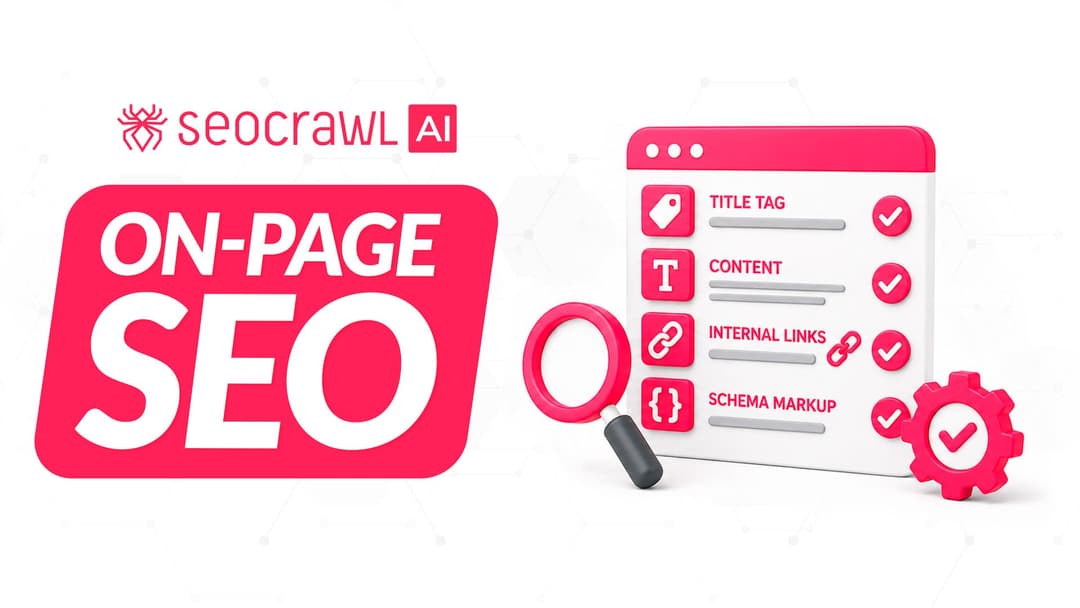
On-page SEO is everything you control on a page: content, title, meta description, headings, URL, images and internal links. Here is a checklist element by element, an audit process and what changes with AI Overviews and AI Mode.